
In 2026, the most lucrative Western Canadian Sedimentary Basin investment isn't found by discovering new reservoirs, but by optimizing the assets we've already mapped. You've likely felt the weight of commodity price volatility or the frustration of deciphering which junior producers actually hold technical promise as the federal carbon price hits $110 per tonne. It's a complex environment where the distinction between conventional and unconventional plays often blurs, making it difficult to identify undervalued opportunities.
This guide provides the critical value drivers and strategic frameworks necessary to realize superior returns in the current energy sector. We'll show you how to evaluate asset longevity through enhanced oil recovery and why the narrowing WCS-WTI differential has fundamentally changed the play for Canadian operators. By examining the strategic advantage of TSXV-listed energy firms and the impact of high-intensity completion techniques, we'll equip you with a professional roadmap to navigate the basin's evolving infrastructure. From the commercial success of TMX to the structural demand from LNG exports, you'll understand exactly how to position your portfolio for long-term growth.
Key Takeaways
- Learn to navigate the shift from volume-driven growth to capital-efficient development by prioritizing assets that deliver high netbacks over raw production totals.
- Master a sophisticated framework for Western Canadian Sedimentary Basin investment that integrates geological de-risking with the strategic valuation of midstream infrastructure.
- Identify the specific technical indicators that allow agile junior producers to outmanoeuvre integrated majors through niche asset optimization and disciplined cost management.
- Understand the critical role of enhanced oil recovery and high-intensity completions in revitalizing mature assets and extending profitable life cycles under 2026 regulatory standards.
- Discover how strategic alignment with public equity exposure on the TSXV provides a unique mechanism for realizing superior returns during commodity price cycles.
The 2026 WCSB Investment Landscape: Strategic Context
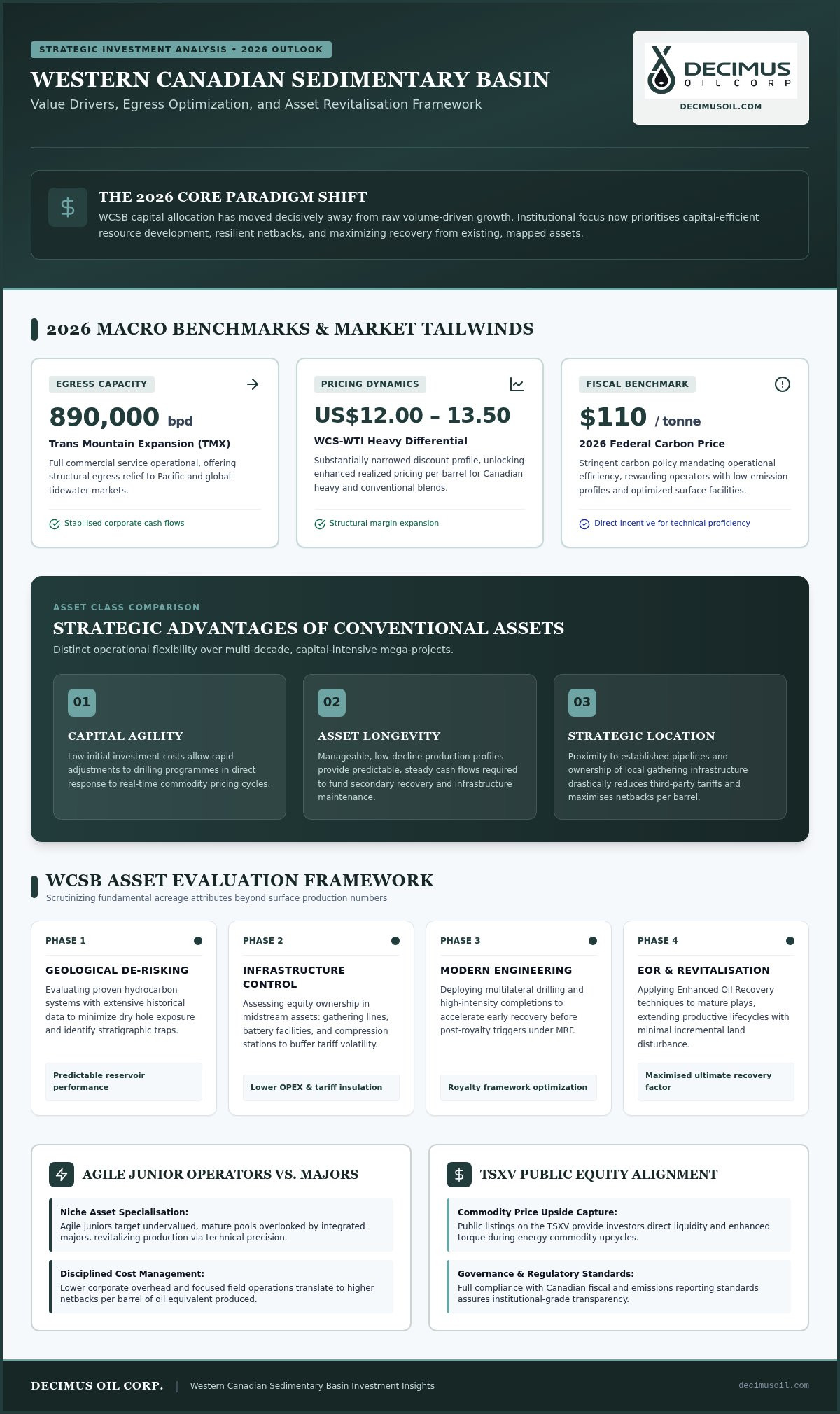
The energy market in 2026 has moved decisively past the era of volume growth at any cost. Investors now prioritize capital-efficient resource development and sustainable netbacks over raw production totals. A successful Western Canadian Sedimentary Basin investment requires a sophisticated understanding of how operational intensity and asset revitalization drive shareholder value in an environment of structural egress relief. For those seeking a Western Canada Sedimentary Basin overview, it's clear that this geological structure remains a cornerstone of global energy supply, providing a reliable source of ethically produced hydrocarbons. Control over midstream infrastructure and takeaway capacity, bolstered by the full commercial service of the Trans Mountain Expansion (TMX) at 890,000 bpd, has stabilized corporate cash flows and narrowed the WCS-WTI differential to a range of US$12.00 to US$13.50 per barrel.
The Resilience of Conventional Energy Assets
Conventional oil and gas exploration offers a distinct strategic advantage compared to the massive, multi-decade capital requirements of oil sands projects. These assets typically feature lower initial investment costs and manageable decline profiles, which are essential for maintaining consistent dividend potential and capital flexibility. In 2026, mature plays aren't being abandoned; they're being revitalized through modern engineering. Sophisticated junior operators use high-intensity completions and multilateral drilling to extract maximum value from existing reservoirs. This approach allows firms to maintain operational discipline while maximizing early recovery before post-royalty triggers take effect under the Alberta Modernized Royalty Framework.
- Capital Agility: Conventional projects allow for rapid adjustments to drilling programs based on real-time commodity pricing.
- Asset Longevity: Low-decline profiles provide the steady cash flow needed to fund secondary recovery and infrastructure maintenance.
- Strategic Location: Ownership of well-placed infrastructure reduces transportation costs and improves overall netbacks per barrel.
Regulatory and Market Tailwinds in 2026
The Canadian fiscal regime has evolved to reward technical efficiency and emissions management. With the federal carbon price set at $110 per tonne for 2026, producers must be technically proficient to maintain high margins. This regulatory environment hasn't stifled investment; it's focused it on high-quality assets. Global markets increasingly demand the stability and ethical standards that Canadian energy provides. In a volatile geopolitical climate, the strategic importance of Western Canadian energy security cannot be overstated. Investors are looking for operators that combine decades of expertise with modern methodologies to navigate these fiscal benchmarks successfully while realizing superior returns.
Evaluating Asset Quality: A Framework for WCSB Investors
To secure a successful Western Canadian Sedimentary Basin investment, one must look beyond surface-level production numbers and scrutinize the fundamental attributes of the acreage. Asset quality in the WCSB is the intersection of geological certainty and infrastructure proximity. Geological de-risking involves identifying plays with proven hydrocarbon systems where historical data minimizes the probability of dry holes. Investors should prioritize operators that demonstrate technical proficiency in mapping stratigraphic traps and reservoir characteristics within established fairways. This disciplined approach ensures that capital is deployed into formations with predictable performance and high recovery potential.
The Role of Energy Infrastructure Management
Effective energy infrastructure management Alberta reduces operational friction and directly protects the corporate bottom line. Ownership or control of midstream assets, including gathering lines, battery facilities, and compression stations, provides a strategic advantage by insulating the producer from third-party tariff volatility. According to Canada Energy Regulator pipeline throughput data, egress utilization remains high across the system, making pipeline connectivity a significant barrier to entry for competitors. Controlling the flow of product from the wellhead to the sales point ensures higher netbacks and provides a buffer during periods of regional price widening.
Quantifying Resource Development Potential
Investors must evaluate 2P (Proven + Probable) reserves as the primary growth indicator for any energy firm. A robust, multi-year drilling inventory allows for consistent capital allocation and methodical operational planning. Understanding WCSB resource development through the lens of lifecycle management ensures that assets are optimized for long-term recovery rather than short-term volume spikes. This process requires a deep dive into decline rate analysis; low-decline assets provide superior capital protection by reducing the maintenance capital required to sustain production levels. Sophisticated operators like Decimus Oil Corp. focus on these high-margin, low-risk opportunities to align corporate growth with shareholder interests.
Operational efficiency serves as the final filter in this framework. It's measured by scrutinizing General and Administrative (G&A) costs against production barrels to ensure that management isn't bloated. In a mature basin, the ability to maintain lean administrative overhead while executing high-intensity technical programs is a hallmark of a disciplined operator. By combining geological de-risking with aggressive infrastructure integration, investors can identify producers positioned to thrive throughout the commodity cycle.
Junior Producers vs. Integrated Majors: Navigating Growth
Understanding the distinction between integrated majors and junior producers is vital for any Western Canadian Sedimentary Basin investment strategy. While majors offer stability, junior producers provide the agility required to exploit niche, high-margin plays. Juniors move fast. They target specific fairways where high-intensity completion techniques yield the highest returns. A successful Western Canadian Sedimentary Basin investment often hinges on identifying these agile operators before they reach mid-cap status. This concentrated focus often results in superior capital appreciation during commodity price upswings. Junior stocks typically offer higher leverage to price movements than their larger counterparts. Strategic alignment is another hallmark of the junior sector. For instance, Decimus Oil Corp. maintains over 27% insider ownership, which ensures management's interests are directly tied to shareholder value.
The U.S. Energy Information Administration country analysis highlights Canada's role as a primary supplier to North American refining markets. This macro trend benefits all operators, but the risk profiles differ. Juniors must balance exploration upside with production stability to manage debt. They prioritize high-netback barrels over sheer volume. By focusing on low-decline conventional assets, these firms protect their capital base while maintaining the flexibility to pursue growth when market conditions are favourable.
The TSX Venture Advantage for Energy Investors
The TSX Venture Exchange (TSXV) provides a critical platform for liquidity and transparency within the public equity energy sector. It allows junior producers to access the capital necessary for high-intensity resource development. This transparent market structure facilitates the path from a junior explorer to a mid-cap producer. It offers a clear trajectory for corporate growth. For the investor, the TSXV represents an opportunity to participate in the early stages of asset optimization and regional consolidation. It's about finding value before the broader market reacts.
Evaluating Management and Technical Expertise
Successful resource development relies heavily on technical proficiency and historical perspective. Experience counts. In the WCSB, having a team with over 100 years of combined experience is a requirement for navigating complex stratigraphic formations. Technical proficiency in horizontal drilling is non-negotiable in 2026. Management must demonstrate a proven track record of disciplined capital allocation. Every dollar spent on drilling or enhanced recovery must translate into measurable reserve growth. To help identify firms that meet these rigorous standards, you can discover TickerAI for advanced stock discovery and algorithmic insights. Sophisticated operators focus on asset optimization to ensure long-term sustainability and professional integrity.
Realizing superior returns in a Western Canadian Sedimentary Basin investment now requires a focus on extraction efficiency rather than just discovery. As the federal carbon price reaches $110 per tonne in 2026, the economic case for revitalizing mature assets through enhanced oil recovery techniques has never been stronger. These methods, including sophisticated waterflooding and pressure maintenance strategies, allow operators to stabilize production curves and extend the life of conventional pools. By utilizing existing wellbores, firms reduce their environmental footprint and closure liabilities while capturing bypassed pay that traditional vertical wells could not reach. It is a strategic synergy of environmental responsibility and economic performance.
High-intensity completion strategies have redefined the productivity of conventional fairways. Modern horizontal drilling, often utilizing sand loadings between 1.5 and 2.5 tonnes per lateral meter, allows for maximum reservoir contact. This approach targets bypassed hydrocarbons with surgical precision. It is a technical evolution that transforms legacy assets into high-margin producers. The ability to execute these complex completions is what separates sophisticated operators from the rest of the field.
The Economics of Production Enhancement
The capital requirements for EOR are significantly lower than greenfield exploration. While new discoveries carry high geological risk and massive infrastructure costs, EOR targets known reservoirs with proven hydrocarbon systems. This stability is crucial for capital protection. By maximizing the recovery factor of a field from 20% to 30% or higher, operators significantly improve the net present value of their portfolio. It is about operational excellence. Technical innovation in solvent-assisted sweeps and polymer floods ensures that every barrel produced is as cost-effective as possible. This disciplined approach to resource management provides a steady foundation for long-term growth.
Technological Advancements in the Field
Multi-stage fracturing has fundamentally altered the productivity of conventional reservoirs. When combined with digital oilfield technologies, such as real-time production monitoring, operators can adjust injection rates and pressures instantly to optimize sweep efficiency. These advancements ensure that oil and gas exploration economics are increasingly defined by technological proficiency. As extraction efficiency improves, the break-even costs for conventional plays continue to drop, even in a high-carbon-tax environment. To see how these technical frameworks translate into shareholder value, examine our strategic asset development model.
Strategic Alignment with Decimus Oil: A WCSB Investment Case
Decimus Oil Corp. (TSXV:WCSB) represents the practical application of the strategic frameworks discussed throughout this guide. In an era where capital efficiency defines the top tier of the energy sector, we focus on realizing value through a disciplined strategy of acquisition and optimization. Our approach to Western Canadian Sedimentary Basin investment is predicated on the intersection of conventional exploration and aggressive enhanced oil recovery. By targeting low-decline assets with established production histories, we minimize geological risk while maximizing the impact of modern engineering. This strategy ensures that our resource development remains sustainable even as the federal carbon price reaches $110 per tonne, providing a resilient platform for public equity exposure.
The Decimus Operational Edge
Our competitive advantage is rooted in a team with over 100 years of combined energy experience. This deep institutional knowledge allows us to identify undervalued assets that larger integrated majors might overlook. We maintain a lean corporate structure, ensuring that every dollar of revenue is optimized to improve netbacks and drive shareholder value. This seasoned leadership is matched by over 27% insider ownership, which ensures our management team is fundamentally aligned with our investors. We don't just manage assets; we operate as sophisticated owners who understand the technical nuances of high-intensity completions and infrastructure integration. Our focus remains on:
- Resource Optimization: Utilizing secondary recovery to extend the economic life of proven reservoirs.
- Infrastructure Control: Managing midstream assets to reduce operational friction and protect margins.
- Capital Discipline: Prioritizing high-netback barrels over unhedged volume growth.
Next Steps for the Strategic Investor
As the 2026 energy landscape continues to reward technical proficiency, the case for a focused Western Canadian Sedimentary Basin investment becomes increasingly clear. Decimus Oil Corp. offers a transparent path for investors to participate in the revitalization of the national energy sector through our public listing. We invite strategic investors to review our corporate presentation and explore our long-term vision for asset development. Our goal is to build a high-margin producer that thrives on operational excellence and professional integrity. Learn more about investing in Decimus Oil Corp. and discover how our strategic alignment can enhance your energy portfolio.
Navigating the Future of Canadian Energy Value
The 2026 landscape has shifted decisively toward capital discipline and technical mastery. Identifying a high-potential Western Canadian Sedimentary Basin investment requires a focus on asset quality and operational agility. You've seen how infrastructure ownership and enhanced oil recovery provide the necessary buffers against commodity volatility and carbon pricing. Decimus Oil Corp. (TSXV:WCSB) exemplifies this strategic alignment, backed by a management team with over 100 years of energy expertise and over 27% insider ownership. This commitment ensures that our corporate growth remains directly tied to shareholder value. By revitalizing mature fairways and maintaining a lean administrative structure, we're positioned to thrive in an evolving market.
Take the next step in your portfolio's growth. Explore Investment Opportunities with Decimus Oil Corp. and discover how our disciplined approach to resource development can realize superior returns in the years ahead. The future of the basin belongs to those who build on experience while embracing innovation.
Frequently Asked Questions
Why is the Western Canadian Sedimentary Basin still a top destination for energy investment?
The basin remains a premier destination due to its vast hydrocarbon endowment and the recent stabilization of market egress. With the expansion of pipeline systems providing nearly 600,000 bpd of incremental capacity, producers can now realize better pricing for heavy crude. Canada's commitment to ethical production and high environmental standards makes it a stable alternative in a volatile global market. This infrastructure reliability ensures long-term viability for both conventional and unconventional resource development projects.
What is the difference between conventional and unconventional oil and gas exploration?
Conventional exploration targets traditional reservoirs where hydrocarbons flow more naturally into the wellbore. These projects typically require lower initial capital and offer manageable decline rates. Unconventional plays, such as oil sands or shale gas, require high-intensity technologies like steam injection or massive hydraulic fracturing to unlock resources. While unconventional plays offer scale, conventional assets provide the capital agility and steady cash flow necessary for maintaining a balanced energy portfolio in 2026.
How does Enhanced Oil Recovery (EOR) benefit energy investors?
Enhanced Oil Recovery (EOR) maximizes the value of existing assets by increasing the total recovery factor of a reservoir. For a Western Canadian Sedimentary Basin investment, EOR techniques like waterflooding or pressure maintenance provide a low-risk method to stabilize production curves. This approach is often more cost-effective than greenfield exploration because it utilizes established infrastructure. Investors benefit from extended asset longevity and improved net present value without the high geological risks of new discoveries.
What are the risks associated with investing in junior oil and gas companies?
Investing in junior producers involves balancing high growth potential against risks like commodity price volatility and limited access to capital. Smaller firms often face higher cost-of-capital hurdles and are more sensitive to regional price differentials. Operational scale is another factor; juniors must maintain lean structures to survive market downturns. However, these risks are often mitigated by experienced management teams that focus on niche, high-margin conventional plays and disciplined resource development strategies.
How can I invest in the Canadian energy sector through public equity?
Public equity investment offers a transparent way to gain exposure to the Canadian energy sector. Investors can purchase shares of companies listed on the TSX or TSX Venture Exchange (TSXV). For example, Decimus Oil Corp. trades under the ticker TSXV:WCSB, providing a direct path to participate in conventional exploration and infrastructure growth. This method offers liquidity and regulatory oversight, allowing shareholders to benefit from both dividend potential and capital appreciation as the company expands its asset base.
What role does infrastructure play in the valuation of an energy company?
Infrastructure is a critical driver of corporate valuation because it dictates the netback realized on every barrel produced. Owning gathering lines, processing batteries, and compression stations reduces reliance on third-party providers and lowers transportation costs. In a basin where egress is often contested, controlling the midstream component acts as a significant barrier to entry for competitors. It ensures that a producer remains profitable even during periods of regional price fluctuations by securing reliable market access.
Why is management experience so critical in the junior energy sector?
Navigating the technical and regulatory complexities of a Western Canadian Sedimentary Basin investment requires deep industry knowledge. Management teams with over 100 years of combined experience, such as the leadership at Decimus Oil Corp., are better equipped to optimize capital allocation across diverse geological formations. In the junior sector, technical proficiency in horizontal drilling and secondary recovery is a requirement for survival. Experienced leaders understand the nuances necessary to de-risk plays and protect shareholder capital throughout the commodity cycle.
What is the outlook for Canadian oil and gas production in 2026?
The 2026 outlook is characterized by production growth nearing 5.0 million bpd and a focus on operational efficiency. With the federal carbon price at $110 per tonne, producers are prioritizing technical innovation and emissions management to maintain margins. The structural demand from LNG export facilities, which have already exported numerous commercial cargoes, provides a new egress route for natural gas. This maturing landscape rewards disciplined operators who can balance volume growth with sustainable, capital-efficient resource development.


