
The most valuable oil your company owns isn't found in a recent discovery; it's already sitting in your mature reservoirs, waiting for the right technical catalyst to realize its worth. As production naturally declines across the Western Canadian Sedimentary Basin, the pressure to find new reserves often overshadows the immense potential trapped within existing infrastructure. By deploying advanced enhanced oil recovery techniques, sophisticated operators are now transforming what were once considered liabilities into high-performing, cash-flow-positive assets.
You're likely facing the dual challenge of high capital intensity for new exploration and the uncertainty of economic thresholds for tertiary recovery. Discover how advanced enhanced oil recovery techniques revitalize mature assets and drive strategic value for energy shareholders. We'll evaluate cost-effective recovery methods, the impact of the 25% CCUS Investment Tax Credit for capture equipment, and the strategic role of EOR in a growth-focused energy portfolio. Understanding the intersection of geology and capital appreciation is essential for maximizing the lifecycle of conventional assets and ensuring long-term institutional stability.
Key Takeaways
- Identify why tertiary recovery serves as a critical strategic pivot for offsetting natural decline rates within mature Western Canadian reservoirs.
- Evaluate the technical applications of primary enhanced oil recovery techniques, specifically thermal, chemical, and gas injection, to optimize reservoir pressure and fluid properties.
- Analyze the economic threshold for pivoting from secondary waterflooding to tertiary methods to ensure capital efficiency and protect shareholder margins.
- Gain a structured framework for assessing asset potential using advanced reservoir modelling and seismic data to revitalize stagnant production.
- Discover how a combination of deep regional expertise and modern infrastructure management can realize hidden value within a conventional energy portfolio.
The Strategic Role of Enhanced Oil Recovery in Modern Resource Development
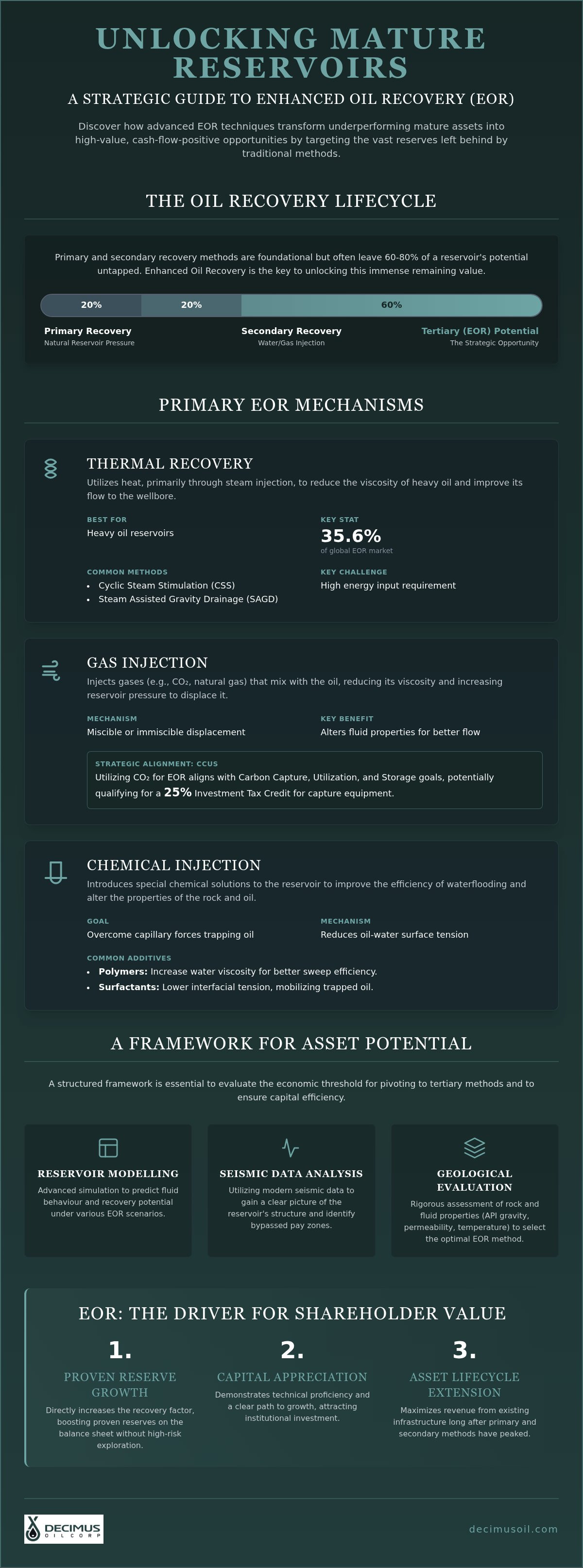
The maturation of conventional reservoirs in the Western Canadian Sedimentary Basin (WCSB) necessitates a shift from traditional extraction methods toward more sophisticated reservoir management. Enhanced oil recovery represents the tertiary stage of production, following the depletion of natural energy and the eventual limits of secondary pressure maintenance. While primary and secondary methods are foundational, they often leave a substantial volume of hydrocarbons behind. Enhanced oil recovery is the sophisticated tertiary phase of hydrocarbon extraction designed to increase the recovery factor of a reservoir beyond the physical limits of natural pressure and secondary displacement.
Deploying advanced enhanced oil recovery techniques allows operators to target the significant percentage of original oil in place that remains trapped after waterflooding. This approach is critical for offsetting the natural decline rates that characterize mature fields across Canada. Instead of accepting the cessation of production, strategic operators utilize these methodologies to stabilize output and maximize the total resource recovery from existing wellbores. This transition marks a shift from simple extraction to complex resource optimization.
Beyond Primary and Secondary Recovery
Primary recovery relies on natural reservoir pressure; secondary recovery typically involves waterflooding or gas injection to maintain that pressure. However, these methods usually recover only 20% to 40% of the reservoir's potential. The economic imperative to extract the remaining 60% to 80% of oil has become a strategic priority for companies focused on long-term value. By altering the chemical or physical properties of the oil or the reservoir rock, tertiary techniques overcome the capillary forces that hold oil in the pores. This extension of the commercial lifecycle of conventional assets ensures that existing infrastructure continues to generate revenue long after traditional methods have peaked.
EOR as a Driver for Capital Appreciation
From a corporate perspective, the application of enhanced oil recovery techniques is inextricably linked to oil and gas exploration economics. Increasing the recovery factor directly translates to proven reserve growth on the balance sheet, which is a primary driver of shareholder value. This technical proficiency allows a company to grow its reserve base without the high risk and capital intensity associated with greenfield exploration. Modern resource development relies on this technological efficiency to optimize existing assets, attracting investment by demonstrating a clear path to capital appreciation and operational excellence in a competitive energy landscape.
Primary Tertiary Recovery Mechanisms: Thermal, Chemical, and Gas Injection
Selecting the appropriate methodology requires a rigorous evaluation of the reservoir's geological profile. Operators must weigh API gravity, permeability, and reservoir temperature to determine which enhanced oil recovery techniques will yield the highest return on investment. Modern resource development has shifted toward high-intensity methodologies that prioritize precision and sweep efficiency over simple volume. These mechanisms are generally categorized into thermal, gas, and chemical processes, each designed to alter the physical state of hydrocarbons or the pressure dynamics within the formation to unlock previously inaccessible reserves.
Thermal Recovery and Steam Injection
Thermal methods primarily target heavy oil reservoirs where high viscosity prevents natural flow. As of 2026, the thermal segment is expected to account for 35.6% of the global EOR market, reflecting its critical role in heavy oil plays. Cyclic Steam Stimulation (CSS) utilizes a cyclical method, injecting high-pressure steam into a well to heat the surrounding area before switching to production. Steam Assisted Gravity Drainage (SAGD) employs a more continuous approach with parallel horizontal well pairs. While highly effective, these methods require significant energy inputs, making efficient infrastructure management a cornerstone of commercial success in the Canadian landscape.
Gas Injection and Miscible Displacement
Gas injection restores reservoir pressure while simultaneously acting as a solvent to mobilize trapped oil. By injecting CO2, nitrogen, or natural gas, operators achieve miscible displacement, a state where the gas and oil blend into a single phase. This process significantly reduces the surface tension that keeps oil bound to rock pores. The strategic value of gas injection has increased following the April 2026 expansion of the Canadian CCUS Investment Tax Credit, which offers a 25% credit for capture equipment. This synergy allows operators to align production goals with carbon management strategies, creating a more resilient economic framework for mature assets.
Chemical EOR: Polymers and Surfactants
Chemical enhanced oil recovery techniques focus on improving the mobility ratio between the injected fluid and the oil. Polymer flooding increases the viscosity of the water drive to ensure a more uniform sweep of the reservoir, preventing the bypass of oil through high-permeability channels. Surfactants reduce interfacial tension, effectively scrubbing oil from the mineral surfaces of the rock. As chemical performance metrics continue to improve, these methods provide a flexible alternative for reservoirs where thermal or gas injection may not be feasible. To understand how these technical choices impact the bottom line, sophisticated operators often evaluate asset potential through the lens of long-term capital appreciation and technical integrity.
Evaluating Economic Viability: Secondary vs. Tertiary Recovery Strategies
Determining the economic viability of tertiary recovery requires a shift from exploration-focused accounting to a lifecycle-value perspective. While greenfield exploration carries the lure of significant initial production, it's often shadowed by geological uncertainty and escalating drilling costs. In contrast, enhanced oil recovery techniques target reservoirs with established geological data, providing a level of technical certainty that exploration projects lack. The pivot from secondary waterflooding to tertiary methods generally occurs when the marginal cost of water handling outweighs the revenue from declining oil volumes. Utilizing existing energy infrastructure management frameworks allows operators to leverage legacy wells and pipelines, significantly reducing the initial capital entry cost for EOR.
The ROI of Mature Asset Revitalization
Revitalizing a mature asset is essentially an exercise in capturing "found" oil. The capital expenditure (CAPEX) required to implement EOR is frequently lower than the cost of acquiring and drilling new land, especially when legacy facilities are already in place. By extending the plateau of a field's production profile, these techniques mitigate the steep decline rates common in conventional plays. This results in a more predictable cash flow, allowing for better long-term planning and capital allocation across the corporate structure. When the cost-per-barrel of recovery is weighed against the risk of a dry hole, the strategic value of mature assets becomes clear.
Strategic Alignment and Portfolio Stability
Integrating low-decline EOR assets provides a necessary hedge against the inherent volatility of high-risk exploration. For companies operating within the public equity energy sector, this balance is vital for maintaining investor confidence and institutional stability. Operational efficiency becomes the primary driver of netbacks in these scenarios. By optimizing every barrel recovered through enhanced oil recovery techniques, a strategic operator can realize significant value even in moderate price environments, such as the US$56.00 per barrel base case forecast for Western Canadian Select in 2026. This focus on resource optimization ensures that the portfolio remains resilient across various market cycles while continuing to drive growth.
Revitalizing Mature Assets: A Framework for Production Optimization
Optimization in the WCSB requires more than just technical application; it demands a structured operational framework that bridges the gap between laboratory modelling and field-scale execution. Strategic operators don't simply apply enhanced oil recovery techniques in isolation. Instead, they integrate these methodologies with modern horizontal drilling and high-intensity completion designs to maximize reservoir contact. Navigating the regulatory landscape in Western Canada is equally critical, as jurisdictions like Alberta and Saskatchewan maintain specific requirements for pressure maintenance and fluid disposal. A disciplined approach ensures that production gains are both sustainable and compliant with regional environmental standards.
Phase 1: Reservoir Characterization and Screening
The foundation of any successful tertiary project is a rigorous assessment of historical production data and remaining oil in place (ROIP). Advanced geological modelling allows engineers to identify bypassed pay zones that secondary waterfloods may have missed due to reservoir heterogeneity. This phase involves several technical checkpoints:
- Data Integration: Combining 3D seismic data with legacy well logs to map structural traps and fluid boundaries accurately.
- Mineralogical Compatibility: Analyzing rock samples to ensure that injected polymers or gases won't cause formation damage or adverse chemical reactions.
- Sweep Analysis: Determining previous injection patterns to locate areas of high oil saturation that remain untapped.
Phase 2: Pilot Testing and Scale-Up
Transitioning from a theoretical model to a full-field deployment requires a phased approach to manage technical risk. Small-scale field pilots are essential for monitoring real-world pressure responses and fluid breakthrough timing. These pilots provide the empirical data necessary to refine injection rates and optimize well spacing before committing significant capital to a larger area. Success in the pilot phase depends on precise monitoring of the production stream to verify that the enhanced oil recovery techniques are mobilizing the targeted hydrocarbons as predicted. Once the sweep efficiency is confirmed, the project can be scaled across the asset to realize its full commercial potential.
Effective resource development relies on this intersection of deep regional knowledge and modern technical execution. If you are looking to optimize your existing holdings, you should evaluate your asset portfolio with Decimus Oil Corp. to identify high-potential tertiary recovery opportunities.
Realizing Shareholder Value: The Decimus Oil Approach to EOR
Decimus Oil Corp. approaches resource development with the precision of a technical specialist and the foresight of a strategic capital manager. By focusing on the intersection of geology and asset optimization, the company identifies value in conventional reservoirs that larger, less agile operators often overlook. The application of sophisticated enhanced oil recovery techniques is not merely a technical requirement; it's a core component of a corporate strategy designed to maximize the ultimate recovery from every wellbore. Decimus leverages over 100 years of combined management experience to bridge the gap between traditional WCSB field knowledge and the high-intensity methodologies required in the modern energy sector.
Conventional Play Focus and Resource Development
The strategic prioritization of conventional assets in Western Canada allows Decimus to build a portfolio characterized by geological certainty and established infrastructure. Utilizing EOR within these plays is the primary mechanism for driving growth and extending the commercial lifecycle of mature holdings. By transforming legacy fields into high-performance assets, the company reduces the need for speculative, high-cost exploration. This approach focuses on realizing hidden value through meticulous reservoir management and the strategic deployment of infrastructure, ensuring that capital is deployed where it has the highest probability of appreciation.
Investment Opportunity in Junior Energy
For investors, Decimus Oil Corp. (TSXV:WCSB) represents a unique entry point into a growth-focused energy enterprise. The company's model relies on operational excellence to provide a resilient alternative to the volatility often associated with exploration juniors. High insider ownership ensures that management's interests are directly aligned with those of the shareholders, fostering a culture of accountability and long-term value creation. As the global EOR market continues to expand, Decimus is positioned to capture a significant share of regional potential through its disciplined application of enhanced oil recovery techniques.
Technical proficiency and strategic alignment are the hallmarks of the Decimus approach. By maintaining a lean operational structure and leveraging existing infrastructure, the company minimizes production costs while maximizing output. Investors looking at TSXV:WCSB can participate in an entity that understands how to navigate the complex economic and technical landscape of the WCSB. This focus on stability and advancement ensures that Decimus remains a leader in the revitalization of Canada's conventional energy resources.
Strategic Resource Management for Long-Term Capital Appreciation
The long-term vitality of the Western Canadian Sedimentary Basin depends on the ability of sophisticated operators to extract latent value from mature reservoirs. By deploying advanced enhanced oil recovery techniques, companies can transform declining fields into resilient, high-performing assets that drive consistent shareholder value. This transition from simple primary extraction to complex resource optimization represents a strategic imperative for maintaining portfolio stability and institutional growth.
Decimus Oil Corp. (TSXV:WCSB) leverages over 100 years of combined energy sector experience to lead this charge, maintaining a dedicated focus on WCSB resource development. Our approach integrates modern technical execution with disciplined infrastructure management to minimize costs and maximize recovery factors across conventional plays. This methodology ensures that capital is deployed where it has the highest probability of realizing significant returns through operational excellence.
Explore Investment Opportunities with Decimus Oil Corp. (TSXV:WCSB) to discover how we realize hidden potential in the Canadian energy landscape. The path to sustainable capital appreciation in mature fields is accessible for those who combine deep regional expertise with technical innovation.
Frequently Asked Questions
What are the three main types of enhanced oil recovery techniques?
The three primary categories of enhanced oil recovery techniques utilized in modern operations are thermal recovery, gas injection, and chemical flooding. Thermal methods, such as steam injection, reduce oil viscosity to improve flow in heavy oil reservoirs. Gas injection involves the use of CO2 or nitrogen to restore reservoir pressure and mobilize trapped hydrocarbons. Chemical techniques employ polymers or surfactants to reduce interfacial tension, ensuring a more thorough sweep of the formation.
How does EOR differ from secondary recovery methods like waterflooding?
EOR differs from secondary recovery by actively altering the physical or chemical properties of the hydrocarbons and the reservoir rock. While secondary methods like waterflooding focus on maintaining reservoir pressure to displace oil, tertiary EOR techniques target the capillary forces that trap oil in pore spaces. This phase of production allows for the extraction of resources that remain inaccessible after natural pressure and secondary displacement have been exhausted.
Is enhanced oil recovery economically viable at lower oil prices?
Economic viability for EOR depends on the operator's ability to leverage existing infrastructure and navigate fiscal incentives. In Canada, the expansion of the CCUS Investment Tax Credit in 2026 provides a 25% credit for capture equipment, significantly improving the cost profile of CO2-EOR projects. By utilizing legacy wellbores and pipelines, strategic operators can maintain positive margins even in moderate price environments, such as the US$56.00 per barrel base case forecast for Western Canadian Select.
What role does CO2 injection play in modern oil recovery?
CO2 injection serves a dual purpose by restoring reservoir pressure and acting as a solvent to mobilize oil through miscible displacement. When CO2 blends with the oil, it reduces viscosity and causes the oil to swell, making it easier to extract from tight rock formations. This methodology is increasingly prioritized because it aligns production growth with carbon management goals, especially in jurisdictions with established regulations for permanent geological storage.
Can EOR techniques be used in conventional oil fields in Canada?
Conventional oil fields in the Western Canadian Sedimentary Basin are ideal candidates for various enhanced oil recovery techniques. These mature assets often possess high levels of geological certainty and extensive existing infrastructure, which reduces the capital intensity of implementation. Decimus Oil Corp. focuses on these high-potential conventional plays to maximize the lifecycle of resources and drive capital appreciation without the extreme risks associated with greenfield exploration projects.
How does enhanced oil recovery impact the lifespan of an oil field?
EOR significantly extends the commercial lifespan of an oil field by delaying the abandonment phase. By increasing the ultimate recovery factor, these techniques allow a field to remain productive for years or even decades after primary and secondary methods have peaked. This extension provides a stable, low-decline production profile that supports long-term corporate planning and ensures that existing energy infrastructure continues to generate revenue for shareholders.
What are the environmental considerations for EOR implementation?
Environmental considerations focus on carbon management, water conservation, and regulatory compliance within the Canadian landscape. Modern EOR projects often integrate carbon capture and storage (CCS) to sequester CO2 permanently underground, helping to meet emissions reduction targets. Operators must also manage produced water responsibly and ensure that injection pressures remain within the limits defined by provincial regulators to protect groundwater resources and maintain the geological integrity of the formation.
Why should investors care about a junior producer’s EOR strategy?
A junior producer's EOR strategy provides a pathway to reserve growth with lower geological risk than traditional exploration. For companies like Decimus Oil Corp. (TSXV:WCSB), these techniques allow for the realization of hidden value within proven assets. Investors benefit from a more resilient portfolio and the strategic alignment of a management team with over 100 years of combined experience, focusing on operational excellence rather than speculative drilling.


