
Primary oil recovery can leave about 90% of a reservoir’s oil untouched. Secondary methods generally recover 20 to 40 percent of the original oil in place; among secondary hydrocarbon recovery techniques, waterflooding works by injecting water to maintain pressure and move oil towards producing wells.
Additional production depends on more than simply injecting water. Formation properties and the path water takes through the reservoir affect how effectively it displaces oil and moves it towards producing wells.
This article explains secondary oil recovery, how waterflooding works and how it can support production. It compares waterflooding with gas injection, outlines factors that affect recovery performance and explains where enhanced oil recovery fits into the development of Canadian hydrocarbon resources.
Key Takeaways
- Understand why production can decline as reservoir pressure falls, and how secondary recovery can help sustain oil flow.
- Learn how waterflooding uses injected water to support pressure and move oil towards producing wells.
- Recognize why reservoir characteristics and water movement influence the production response to a waterflood.
- Compare waterflooding with gas injection to see how different approaches support recovery from producing fields.
What Is Secondary Oil Recovery?
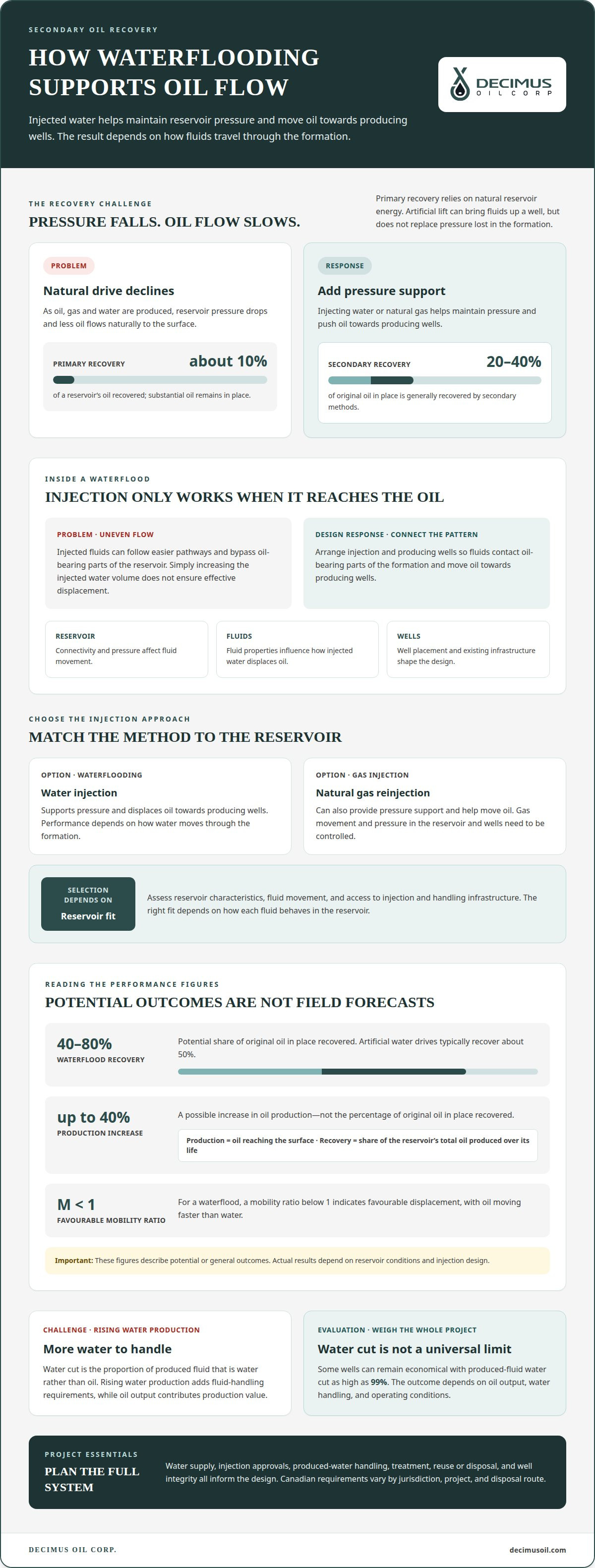
Primary oil recovery relies on the natural energy in an oil reservoir to move hydrocarbons towards producing wells. As oil, gas and water are produced, reservoir pressure declines, and less oil flows naturally to the surface. Artificial lift can help bring fluids up the well, but it doesn't replace pressure lost in the formation. Primary recovery methods recover about 10% of a reservoir’s oil, leaving substantial oil in place.
Secondary recovery addresses that decline by adding pressure support. Water injection and natural gas reinjection introduce fluids into the reservoir, helping maintain pressure and push oil towards producing wells. The injection pattern, reservoir connectivity and the way fluids travel through the rock affect how much oil reaches the surface. Secondary recovery techniques generally recover 20 to 40 percent of the original oil in place. These oil recovery methods extend production by using existing wells and reservoir energy more effectively.
How does secondary recovery differ from enhanced oil recovery? Secondary recovery mainly uses water or gas injection to maintain reservoir pressure and displace oil. Enhanced oil recovery, also called tertiary recovery, uses approaches such as thermal recovery or chemical processes to change oil flow or its interaction with the reservoir. Tertiary methods offer prospects for producing 30 to 60 percent or more of a reservoir’s original oil in place. The categories describe different recovery stages, not a guarantee of a particular field’s production.
In Canada, environmental and operational risks include managing injected fluids, produced water and well integrity. Water injection requires a reliable water supply and careful handling of water produced alongside oil. Leaks or inadequate containment can affect surrounding land or water. Natural gas injection requires control of gas movement and pressure in the reservoir and wells. Operators also need to consider the energy required for pumping and fluid handling, as well as equipment failure, corrosion and unintended fluid migration. These factors inform pressure maintenance and the design of secondary hydrocarbon recovery techniques.
Waterflooding
Waterflooding injects water into a reservoir to displace oil towards producing wells. Its performance depends on how fluids move through the formation, not simply on the volume injected.
To choose between water and gas injection, operators assess reservoir characteristics, fluid movement and access to injection and handling infrastructure. Waterflooding supports pressure and moves oil with injected water; natural gas injection can also provide pressure support. The right fit depends on how each fluid behaves in the reservoir.
Thermal recovery injects steam or heated water to reduce oil viscosity, helping it flow through the formation and wellbore to the surface. Unlike a conventional waterflood, it uses heat to change how readily the oil moves. Thermal recovery and water injection are distinct approaches to improving oil recovery.
Water Cut and Project Economics
Water cut is the proportion of produced fluid that is water rather than oil. It matters because rising water production adds fluid-handling requirements while the oil contribution determines production value. Some wells can remain economical with a produced-fluid water cut as high as 99%, but that figure isn't a universal threshold. The result depends on oil output, water handling, and operating conditions.
Recovery Rates and Reservoir Conditions
Waterflooding can recover 40% to 80% of original oil in place; artificial water drives typically recover about 50%. These ranges describe potential outcomes, not a forecast for every field. A waterflood mobility ratio below 1, expressed as M < 1, indicates favourable displacement, with oil moving faster than water.
Secondary recovery in Canada uses water or gas injection. Gas lift can also support reservoir pressure. Performance depends on reservoir connectivity, pressure, fluid properties and well placement. Injection and producing wells need to be arranged so injected fluids contact oil-bearing parts of the formation rather than bypassing them.
Water Injection and Produced-Water Rules
Canadian requirements for water injection and produced-water disposal vary by jurisdiction, project and disposal route. Operators must account for approvals governing injection and requirements for handling, treatment, reuse or disposal. Water produced alongside oil needs appropriate management, and injection plans must meet the applicable operating requirements. The disposal route can also shape fluid-handling design and project economics.
For a broader view of recovery planning, explore reservoir development perspectives.
Production increases from secondary oil recovery
Secondary recovery can increase oil production by as much as 40 percent. That figure describes a possible production uplift, not the percentage of original oil in place recovered. The distinction matters: production measures the rate of oil reaching the surface, while recovery describes the share of a reservoir’s total oil produced over its life. A pressure-support project may improve output by helping oil move through the formation towards producing wells.
Injection affects production by changing pressure and fluid movement. Water or gas enters through injection wells and helps displace oil towards producing wells. Results depend on reservoir connectivity, fluid properties, well placement and how injected fluids travel through the rock. Existing wells and infrastructure also shape project design, since injection and production need to function as a connected system. If fluids follow easier pathways, they may bypass oil-bearing parts of the reservoir.
Gas injection can use nitrogen or carbon dioxide to support pressure and move oil. Chemical recovery takes a different approach: a water and micellar polymer solution can reduce friction between water and oil. Thermal recovery uses steam or heated water to change oil viscosity. The effect of each method on production depends on the reservoir and the injection design.
Weyburn in Saskatchewan illustrates how an injection project can form part of a field’s longer-term development. Its operator hoped carbon dioxide injection would extend the field’s productive life by another 25 years and add as much as 130 million barrels of oil. A 204-mile pipeline carries carbon dioxide from North Dakota, United States, to the Weyburn oil field. The example connects recovery planning with energy infrastructure and cross-border supply.
For production planning, the key question is how injection changes oil flow across the field, not just how much fluid enters a well. Pressure response, produced-fluid composition and movement between injection and producing wells help indicate whether the method is supporting oil output. Tracking these operating signals over time can distinguish sustained improvement from a short-lived change. It can also help determine whether water, gas or another recovery method best fits the reservoir’s development strategy.
How do waterflooding and gas injection improve oil recovery?
Both methods change pressure and fluid movement in an oil reservoir, but they work differently. In waterflooding, injected water supports pressure and displaces oil towards producing wells. Its path through the formation matters: water moving through connected, permeable zones can reach oil that might otherwise remain behind. Poorly distributed flow can bypass parts of the reservoir and limit contact with oil.
Gas injection introduces nitrogen or carbon dioxide through a well. As gas expands, it can help push oil up the wellbore, supporting production when reservoir pressure has declined. The outcome depends on how gas moves through the rock and interacts with reservoir fluids. Operators consider these flow patterns alongside well performance when planning an injection strategy.
Carbon dioxide injection can also serve as enhanced oil recovery. In CO2-EOR, carbon dioxide enters a depleted oil field and is mostly left underground. This differs from describing gas injection only as secondary pressure support: the method and its purpose depend on the project design. Water-alternating-gas, or WAG, combines water and gas injection and is regarded as the default process for commercial gas-injection projects.
Choosing between water and gas means weighing reservoir behaviour, fluid movement and the infrastructure needed for injection and produced-fluid handling. Water can displace oil through the formation; gas can expand and push oil towards the well. Water-alternating-gas injection, or WAG, uses alternating slugs of each fluid. Reservoir flow paths help determine whether this approach is appropriate.
Production response is assessed through operating data, including pressure behaviour, oil output and fluid movement between injection and producing wells. These signals help show whether injected fluids are reaching productive parts of the reservoir or taking easier pathways. For Canadian resource development, aligning injection design with asset conditions is central to recovery planning. Explore enhanced oil recovery as part of a broader approach to developing hydrocarbon assets.
Decimus Oil: Enhanced Oil Recovery
Decimus Oil Corp. focuses on enhanced oil recovery as part of the strategic development of hydrocarbon resources. When assessing how secondary recovery fits into a field’s wider development, consider the reservoir, production goals and role of existing energy infrastructure together.
Waterflooding and gas injection support production through pressure maintenance and fluid displacement; enhanced recovery methods can extend the development strategy. Decimus Oil Corp.’s work in conventional oil and gas exploration, energy infrastructure and enhanced oil recovery connects these considerations to resource development. Investors can explore how the company’s work relates to enhanced oil recovery and hydrocarbon resource development.
Contact Decimus Oil Corp. to discuss enhanced oil recovery and hydrocarbon resource development.
Plan the next stage of field development
Choosing among secondary hydrocarbon recovery techniques is part of a wider development decision: how to align reservoir behaviour, operating priorities and long-term resource value. Assess how a recovery strategy fits the asset’s overall direction, including the role of existing infrastructure and future development opportunities. This connects technical choices with the broader stewardship of a hydrocarbon asset.
For Canadian energy projects, disciplined planning helps clarify where enhanced recovery fits within an asset strategy and which considerations should guide further development. Decimus Oil Corp.’s focus on hydrocarbon resources is relevant to readers assessing these decisions.
Contact Decimus Oil Corp. today to discuss resource development and the next stage of your energy strategy. A considered path forward begins with clear priorities and a long-term view.
Frequently Asked Questions
What is secondary hydrocarbon recovery in oil and gas production?
Secondary hydrocarbon recovery is a production stage that uses injected fluids to support pressure and move oil towards producing wells. Water and gas injection are common methods, considered when natural reservoir energy no longer moves oil effectively. For example, an operator may inject water through designated wells while producing oil from others, coordinating both to improve fluid movement through the reservoir.
How does waterflooding work, step by step?
A waterflood coordinates injection and production through a planned operating sequence:
- Designate wells for water injection and oil production.
- Inject water into the reservoir to support pressure and displace oil.
- Track pressure, oil output and water returning with produced fluids.
- Adjust injection operations as reservoir response becomes clearer.
Fluid movement and well performance guide these adjustments, helping operators manage the flood as field conditions change.
What recovery factor can secondary recovery achieve compared with primary recovery?
Primary recovery methods recover about 10% of a reservoir’s oil, while secondary recovery techniques generally recover 20 to 40 percent of original oil in place. These figures describe recovery factors, not a guaranteed result for an individual field. The actual outcome depends on reservoir properties, fluid movement and well arrangement. Comparing recovery factors helps distinguish total oil recovered from changes in production rate.
What are typical costs per barrel for waterflooding and gas injection in Canada?
There is no single typical per-barrel cost that applies to waterflooding and gas injection across Canadian projects. Costs depend on reservoir conditions, injection-fluid supply, existing wells, required infrastructure, energy use and produced-fluid handling. A project-specific price depends on the case and is provided after a quote request. These factors help explain why costs can differ between fields and between injection methods.


