
Oil and gas asset exploration programs track potential reserves by combining estimates of recoverable volumes with reservoir performance and production data. That evidence informs development plans and investment decisions. Teams assess prospects using geological and seismic information, well records and nearby field analogues. They may advance a prospect through drilling or acquisition, while a final investment decision weighs technical potential against commercial viability and execution risk.
A discovery and a reserve estimate are related, but they are not interchangeable. A discovery means a well has encountered petroleum; reserve estimates indicate how much may be commercially recoverable under defined conditions. Keeping the distinction clear helps when comparing prospects, tracking asset value and deciding whether further appraisal or development is justified.
This article explains how reserve tracking fits into the exploration process, how Canadian prospects are evaluated, and what drilling or an acquisition can establish. It also covers development status and the factors behind a final investment decision, showing how evidence moves from subsurface opportunity to a disciplined capital commitment.
Key Takeaways
- Track ownership, reserves, production and location together to understand what an asset record can show about a prospect.
- Assess prospects by combining seismic data, geological reports, well logs, core reports and nearby field analogues.
- Understand how exploratory drilling and acquisitions can advance an opportunity, and what appraisal wells help establish after a discovery.
- Compare development status and technical, commercial and execution considerations to see how they inform a final investment decision.
How are reserves tracked?
Investors compare oil and gas exploration programs by considering project ownership, reserve estimates, production history and location together. An asset record identifies working interests, operators, wells, field boundaries and ownership changes. Reserve updates distinguish proved volumes from less certain resources and outline assumptions about recovery, prices and development. Production data then shows whether reservoir performance matches the technical model and economic plan.
Discoveries and production trends provide context, not a forecast for any single asset. Global oil and gas discoveries totalled 7 billion boe in 2025, equal to 45% of the discovery volumes called for. These figures frame the replacement challenge, while an operator’s own record depends on geology, exploration activity and field maturity. Compare production trends alongside reserve revisions and operating performance.
In Southeast Asia, production-sharing contracts allocate production between a government and contractor under agreed terms. Indonesia pioneered this contract model in the 1960s. For an investor, the contract structure affects how project ownership, production entitlements and economic returns are recorded. It should be assessed alongside the asset’s technical data, operating obligations and location.
Operating costs include ongoing field expenses, while development costs relate to preparing an asset for production. During the tendering and procurement stage, oil and gas cost estimates are well-defined and stay within a ±5% range. Evaluation also compares actual operating costs with forecasts, production performance and planned field development. Carbon considerations can inform the assessment of operating strategy and long-term asset exposure.
In Canada, environmental assessment and consultation requirements depend on a project’s location, scope and potential effects. Planning considers the applicable federal, provincial or territorial processes, including Indigenous consultation where required. Programs also vary with geology, land tenure, infrastructure and regulation. Geological risk concerns whether a viable reservoir exists; financial and operational risks include costs, access and execution. Exploration, permitting and leasing can take years or decades, depending on the location and activity. There is no single success rate: outcomes depend on basin maturity, prospect quality and how success is defined.
Exploration methods for locating oil and gas prospects
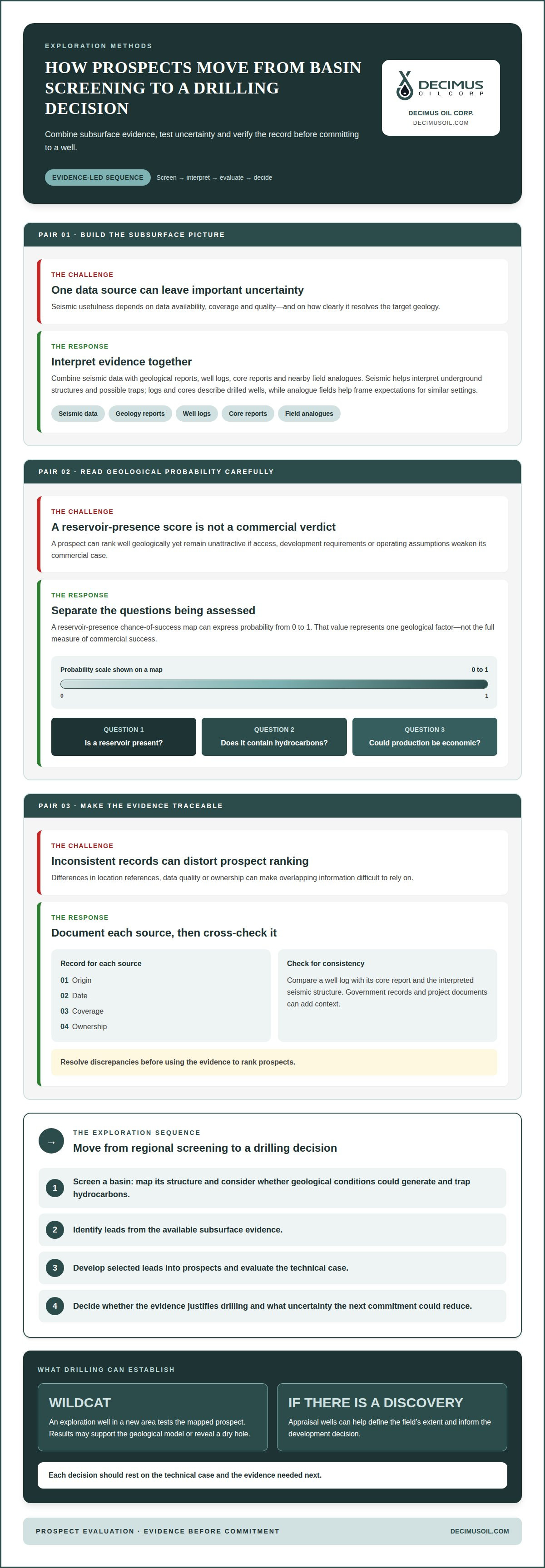
An exploration program typically moves from regional screening to prospect identification, technical evaluation and a drilling decision. Early analysis maps basin structure and asks whether geological conditions could have generated and trapped hydrocarbons. Teams then combine available subsurface evidence to rank prospects and identify work that could reduce uncertainty. At each stage, they assess whether stronger evidence supports the next commitment.
Seismic data helps geoscientists interpret underground structures and identify possible oil or natural gas traps. Its usefulness depends on data availability, coverage and quality, as well as how clearly it resolves the target geology. Teams interpret seismic alongside geology reports, well logs, core reports and nearby field analogues. Each source contributes different evidence: logs and cores describe drilled wells, while analogue fields help frame expectations for similar settings.
A reservoir-presence chance-of-success map can express probability on a scale from 0 to 1. That value represents one geological factor, not a complete measure of commercial success. Separate questions concern whether a reservoir exists, whether it contains hydrocarbons and whether production could be economic. A prospect can rank well geologically yet remain unattractive if access, development requirements or operating assumptions weaken its commercial case.
Reliable research depends on documenting evidence as carefully as interpreting it. Teams can record each source’s origin, date, coverage and ownership, then check overlapping information for consistency. For example, they can compare a well log with its core report and the interpreted seismic structure. Government records and project documents can add context. Resolve discrepancies in location references, data quality or ownership before using the evidence to rank prospects.
The practical sequence is to screen a basin, identify leads, develop selected leads into prospects, evaluate the evidence and decide whether drilling is justified. A new-area exploration well is called a wildcat. Its results may confirm a discovery or prompt a revised geological model. Conventional oil and gas exploration follows this progression to test subsurface potential, with each decision based on the technical case and the evidence needed next.
Exploratory drilling and acquisitions
Drilling tests whether a mapped prospect contains petroleum and merits further evaluation. An exploration well in a new area is a wildcat; its results may support the geological model or reveal a dry hole. A dry hole does not encounter commercial quantities of petroleum and is usually plugged and abandoned. If drilling makes a discovery, appraisal wells can help define the field’s extent and inform the development decision.
Onshore and offshore drilling present different site and execution conditions. Onshore wells can occupy from a half acre per well for heavy crude oil to 80 acres per well for natural gas. Offshore teams have discovered reservoirs at water depths exceeding 3,000 m. These settings shape access, equipment, logistics and environmental planning. Unconventional extraction also involves different reservoir and development considerations from conventional oil and natural gas projects.
Offshore drilling plans address well control, equipment integrity, emergency response and environmental monitoring. Drilling waste plans cover the handling, containment, transport and disposal of materials generated during operations. Onshore and offshore projects account for their different locations and waste streams. In Canada, regulatory and consultation requirements depend on the project’s jurisdiction and characteristics, so a national-level overview cannot describe every site.
Acquisition offers another way to pursue an exploration opportunity. A buyer can review an asset’s ownership interests, location, geological data, well records, lease obligations and existing infrastructure. An exploration lease may also require work, such as acquiring seismic data or drilling wells. These commitments shape the work plan and should be considered alongside the available evidence and the operator’s capacity to execute.
Drilling and acquisition are different ways to advance a prospect. Drilling generates direct subsurface evidence; an acquisition provides access to an existing position and its records. Either route connects technical interpretation with operating capacity, environmental planning and commercial potential. Results help determine whether an oil and gas exploration program should proceed to appraisal, further exploration or abandonment.
Development status categories and final investment decisions
Development status indicates how far an asset has progressed from geological opportunity to production. A prospect is an exploration target; a discovery means petroleum has been encountered, while appraisal clarifies its scale and characteristics. A development-stage asset has a plan to prepare reservoirs for production. A producing asset is in operation, allowing output and reservoir performance to be compared with forecasts. These distinctions are useful, but do not replace a review of the underlying evidence.
A final investment decision (FID) weighs whether a proposed development is technically, economically and operationally viable. The investment case brings together reservoir performance, expected production, development scope, operating assumptions and forecast revenue. Common measures of profitability include net present value, internal rate of return, return on investment and payback period. Each reveals a different aspect of the project, so decision-makers consider them together rather than relying on a single result.
Forecasts connect the asset’s current status to its longer-term potential. Revenue and cost forecasts may cover concession periods of 10 to 40 years, making production profiles and assumptions about operating costs important to the assessment. Development cost estimates can vary by as much as ±40%, depending on the phase of development. As engineering and procurement advance, estimates become more specific, allowing the investment case to be tested against a clearer project scope.
A disciplined FID also identifies the conditions required for development to create value. Decision-makers test whether reservoir evidence supports planned output, whether infrastructure and operating plans suit the location, and whether the forecast holds up when assumptions change. A technically viable reservoir alone does not establish that conventional development is economic. The decision should connect subsurface evidence to an executable plan, capital requirements and expected production.
For investors assessing the path from resource to development, compare project status with the evidence and economics supporting each next step. Explore public equity investment as one way to participate in the energy sector.
Decimus Oil: Public Equity Investment (TSXV:WCSB)
Decimus Oil Corp. offers public equity investment through TSXV:WCSB for readers seeking exposure to a Canadian energy company focused on conventional oil and gas exploration and resource development. Its activities also include energy infrastructure and enhanced oil recovery, linking exploration opportunities with the development and management of hydrocarbon assets.
Decimus Oil Corp. may be relevant if you are assessing how an exploration opportunity could progress from prospect evaluation toward development, or considering public equity investment in the energy sector. Exploration and investment decisions involve geological, operational and economic factors. Reviewing the company’s focus can help you decide whether its activities align with your interests.
Contact Decimus Oil Corp. to discuss its exploration and investment focus.
Turn asset insight into a considered next step
Before committing further attention or capital, define what you need to learn. For an asset under review, identify the information needed to assess its potential, the decision that evidence must support and how an investment fits your overall objectives. For private collectors seeking to diversify into tangible luxury assets alongside traditional resource markets, Cask Club provides curated access to premium Scotch and Irish whisky casks. A focused question helps guide the next discussion and keeps attention on the factors that matter to your position.
Oil and gas asset exploration programs involve uncertainty, so a clear view of the opportunity and its decision points is essential. Whether you’re assessing an asset or considering participation in the sector, Decimus Oil can be part of that conversation. Discuss your assets with Decimus Oil and take a considered step toward your next decision.
Frequently Asked Questions
What are oil and gas asset exploration programs?
Oil and gas asset exploration programs coordinate efforts to identify, assess and advance potential oil and natural gas assets. A program may combine geological review, seismic interpretation, land access, permitting, drilling and evaluation of results. For example, an operator might screen an area, gather more subsurface data and then decide whether to drill. The process connects technical evidence with operating plans and commercial decisions.
How much do oil and gas exploration programs cost in Canada?
Program costs depend on location, geological maturity, available data, drilling requirements and operating conditions. An onshore project with existing infrastructure has different cost drivers from a remote or offshore prospect. Estimates also change as the project scope, equipment, logistics, environmental planning and procurement become clearer. Comparisons are most useful when estimates cover the same work scope and development assumptions.
What exploration methods and technologies are used to find oil and gas?
Exploration teams combine geological mapping, seismic interpretation and existing well information to assess subsurface prospects. Seismic data helps interpret underground structures; well logs and core samples provide direct information from drilled formations. Comparing these sources with nearby field analogues can refine a geological model. The methods chosen depend on the area, the quality of existing data and the uncertainty the next phase needs to address.
What permits and regulations govern oil and gas exploration in Canada?
Exploration follows the requirements of the relevant province or territory, with federal processes also applying where a project falls under federal jurisdiction. Depending on the project, approvals may cover land access, drilling, environmental effects, waste handling and consultation. Assessment and consultation requirements depend on location, project scope and potential effects. Operators plan for these requirements alongside technical work and project scheduling.
How are exploration acreage, leases, and mineral rights acquired in Canada?
Acquisition depends on who owns the mineral rights and the rules governing the land. Rights may be administered by a provincial or territorial government or held privately. An operator can pursue a land disposition where available or negotiate with a private rights holder. Before committing, review the legal interests, boundaries, existing obligations and any work requirements attached to the rights.
How do operators evaluate exploration prospects and estimate reserves?
Operators assess prospects by combining geological interpretation, seismic data, well logs, core information and evidence from nearby fields. They estimate the chance of geological success separately from the economic viability of developing a discovery. Reserve estimates draw on subsurface evidence, expected recovery and commercial assumptions. As drilling and production yield new information, teams can revise the model, changing estimated volumes and the development case.


