
The era of chasing speculative growth has ended, replaced by a rigorous focus on capital discipline and operational intensity. As global oil and gas production capital expenditure is projected to fall by 4.3 percent to $341.9 billion in 2026, the industry has reached a pivotal juncture. You likely recognize that the complexity of upstream cost modelling and the uncertainty of regulatory impacts on net present value make investment decisions more difficult than ever. Understanding the nuances of oil and gas exploration economics is no longer just a technical requirement; it's a strategic necessity for those seeking to realize value in a market where WTI crude trades near $91.54 per barrel.
This article provides the critical economic frameworks and emerging trends shaping conventional resource development within the Canadian energy sector. We'll establish a clear framework for evaluating exploration projects while identifying why low-decline assets often outperform more volatile alternatives. You'll discover how strategic infrastructure impacts the bottom line and how 2026 regulatory shifts are estimated to save the industry $2.5 billion. By the end of this analysis, you'll have the insights needed to distinguish between junior and senior producer economics and identify high-value opportunities in the current fiscal environment.
Key Takeaways
- Develop a comprehensive understanding of oil and gas exploration economics to navigate the industry's shift from high-growth mandates toward disciplined, long-term value creation.
- Identify the primary drivers of capital intensity in 2026, including the impact of interest rates and inflation on upstream project financing and completion costs.
- Learn how integrating Enhanced Oil Recovery (EOR) techniques can de-risk the exploration lifecycle by extending field life and maximizing ultimate recovery factors.
- Evaluate the strategic role of owned energy infrastructure in optimizing netbacks and building a sustainable competitive moat against third-party processing burdens.
- Discover how public equity investment provides a transparent entry point for realizing value through conventional resource development and strategic asset growth.
The Shifting Landscape of Oil and Gas Exploration Economics in 2026
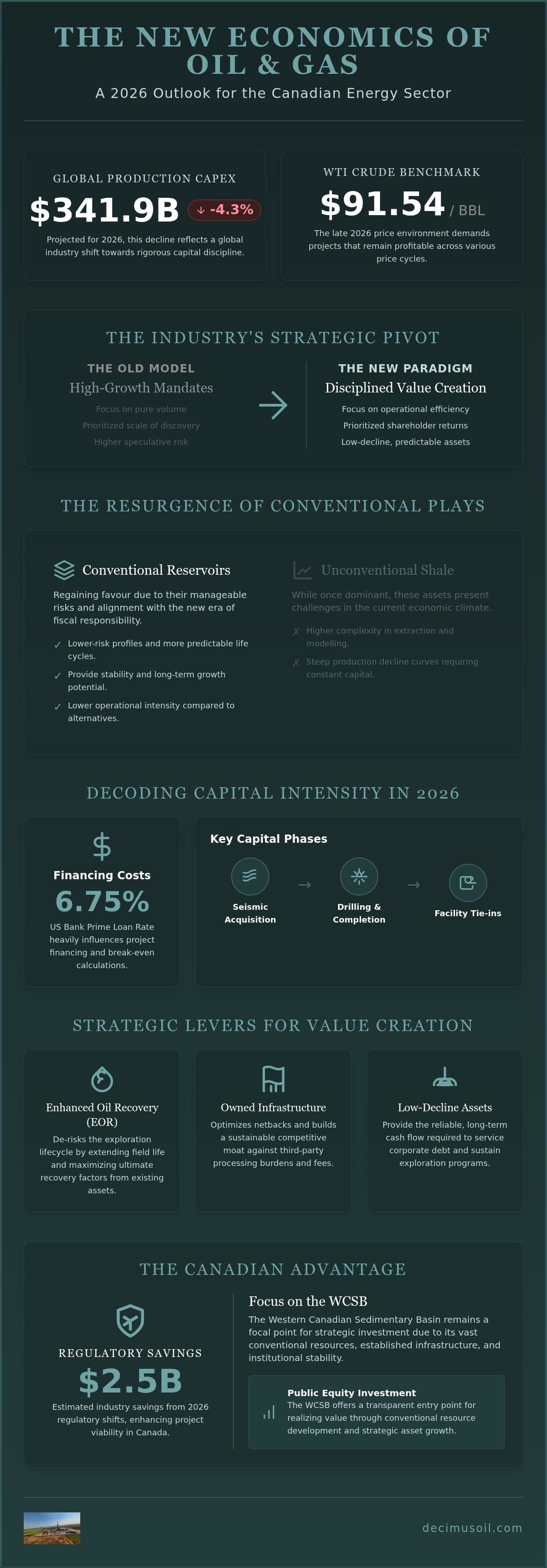
Oil and gas exploration economics functions as the analytical framework for capital allocation within the upstream sector, balancing the technical risks of discovery against the projected net present value of reserves. By 2026, the industry has fundamentally moved away from the high-growth mandates of the previous decade. Operators now prioritize disciplined value creation over pure volume. This transition is evidenced by a projected 4.3 percent decline in global production capital expenditure, which is expected to settle at $341.9 billion this year. This contraction reflects a broader commitment to capital discipline; every dollar spent must now withstand rigorous economic scrutiny and demonstrate a clear path to shareholder returns.
The resurgence of conventional plays marks a significant turning point in oil and gas exploration economics. While unconventional shale resources once dominated headlines, the complexity and steep decline curves associated with those assets have led many producers back to conventional targets. These traditional reservoirs offer lower-risk profiles and more predictable life cycles, making them ideal for the current era of fiscal responsibility. Global supply dynamics, influenced by geopolitical volatility and rising energy security concerns, continue to shape Canadian exploration budgets. As a result, the focus has shifted toward domestic assets that provide stability and long-term growth potential.
Value-Driven Exploration vs. Traditional Discovery Models
Traditional exploration models often prioritized the sheer scale of a discovery, but modern methodologies focus on operational efficiency and the ability to realize value quickly. Conventional targets are regaining favour because they offer manageable technical risks and lower operational intensity. With global oil prices like West Texas Intermediate trading at $91.54 per barrel in late 2026, the industry is increasingly focused on projects that remain profitable across varying price cycles. Success is no longer measured by the total barrels in place; it's defined by the ability to optimize extraction and maintain low-decline characteristics over decades.
Macroeconomic Influences on Canadian Hydrocarbon Exploration
The Western Canadian Sedimentary Basin remains a focal point for strategic investment due to its vast conventional resources and established infrastructure. Canadian fiscal policy and evolving carbon pricing frameworks require sophisticated modelling to ensure project viability. International energy security concerns are currently driving a resurgence in domestic investment as global markets look for institutional stability. While global capital spending is tightening, the strategic importance of the WCSB allows for targeted resource development that balances environmental mandates with the need for reliable energy production. This environment favours experienced operators who can organize complex projects while providing a transparent entry point for public equity exposure.
Decoding the Capital Intensity of Conventional Resource Development
Capital intensity in the conventional sector involves a rigorous sequence of high-cost phases. It begins with sophisticated seismic acquisition and moves through drilling, completion, and final facility tie-ins. In 2026, project financing is heavily influenced by macroeconomic factors, including a US Bank Prime Loan Rate of 6.75 per cent. This interest rate environment necessitates a disciplined approach to capital allocation, making it fundamental to oil and gas exploration economics in the current market. Producers must ensure that the "all-in" break-even price of a well accounts for these financing costs alongside operational expenses. Low-decline assets are essential in this context; they provide the reliable cash flow required to service corporate debt and sustain long-term exploration programs without constant capital injections.
Cost Structures in Modern Drilling and Completion
The choice between horizontal and vertical drilling is a primary driver of oil and gas exploration economics. Horizontal wells typically offer higher initial production rates, yet vertical wells in conventional reservoirs often present a more attractive risk-adjusted return due to lower upfront completion costs. High-intensity completion techniques, while effective at boosting early output, must be weighed against their impact on the overall decline rate. This careful balancing of technical methodology is a central theme in Petroleum Economics and Policy. Success depends on maintaining low finding and development (F&D) costs, ensuring that each dollar invested generates a predictable and profitable stream of reserves over the asset's lifecycle. It's a strategy that prioritizes long-term stability over short-term production spikes.
Capital Allocation Strategies for Junior Energy Producers
Junior energy firms operate in a high-stakes environment where they must balance exploration risk with the necessity of production maintenance. Small-cap producers often leverage public equity markets to fund their resource development. The TSX Venture Exchange serves as a vital engine for this growth, providing the liquidity needed to execute targeted acquisition strategies. By focusing on under-developed conventional assets with low-decline characteristics, these firms can realize value that larger operators might overlook. This disciplined approach to capital allows junior producers to build portfolios that are both resilient and scalable. Investors and stakeholders often look to the strategies of a growth-oriented Canadian energy firm to see how optimized infrastructure and EOR techniques can transform mature fields into high-performing assets.
Risk Mitigation and the Economic Value of Enhanced Oil Recovery
De-risking the exploration lifecycle is a priority for operators looking to maximize shareholder value in 2026. While initial discovery represents the high-risk phase of oil and gas exploration economics, the transition to optimized extraction through Enhanced Oil Recovery (EOR) provides a more predictable path to capital appreciation. EOR techniques, including waterflooding and secondary recovery methods, are no longer just late-stage options; they are strategic tools used to stabilize corporate decline rates. By extending the productive life of a field, these methods increase the ultimate recovery factor, ensuring that the initial capital invested in infrastructure continues to yield returns long after the primary production phase has peaked.
When evaluating the NPV of a new exploration well versus an EOR-enhanced mature well, the economic advantages of the latter often become clear. A new discovery requires significant upfront capex for drilling and tie-ins, whereas EOR leverages existing facilities to lower the entry cost. This shift is reflected in the global EOR market, which is estimated to be valued between $50.46 billion and $60.61 billion in 2026. Understanding the Economic and Financial Determinants of Oil and Gas Exploration helps producers recognize that secondary recovery offers a lower-risk profile, shielding the balance sheet from the volatility associated with frontier drilling. By focusing on these low-decline characteristics, firms can maintain steady cash flow even during periods of commodity price fluctuation.
Enhanced Oil Recovery as a Strategic Financial Tool
EOR serves as a catalyst for maximizing the value of established energy infrastructure. By implementing field-wide optimization strategies, producers can significantly reduce unit operating costs and maintain steady production levels. In a market defined by capital discipline, the predictability of secondary recovery provides a reliable foundation for corporate growth. This approach transforms mature fields into high-intensity assets that contribute to a firm’s long-term resilience and operational stability.
Technical Evaluation and Economic Probability of Success
Modern geological modelling is essential for improving the success rates of EOR projects. Technical proficiency in reservoir characterization directly correlates with shareholder value realization, as it reduces the probability of sub-optimal capital allocation. Precision in engineering ensures that recovery targets are met with fiscal efficiency. EOR economics is the intersection of engineering precision and fiscal discipline.
Strategic Infrastructure as a Catalyst for Operational Efficiency
In the Western Canadian Sedimentary Basin, the strategic ownership of energy infrastructure serves as a critical competitive moat. While some frameworks view gathering and processing as midstream concerns, these assets are fundamentally central to oil and gas exploration economics. The economic burden of third-party processing can significantly erode margins, particularly when commodity prices fluctuate. By controlling integrated gathering and transportation systems, operators can drastically reduce operational down-time and improve field-level economics. This level of control allows for a more responsive approach to production management, ensuring that the corporate bottom line remains resilient against escalating external fee structures and logistical bottlenecks.
Strategic infrastructure also plays a vital role in meeting modern regulatory standards with fiscal efficiency. For instance, the EPA finalized a rule in April 2026 to revise technical aspects of the Clean Air Act, focusing on flaring and vent gas monitoring. This action is estimated to save the industry $2.5 billion between 2024 and 2038. Operators with owned, modern infrastructure are better positioned to realize these savings by implementing efficient monitoring systems that reduce environmental liabilities and operational costs simultaneously. This alignment of technical capability and fiscal discipline is a hallmark of a sophisticated operator focused on long-term resource growth.
Maximizing Netbacks through Integrated Asset Management
A netback is the revenue realized per barrel after deducting production, royalty, and transportation costs. Strategic infrastructure ownership directly increases this per-barrel profitability by eliminating the tolls and processing fees paid to third-party midstream providers. It's a strategic advantage. Managing infrastructure alongside resource development provides lifecycle benefits, allowing for seamless scaling as production volumes grow. When an operator owns the processing facilities, they capture more value from every unit of energy produced, effectively turning a traditional cost centre into a strategic asset. This integrated approach ensures that capital is recycled back into exploration and development rather than being leaked to external service providers.
Operational Excellence and the Bottom Line
Operational excellence requires high-intensity methodologies in field management to ensure every asset performs at its peak. Efficiency drives shareholder value. Modernized infrastructure reduces environmental liabilities by utilizing efficient extraction and processing techniques that minimize leaks and maximize throughput. This synergy is particularly evident when combined with Enhanced Oil Recovery (EOR) techniques, as existing pipelines and facilities can be repurposed for waterflooding or gas injection with minimal additional capex. By optimizing these existing assets, firms can maintain low-decline characteristics while realizing superior returns on capital. To see how these strategies drive value in the WCSB, learn more about our integrated energy infrastructure management and resource development.
Realizing Value through Public Equity and Resource Growth
Public equity markets provide the necessary liquidity to transform technical prospects into commercial realities. In Canada, the TSX Venture Exchange serves as a primary engine for energy innovation, allowing junior producers to access the capital required for sophisticated resource development. While some academic perspectives suggest public markets are reserved for mature entities, the reality of oil and gas exploration economics in the Western Canadian Sedimentary Basin proves otherwise. Investors seek exposure to junior firms because they offer a unique pathway to capital appreciation through the discovery and development of conventional assets. These conventional plays, characterized by their low-decline rates, provide a stable foundation that contrasts with the volatility of unconventional shale.
Success in the junior sector is determined by the quality of the management team and their alignment with shareholders. High insider ownership is a critical indicator of confidence. When leadership holds a significant stake, it signals that they're personally invested in the firm's long-term success. This alignment ensures that strategic decisions focus on realizing value rather than just increasing production volume for its own sake. Transparency builds trust.
Evaluating Junior Energy Firms for Growth Potential
Investors must look beyond surface-level production numbers to assess a firm's true potential. Key metrics include reserve replacement ratios and debt-to-cash-flow, which provide a clearer picture of financial health. A strategic advantage is often found in firms that maintain a diversified portfolio, combining high-impact exploration with the steady returns of Enhanced Oil Recovery (EOR) assets. Publicly traded firms offer a level of transparency and liquidity that private entities can't match, allowing stakeholders to monitor operational progress in real-time. This visibility is essential for navigating the complexities of oil and gas exploration economics in a market that demands both technical proficiency and fiscal responsibility. Efficiency drives returns.
Decimus Oil: A Case Study in Strategic Alignment
Decimus Oil Corp. (TSXV:WCSB) exemplifies the integration of technical expertise and strategic capital allocation. The firm leverages over 100 years of combined team experience to identify and optimize conventional assets within the WCSB. With 27 per cent insider ownership, the leadership team is deeply aligned with shareholder interests, ensuring a focus on operational efficiency and the maximization of asset value. By combining conventional exploration with strategic infrastructure management and EOR, Decimus positions itself as a sophisticated operator capable of realizing superior returns. Explore investment opportunities with Decimus Oil Corp. to learn how a disciplined approach to resource growth can drive long-term value in the Canadian energy sector.
Strategic Positioning in a Disciplined Energy Market
The evolution of the energy sector in 2026 demands a sophisticated understanding of oil and gas exploration economics. Success is no longer defined by discovery alone; it's defined by the ability to manage capital intensity through integrated infrastructure and Enhanced Oil Recovery. By focusing on low-decline conventional assets, operators can build resilient portfolios that withstand commodity price volatility and regulatory shifts. This disciplined approach ensures that capital is allocated where it generates the highest risk-adjusted returns while maintaining long-term operational stability.
Decimus Oil Corp. (TSXV:WCSB) leverages over 100 years of combined energy sector experience to realize value in the Western Canadian Sedimentary Basin. Through a strategic focus on operational efficiency and resource growth, the firm provides a transparent vehicle for sophisticated energy investment. Learn more about Decimus Oil Corp.'s strategic approach to resource development and public equity investment. We're committed to advancing the potential of Canadian conventional resources through technical precision and fiscal integrity.
Frequently Asked Questions
What are the primary factors influencing oil and gas exploration economics in 2026?
Primary factors include capital spending discipline and the prevailing interest rate environment, specifically the US Bank Prime Loan Rate of 6.75 per cent. Additionally, regulatory changes such as the EPA’s 2026 flaring rule revisions are expected to save the industry $2.5 billion by 2038. These elements collectively shape oil and gas exploration economics by redefining the hurdle rates required for project approval and prioritizing assets that offer immediate fiscal resilience and long-term resource growth.
How does enhanced oil recovery (EOR) impact the profitability of an energy asset?
Enhanced Oil Recovery significantly increases profitability by maximizing the ultimate recovery factor of a field while leveraging existing energy infrastructure. By utilizing waterflooding or gas injection, operators can stabilize production and extend field life beyond primary extraction phases. This approach is increasingly valuable as the global EOR market reaches an estimated $60.61 billion in 2026. It allows firms to revitalize mature fields with lower capital intensity compared to drilling new frontier wells.
What is the difference between conventional and unconventional exploration economics?
Conventional exploration economics focus on reservoirs with high permeability and low-decline characteristics, offering more predictable cash flows and lower operational complexity. In contrast, unconventional plays require high-intensity completion techniques and face rapid initial production declines. Conventional assets are currently regaining favour because they provide a stable, value-driven alternative to the volatile spending cycles often associated with shale development. This stability is essential for maintaining consistent shareholder returns in a disciplined market.
Why is infrastructure management critical for junior oil and gas producers?
Infrastructure management serves as a critical competitive moat by eliminating the economic burden of third-party processing fees. Junior producers who own their gathering and transportation systems can significantly optimize their netbacks and reduce operational down-time. This level of control ensures that every barrel produced contributes more directly to the bottom line. Integrated asset management allows smaller firms to scale their resource development efficiently while shielding their margins from external midstream cost fluctuations.
How do interest rates and inflation affect upstream energy project financing?
High interest rates, such as the current prime rate of 6.75 per cent, increase the cost of debt and necessitate more rigorous capital allocation strategies. Inflationary pressures on labour and equipment also raise the "finding and development" costs for new projects. Consequently, producers must prioritize high-margin assets and low-decline production to service financing obligations. This environment favours experienced management teams who can organize complex projects while maintaining a healthy debt-to-cash-flow ratio.
What role does the TSX Venture Exchange play in the Canadian energy sector?
The TSX Venture Exchange provides a vital platform for Canadian energy innovation by offering junior producers access to public equity markets. This listing facilitates the liquidity needed to fund conventional exploration and strategic acquisitions. For investors, the exchange offers a transparent entry point into the energy sector, backed by regulatory oversight. It allows growth-oriented firms to realize value through resource development while providing shareholders with exposure to a diversified portfolio of hydrocarbon assets.
What metrics should investors use to evaluate a junior energy producer's economics?
Investors should prioritize metrics like production growth, reserve replacement ratios, and debt-to-cash-flow to assess a firm's economic health. Technical proficiency and management experience are equally important, as seen in teams with over 100 years of combined industry knowledge. High insider ownership, such as 27 per cent, is also a key indicator of alignment between leadership and shareholders. These factors demonstrate a commitment to operational efficiency and the disciplined execution of oil and gas exploration economics.
How does conventional exploration contribute to energy security in Canada?
Conventional exploration provides a reliable domestic supply of hydrocarbons, which is essential for national energy security amidst global geopolitical uncertainty. By focusing on low-decline assets within the Western Canadian Sedimentary Basin, producers ensure a steady flow of energy that supports domestic demand. This stable production profile reduces reliance on volatile international markets. Furthermore, conventional resource development utilizes established infrastructure, allowing for efficient extraction that balances economic growth with modern environmental and regulatory standards.


