
The Western Canadian Sedimentary Basin is frequently mischaracterized as a mature relic of a previous era, yet it remains the most sophisticated engine of North American energy security. You likely recognize the difficulty in distinguishing between the massive scale of oil sands and the nuanced economics of conventional plays; the technical jargon surrounding horizontal drilling and enhanced oil recovery can often obscure real growth potential. We realize that concerns regarding the decline of mature basins are common, but modern technology is fundamentally changing the trajectory of these assets.
This guide explores how strategic WCSB resource development is undergoing a technological renaissance that unlocks significant 'second-life' value in conventional plays. You will gain a clear understanding of the asset development lifecycle and see how high-intensity completion techniques extend the economic life of proven reserves. We will also identify the critical value drivers that allow agile junior energy stocks to optimize existing infrastructure and deliver superior results in a competitive global market.
Key Takeaways
- Understand the immense scale of the Western Canadian Sedimentary Basin and its role as a global energy powerhouse spanning 1.4 million square kilometres.
- Learn how modern WCSB resource development utilizes horizontal drilling and high-intensity completions to revitalize mature assets and maximize production efficiency.
- Identify the strategic advantages of conventional oil and gas exploration, which offers lower decline rates and more stable cash flows compared to high-cost unconventional plays.
- Discover how enhanced oil recovery and waterflooding techniques are being deployed to extract significant value from previously overlooked reservoirs.
- Explore the essential role of agile junior producers in acquiring and optimizing non-core assets divested by larger industry players.
What is the Western Canadian Sedimentary Basin (WCSB)?
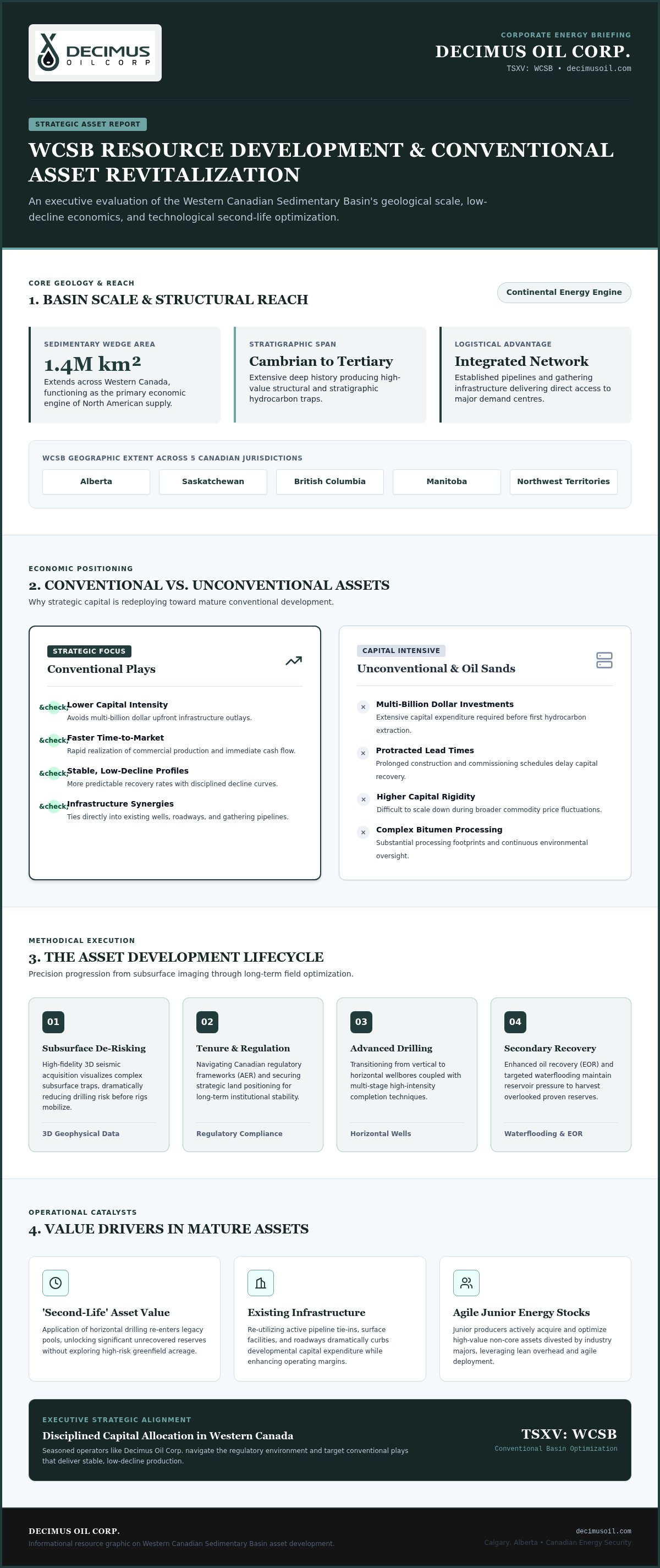
The Western Canada Sedimentary Basin (WCSB) represents a massive sedimentary wedge that extends across 1.4 million square kilometres, encompassing parts of Manitoba, Saskatchewan, Alberta, British Columbia, and the Northwest Territories. As a global energy powerhouse, the WCSB contains some of the world's most substantial reserves of petroleum and natural gas. This geological formation serves as the primary economic engine of the Canadian energy sector. Effective WCSB resource development requires a sophisticated understanding of the diverse asset classes within the basin, which include oil sands, shale formations, and high-value conventional plays.
The Geological Significance of the Basin
The basin's complexity is defined by its vast stratigraphy, with formations ranging from the Cambrian to the Tertiary periods. This deep geological history has created diverse 'trap' types, including structural and stratigraphic traps, which are essential for the accumulation of conventional resources. These geological features allow for the concentration of hydrocarbons in specific reservoirs, making them accessible through targeted drilling and advanced engineering. Precision in these field operations is paramount, and leveraging a professional GNSS network like WizNET ensures the high-accuracy positioning required for modern surveying and site development. Beyond its internal geology, the basin's strategic positioning provides direct access to North American energy markets. The existing network of pipelines and processing facilities ensures that resources can be efficiently transported to major demand centres; this provides a logistical advantage that few other global basins can match.
Why Conventional Plays are Gaining Renewed Interest
While oil sands megaprojects often dominate headlines, conventional plays are experiencing a significant resurgence among strategic operators. This shift is driven by the lower capital intensity required for conventional exploration compared to the multi-billion dollar investments needed for bitumen extraction. Conventional assets offer a faster time-to-market, allowing companies to realize production results and cash flow much sooner than unconventional projects. This agility is particularly valuable in a market that prioritizes capital discipline and shareholder returns.
Strategic WCSB resource development in the conventional sector also allows for a more focused approach to liability management and asset lifecycle optimization. The ability to utilize mature energy infrastructure significantly reduces development costs. By leveraging existing wells, roads, and pipelines, operators can optimize their capital allocation and focus on high-intensity completion techniques that maximize recovery from proven reservoirs. This strategic focus on conventional assets provides a stable, low-decline alternative to more volatile energy investments. Seasoned operators like Decimus Oil Corp. (TSXV:WCSB) focus on these nuances to realize maximum asset value while navigating the complex regulatory landscape of Western Canada.
The Lifecycle of WCSB Resource Development
Success in the basin depends on a methodical progression from geological identification to long-term reservoir management. It's not merely a matter of drilling; it's a sophisticated series of integrated milestones that balance technical precision with financial discipline. Operators must navigate a path that includes high-fidelity seismic acquisition, complex drilling operations, and the establishment of robust gathering infrastructure to ensure reliable market access. This lifecycle approach ensures that capital is deployed efficiently across the basin's diverse play types, allowing for maximum recovery during every phase of WCSB resource development.
Exploration and Risk Mitigation
Geophysical analysis serves as the critical foundation for strategic capital allocation. By utilizing 3D seismic data, companies visualize subsurface structures with high clarity, which significantly de-risks drilling locations before a rig ever moves to the site. This technical rigour is essential when analyzing oil and gas exploration economics, where the margin for error is increasingly narrow in a mature basin. Beyond the geology, securing land tenure and navigating the Canadian regulatory framework are vital steps in the pre-drilling phase. Data from the Alberta Energy Outlook confirms that strategic land positioning and regulatory compliance remain the primary drivers of long-term reserve growth and institutional stability for operators across Western Canada.
Drilling and Completion Innovations
The transition from vertical to horizontal drilling has fundamentally revolutionized the basin's production profile. Modern horizontal techniques allow for up to 10 times more reservoir contact compared to traditional vertical methods, which drastically improves initial production rates and overall recovery factors. Multi-stage hydraulic fracturing has also evolved into a precision tool, specifically tailored for the unique pressures and permeabilities found in conventional reservoirs. To minimize the environmental and operational footprint, operators now prioritize pad drilling. This approach allows multiple wells to be drilled from a single surface location, reducing land disturbance while concentrating infrastructure to lower lease operating expenses and improve project logistics.
Once a well is completed, the focus shifts to production and infrastructure management. Establishing efficient gathering systems and processing facilities is crucial for realizing the full value of the asset. As these fields mature, the WCSB resource development lifecycle enters an optimization phase where infrastructure becomes a key differentiator. Implementing secondary recovery methods can significantly extend the economic life of a reservoir by maintaining pressure and displacing trapped hydrocarbons. If you're seeking a seasoned operator that understands how to manage these complex lifecycles, Decimus Oil Corp. specializes in optimizing mature conventional assets for maximum production efficiency and shareholder value.
Conventional vs. Unconventional: The Strategic Edge
The choice between conventional and unconventional assets defines an operator's risk profile and capital allocation strategy. While massive oil sands projects often dominate the national narrative, strategic WCSB resource development in the conventional sector offers a distinct competitive advantage. Conventional assets are characterized by lower decline rates and more predictable cash flows, providing a stable foundation for energy portfolios. Unlike the multi-billion dollar upfront costs and high energy intensity associated with bitumen extraction, conventional development allows companies to remain agile. This flexibility ensures that operators can respond quickly to commodity price fluctuations, scaling activity up or down without the massive logistical friction inherent in unconventional megaprojects.
Capital Efficiency in the WCSB
Capital efficiency remains the primary metric for success in the basin. Modern conventional plays, such as the Clearwater and Mannville formations, currently deliver some of the lowest break-even costs in North America. Industry data indicates that these plays can remain profitable with WTI prices between $30 and $40 per barrel, significantly lower than the requirements for many greenfield unconventional projects. Junior producers specifically target these conventional reservoirs to maximize return on investment, as the shorter cycle times from drilling to first production accelerate the recycling of capital. In mature fields, operational efficiency becomes the key value driver, where decades of technical data allow for precise well placement and optimized recovery strategies.
Infrastructure as a Value Multiplier
Ownership and control of physical assets represent a critical barrier to entry and a significant value multiplier. Strategic energy infrastructure, including gathering lines, batteries, and compression stations, provides an operator with a massive competitive edge. By owning these facilities, a company eliminates the burden of third-party processing fees, which can otherwise erode netbacks during periods of price volatility. This integration is essential for commercializing production, especially when navigating the complexities detailed in the Canada Energy Regulator's crude oil pipeline transportation assessment regarding regional takeaway capacity.
Effective Alberta energy infrastructure management transforms a simple drilling program into a sophisticated production engine. It's not just about moving product; it's about controlling the flow and timing of market egress to capture maximum value. For a growth-focused enterprise like Decimus Oil Corp. (TSXV:WCSB), the synergy between conventional exploration and infrastructure ownership creates a robust model for realizing asset value. This strategic alignment ensures that WCSB resource development remains both profitable and sustainable, even as the broader energy landscape continues to evolve toward higher efficiency and lower carbon intensity.
Modern Techniques Revitalizing Mature Assets
The Western Canadian Sedimentary Basin is entering a period where asset longevity is defined by technical innovation rather than just initial exploration. Enhanced oil recovery (EOR) is the primary tool for maximizing the lifecycle of Canadian oil assets. By utilizing WCSB resource development strategies that prioritize secondary and tertiary recovery, operators can extract significant value from reservoirs once considered depleted. Techniques such as waterflooding, CO2 injection, and polymer flooding allow for the displacement of trapped hydrocarbons that traditional primary methods simply cannot reach. These methodologies are essential for maintaining the basin's status as a top-tier energy producer.
Waterflooding remains a cornerstone of the industry; it is a proven and cost-effective method for maintaining reservoir pressure and increasing recovery factors across conventional plays. When combined with modern high-intensity completions, the results are often transformative for a producer's bottom line. By re-fracturing older wells with more sophisticated proppant and fluid designs, operators tap into previously bypassed pay zones. This allows for the realization of production volumes that rival new drills but at a significantly reduced capital cost. This approach not only optimizes existing surface infrastructure but also reduces the necessity for new land disturbance, aligning operational goals with environmental responsibility.
The Mechanics of Enhanced Oil Recovery
The transition from primary recovery, which relies on natural reservoir pressure, to secondary and tertiary phases represents a fundamental shift in field management. While primary recovery often leaves up to 80% of the original oil in place, a well-executed EOR program can increase a field's total recovery from 20% to over 50%. This step-change in recovery factors fundamentally alters the financial profile of a mature asset, turning a declining field into a long-term cash flow engine. For a deeper look at the specific engineering and chemical processes involved in these stages, refer to our detailed guide on enhanced oil recovery techniques.
Environmental Stewardship and Efficiency
Modern WCSB resource development successfully integrates environmental performance with high-level operational efficiency. Operators are increasingly reducing fresh water consumption by implementing sophisticated water recycling and treatment systems within their EOR operations. Additionally, the role of carbon capture and storage (CCS) is becoming a cornerstone of future development in Western Canada. This technology allows for the injection of CO2 to both enhance recovery and sequester emissions deep underground. Following the 2025 amendments to the Competition Act, environmental claims must now be substantiated by internationally recognized methodology, making operational integrity and third-party auditing essential components of long-term asset value. This commitment to efficiency directly impacts the stability of the asset base.
If you're interested in how these sophisticated techniques translate into shareholder value, learn more about Decimus Oil's strategic focus on EOR and conventional asset optimization.
The Role of Junior Producers in WCSB Growth
While major operators focus on large-scale consolidation and bitumen extraction, junior producers provide the agility required for targeted WCSB resource development. Companies like Decimus Oil (TSXV:WCSB) specialize in acquiring "non-core" conventional assets that larger firms divest to simplify their portfolios. These assets, often mature but possessing significant remaining potential, become high-value opportunities when managed by a lean, technically proficient team. This specialization allows juniors to identify bypassed pay zones and optimize existing infrastructure that might otherwise be overlooked in a massive corporate budget.
Strategic Alignment and Public Equity
The TSX Venture Exchange serves as a critical hub for energy financing, allowing investors to participate in the growth of agile, results-oriented operators. Evaluating management experience is a primary indicator of success in this sector; Decimus, for example, leverages over 100 years of combined team experience to navigate the technical and regulatory complexities of Western Canada. This strategic alignment ensures that capital is directed toward high-potential conventional exploration and infrastructure optimization. For those seeking exposure to these growth drivers, understanding the nuances of public equity in the Canadian energy sector is essential for identifying value in a competitive market.
The Future Outlook for WCSB Development
Looking toward 2026, we anticipate a dual trend of continued consolidation among intermediate players and increased niche specialization among junior producers. As the global energy mix evolves, the relevance of conventional oil remains high due to its lower carbon intensity and superior capital efficiency compared to many unconventional sources. The basin is not a declining relic; it's a technological frontier. Through advanced WCSB resource development and disciplined asset management, the Western Canadian Sedimentary Basin will continue to serve as a resilient and evolving powerhouse for decades to come. Producers who combine modern, high-intensity methodologies with a commitment to professional integrity are best positioned to realize the full value of this extraordinary region.
Strategic Advancement in the Western Canadian Sedimentary Basin
The Western Canadian Sedimentary Basin remains a pillar of global energy security, transitioning from a traditional production model to a sophisticated, technology-driven ecosystem. Successful WCSB resource development now requires a combination of geological expertise and high-intensity completion techniques to maximize the lifecycle of conventional assets. By prioritizing capital efficiency and leveraging existing infrastructure, operators can maintain stable production while navigating the complexities of the modern regulatory landscape.
Junior producers are uniquely positioned to drive this growth by acquiring and optimizing non-core assets that larger firms often overlook. Decimus Oil Corp. (TSXV:WCSB) brings over 100 years of collective energy experience to this sector, focusing on high-value conventional assets that deliver predictable cash flows. Our commitment to professional integrity and operational excellence ensures we remain at the forefront of the basin's revitalization. Learn more about Decimus Oil's strategic approach to WCSB development and discover how we are realizing the full potential of Canada's energy powerhouse. The future of the basin is bright for those who embrace innovation and disciplined asset management.
Frequently Asked Questions
What exactly is the Western Canadian Sedimentary Basin (WCSB)?
The Western Canadian Sedimentary Basin is a massive geological formation spanning 1.4 million square kilometres across Manitoba, Saskatchewan, Alberta, British Columbia, and the Northwest Territories. It serves as the primary source of Canada’s crude oil and natural gas. Beyond its scale, the basin is characterized by a sophisticated network of reservoirs that support a diverse range of extraction activities. This geological wedge provides the foundational resources for the nation's energy sector and long-term energy security.
How does conventional oil development differ from oil sands production?
Conventional oil development involves extracting hydrocarbons through traditional drilling methods from porous rock formations, whereas oil sands production requires large-scale mining or steam-assisted gravity drainage (SAGD). Conventional plays typically offer lower capital intensity and faster cycle times from discovery to production. This agility allows operators to respond efficiently to market shifts. While oil sands provide massive scale, conventional WCSB resource development focuses on high-value, low-decline assets that offer more predictable cash flow profiles.
Why is Enhanced Oil Recovery (EOR) important for the WCSB?
Enhanced Oil Recovery (EOR) is vital because it allows operators to extract significant volumes of oil that remain trapped after primary and secondary recovery phases. By injecting water, CO2, or polymers, companies maintain reservoir pressure and displace hydrocarbons toward production wells. In a mature basin, EOR can increase total recovery factors from 20% to over 50%. This technology is essential for maximizing the economic life of proven reserves and realizing the full value of existing energy infrastructure.
What are the primary risks involved in WCSB resource development?
The primary risks include commodity price volatility, evolving regulatory frameworks, and liability management requirements. The Alberta Energy Regulator’s Liability Management Framework now mandates specific closure spending, which impacts cash flow allocations. Additionally, operators must navigate the transition from the old Liability Management Rating to the newer Licensee Capability Assessment. Managing these risks requires a combination of technical proficiency and disciplined financial oversight to ensure long-term operational integrity and institutional stability within the basin's competitive landscape.
How do junior energy companies contribute to the basin's economy?
Junior producers drive economic growth by identifying and developing niche assets that larger entities often divest. Their operational agility allows them to deploy modern methodologies on a smaller, more focused scale, creating value through lean management and technical expertise. By acquiring non-core conventional packages, these firms revitalize mature fields and support local service industries. Publicly traded juniors, such as Decimus Oil (TSXV:WCSB), provide essential liquidity and investment opportunities that diversify the broader Canadian energy market.
What role does infrastructure play in the value of an oil asset?
Infrastructure ownership acts as a significant value multiplier by reducing operational expenses and ensuring reliable market access. Controlling gathering lines, processing batteries, and compression facilities allows an operator to eliminate costly third-party fees and manage production timing more effectively. This strategic integration improves netbacks and protects margins during periods of price instability. Assets tied to robust, owned infrastructure are generally more resilient and valuable, as they offer greater control over the entire resource development lifecycle.
Is the WCSB still a viable target for new investment in 2026?
The basin remains a premier investment target in 2026 due to improved market egress and technological breakthroughs. The full commercial operation of the Trans Mountain Expansion and the maiden exports from LNG Canada have structurally narrowed price differentials. Innovations like open-hole multi-lateral drilling have lowered break-even costs in conventional plays to between $30 and $40 per barrel. These factors, combined with a focus on capital discipline, make WCSB resource development a compelling opportunity for strategic energy investors.
What are high-intensity completion techniques?
High-intensity completion techniques involve the use of advanced multi-stage hydraulic fracturing and precision proppant placement to maximize reservoir contact. These methods allow operators to tap into pay zones that were previously bypassed or considered uneconomic. By re-fracturing older wells or utilizing fishbone horizontal designs, companies can significantly boost initial production rates and total recovery. These innovations are particularly effective in conventional reservoirs, where they extend the productive life of mature assets while minimizing the overall surface footprint.


