
What if the most resilient growth in your portfolio didn't come from the latest technology trend, but from the strategic deployment of capital within the public equity energy sector? Most sophisticated investors agree that the Western Canadian Sedimentary Basin offers unparalleled resource potential, yet the high capital intensity and commodity volatility can make it difficult to identify truly stable growth. Discover how the public equity energy sector drives the Canadian energy landscape and learn the professional framework for evaluating high-growth upstream opportunities with precision. This article provides a clear framework for evaluating energy equity, examines the role of public markets in financing exploration, and identifies how the public equity energy sector functions as a vehicle for asset optimization. By understanding these technical and financial dynamics, you can better align your capital with proven operational excellence and realize long-term value in a complex global market.
Key Takeaways
- Understand how the public equity energy sector serves as a vital financing mechanism for high-intensity resource development and strategic growth across Canada.
- Learn to evaluate the unique capital structures within the Western Canadian Sedimentary Basin (WCSB) that support conventional oil and gas exploration.
- Differentiate between established majors and high-growth junior producers to better navigate the diverse investment landscape of the TSX Venture Exchange.
- Master key performance indicators, such as Operating Netback and Reserve Replacement Ratio, to accurately assess the efficiency and sustainability of energy assets.
- Identify the importance of management alignment and insider ownership in driving long-term shareholder value through disciplined resource optimization.
The Role of Public Equity in the Energy Sector
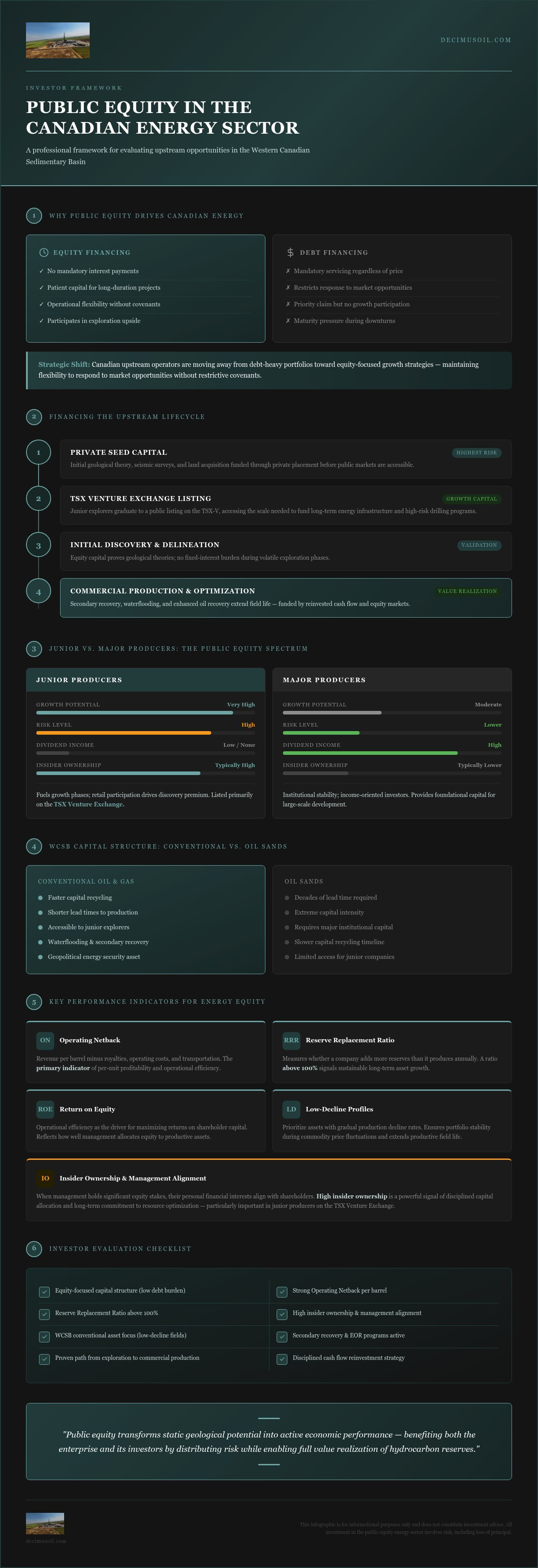
Public equity acts as the fundamental engine for capital-intensive ventures within the energy industry. For Canadian producers, this mechanism facilitates the essential transition of underground reserves into liquid shareholder value. Unlike debt, which requires immediate and often rigid servicing, equity provides the patient capital necessary for large-scale resource development. In the Canadian upstream sector, there's been a noticeable strategic shift. Operators are moving away from debt-heavy portfolios toward equity-focused growth strategies. This transition allows firms to maintain operational flexibility, ensuring they can respond to market opportunities without the constraints of restrictive covenants.
The public markets provide the liquidity required to fund multi-billion dollar projects that define the Canadian landscape. By inviting shareholder participation, companies can realize the full value of their hydrocarbon reserves while distributing the inherent risks of exploration. This collective investment model is what enables the public equity energy sector to drive innovation in extraction and processing technologies. It transforms static geological potential into active economic performance, benefiting both the enterprise and its investors.
Financing the Upstream Lifecycle
Exploration and production (E&P) firms rely heavily on equity during the most volatile phases of the upstream lifecycle. High-risk drilling and initial discovery phases require capital that isn't burdened by mandatory interest payments. Most junior explorers in Canada follow a proven trajectory: they begin with private seed capital and eventually graduate to a public listing on the TSX Venture Exchange. This path provides the necessary scale to organize capital for long-term energy infrastructure projects. It's a methodical process that ensures a company has the financial runway to prove its geological theories and move toward commercial production.
Equity vs. Debt in Energy Portfolios
Analyzing the capital structure of an energy firm reveals its true risk-reward profile. Debt holders have a priority claim on assets, but they don't participate in the explosive growth that characterizes successful discoveries. Conversely, equity financing reduces the burden of fixed interest payments, which is a critical advantage during the inevitable fluctuations of commodity price cycles. When a company prioritizes equity, it can focus its cash flow on realizing resource growth and asset optimization. This structure provides a buffer against volatility, allowing the management team to execute high-intensity completion techniques and enhanced oil recovery programs without the immediate pressure of debt maturity dates.
Analyzing Capital Structures in Canadian Oil and Gas
The capital composition in the Western Canadian Sedimentary Basin (WCSB) is unique compared to global basins. It demands a delicate balance between institutional oversight and retail agility. In the public equity energy sector, conventional oil and gas exploration dictates specific equity requirements that differ significantly from capital-intensive oil sands projects. While oil sands require decades of lead time, conventional plays allow for quicker capital recycling. Institutional investors often provide the foundational stability required for large-scale development, whereas retail participation often fuels the growth phases of junior producers. TD Securities' analysis of the Canadian energy market highlights how geopolitical shifts have refocused attention on these conventional assets as reliable sources of energy security. Ensuring capital is deployed toward high-intensity completion and recovery is paramount for realizing superior returns.
Resource Development and Capital Allocation
Equity is the primary tool for funding advanced techniques like secondary oil recovery and waterflooding. These methods are essential for extending the life of mature fields in the WCSB. Operational efficiency isn't just a metric; it's the driver for maximizing Return on Equity (ROE). Investors should look for teams that centre their investment on assets with low-decline profiles. This approach ensures portfolio stability even when commodity prices fluctuate. By optimizing existing reservoirs through resource development, companies can create a predictable production base that supports future exploration.
Managing Energy Infrastructure Assets
Midstream and transportation infrastructure represent the backbone of the energy industry, yet they are notoriously capital-heavy. Public equity provides the stable financial base necessary for long-term asset management in this space. There's a profound advantage in realizing synergies between upstream production and infrastructure ownership. When a producer owns or controls its gathering systems, it reduces third-party costs and improves the overall netback. This integrated approach allows firms to capture value at every stage of the hydrocarbon chain, from the wellhead to the sales point.
Junior vs. Major Producers: The Public Equity Spectrum
The public equity energy sector offers a diverse spectrum of entry points for investors, ranging from integrated global majors to agile junior producers. Integrated majors provide stability through diversified business models that often include downstream refining and retail distribution. However, for those seeking high-intensity capital appreciation, junior producers represent the most direct exposure to the underlying resource value of the Western Canadian Sedimentary Basin. These smaller firms focus their capital on specific geological plays, allowing for significant valuation growth when drilling results prove successful. The primary differentiator lies in the growth profile; while majors prioritize dividend consistency, juniors are built to realize rapid production expansion and reserve growth.
A critical factor in the performance of junior energy equity is the level of insider ownership. High alignment between management and shareholders ensures that corporate strategy is driven by the goal of maximizing per-share value. Professional investors often look for insider ownership levels exceeding 20% to confirm that the leadership team is financially committed to the company's success. This alignment is essential in the junior space, where strategic decisions regarding capital allocation and asset optimization directly impact the equity's risk-reward profile.
The Junior Advantage on the TSXV
The TSX Venture Exchange (TSXV) serves as a premier global hub for energy public equity, providing a regulated environment that facilitates small-cap growth. It offers a structured path for companies to transition from initial exploration phases to becoming mid-tier producers. Through strategic equity raises, firms on the TSXV can fund high-intensity drilling programs that would be difficult to finance through traditional debt markets. For example, a junior producer achieving production levels of 165 barrels of oil equivalent per day (boe/d) can see a transformative impact on its valuation following a successful completion program. This exchange provides the liquidity necessary for investors to participate in the early lifecycle of significant resource discoveries.
Risk Mitigation in Small-Cap Energy Equity
Investing in junior producers requires a sophisticated approach to risk management. Diversification across different geological formations, such as the prolific Mannville formation, helps mitigate the technical risks associated with individual wells. Investors should prioritize management teams with a proven track record; a collective experience of over 100 years in the WCSB is a strong indicator of operational proficiency. Stability is further enhanced when a company balances its exploration upside with ownership of existing energy infrastructure. This integrated approach reduces operating costs and ensures that the firm can continue to realize value even during periods of commodity price volatility.
Evaluating Energy Equity: Key Performance Indicators
Evaluating a firm within the public equity energy sector requires a shift from qualitative strategy to rigorous quantitative analysis. The Reserve Replacement Ratio (RRR) stands as the primary indicator of long-term sustainability; it measures a company's ability to replace the hydrocarbons it produces through new discoveries or acquisitions. A ratio exceeding 100% suggests a growing resource base, whereas a lower figure may signal a depleting asset portfolio. Sophisticated investors prioritize companies that consistently demonstrate an ability to expand their proven reserves without excessive capital outlays, ensuring the enterprise remains oriented toward future growth.
Operating Netback is a non-GAAP measure that determines the profit margin per barrel of oil equivalent by subtracting royalties, operating costs, and transportation expenses from total revenue, expressed as (Revenue - Royalties - Operating Costs - Transportation Costs) / boe. This metric allows for a direct comparison of operational efficiency across different producers, regardless of their size or capital structure. When combined with an analysis of decline rates, it provides a clear picture of the longevity of production from conventional assets. Low-decline assets provide a stable cash flow base, reducing the pressure on Capital Expenditure (CapEx) to maintain production levels and allowing management to focus on realizing value through strategic expansion.
Technical Metrics for Informed Investors
Advanced technical methodologies significantly influence asset valuation. The application of enhanced oil recovery (EOR) and high-intensity completion techniques can transform marginal plays into high-performing assets. Horizontal drilling has further unlocked potential in tight formations, but its success depends on the technical proficiency of the engineering team. Quality energy infrastructure acts as a hidden driver of equity value; reliable gathering systems and processing facilities directly impact a firm's ability to bring product to market efficiently while minimizing third-party fees. Analyzing these technical attributes ensures that capital is deployed where it can achieve the highest operational impact.
Financial Health and Strategic Optimism
Strategic optimism must be grounded in financial discipline. A strong balance sheet allows a company to navigate commodity price volatility without resorting to dilutive equity raises at inopportune times. Investors should monitor the relationship between cash flow from operations and capital reinvestment to ensure that production growth isn't achieved at the expense of shareholder equity. A self-sustaining model, where development is funded through internal cash flow rather than constant market intervention, is the hallmark of a mature and well-managed producer. For those seeking direct exposure to these high-performing conventional plays, exploring public equity investment opportunities provides a path to participate in the ongoing optimization of the WCSB.
Decimus Oil: Driving Value in the Public Equity Energy Sector
Decimus Oil Corp. (TSXV:WCSB) represents a sophisticated entry point for investors seeking disciplined exposure to the Western Canadian Sedimentary Basin. We operate as a growth-oriented enterprise, combining decades of collective knowledge with modern, high-intensity methodologies. Our leadership team brings over 100 years of combined energy sector experience to every operational decision. This depth of expertise is matched by over 27% insider ownership, ensuring our strategic direction remains firmly aligned with the interests of our shareholders. Within the public equity energy sector, this level of management commitment serves as a powerful indicator of professional integrity and long-term vision. We recognize that shareholder value is realized through the meticulous execution of technical strategies that prioritize capital efficiency over speculative volume.
A Disciplined Approach to Resource Development
Our operational focus remains centred on high-potential conventional assets within the WCSB, a region known for its geological reliability and established infrastructure. We leverage enhanced oil recovery and high-intensity completion techniques to optimize existing reservoirs, transforming low-decline assets into consistent engines of cash flow. In the first quarter of 2026, Decimus Oil Corp. achieved production of 165 barrels of oil equivalent per day (boe/d) and reported an operating netback of C$5.76/boe. These figures reflect our commitment to operational excellence and our ability to manage infrastructure to support long-term efficiency. By controlling our gathering and processing assets, we minimize third-party fees and ensure that our resource development programs remain insulated from midstream bottlenecks. This tactical control over the value chain is essential for navigating the complexities of the modern energy landscape.
Building Shareholder Value Through Operational Excellence
Our roadmap for capital appreciation is built on the revitalization of mature plays through advanced engineering and geological insight. We view public equity as a strategic vehicle for funding exploration and development phases that offer the highest potential for per-share growth. This approach allows us to maintain a strong balance sheet while aggressively pursuing opportunities that align with our core competencies in conventional oil and gas exploration. We don't just participate in the energy sector; we aim to lead through a calculated visionary approach that balances technical nuance with a relentless focus on the bottom line and institutional stability. Our commitment to high-level execution ensures that every dollar of capital is deployed toward realizing the maximum potential of our asset base. Learn more about our strategic approach to energy investment at Decimus Oil Corp.
Strategic Alignment for Resource Growth
Strategic participation in the public equity energy sector requires a disciplined focus on technical proficiency and capital efficiency. We've examined how professional frameworks, such as analyzing operating netbacks and reserve replacement ratios, allow investors to identify high-potential conventional plays within the Western Canadian Sedimentary Basin. By prioritizing firms that balance exploration upside with the stability of existing energy infrastructure, stakeholders can better manage the inherent volatility of commodity cycles while positioning themselves for significant capital appreciation.
Decimus Oil Corp. embodies this strategic approach. Backed by a management team with over 100 years of combined industry experience and a significant 27% insider ownership, we ensure alignment with shareholder interests. Our listing on the TSX Venture Exchange as TSXV:WCSB ensures the transparency and liquidity necessary for sophisticated investors to participate in the next phase of resource development. We remain committed to modern, high-intensity methodologies that realize the true value of Canadian hydrocarbon assets. Invest in the future of Canadian energy: Explore TSXV:WCSB. The potential for advancement in the conventional space has never been clearer for those with a long-term, results-oriented perspective.
Frequently Asked Questions
What is the difference between public equity and debt in the energy sector?
Public equity represents a direct ownership stake in a company, whereas debt is a loan that requires fixed interest payments regardless of commodity prices. In the public equity energy sector, equity is often the preferred financing mechanism for high-growth exploration. It allows companies to share risk with investors and reinvest cash flow into resource development rather than servicing debt. This structure provides a crucial buffer during periods of market volatility.
Why do Canadian energy companies list on the TSX Venture Exchange?
The TSX Venture Exchange (TSXV) serves as a specialized incubator for small-cap energy firms seeking to scale their operations. It provides a regulated, transparent environment that attracts global capital for resource development in the Western Canadian Sedimentary Basin. Listing on the TSXV allows junior producers to access the liquidity needed for high-intensity drilling programs. This platform facilitates the transition from early-stage exploration to becoming a stable, mid-tier producer.
How does enhanced oil recovery (EOR) impact a company’s equity value?
Enhanced oil recovery (EOR) implementations significantly improve a company's equity value by maximizing the ultimate recovery of hydrocarbons from mature reservoirs. These advanced techniques extend the productive life of conventional assets and improve operating netbacks. Investors view successful EOR programs as evidence of technical proficiency and operational excellence. By optimizing existing fields, a producer can build a stable, low-decline production base that supports long-term shareholder value and capital appreciation.
What are the risks of investing in junior energy producers?
Investing in junior producers involves exposure to commodity price fluctuations and the technical risks inherent in drilling new formations. These firms often face high capital intensity during the exploration phase. To mitigate these risks, investors should prioritize companies that own their energy infrastructure and maintain a diversified portfolio of low-decline assets. A management team with a proven track record in the WCSB is essential for navigating these operational and financial complexities successfully.
How can I evaluate the management team of a public energy company?
Evaluating a leadership team requires looking beyond professional titles to assess collective experience and financial alignment. A team with over 100 years of combined energy sector experience provides the technical nuance needed for complex resource development. Additionally, significant insider ownership, such as the 27% held by Decimus Oil management, ensures that executives are financially committed to the company's performance. This alignment is a primary indicator of professional integrity and disciplined capital allocation.
What role does the Western Canadian Sedimentary Basin play in energy equity?
The Western Canadian Sedimentary Basin (WCSB) is the primary engine for conventional oil and gas exploration in Canada. It offers prolific geological formations and a well-developed network of energy infrastructure that reduces transportation costs. For investors, the WCSB provides a predictable regulatory environment and a vast resource base for resource development. Operating within this basin allows firms to leverage localized expertise and proven extraction methodologies to drive consistent production growth.
What is high-intensity completion and why does it matter to investors?
High-intensity completion involves using advanced engineering and higher volumes of materials to maximize the initial production and recovery rates of a well. This methodology is critical because it accelerates the return on capital and improves the overall efficiency of a drilling program. For investors, successful high-intensity completions signal a company's ability to optimize its asset base. This technical advantage translates into stronger operating netbacks and faster capital recycling for future growth projects.
How does insider ownership affect energy stock performance?
Insider ownership is a vital metric that directly influences corporate strategy and stock performance. When management holds a substantial stake, such as 27% at Decimus Oil, they're incentivized to prioritize per-share value over mere production volume. This alignment ensures that shareholder-first decisions drive the company's roadmap. High insider ownership often results in more disciplined capital expenditure and a focused approach to asset revitalization, creating a narrative of stability and strategic optimism.


