
CO₂ does more than push oil through a depleted reservoir. In miscible flooding, supercritical CO₂ can dissolve in oil, swell it and lower its viscosity, helping move it toward producing wells. For miscible flood oil recovery projects in Canada, the key question is whether reservoir pressure can reach the minimum miscibility pressure (MMP) without exceeding formation limits. Operators assess this balance and may investigate solvents or other injection strategies to reduce MMP.
The injected gas gets much of the attention, but reservoir conditions and fluid behaviour determine whether miscibility can be achieved and maintained. This article explains how CO₂ flooding mobilizes oil, how engineers assess and seek to lower MMP, and where natural gas, flue gas and other solvents may fit. It also covers water-alternating-gas injection, which pairs slugs of gas and water, and the factors that affect recovery performance. Together, these points offer a clearer framework for understanding the technical choices behind miscible flooding and its role in enhanced oil recovery.
Key Takeaways
- Understand how CO₂ can swell oil and lower its viscosity, supporting its movement through a reservoir.
- See why minimum miscibility pressure must be assessed alongside formation pressure when evaluating a flooding approach.
- Compare how natural gas, flue gas and solvent additives may support miscible displacement under different reservoir conditions.
- Learn which technical and project-status details help distinguish Canadian field activity from laboratory studies.
CO2 miscible flooding and oil recovery
CO2 miscible flooding uses injected carbon dioxide to mobilize residual oil in a reservoir. Its effectiveness depends on fluid composition, pressure and formation limits.
Flooding Method Comparisons
Waterflooding displaces oil with injected water; miscible CO2 can also dissolve into oil, swell it and reduce its viscosity. Immiscible gas injection provides pressure support but does not achieve the same oil-gas miscibility. In water-alternating-gas injection, or WAG, operators alternate water and gas slugs; experiments have assessed a 1:1 water-to-gas ratio. These differences matter because displacement behaviour and pressure support vary by method.
Regulations, Permits, and Project Economics
In Alberta and elsewhere in Canada, applicable approvals depend on the project location, wells, facilities and injection design. The relevant regulatory pathway must address subsurface injection, well integrity, environmental effects and CO2 handling. Project economics depend on reservoir response, required compression and transportation infrastructure, injection volumes, operating demands and the value of incremental oil. These factors shape whether a technically feasible flood can proceed commercially; no single cost figure applies across projects.
Active Projects and Their Locations
Wabamun is a named Alberta region, but a location alone does not establish that a miscible flood is operating there. Confirming active status requires a current injection operation linked to a specific reservoir and project. Across Canada, screening considers whether reservoir fluid composition and pressure can support miscibility, as well as access to injection infrastructure. When assessing a location, distinguish clearly between a proposed development, a laboratory study and active field injection.
Flood Operation and Production Results
In Wabamun or another Alberta field, a miscible flood would inject CO2 through designated wells and produce displaced oil through connected wells. Engineers assess reservoir pressure against minimum miscibility pressure and formation fracture pressure, then set injection conditions. Laboratory tests can establish MMP through multiple-contact experiments and swelling tests. Typical field recovery rates and production increases cannot be inferred from a single experiment; reservoir properties and flood design shape results. CO2 capture can reduce atmospheric emissions when captured at combustion and stored underground or used for enhanced oil recovery, while injection requires attention to containment and potential leakage.
Methods for reducing CO2 minimum miscibility pressure
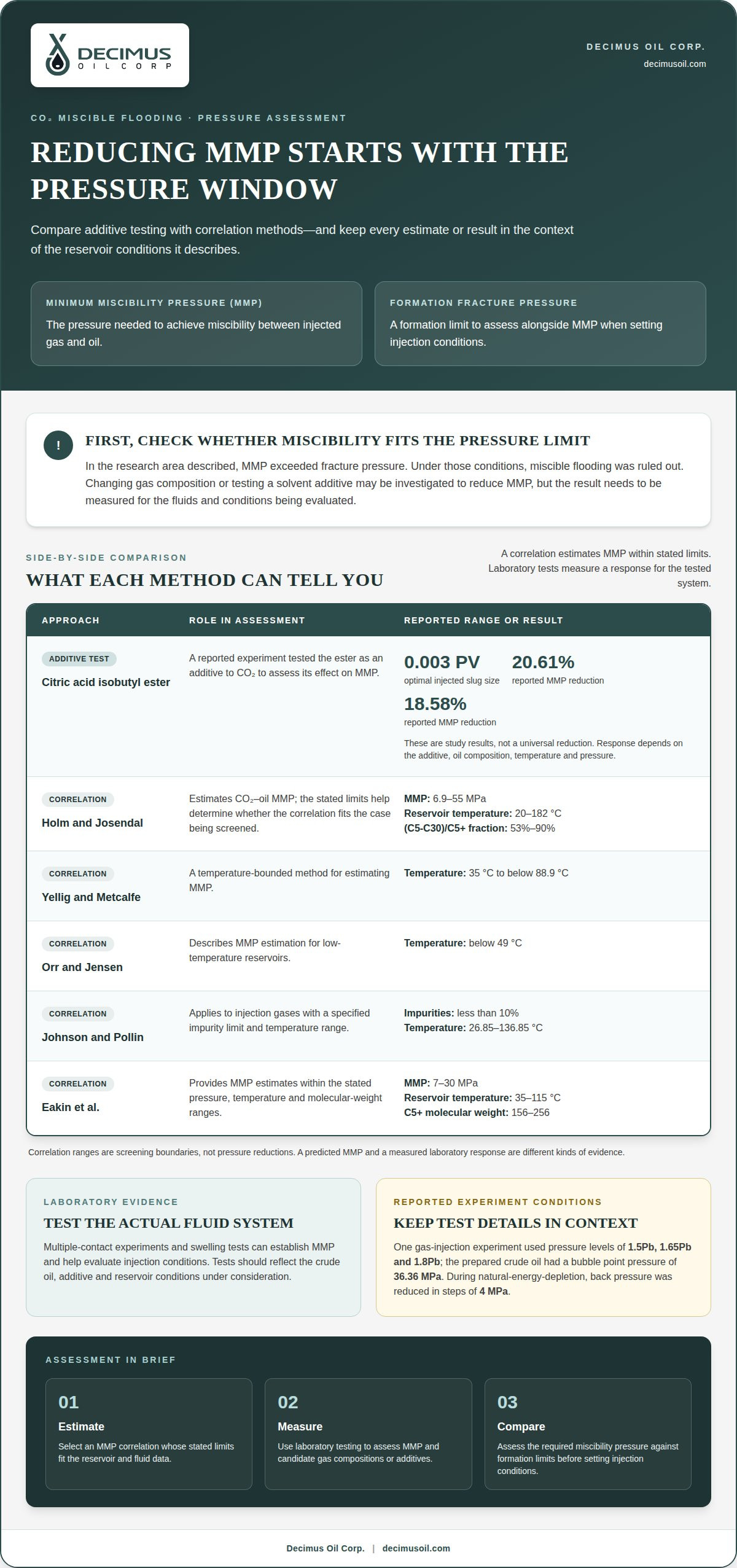
Lowering minimum miscibility pressure (MMP) may matter when a reservoir’s formation fracture pressure is below the pressure required for miscibility. In the research area described, MMP exceeded fracture pressure, ruling out miscible flooding under those conditions. Operators can assess changes to injection-gas composition and solvent additives, then measure their effects through laboratory testing. The objective is to reduce the pressure needed for miscibility while maintaining a workable injection design.
One reported experiment tested citric acid isobutyl ester as an additive to CO2. At an optimal injected slug size of 0.003 pore volumes (PV), the study reported MMP reductions of 20.61% and 18.58%. Those results demonstrate a possible laboratory approach, not a universal reduction for every crude or reservoir. The response depends on interactions among the additive, oil composition, temperature and pressure, so tests need to reflect the fluids and conditions being evaluated.
Correlation methods help estimate baseline MMP and identify where a prediction applies; they don’t lower pressure themselves. Holm and Josendal’s CO2-oil correlation covers MMP values from 6.9 to 55 MPa and reservoir temperatures from 20 to 182 °C, with a specified (C5-C30)/C5+ fraction of 53% to 90%. Yellig and Metcalfe’s correlation applies from 35 °C to below 88.9 °C. These limits help engineers select an appropriate estimate before comparing candidate additives or gas compositions.
Other correlations provide additional screening boundaries. Orr and Jensen describe MMP estimation for low-temperature reservoirs below 49 °C. Johnson and Pollin’s correlation applies to injection gases with less than 10% impurities and temperatures from 26.85 to 136.85 °C. Eakin et al. specify MMP values from 7 to 30 MPa, reservoir temperatures from 35 to 115 °C, and C5+ molecular weights from 156 to 256. Used alongside multiple-contact experiments and swelling tests, these tools help distinguish an estimated MMP from a measured response and guide the next test.
Minimum miscibility pressure for these flooding techniques is determined through multiple-contact experiments and swelling tests to establish optimum injection conditions. The gas-injection experiment used specified pressure levels of 1.5Pb, 1.65Pb and 1.8Pb; prepared crude oil had a bubble point pressure of 36.36 MPa. During natural-energy-depletion, back pressure was reduced in steps of 4 MPa. Some miscible flooding displacements may amount to pressure maintenance in the reservoir.
Miscible solvents
CO2, natural gas and flue gas can serve as injection gases for miscible displacement. Solvent selection influences how injected gas interacts with reservoir oil and whether the flood can achieve its recovery objective.
Solvent Choices
CO2 is one option; natural gas and flue gas are also used for miscible oil displacement in some large reservoirs. Solvent additives can modify the interaction between injected gas and oil. Their value depends on the fluid mixture and reservoir conditions, so laboratory evaluation helps distinguish a promising candidate from one that performs poorly in a particular system.
In a reported experiment, oil recovery after injection of citric acid isobutyl ester was 6.5% to 11.6% higher than recovery without the additive. This result describes that experiment, not a universal field outcome. It shows why solvent evaluation considers both the oil response and the injection design. A useful comparison measures recovery with and without the additive under equivalent conditions.
Gases Used in Canadian Reservoirs
CO2, natural gas and flue gas are gases used for miscible flooding in Canadian oil reservoirs. The best fit depends on the reservoir’s crude composition, pressure conditions and the injected gas’s composition. A laboratory-prepared hydrocarbon injection gas in one experiment contained 81% C1, or methane. That composition is an example, not a standard specification for Canadian projects.
Water-alternating-gas (WAG) tests illustrate how gas selection interacts with injection sequence. Experiments assessed a 1:1 water-to-gas ratio using gas slugs of 0.2, 0.4 and 0.6 pore volumes (PV). Another test used a 1:2 ratio and a 0.2 PV slug. These controlled comparisons help characterize how water and gas injection affect displacement.
The experimental study recommended a 1:1 WAG ratio, while also comparing WAG with continuous gas injection using a 1:2 ratio and a 0.2 PV slug. These are test conditions, not universal operating instructions. For a Canadian reservoir, gas composition and injection sequence must be assessed together, since either can change how the solvent contacts and mobilizes oil.
Which miscible flood oil recovery projects are active in Canada?
Laboratory experiments can illustrate gas-displacement behaviour, but they do not by themselves establish whether a field operation is active. The distinction is important: a core-flood test can show how gas and oil interact, but it does not prove that a reservoir is currently receiving miscible gas injection. Whether a technique has been tested and whether a project is active are separate questions.
For example, one reported experiment used simulated crude oil at a formation pressure of 23.8 MPa. Another investigated water-alternating-gas (WAG) displacement, including a 1:1 water-to-gas ratio and slug sizes of 0.2, 0.4 and 0.6 pore volumes. These are specific experimental conditions. They do not identify an operator, Canadian field, operating dates or current injection status.
A useful Canadian project record connects four elements: a named reservoir, an operator, a miscible injection operation and its current operating status. Location alone is not enough. A field may have conventional production, water injection, a proposed enhanced recovery plan or an associated laboratory study. None of these descriptions, on its own, establishes an active miscible flood.
For each project, distinguish field operations from earlier development stages. A concept or feasibility assessment evaluates whether reservoir pressure and fluid composition could support miscibility. A pilot tests an injection design at limited field scale. An operating flood injects gas into the reservoir to displace oil toward producing wells. A laboratory core test examines samples under controlled conditions, rather than measuring full-field performance.
This classification also helps interpret reported recovery results. The fractured-vuggy reservoir study reported that WAG after waterflooding increased recovery by 6.6 to 8.8 percentage points compared with waterflooding alone. That is an experimental result, not evidence of an active Canadian project or a typical field increase. Treating the result in context keeps project comparisons accurate and separates technical evidence from current operating activity.
Decimus Oil: Enhanced Oil Recovery
Decimus Oil Corp.’s enhanced oil recovery work connects the technical principles of miscible flooding with broader resource development decisions. This perspective is useful when assessing how reservoir conditions, injection options and recovery potential fit an oil and gas asset’s development strategy. A miscible flood is not suitable for every reservoir: pressure limits, oil composition and project economics all shape the evaluation.
Decimus Oil Corp. also focuses on conventional oil and gas exploration and resource development, providing context for evaluating recovery methods alongside asset opportunities. Readers interested in the company’s public equity can find Decimus Oil Corp. listed on the TSX Venture Exchange as WCSB.
Contact Decimus Oil Corp. to discuss enhanced oil recovery and resource development.
Advance the recovery opportunity with a clear development strategy
The next step for miscible flood oil recovery projects is to connect the subsurface opportunity with the broader development plan. Technical screening can help determine whether a concept merits further evaluation, while infrastructure needs and resource priorities shape its fit within an asset strategy. This integrated approach helps decision-makers move from a recovery method to a considered development pathway.
Decimus Oil’s energy infrastructure work supports this broader planning context. For teams weighing recovery potential alongside infrastructure and resource development, a focused discussion can help clarify the opportunity and its strategic fit. Bring the project context and the questions most relevant to your next decision.
Contact Decimus Oil to discuss your project and take a considered next step toward evaluating its potential.
Frequently Asked Questions
What is a miscible flood in enhanced oil recovery?
A miscible flood is an enhanced oil recovery method that injects a gas or solvent intended to mix with reservoir oil under subsurface conditions. For example, injected CO₂ can contact crude, change its flow behaviour and help move it toward producing wells. The defining test is whether the injected fluid and oil become miscible at reservoir pressure and temperature, rather than remaining as separate phases.
What are typical recovery rates and production increases from miscible flood projects?
Typical field recovery rates and production increases cannot be inferred from the experiments; results depend on reservoir properties and flood design. In one experiment, WAG after water flooding increased recovery by 6.6 to 8.8 percentage points, but this is not a typical field rate.


