
Environmental liabilities don't have to erode balance sheet resilience; executed with disciplined foresight, regulatory compliance becomes a measurable operational advantage. Upstream producers understand the challenge firsthand. Keeping pace with the Alberta Energy Regulator's shifting framework has grown increasingly demanding, particularly as the province enforces a $750 million industry closure quota for 2026 and applies strict Licensee Capability Assessments under Directive 088. In this climate, executing proactive Alberta oil field lifecycle management is no longer just an administrative box to check. It's a foundational requirement for securing capital, safeguarding licences, and protecting investor trust.
You don't need to let aging infrastructure dictate your balance sheet. This guide delivers the strategic clarity needed to govern the full operational arc, from initial exploration and enhanced oil recovery to site abandonment and final reclamation certification. We examine the exact regulatory mechanics, reserve optimization practices, and mandatory spend banking tools that enable disciplined operators to turn mature assets into lasting value.
Key Takeaways
- A disciplined approach to Alberta oil field lifecycle management aligns regulatory compliance with capital strategy, protecting corporate solvency from initial drilling through to site reclamation.
- Navigating the operational continuum requires strategic planning across each stage, coupling advanced completion methodologies with robust energy infrastructure to support long-term field economics.
- Understanding the Alberta Energy Regulator's Directive 088 requirements and Licensee Capability Assessment metrics is vital for maintaining licence eligibility and managing corporate liability profiles.
- Deploying enhanced oil recovery mechanisms during the production phase extends the productive life of mature reservoirs while deferring premature abandonment expenditures.
- Combining deep basin expertise with proactive liability management provides junior operators with a clear pathway to realize long-term value from conventional assets.
The Strategic Framework of Alberta Oil Field Lifecycle Management
Energy producers operating in the Western Canadian Sedimentary Basin (WCSB) face a distinct operational reality. With decades of drilling records, extensive geological logs, and mature infrastructure networks, the basin offers unprecedented technical data alongside complex end-of-life commitments. Regulatory agencies, led primarily by the Alberta Energy Regulator (AER), no longer treat environmental compliance as an afterthought. Instead, responsible stewardship forms an operational baseline. Navigating this environment requires disciplined Alberta oil field lifecycle management that views an asset not simply as an immediate source of cash flow, but as an ongoing operational sequence extending from exploratory drilling and long-term production to eventual suspension, abandonment, and surface reclamation.
For junior energy firms listed on the TSX Venture Exchange, aligning development plans with full lifecycle milestones is critical to corporate longevity. Junior operators rarely enjoy the capital flexibility to absorb sudden compliance directives or unbudgeted remediation burdens. By implementing a systematic management framework across every development phase, operators can effectively:
- Anticipate regulatory thresholds before they trigger mandatory closure actions;
- Integrate regional abandonment and reclamation models directly into annual capital allocations;
- Maintain operational agility during commodity price cycles without risking licence eligibility.
Understanding the Lifecycle Mandate
Moving from acquisition to active stewardship requires proactive development planning. In conventional oil and gas exploration, understanding subsurface decline curves and infrastructure wear over several decades allows engineering teams to budget effectively for facility decommissioning long before wells reach their economic limits. Lifecycle discipline prevents sudden, unbudgeted capital calls by identifying non-productive wellbores early, keeping operating margins predictable and regulatory filings orderly.
The Economic Impact of Proactive Management
Proactive asset stewardship directly protects corporate valuation and bolsters market confidence. Strategic lifecycle management serves as a vital value-preservation strategy that transforms downstream environmental liabilities into quantifiable, predictable capital investments. Under capital-market scrutiny, public energy enterprises with well-defined lifecycle programs reduce their exposure to regulatory penalties, streamline license transfers, and present a cleaner risk profile to institutional investors.
Focusing on low-decline conventional assets further stabilizes this operational formula. Predictable production curves deliver the reliable free cash flow necessary to service steady asset retirement activities. Rather than diverting drilling capital to settle emergency cleanup orders, disciplined operators turn holistic Alberta oil field lifecycle management into a commercial advantage that protects working capital and supports long-term growth.
Navigating the Core Phases: From Exploration to Reclamation
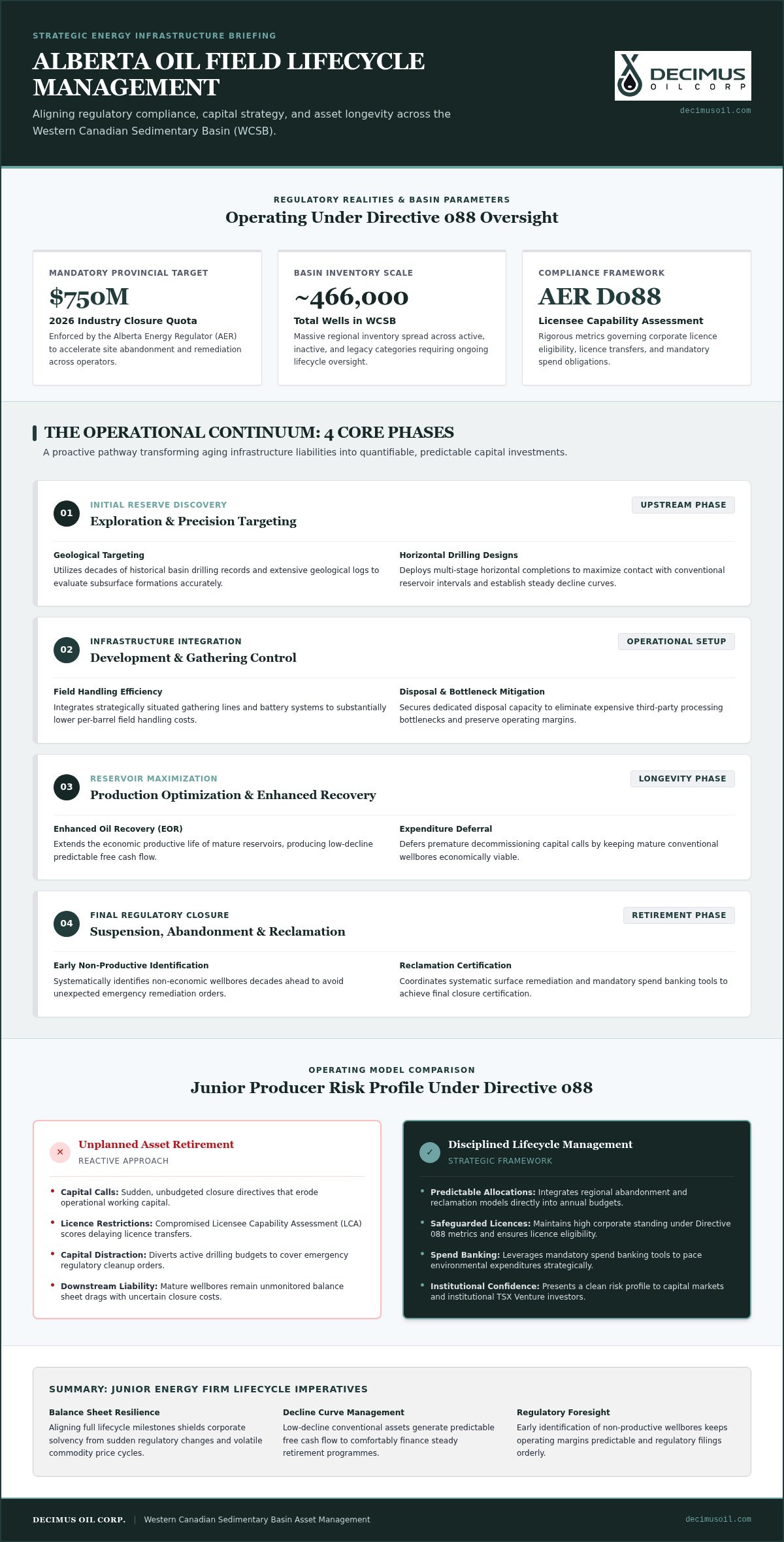
Executing an effective asset strategy requires operators to coordinate technical operations across four distinct stages: exploration, development, production optimization, and final closure. Within the Western Canadian Sedimentary Basin, roughly 466,000 wells populate the regional landscape, highlighting the massive operational inventory spread across active, inactive, and legacy categories. Successfully overseeing these operations demands an integrated framework for Alberta oil field lifecycle management that preserves value during high-margin recovery and minimizes capital drag as reservoirs mature.
Upstream Development and Infrastructure Setup
Initial reserve discovery relies on precision geological targeting and modern completion designs. Operators frequently deploy multi-stage horizontal drilling configurations to enhance reservoir contact, transforming complex conventional intervals into steady production profiles. Long-term commercial success, however, hinges on gathering and processing control. Integrating strategically situated gathering lines, battery systems, and disposal capacity lowers field handling costs and eliminates third-party processing bottlenecks. To evaluate the strategic role of plant control in field economics, review how Alberta Energy Infrastructure: Maximizing Asset Value 2026 provides long-term operational leverage.
Production Optimization and Mid-Life Management
Mid-life management centres on arresting steep initial declines. After flush production subsides, operators implement secondary recovery mechanisms to stabilize throughput. Key operational priorities during this stage include:
- Transitioning to waterflood or pressure maintenance systems to preserve reservoir energy;
- Executing mechanical workovers and pump optimizations to maintain steady lift efficiency;
- Consolidating processing lines to decrease operating expenses per barrel of oil equivalent.
These practices unlock incremental hydrocarbons while generating the cash flow needed to self-fund eventual closure duties. Forward-thinking firms like Decimus Oil Corp. demonstrate how aligning disciplined conventional exploration with dedicated infrastructure management sustains productive field margins over decades.
Closure, Abandonment, and Site Restoration
The closing stage begins when a wellbore reaches economic depletion. Under AER Directive 020, downhole abandonment requires permanent isolation of all porous zones and groundwater intervals through downhole bridge plugs and prescriptive cement capping. Surface infrastructure must be completely dismantled and salvaged.
Restoring surface capability marks the final regulatory phase. Under provincial guidelines, licensees must conduct Phase 1 and Phase 2 Environmental Site Assessments, remediate impacted soils, re-establish natural drainage contours, and achieve equivalent land capability to obtain an official Reclamation Certificate via OneStop. Crucially, operators retain a 25-year post-certification liability window for surface vegetation, soil stability, and settlement, while contamination and subsurface liabilities remain permanent. Orchestrating these closure campaigns proactively within an established Alberta oil field lifecycle management framework prevents late-stage liability accumulation from disrupting operational momentum.
Liability Management and Regulatory Compliance in 2026
Provincial regulatory standards have fundamentally transformed how upstream energy producers budget for environmental obligations. The Alberta Energy Regulator's industry-wide closure quota requires licensees to collectively deploy $750 million toward decommissioning and site restoration across the province in 2026. This mandatory spend is no longer calculated under the historical two-rate formula; each licensee is assigned a quota strictly proportionate to its share of total industry inactive liability. Concurrently, the Orphan Well Association (OWA) assessed an annual Orphan Fund Levy of $154.56 million for the 2026/27 fiscal period to address an orphan inventory containing over 7,370 wellbores and 9,151 reclamation sites. For modern operators, thorough Alberta oil field lifecycle management is essential to maintain licence eligibility, preserve credit capacity, and safeguard corporate liquidity.
The AER’s Liability Management Framework (LMF)
The updated Liability Management Framework replaces the single-ratio Liability Management Rating (LMR) with the multi-tiered Licensee Capability Assessment (LCA). Governed under Directive 088 and Directive 067, the LCA evaluates over 40 distinct operational and financial indicators. The regulator systematically screens producers across five core pillars:
- Financial health, including debt-service coverage, cash flow generation, and net debt-to-cash ratios;
- Liability magnitude, comparing active production against total deemed asset retirement obligations;
- Operational performance and pipeline compliance integrity;
- Closure execution, measuring actual site reclamation progress against assigned quotas;
- Management competence and regulatory compliance track record.
The Liability Management Framework ensures full industry accountability by linking operating approvals, drilling licences, and asset transfers directly to verifiable environmental stewardship and financial solvency.
Mitigating Environmental and Financial Risks
Proactive liability management directly improves financial resilience. Under Directive 088, operators who exceed their annual mandatory closure spend by at least 20% can bank the excess to offset mandatory closure quotas in 2027. Early retirement of inactive infrastructure reduces annual administrative levies, lowers municipal property taxes, and eliminates potential non-compliance penalties under Directive 013 suspension rules. Review the fundamentals of Oil and Gas Exploration Economics to see how disciplined capital allocation impacts corporate returns.
Lenders and equity partners actively scrutinize a firm's LCA standing before committing capital. Producers that systematically retire legacy wells maintain cleaner balance sheets, avoid mandatory security deposit demands from the AER, and command valuation premiums during property acquisitions. Integrating regulatory milestones into day-to-day Alberta oil field lifecycle management transforms environmental accounting from a balance sheet risk into an operational indicator of corporate health.
Leveraging Enhanced Recovery to Extend Asset Longevity
Asset depletion doesn't happen overnight. While primary recovery typically captures only 10% to 20% of the original oil in place, moving directly to abandonment leaves substantial resource value behind. In the context of Alberta oil field lifecycle management, enhanced oil recovery (EOR) occupies the critical middle phase. It extends the productive life of producing reservoirs by years, or even decades, while deferring substantial asset retirement obligations into the future. By maintaining stable production, operators generate ongoing cash flows that support orderly decommissioning timelines.
Provincial royalty policy strongly incentivizes this approach. With the legacy EOR scheme terminating on December 31, 2026, schemes transition under the Modernized Royalty Framework (MRF), the Incremental Hydrocarbon Recovery Royalty Regulation enacted in July 2026, and the Enhanced Hydrocarbon Recovery Program (EHRP). Qualifying projects secure a flat Crown royalty rate of 5% for up to 90 months. This fiscal incentive significantly lowers operating netbacks, enabling energy firms to reinvest capital directly into regional reservoir optimization.
Secondary Recovery and Waterflooding Strategies
Waterflooding serves as the operational baseline for pressure maintenance in mature sandstone reservoirs throughout the basin. Rather than drilling costly new wildcats, operators convert legacy vertical wellbores into injection conduits, establishing balanced voidage-replacement ratios. This process sweeps bypassed hydrocarbons toward active producers, mitigating natural pool decline. Discover how strategic flood designs optimize mature reservoir economics by reading Enhanced Oil Recovery Techniques: Maximizing Asset Value in the WCSB.
Deploying targeted flood patterns requires precise execution, including:
- Continuous water-chemistry screening to mitigate scaling downhole;
- Pattern-level voidage tracking to prevent premature water breakthrough;
- Automated pressure monitoring across injection clusters to protect caprock integrity.
Infrastructure Modernization for Efficiency
Sustaining secondary recovery requires facilities designed for long-term handling efficiency. Legacy separators, pumping batteries, and fluid transfer systems often operate below optimal energy ratings, adding unnecessary lifting costs to mature fields. Upgrading to closed-loop fluid separation systems and modern multiphase pump setups materially lowers the carbon intensity per barrel produced.
Modernization also leverages digital real-time instrumentation. Downhole pressure gauges, automated acoustic fluid-level loggers, and supervisory control and data acquisition (SCADA) monitoring enable engineering teams to diagnose production dips instantly. Identifying scaling, mechanical failure, or casing pressure anomalies within hours saves hundreds of thousands of dollars in emergency workovers. Through proactive infrastructure upgrades, producers realize higher ultimate recovery while operating within an accountable lifecycle framework. Explore how Decimus Oil Corp. optimizes conventional assets through strategic recovery and disciplined operations.
Decimus Oil Corp.: Driving Value Through Disciplined Asset Management
Executing an effective asset strategy requires leadership grounded in basin-specific operational reality. Decimus Oil Corp. (TSXV:WCSB) brings over 100 years of collective management experience to the Western Canadian Sedimentary Basin, pairing deep regional knowledge with modern reservoir enhancement techniques. Instead of pursuing aggressive, capital-dilutive drilling programs, the corporate mandate centres on operational excellence, balance sheet strength, and regulatory integrity. By incorporating predictable retirement schedules directly into long-term field development, Decimus demonstrates that systematic Alberta oil field lifecycle management protects working capital while generating consistent equity returns.
The Decimus Strategy: Conventional Focus and Low-Decline Assets
Conventional plays provide a distinct economic advantage over steep-decline unconventional reservoirs. Their stable depletion curves deliver steady cash flows, allowing technical teams to plan secondary recovery projects and decommissioning schedules years in advance. Decimus leverages high-intensity completion methodologies and modern workover practices across its conventional inventory to extract incremental value from proven geologic zones. Aligning capital deployment with long-term regional development forms the core of this strategy; explore our comprehensive analysis in WCSB Resource Development: A Strategic Guide.
Alignment with investors reinforces this operational discipline:
- A 27% insider ownership stake ensures management decisions reflect long-term per-share value;
- Capital allocation prioritizes low-risk recompletions and enhanced oil recovery over speculative wildcats;
- Proactive liability management preserves the firm's Licensee Capability Assessment profile under Directive 088.
Investing in the WCSB Lifecycle (TSXV:WCSB)
Decimus offers public equity investors direct participation in a growth-oriented conventional producer. Focused on conventional oil and gas exploration, dedicated energy infrastructure, and enhanced recovery projects, the company creates value across every stage of the asset continuum. Infrastructure ownership reduces third-party transport tariffs, while secondary recovery sustains production netbacks across market cycles.
By transforming regulatory compliance from an operational burden into a strategic discipline, Decimus proves that thoughtful Alberta oil field lifecycle management drives corporate durability. Learn more about Decimus Oil Corp. investment opportunities and discover how disciplined asset stewardship unlocks long-term value across the Western Canadian Sedimentary Basin.
Securing Long-Term Value Through Strategic Asset Stewardship
Sustainable development across the Western Canadian Sedimentary Basin demands a shift from reactive compliance to calculated asset governance. Successfully navigating the regulatory framework requires operators to treat liability not as an eventual exit penalty, but as an active component of daily operational strategy. By coupling secondary recovery techniques with phased closure execution, forward-thinking producers preserve balance sheet integrity while extending field economics well past traditional depletion curves.
Decimus Oil Corp. (TSXV:WCSB) brings this disciplined mindset to conventional exploration. Backed by over 100 years of combined management experience, a high-conviction 27% insider ownership stake, and a strategic WCSB asset portfolio, the firm demonstrates how systematic operational execution generates sustainable shareholder returns. Rigorous Alberta oil field lifecycle management isn't just about meeting compliance benchmarks; it's the defining operational discipline that protects working capital and drives enduring corporate performance.
Explore strategic energy investment with Decimus Oil Corp. (TSXV:WCSB) and discover how proactive basin leadership translates mature reservoir potential into lasting enterprise value.
Frequently Asked Questions
What is the Alberta oil field lifecycle?
The Alberta oil field lifecycle represents the complete operational progression of an upstream asset across four distinct phases: initiate, construct, operate, and close. Regulated by the AER, this continuum tracks an asset from mineral acquisition, licensing, and drilling through secondary production and mid-life optimization. It concludes with downhole wellbore abandonment, environmental remediation, and final reclamation certification. Disciplined Alberta oil field lifecycle management ensures capital efficiency while systematically neutralizing environmental liabilities across each stage.
How does the AER manage oil and gas liabilities?
The Alberta Energy Regulator oversees liabilities through its Liability Management Framework and Directive 088. Instead of relying on static deemed asset ratios, the regulator evaluates licensees holistically using risk assessments and financial disclosures. The framework enforces annual mandatory closure spend quotas, requiring producers to retire a proportionate share of inactive liabilities. Regulators also scrutinize licence transfers, security deposits, and corporate solvency to prevent cleanup costs from shifting to the public or the Orphan Well Association.
What is the purpose of enhanced oil recovery in lifecycle management?
Enhanced oil recovery bridges the operational space between primary production and field abandonment. Techniques like waterflooding restore reservoir pressure and sweep bypassed hydrocarbons toward active producers, unlocking incremental reserves from mature intervals. Integrating enhanced recovery into an asset strategy significantly extends an oil pool's economic lifespan. This longevity defers costly decommissioning expenditures while generating steady cash flow that operators can allocate directly toward eventual environmental obligations and site restoration.
Why is infrastructure management important for junior oil companies?
Controlling energy infrastructure gives junior producers direct operational independence and superior margin control. Owning processing batteries, compression units, and gathering lines shields an operator from expensive third-party processing tariffs and pipeline bottlenecks. For a junior firm, infrastructure control also provides strategic optionality. It enables operators to optimize fluid handling, lower operating costs per barrel, and tie in newly drilled or recompleted conventional wells quickly without waiting for third-party approvals.
How does reclamation work in the Alberta energy sector?
Reclamation begins once wellbores are cut and capped below ground level. Environmental specialists conduct Phase 1 and Phase 2 Environmental Site Assessments to locate and remediate any soil or groundwater contamination. Operators then re-contour the landscape and re-establish native vegetation to match pre-disturbance capability. Once standards are met, the AER issues a Reclamation Certificate via OneStop, though operators retain responsibility for surface soil settling and vegetative growth for a mandatory 25-year post-certification window.
What is the Licensee Capability Assessment (LCA)?
The Licensee Capability Assessment is the AER's comprehensive screening system used to evaluate an energy operator's financial health and operational integrity under Directive 088. Assessing dozens of parameters across balance sheet liquidity, remaining asset life, closure performance, and regulatory compliance, the LCA replaced the obsolete Liability Management Rating. The AER uses LCA scores to determine mandatory closure targets, review asset acquisition applications, and decide whether an operator must submit upfront security deposits.
How can investors evaluate the lifecycle management of a junior producer?
Investors should examine a junior producer's Licensee Capability Assessment standing, inactive well ratios, and annual closure spending history. Firms that align insider equity with public shareholders, such as Decimus Oil Corp. (TSXV:WCSB) with its 27% insider ownership, often prioritize balance sheet health and capital discipline. Evaluating how a company manages conventional assets and addresses Directive 088 targets provides clear insight into whether its Alberta oil field lifecycle management strategy creates or destroys equity value.
What are the benefits of low-decline oil assets?
Low-decline conventional oil assets offer predictable production profiles that don't suffer from the steep initial drops typical of unconventional shale plays. This production stability translates into dependable, multi-year operating cash flows with modest ongoing reinvestment requirements. Operators can allocate this steady revenue toward secondary recovery optimizations, regular dividend distributions, and scheduled asset retirement activities, insulating corporate balance sheets from the extreme price swings common in volatile energy commodity markets.


