
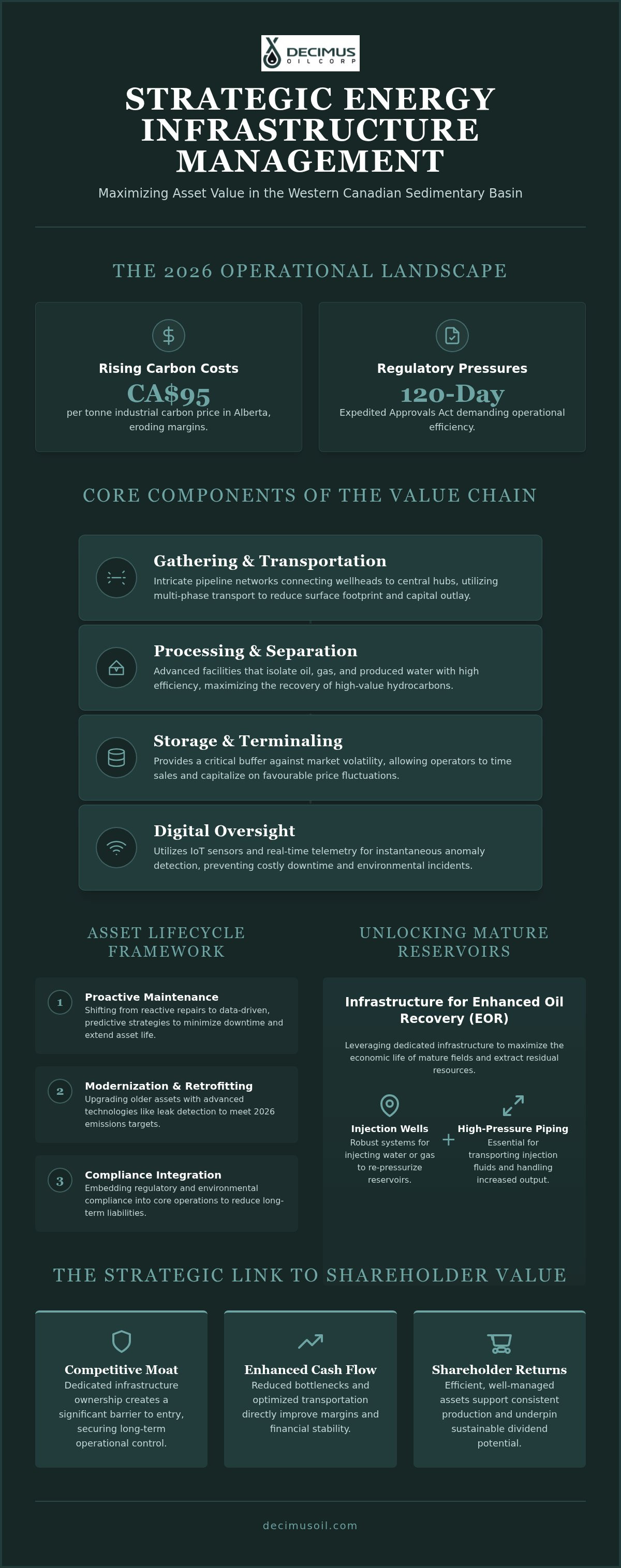
In the 2026 energy landscape, infrastructure is no longer a mere utility; it is a strategic asset that dictates the economic ceiling of every conventional play in the Western Canadian Sedimentary Basin. Many operators struggle to align production growth with the rising costs of resource transportation, especially as Alberta's industrial carbon price reaches CA$95 per tonne this year. Effective energy infrastructure management Alberta strategies provide the necessary bridge between technical potential and realized shareholder value. You likely recognize that managing aging assets within a tightening regulatory environment, including the new Expedited 120-Day Approvals Act, requires more than just routine maintenance.
We understand that inefficiencies in processing and transportation can quickly erode the margins of even the most promising upstream assets. This article outlines how sophisticated infrastructure management drives operational excellence and long-term profitability. You'll gain a clear framework for infrastructure lifecycle management and a deeper understanding of the vital link between midstream efficiency and upstream output. We also examine how modern infrastructure supports enhanced oil recovery to maximize the life of mature reservoirs and ensure every asset reaches its full economic potential.
Key Takeaways
- Understand how strategic oversight of gathering and processing assets serves as a vital value multiplier for conventional energy hubs within the WCSB.
- Discover how proactive energy infrastructure management Alberta practices reduce operational bottlenecks and better align midstream costs with production growth.
- Learn the critical role that robust injection wells and high-pressure piping play in supporting successful enhanced oil recovery initiatives.
- Implement a comprehensive lifecycle approach and predictive maintenance to realize significant cost savings and ensure operational stability.
- Gain insight into how dedicated infrastructure ownership creates a competitive moat that enhances cash flow and supports shareholder dividend potential.
Defining Energy Infrastructure Management in the Western Canadian Sedimentary Basin
Energy infrastructure management Alberta represents the integrated strategic oversight of gathering, processing, and transportation networks. It's the circulatory system of the Western Canadian Sedimentary Basin (WCSB). This region remains a premier global hub for conventional energy, providing high-intensity opportunities for sophisticated operators who understand the technical nuances of mature reservoirs. Effective management ensures that every molecule of oil and gas is moved safely and efficiently from the wellhead to the point of sale, maximizing the economic life of the asset.
In 2026, infrastructure serves as the fundamental backbone of oil and gas exploration economics in Western Canada. Without efficient midstream connectivity, even the most prolific geological discoveries remain stranded or economically unfeasible. We've seen a decisive shift from reactive maintenance to proactive, data-driven asset optimization. This evolution ensures that capital isn't just preserved but actively deployed to maximize throughput and minimize downtime across the entire lifecycle of the asset.
The Scope of Upstream and Midstream Assets
Understanding the distinction between wellhead infrastructure and regional gathering systems is essential for operational clarity. Wellhead assets focus on immediate extraction, while gathering systems bridge the gap to larger processing centres. Modern field development increasingly relies on multi-phase pipelines, which allow for the simultaneous transport of oil, gas, and produced water. This reduces the physical footprint of surface facilities and lowers initial capital outlays. Proximity to these processing facilities often determines the economic viability of new conventional oil plays, making infrastructure access a primary driver of leasehold value.
Regulatory and Environmental Compliance Frameworks
Alberta's energy sector operates under a rigorous framework overseen by provincial regulatory bodies like the Alberta Energy Regulator. These organizations ensure that Alberta's energy-driven economy remains sustainable while meeting stringent safety standards. Meeting 2026 emissions reduction targets requires a sophisticated approach to facility management and modernization, often involving retrofitting older assets with advanced leak detection technology. Proactive compliance isn't just a legal necessity; it's a strategic tool. By integrating high-level integrity management, junior producers can significantly reduce long-term environmental liabilities and enhance the overall marketability of their assets to potential investors.
Core Components of Modern Energy Infrastructure Management
Modern energy infrastructure management Alberta requires a precise orchestration of physical assets and digital oversight. This architecture ensures that conventional resources move seamlessly through the value chain. Effective stewardship starts with the gathering system, an intricate network of pipelines that connects individual wellheads to central processing hubs. These facilities employ advanced separation technologies to isolate oil, gas, and produced water with high efficiency. By maintaining rigorous standards for Alberta's energy and mineral resources, operators can maximize the recovery of high-value hydrocarbons while minimizing waste.
Strategic inventory management through storage and terminaling provides a vital buffer against market volatility. Operators use these assets to time their sales, capitalizing on price fluctuations rather than being forced to sell into a depressed market. This physical flexibility is increasingly paired with digital monitoring systems. Utilizing IoT sensors and real-time telemetry allows for instantaneous detection of pressure drops or mechanical anomalies. This predictive capability prevents costly downtime and environmental incidents, ensuring that the basin remains a reliable source of energy.
Pipeline Integrity and Flow Assurance
Maintaining the health of gathering lines in mature fields is a technical priority. Strategies for preventing internal corrosion and mineral scale are essential to preserve the structural integrity of the network. Regular chemical injection and scheduled pigging programs ensure that pipelines operate at peak capacity. Flow assurance is the practice of ensuring cost-effective hydrocarbon stream delivery. By focusing on these preventative measures, sophisticated operators like Decimus Oil protect the long-term value of their midstream investments.
Facility Optimization and Modernization
Legacy processing facilities often require significant upgrades to handle higher-intensity production profiles. Modernizing separators and treaters allows for better fluid handling and reduced energy consumption. Integrating automated control systems further optimizes performance by reducing the need for manual field labour and providing more accurate data for decision-making. In the WCSB, the strategic benefit of owning infrastructure over relying on third-party processing is clear. Ownership provides direct control over operating costs and ensures that production isn't curtailed by the priorities of external midstream providers.
Leveraging Infrastructure for Enhanced Oil Recovery (EOR)
Sophisticated energy infrastructure management Alberta strategies are the primary enablers of secondary and tertiary recovery. In mature basins, the transition from primary extraction to enhanced oil recovery techniques isn't merely a geological challenge; it's an infrastructure one. Robust surface assets allow operators to maintain reservoir pressure and sweep efficiency, which are critical for realizing the full economic potential of the WCSB. By repurposing existing gathering lines and processing hubs, companies can significantly lower the capital threshold required to extend the life of a field.
Waterflooding remains the most prevalent EOR method, requiring a dedicated network of high-pressure injection wells and specialized piping. These systems must handle high volumes of fluid without compromising integrity. Similarly, gas injection systems rely on complex compression and distribution infrastructure to manage CO2 or natural gas streams. With Alberta's industrial carbon price set at CA$95 per tonne in 2026, the strategic importance of CO2-EOR is rising. The upcoming Origins Carbon Capture Storage Hub, slated for 2027, highlights the provincial shift toward large-scale infrastructure that supports both emissions reduction and resource maximization.
Water Handling and Produced Water Management
Managing high water-cut production is a logistical reality in mature conventional plays. Efficient infrastructure allows for the implementation of closed-loop water systems, which recycle produced water for reinjection. This approach minimizes the environmental footprint and reduces the costs associated with fresh water sourcing and disposal. Strategic ownership of disposal wells provides a competitive advantage, ensuring that production isn't bottle-necked by third-party capacity or rising disposal fees. It's a critical component of maintaining a low-cost operating structure.
Infrastructure Revitalization for Mature Fields
Assessing the viability of retrofitting 20-year-old assets is essential for modern recovery methods. Decimus Oil Corp. applies high-intensity completion methodologies alongside existing infrastructure to optimize mature assets without the need for entirely new surface builds. This revitalization strategy balances the cost-benefit of infrastructure expansion versus optimization. In the current economic climate, maximizing the utility of existing steel in the ground is often the most capital-efficient path to growth. We focus on technical proficiency to ensure legacy systems can support the higher pressures and volumes required for modern EOR operations.
Operational Efficiency and Lifecycle Management Strategies
Successful energy infrastructure management Alberta requires a comprehensive lifecycle approach that begins at the design stage and extends through to final decommissioning. Sophisticated operators don't view infrastructure as a static expense; they treat it as a dynamic system that must be continuously optimized to maintain profitability. By integrating predictive maintenance protocols, companies can utilize real-time telemetry to identify potential mechanical failures before they occur. This data-driven strategy realizes significant cost savings by preventing unplanned shutdowns and extending the operational life of high-value equipment. Operational excellence serves as a vital hedge against commodity price volatility, ensuring that assets remain cash-flow positive even during market downturns.
Adopting a rigorous lifecycle methodology ensures that every capital expenditure is aligned with the long-term production goals of the field. This involves constant evaluation of asset performance and the strategic timing of upgrades to maintain throughput. Under current market conditions, where Alberta's industrial carbon price has reached CA$95 per tonne, efficiency isn't just about volume; it's about the carbon intensity of every barrel produced. Modernized systems that reduce venting and optimize fuel consumption are essential for maintaining a competitive edge in the Western Canadian Sedimentary Basin.
Cost Reduction Through Strategic Alignment
Consolidating infrastructure footprints is a proven method for reducing surface land use and associated municipal taxes. Centralized processing hubs for multi-well pads allow for the shared use of separators, treaters, and compression units, which lowers the total capital requirement per barrel. These efficiencies directly drive down the break-even price of conventional oil, making mature plays more resilient to price fluctuations. Operators who prioritize these strategic alignments can realize better margins than those utilizing fragmented, legacy networks. You can learn more about how we implement these strategies by exploring our approach to energy infrastructure optimization.
Decommissioning and Liability Management
Managing the end-of-life phase of infrastructure is a critical component of corporate responsibility and financial health. Navigating the regulatory requirements for pipeline and facility abandonment requires a proactive approach to satisfy the Alberta Energy Regulator (AER). Rather than deferring these costs, sophisticated firms treat reclamation as a strategic tool to strengthen the corporate balance sheet by reducing long-term environmental liabilities. Timely and efficient decommissioning demonstrates professional integrity and ensures that the transition of mature assets doesn't become a financial burden on shareholders. This commitment to lifecycle oversight is what distinguishes seasoned leaders from speculative operators in the basin.
The Strategic Link Between Infrastructure and Public Equity Value
Energy infrastructure management Alberta serves as the definitive foundation for long-term shareholder value in the conventional energy sector. While many investors focus exclusively on drilling results or initial production rates, sophisticated capital allocators recognize that infrastructure ownership creates a formidable economic moat for junior firms. Owning the gathering and processing network allows a company to dictate its own cost structure and avoid the margin compression often associated with high third-party midstream fees. This level of operational control directly impacts cash flow and dividend potential, providing a fiscal stability that infrastructure-light producers simply cannot match.
Positioning public equity in the energy sector as a play on operational excellence is a strategic necessity in 2026. Investors should prioritize firms that don't just extract resources but actively manage the midstream assets that bring those resources to market. This integrated approach ensures that the total value of the reservoir is captured at the corporate level rather than being siphoned off by external service providers. It transforms the business from a speculative explorer into a sophisticated operator with a predictable and resilient financial profile.
Infrastructure as a Valuation Multiplier
The valuation of an energy company is significantly enhanced when infrastructure is integrated into its core business model. Infrastructure-heavy producers typically trade at a premium compared to those relying on rented capacity because of the increased certainty in their net asset value (NAV). 'Behind-the-pipe' infrastructure, which refers to already-installed capacity waiting for new production, adds immediate value to the balance sheet without requiring additional capital outlays. Decimus Oil Corp. (TSXV:WCSB) exemplifies this strategy, focusing on maximizing hydrocarbon resources through the meticulous management of mature assets and their supporting infrastructure networks.
Risk Mitigation for Energy Shareholders
Owned infrastructure serves as a critical buffer against operational risks, specifically third-party processing bottlenecks that often lead to forced production curtailments. When an operator owns the plant, they dictate the priority of throughput, ensuring their volumes reach the sales point even when regional capacity is tight. This control is especially vital for low-decline assets supported by EOR infrastructure, where steady and predictable production is the primary goal. Shareholders realize capital appreciation through the strategic development of energy infrastructure Alberta, as these assets provide a stable foundation for growth that is less sensitive to the immediate whims of the global commodity market.
Strategic Infrastructure Stewardship for the Future of the WCSB
The 2026 energy landscape demands a decisive shift from simple maintenance to high-intensity asset optimization. We've established that sophisticated energy infrastructure management Alberta serves as the primary driver of operational efficiency and long-term shareholder value. By integrating midstream ownership with advanced recovery techniques, operators can protect their margins against commodity volatility and regulatory shifts. Control the value chain. This distinction separates resilient firms from speculative players. Decimus Oil Corp. brings over a century of combined leadership experience to this challenge, utilizing a publicly traded platform to realize the full potential of mature reservoirs. Technical proficiency remains our priority. We invite you to learn more about Decimus Oil Corp.'s strategic asset management and public equity opportunities (TSXV:WCSB). The path to maximizing asset value lies in the seamless integration of geology, engineering, and infrastructure stewardship.
Frequently Asked Questions
What are the primary challenges of energy infrastructure management in Alberta in 2026?
The primary challenges of energy infrastructure management Alberta in 2026 include managing an industrial carbon price of CA$95 per tonne and navigating the Expedited 120-Day Approvals Act. Operators must balance the technical nuances of aging assets with the need for rapid modernization to meet emissions targets. Strategic oversight is essential to ensure that infrastructure costs don't outpace production growth in a tightening regulatory environment.
How does owning infrastructure improve the economics of conventional oil exploration?
Owning infrastructure improves economics by eliminating third-party processing bottlenecks and reducing variable midstream fees. This ownership creates a strategic moat that protects cash flow and enhances the net asset value of a producer. By controlling the gathering and processing network, companies can better time their sales to capitalize on market price fluctuations rather than being forced to sell into depressed markets.
What is the difference between upstream and midstream infrastructure management?
Upstream infrastructure management focuses on wellhead assets and immediate extraction, while midstream management covers the gathering, processing, and transportation of hydrocarbons. Sophisticated operators integrate these functions to ensure seamless flow from the reservoir to the sales point. This coordination reduces downtime and optimizes the lifecycle of the entire asset base within the Western Canadian Sedimentary Basin.
How does enhanced oil recovery (EOR) change infrastructure requirements?
Enhanced oil recovery significantly increases the technical requirements for surface infrastructure, specifically regarding high-pressure piping and injection wells. Modern energy infrastructure management Alberta practices allow operators to repurpose existing assets for waterflooding or gas injection. This revitalization strategy is more capital-efficient than constructing new facilities and extends the economic life of mature fields through secondary and tertiary recovery methods.
What role does the Alberta Energy Regulator play in asset management?
The Alberta Energy Regulator provides critical oversight for pipeline integrity, safety standards, and environmental reclamation. Their framework ensures that infrastructure is managed responsibly from initial design through to decommissioning. For junior producers, proactive engagement with the regulator reduces long-term liability and strengthens the corporate balance sheet by demonstrating a commitment to professional integrity and environmental stewardship.
Can infrastructure management help reduce a company's carbon footprint?
Efficient infrastructure management reduces a company's carbon footprint by minimizing venting, detecting leaks in real-time, and optimizing fuel consumption. Modernizing legacy facilities with automated control systems ensures that operations are as carbon-efficient as possible. As provincial carbon pricing increases, these technical improvements become essential for maintaining investment competitiveness and meeting stringent environmental requirements for public equity investors.
How do junior energy companies like Decimus Oil Corp. manage infrastructure costs?
Decimus Oil Corp. manages infrastructure costs by utilizing high-intensity completion methodologies and leveraging over a century of combined energy sector leadership. The team focuses on optimizing existing surface assets to support growth without the need for excessive capital expenditures. This disciplined approach ensures that capital is deployed where it generates the highest return while maintaining a low-cost operating structure in the WCSB.
Why is infrastructure integrity crucial for investor confidence in the TSXV energy sector?
Infrastructure integrity is a primary indicator of institutional stability and operational excellence for investors on the TSX Venture Exchange. Reliable assets provide a predictable cash flow profile, which is essential for supporting dividends and capital appreciation for TSXV:WCSB shareholders. Strong asset management reduces the risk of unplanned shutdowns or environmental incidents, thereby instilling confidence in the firm's long-term growth potential.


