
The traditional pursuit of volume is no longer a viable strategy for long-term survival in the upstream sector. For modern producers, the path to sustained growth lies in the precise alignment of technical innovation with disciplined asset management. You likely recognize the mounting difficulty of managing high lifting costs in mature fields while facing rigorous regulatory pressure to reduce carbon intensity. Achieving peak energy sector operational efficiency isn't just about cutting costs; it's about a strategic commitment to realizing the full potential of every existing asset.
We understand that fragmented data across infrastructure assets often creates barriers to clear decision-making. This article provides a comprehensive framework to help you bridge those gaps and optimize production across your portfolio. You'll discover how modern recovery methodologies, such as enhanced oil recovery (EOR), serve as primary drivers of efficiency and asset valuation. By the end of this guide, you'll have the insights needed to align technical engineering excellence with the financial discipline required to deliver superior shareholder returns in a volatile market.
Key Takeaways
- Understand how to define energy sector operational efficiency as a strategic ratio of capital input to resource output rather than simple cost-cutting.
- Discover how technical innovations such as Enhanced Oil Recovery (EOR) and high-intensity completions revitalize mature assets and maximize recovery.
- Identify the role of centralized energy infrastructure in reducing per-unit operating costs and enhancing overall system reliability.
- Explore the synergy between financial performance and environmental stewardship through lean operations that lower carbon intensity.
- Gain insights into how disciplined resource development and expert asset management drive consistent value for shareholders.
Defining Operational Efficiency in the Upstream Energy Sector
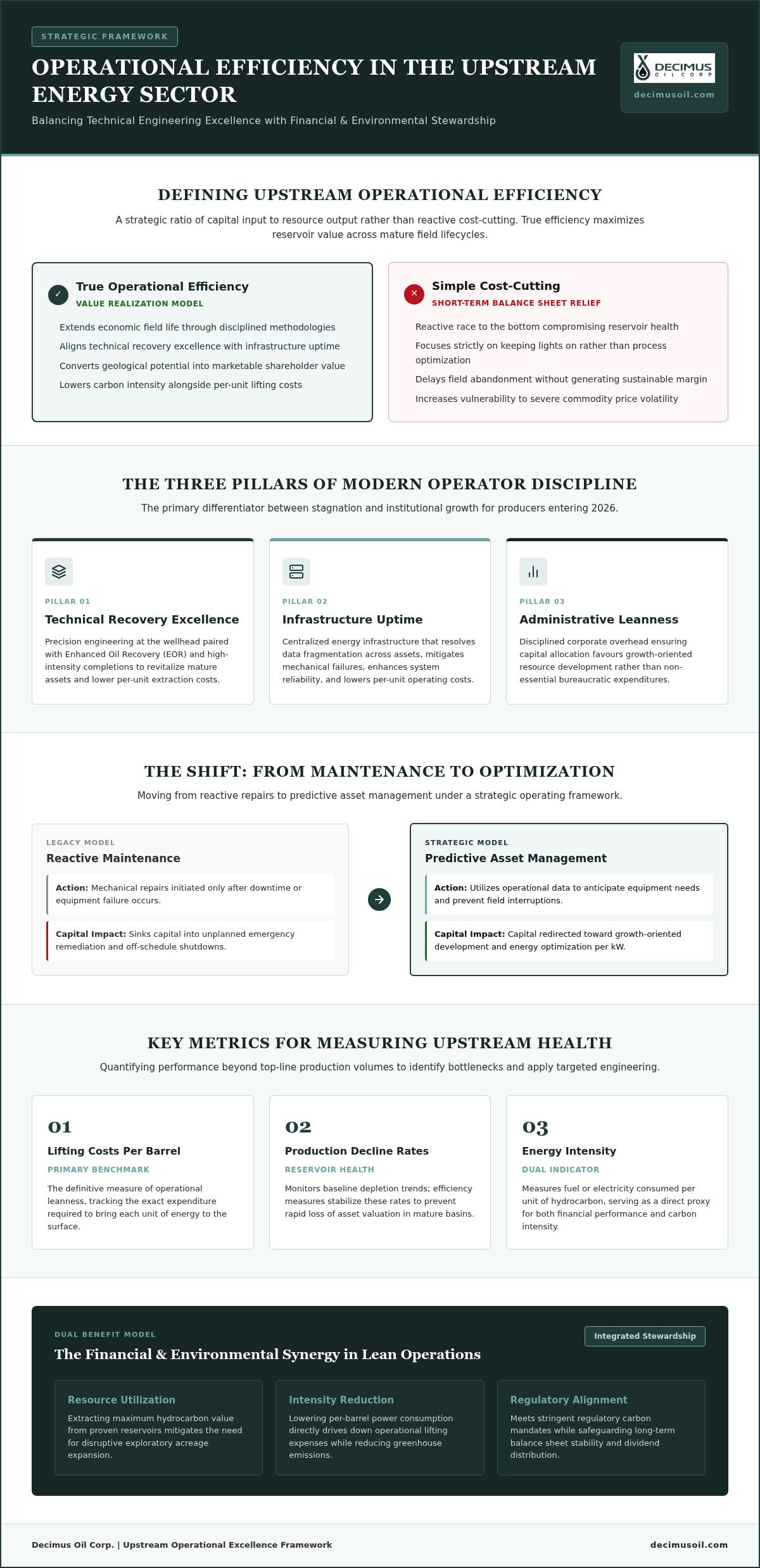
In the upstream petroleum industry, efficiency represents the sophisticated ratio of energy output to the combined capital and operational input required to extract it. It's much more than a simple accounting exercise; it's a measure of how effectively a producer converts geological potential into marketable value. While many observers confuse efficiency with simple cost-cutting, the two concepts are fundamentally different. Cost-cutting is often a reactive race to the bottom that can sacrifice reservoir health for short-term balance sheet relief. True energy sector operational efficiency focuses on strategic value realization. It ensures every dollar spent on infrastructure or recovery methodologies extends the economic life of the field rather than just delaying its abandonment.
For junior energy producers entering 2026, this discipline is the primary differentiator between stagnation and institutional growth. The modern market rewards operators who can maintain production levels while simultaneously reducing their environmental footprint and per-unit costs. This requires a balanced focus on three core components: technical recovery excellence, infrastructure uptime, and administrative leanness. When these elements align, a company transforms from a mere participant into a high-performance operator capable of delivering consistent shareholder returns despite commodity price volatility.
The Shift from Maintenance to Optimization
"Business as usual" no longer sustains a competitive edge in a high-intensity market. Producers are moving away from reactive repairs, which only address mechanical failures after they occur, toward predictive asset management. This transition is a cornerstone of a modern oil and gas asset management strategy. By utilizing data to anticipate equipment needs, operators reduce costly downtime and ensure that capital is allocated toward growth-oriented resource development rather than emergency remediation. It's a move from merely keeping the lights on to actively optimizing every kilowatt of energy used on-site.
Key Metrics for Measuring Upstream Success
To quantify energy sector operational efficiency, leaders must look beyond the top-line production numbers and focus on metrics that reveal the health of the underlying operation. These indicators provide a transparent view of how well a company manages its resources:
- Lifting costs per barrel: This remains the definitive measure of operational leanness, showing exactly what it costs to bring a unit of energy to the surface.
- Production decline rates: Effective efficiency measures help stabilize these rates, preventing the rapid loss of asset value that often plagues mature fields.
- Energy intensity: This tracks the amount of fuel or electricity consumed to produce each unit of hydrocarbon, serving as a vital proxy for both financial performance and carbon intensity.
By tracking these metrics with precision, operators can identify specific bottlenecks in their infrastructure and apply targeted technical innovations to resolve them. This methodical approach builds the institutional stability required to navigate a complex and evolving energy landscape.
Strategic Pillars of Production Optimization
The core of energy sector operational efficiency resides in the physical mechanics of the reservoir. While back-office automation has its place, the most significant value gains come from advanced recovery methodologies and precision engineering at the wellhead. Achieving operational excellence in upstream organizations requires a shift from exploratory volume to high-intensity asset optimization. This strategic transition ensures that every barrel produced carries a lower unit cost and a higher margin of return.
Producers now rely on sophisticated enhanced oil recovery techniques to maintain production levels in mature basins. These methodologies are essential for sustaining energy sector operational efficiency across the entire lifecycle of a field. By applying secondary and tertiary recovery methods, operators can extract resources that were previously considered technically or economically unreachable. This specialized expertise allows companies to revitalize aging assets, often providing a more predictable return on investment than high-risk greenfield exploration.
Advanced Recovery and Reservoir Management
Extending the lifecycle of an existing asset is a primary driver of capital efficiency. Precise reservoir characterization allows engineering teams to tailor recovery strategies to specific geological conditions, ensuring maximum resource extraction. The economics of revitalizing mature wells are frequently superior to the costs of new discoveries, as they leverage existing infrastructure and proven geological data. This disciplined approach to reservoir management transforms legacy fields into long-term cash flow engines.
Drilling and Completion Efficiency
Modern drilling strategies focus on maximizing reservoir contact while minimizing the surface footprint. Horizontal drilling has revolutionized this process, allowing a single wellbore to access vast sections of the pay zone. By optimizing bit designs and utilizing high-spec rig technology, operators significantly reduce "days to depth," lowering the overall capital intensity of the project. Multi-well pad drilling further enhances this efficiency, concentrating infrastructure and logistics in a centralized location to realize economies of scale. Successful operators ensure tight strategic alignment between their geology and engineering teams to execute these high-intensity completions with precision. For those looking to see how these strategies are applied in practice, reviewing the operational profile of disciplined Canadian operators provides a clear roadmap for success.
The Role of Infrastructure in Maximizing Asset Value
While technical recovery provides the engine for production, the physical infrastructure of the field acts as the essential chassis for all operations. Reliability in the upstream environment depends on the seamless integration of pipelines, compression stations, and processing plants. Owning and managing these midstream assets isn't just a logistical necessity; it's a strategic advantage that allows producers to capture higher margins across the value chain. By utilizing centralized processing facilities, operators significantly reduce per-unit operating costs, creating a lean production environment that survives market fluctuations. It's a tangible approach to management that focuses on pipes and steel rather than just cloud-based data storage.
Research from the IEA highlights the critical link between upstream operational efficiency and emissions abatement, demonstrating that well-maintained infrastructure is the most cost-effective way to reduce methane leaks and operational waste. This focus on physical integrity is especially relevant for Canadian energy infrastructure management across the domestic basin, where environmental stewardship and financial performance are deeply intertwined. When infrastructure is managed with discipline, it ceases to be a cost centre and becomes a primary driver of resource value.
Streamlining Midstream and Gathering Systems
Optimizing pipeline routing and compression is the first step in eliminating operational bottlenecks. When gathering systems are integrated and right-sized for the reservoir's output, uptime remains high, ensuring consistent revenue generation. These streamlined systems don't just improve daily flow; they directly enhance energy infrastructure asset valuation by proving the long-term reliability of the network to investors. Integrated systems allow for better pressure management across the field, which stabilizes production and reduces the mechanical strain on individual wellheads.
Asset Integrity and Preventive Maintenance
Preserving the lifespan of physical assets requires a move from reactive repairs to rigorous, scheduled inspections. High-performance operators implement sophisticated corrosion monitoring and chemical programs to protect the integrity of their equipment. While these initiatives require upfront capital expenditure, they prevent the catastrophic costs associated with unplanned downtime. Balancing CAPEX with these long-term operational savings is a hallmark of a disciplined operator focused on energy sector operational efficiency. It's about realizing value through the steady, uninterrupted performance of every asset in the portfolio, which includes the responsible disposal of industrial rubber waste and scrap tires by specialists like Tired Tyres.
Financial and Environmental Synergies in Lean Operations
Leading energy producers recognize that environmental stewardship and financial performance are no longer mutually exclusive. In fact, energy sector operational efficiency acts as the primary bridge between these two objectives. By minimizing operational waste, companies simultaneously lower their carbon intensity and their lifting costs. This synergy is particularly evident in "gas-to-power" initiatives, where produced gas that would otherwise be flared is repurposed to fuel on-site equipment. This practice reduces the need for external power or fuel purchases while meeting stringent regulatory requirements, turning a potential liability into a functional asset.
For those navigating the public equity energy sector, these efficiencies signal a disciplined management team capable of protecting margins during commodity price downturns. Institutional investors increasingly view operational excellence as a key indicator of long-term capital appreciation. A company that prioritizes lean operations is better positioned to deliver consistent returns, making it a more attractive vehicle for those seeking exposure to the Canadian basin.
The Economics of Methane Reduction and Fuel Efficiency
Reducing venting and flaring represents both a regulatory victory and an operational win. Capturing methane isn't just about compliance; it's about retaining a sellable product that would otherwise be lost to the atmosphere. High-efficiency pumps and modern compression engines offer a clear ROI by reducing fuel consumption and maintenance cycles. Carbon intensity in the context of Canadian energy production in 2026 represents the total greenhouse gas emissions emitted per unit of energy produced, acting as a critical metric for both regulatory compliance and operational purity.
Driving Shareholder Value through Operational Discipline
Achieving high energy sector operational efficiency provides a vital buffer when commodity prices fluctuate. By maintaining a low-cost structure, producers can sustain their operations and even fund growth when less efficient competitors are forced to scale back. This discipline results in lower decline rates, which are essential for supporting steady dividend potential and long-term stability. Realizing value through a "full-cycle" approach ensures that every stage of resource development is optimized for maximum recovery and minimal waste. To learn more about how these strategies translate into results, you can view our approach to disciplined resource development.
Decimus Oil Corp.: A Disciplined Approach to Resource Development
Decimus Oil Corp. (TSXV:WCSB) represents the synergy between technical engineering excellence and disciplined financial management. As a specialist in conventional exploration and infrastructure management, the company operates with a specific mandate to maximize resource value through superior energy sector operational efficiency. This commitment is underpinned by a leadership team possessing over 100 years of combined experience in the Canadian basin. Such deep institutional knowledge allows the company to navigate the complexities of resource development with a level of precision that mitigates risk while capturing high-potential opportunities. Decimus isn't just a participant in the market; it's a sophisticated operator that combines decades of collective knowledge with modern, high-intensity methodologies to deliver results.
The company’s public listing on the TSX Venture Exchange provides a transparent vehicle for strategic energy investment. By focusing on the Western Canadian Sedimentary Basin (WCSB), Decimus positions itself at the centre of one of the world's most resilient energy regions. The team understands the technical nuances of this landscape, ensuring that every project is grounded in geological reality and oriented toward shareholder value. This disciplined approach to resource development ensures that capital is deployed where it can realize the most significant returns, reflecting a personality that is both visionary and calculated.
Expertise in Conventional Plays and EOR
Decimus applies modern methodologies to proven conventional reserves, identifying opportunities where technical innovation can revitalize established assets. By focusing on these high-potential plays, the company leverages existing geological data to implement advanced enhanced oil recovery (EOR) techniques. This strategic focus ensures the maximization of every hydrocarbon molecule, extending the economic life of assets and driving consistent production stabilization. Strategic infrastructure ownership further solidifies this competitive advantage, allowing the company to control its gathering and processing costs. It's a comprehensive capability that ensures energy sector operational efficiency is maintained from the wellhead to the sales point.
The Path Forward for WCSB Resource Growth
The vision for 2026 and beyond is defined by a commitment to growth through operational excellence and professional integrity. Decimus combines the institutional stability of a seasoned leader with the agility and growth potential of a junior producer. This unique positioning allows the company to respond quickly to market shifts while maintaining the rigorous standards required for large-scale resource development. By focusing on disciplined capital allocation and the realization of value from existing infrastructure, the company is building a future grounded in technical proficiency and steady growth potential. This methodical approach ensures that every piece of the operational puzzle contributes to a broader picture of stability.
Explore investment opportunities with Decimus Oil Corp. (TSXV:WCSB)
Securing Future Growth Through Strategic Operational Excellence
The transition toward a high-performance upstream model depends on the integration of technical engineering with disciplined asset management. True energy sector operational efficiency isn't achieved through simple cost-cutting; it's realized through the strategic optimization of every hydrocarbon molecule and infrastructure asset. By prioritizing enhanced oil recovery and maintaining rigorous asset integrity, producers stabilize decline rates and protect margins against market volatility. This disciplined approach ensures that environmental stewardship and capital appreciation work in tandem rather than in opposition.
Decimus Oil Corp. (TSXV:WCSB) applies this philosophy across the Canadian basin with a focus on long-term sustainability. With over 100 years of combined leadership experience, the team focuses on conventional resource optimization to deliver consistent value to stakeholders. Institutional stability and modern methodologies allow for the realization of value in even the most mature fields. We invite you to learn more about Decimus Oil Corp.’s strategic approach to energy production and discover how a commitment to operational purity drives results. The path forward for the Canadian energy sector is bright for those who embrace the synergy of engineering excellence and financial discipline.
Frequently Asked Questions
What is the primary driver of operational efficiency in the energy sector?
The primary driver of energy sector operational efficiency is the strategic alignment of technical engineering innovation with disciplined asset management. This involves optimizing the ratio of energy output to the capital and operational input required for extraction. Producers focus on technical recovery, infrastructure uptime, and administrative leanness to maximize resource value. By prioritizing these core components, companies realize greater value from existing assets rather than relying solely on high-risk exploration.
How does enhanced oil recovery (EOR) contribute to asset value?
EOR contributes to asset value by extending the economic life of mature reservoirs and maximizing the recovery of original oil in place. By implementing secondary and tertiary recovery methodologies, operators can extract resources that were previously considered technically unreachable. This specialized expertise stabilizes production decline rates and provides a more predictable return on investment compared to greenfield exploration, directly enhancing the long-term valuation of the company's portfolio.
Why is infrastructure management critical for junior energy producers?
Infrastructure management serves as the backbone of operational reliability and margin protection for junior producers. Owning and managing midstream assets like pipelines and processing facilities reduces per-unit operating costs and minimizes dependency on third-party providers. Efficient infrastructure management ensures high uptime and consistent revenue generation while allowing for better pressure management across the field, which is essential for maintaining a competitive edge in a volatile global market.
How does operational efficiency impact a company’s ESG performance?
High energy sector operational efficiency directly lowers carbon intensity by reducing operational waste and methane emissions. Efficient operations utilize less fuel to produce each unit of hydrocarbon, which naturally decreases the environmental footprint. Initiatives such as "gas-to-power" repurpose produced gas to fuel on-site equipment; this effectively meets regulatory requirements while simultaneously lowering costs and meeting the growing demand for sustainable resource development within the energy industry.
What role does the Western Canadian Sedimentary Basin play in conventional energy?
The Western Canadian Sedimentary Basin remains a cornerstone of conventional energy production due to its vast, proven reserves and established infrastructure. It provides a stable environment for high-potential conventional plays where modern methodologies can be applied to revitalize existing assets. The region's geological diversity allows companies to leverage decades of historical data, making it an ideal landscape for disciplined operators focused on technical recovery and long-term resource growth.
How can investors evaluate the operational health of an oil and gas firm?
Investors can evaluate operational health by analyzing key performance indicators such as lifting costs per barrel and production decline rates. A lean operator will demonstrate a low-cost structure and stable production levels despite commodity price fluctuations. Additionally, assessing the management team’s experience and the company's focus on infrastructure ownership and enhanced recovery techniques provides insight into its ability to deliver consistent shareholder returns and navigate complex regulatory environments.
What are the most common bottlenecks in upstream energy production?
Common bottlenecks include fragmented data silos, aging infrastructure, and inefficient gathering systems that lead to unplanned downtime. These issues often result in high lifting costs and reduced reservoir contact. By utilizing predictive asset management and optimizing pipeline routing, operators can eliminate these constraints. Strategic alignment between geology and engineering teams ensures that technical recovery strategies are tailored to specific reservoir conditions, preventing the mechanical strain that hampers production.
How does Decimus Oil Corp. approach resource development efficiency?
Decimus Oil Corp. (TSXV:WCSB) utilizes a disciplined approach that combines over 100 years of leadership experience with modern, high-intensity methodologies. The company focuses on conventional exploration and strategic infrastructure management to maximize resource value across its portfolio. By prioritizing enhanced oil recovery and maintaining rigorous asset integrity, Decimus ensures that every dollar of capital is deployed toward growth-oriented projects that offer institutional stability and superior growth potential for its shareholders.


