
In the 2026 energy market, the most valuable barrels aren't found through new discoveries, but through the sophisticated management of existing reservoir pressure. Most operators in the Western Canadian Sedimentary Basin recognize the frustration of watching primary extraction rates decline while regulatory levies and industrial carbon prices, now at $95 per tonne, continue to compress margins. Implementing a robust strategy for oil field waterflooding Alberta is no longer just an operational choice; it's a requirement for sustaining institutional confidence and shareholder value.
This guide demonstrates how waterflooding serves as the definitive strategic lever to reverse reservoir depletion and maximize the net present value of mature assets. By focusing on precision voidage replacement and technical efficiency, sophisticated operators can realize extended field life even as primary extraction costs soar. We'll examine the technical mechanics of pressure maintenance, the implications of the 2026 AER Directive 051 updates, and the transition toward the Enhanced Hydrocarbon Recovery Program to ensure your assets remain competitive in a complex regulatory environment.
Key Takeaways
- Understand why secondary recovery is the cornerstone of asset lifecycle management and pressure maintenance across the Western Canadian Sedimentary Basin.
- Identify the technical mechanics of oil field waterflooding Alberta to improve sweep efficiency and maximize total recovery factors in mature fields.
- Evaluate the unique geological characteristics of sandstone and carbonate plays that make conventional assets ideal candidates for water injection.
- Discover how waterflooding stabilizes production and reduces field decline rates, transforming mature assets into reliable, low-decline production centres.
- Learn how a sophisticated approach to enhanced oil recovery can optimize operational efficiency and realize significant long-term shareholder value.
Understanding the Role of Waterflooding in Alberta's Energy Landscape
Strategic asset management in Western Canada requires a clear understanding of reservoir maturity. Waterflooding stands as a sophisticated evolution in the lifecycle of conventional energy assets. As a secondary recovery method, Water injection (oil production) involves the strategic introduction of water into a reservoir to displace hydrocarbons toward production wells. For operators managing an oil field waterflooding Alberta project, this transition from primary depletion is essential for maintaining the economic viability of mature fields.
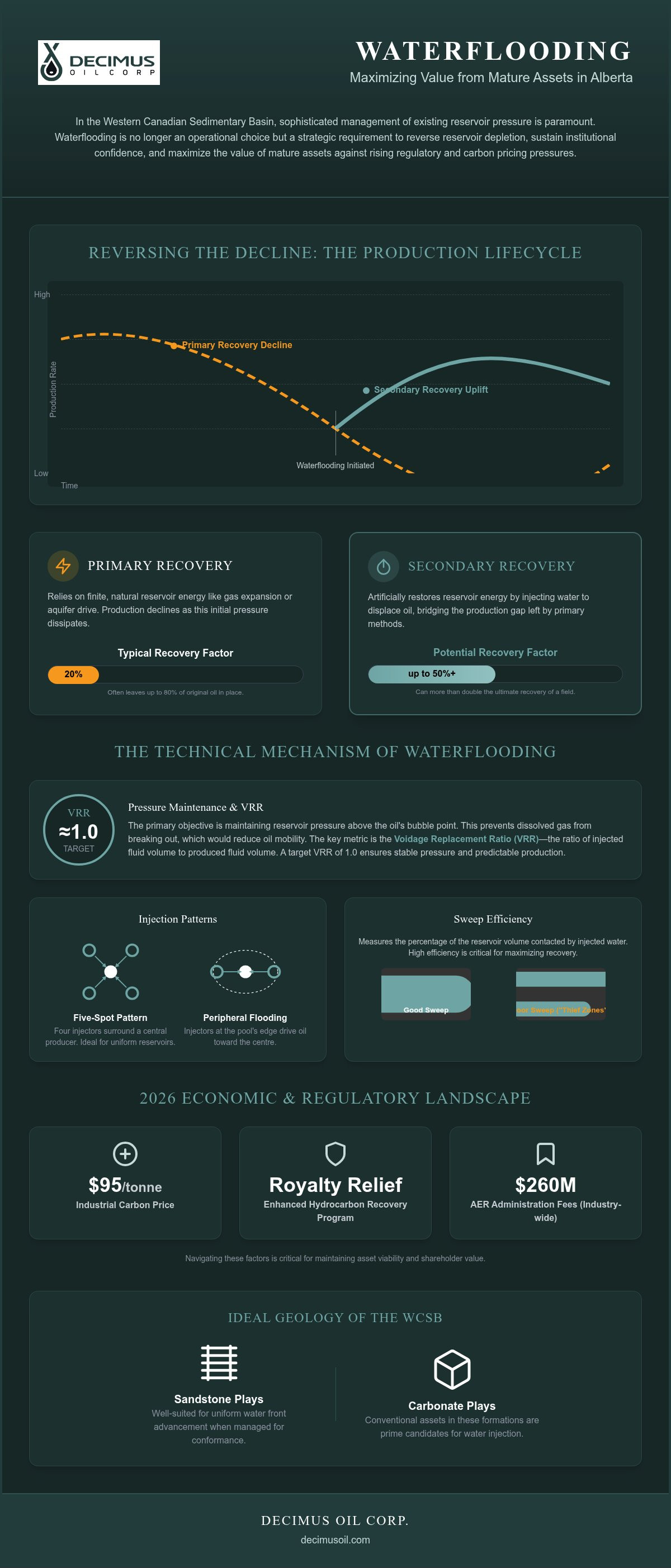
A key metric in this process is the Voidage Replacement Ratio (VRR). This performance indicator tracks the volume of fluids injected versus the volume produced at reservoir conditions. Maintaining a VRR near 1.0 ensures that reservoir pressure remains stable, which prevents the premature abandonment of valuable reserves. It's a calculated approach to maximizing the total recovery factor of a field while managing the costs associated with the province's evolving regulatory framework, including the 2026/27 AER administration fees that now total $260 million across the industry.
Primary vs. Secondary Recovery: Bridging the Production Gap
Primary production relies on natural reservoir energy, such as gas expansion or aquifer drive, to push oil to the surface. This natural energy is finite and often leaves the majority of the resource in the ground. Once primary energy dissipates, recovery factors often stall at levels that don't satisfy modern shareholder expectations. Waterflooding bridges this production gap by artificially restoring energy to the system. The timing of this transition is vital. Initiating secondary recovery at the optimal moment allows operators to realize value that primary methods simply cannot access, often doubling the ultimate recovery of the original oil in place.
The Strategic Importance of Pressure Maintenance
Pressure maintenance is the primary objective of any oil field waterflooding Alberta initiative. When reservoir pressure drops below the bubble point, dissolved gas breaks out of the oil. This gas breakout reduces oil mobility and increases extraction complexity. By keeping pressure elevated, operators preserve the fluid properties of the oil and ensure a predictable decline curve. This stability provides a steady, results-oriented narrative for stakeholders and enhances the overall valuation of energy infrastructure. It's about turning a declining asset into a stable, long-term producer that can withstand price volatility and the $95 per tonne industrial carbon price set for 2026.
The Technical Mechanism of Water Injection and Reservoir Sweep
The physical displacement of hydrocarbons through oil field waterflooding Alberta requires meticulous engineering to ensure injected water effectively "pushes" oil toward production wells. This isn't a random infusion; it's a controlled process where injection wells are strategically placed to create a pressure front. Operators often utilize specific patterns, such as the five-spot arrangement or peripheral flooding, to optimize this movement. A five-spot pattern places four injectors around a central producer, which is ideal for uniform reservoirs. Peripheral flooding, conversely, targets the edges of a pool to drive oil toward the centre.
Success depends heavily on sweep efficiency, which measures the percentage of the reservoir volume contacted by the injected fluid. High sweep efficiency directly correlates to improved recovery factors. To encourage these sophisticated methodologies, Alberta's Enhanced Hydrocarbon Recovery Program provides royalty relief for projects that demonstrate incremental production through secondary methods. This regulatory support makes technical precision a financial imperative for modern energy firms managing an oil field waterflooding Alberta project.
Optimizing Sweep Efficiency and Conformance
Geological heterogeneity often creates "thief zones" where water bypasses oil-bearing rock. Modern monitoring, including injection profile logging and tracer studies, allows operators to identify these bypasses and adjust injection rates accordingly. Conformance in Alberta's sandstone reservoirs refers to the uniformity of the water front's advancement across the entire vertical and horizontal extent of the target formation. Achieving high conformance ensures that water doesn't simply cycle through high-permeability channels without mobilizing trapped oil.
Water Chemistry and Formation Compatibility
The quality of the injection fluid is just as critical as the volume. If the water chemistry is incompatible with the reservoir rock, it can trigger clay swelling or mineral scale formation, which permanently restricts flow. Strategic investment in water treatment infrastructure prevents this formation damage. Most modern projects prioritize the use of produced water over fresh water to enhance sustainability and reduce operational footprints. Effective resource development strategies integrate these treatment protocols into the broader infrastructure management plan to protect the long-term health of the reservoir.
Geological Suitability of the Western Canadian Sedimentary Basin (WCSB)
The WCSB offers a unique convergence of geological stability and technical predictability, making it a premier environment for secondary recovery. Its vast expanse of conventional sandstone and carbonate reservoirs provides the ideal medium for oil field waterflooding Alberta. Success in these projects is often predicated on the basin's favourable permeability and porosity profiles, which allow for efficient fluid displacement. Historical drilling data, accumulated over decades of provincial operations, now serves as a high-fidelity roadmap for modern secondary recovery. This data allows for precise mapping of mobility ratios, ensuring that water-oil displacement remains stable under Alberta's specific depth and temperature regimes.
Targeting the Mannville and Viking Formations
The Mannville and Viking formations represent two of the most consistent targets for pressure maintenance in the province. These formations are characterized by their regional extent and well-defined lithology. Historically, these pools responded exceptionally well to water injection due to their predictable reservoir architecture. The modern application of horizontal drilling has revolutionized waterflood performance in these thin-pay zones, allowing for greater contact with the reservoir and more uniform pressure distribution. This evolution in methodology is a core component of sophisticated conventional oil and gas exploration strategies, where the goal is to optimize every cubic metre of the resource.
Reservoir Heterogeneity and Multi-Zone Potential
Alberta's geological profile frequently features "stacked pay" zones, where multiple oil-bearing formations exist within a single vertical column. This allows strategic operators to implement multi-stage waterflood programs, realizing value across several horizons simultaneously. However, geological heterogeneity also introduces challenges, specifically "thief zones," which are highly permeable layers that can divert injected water away from the target oil. Managing these requires a deep understanding of several critical geological entities:
- Permeability: The capacity of the rock to allow fluid flow.
- Porosity: The volume of pore space available for hydrocarbon storage.
- Lithology: The physical characteristics of the rock, such as sandstone or carbonate.
- Hydrocarbon Saturation: The percentage of pore space occupied by oil versus water.
- Reservoir Continuity: The lateral extent of the target formation.
By analyzing these factors, operators can design injection programs that bypass geological hurdles and maximize the recovery of the original oil in place. This methodical approach ensures that even complex, heterogeneous reservoirs can be transformed into stable, long-term production centres.
Economic Advantages and Operational Efficiency of Waterflooding
Waterflooding offers a superior cost-per-barrel profile compared to more capital-intensive enhanced oil recovery techniques like CO2 or chemical injection. In the current fiscal climate, where the Alberta government forecasts WTI at $60.50 for the 2026/27 year, maintaining low operational expenses is critical for asset viability. By implementing oil field waterflooding Alberta, operators transform high-decline primary assets into stable, predictable producers. This shift significantly improves the net present value (NPV) of a project by deferring abandonment costs and extending the period of positive cash flow. Extending the economic life of existing infrastructure allows firms to amortize their initial investments over decades rather than years.
Maximizing ROI through Infrastructure Re-use
Strategic asset management involves more than just extraction; it requires the intelligent repurposing of existing capital. Converting mature production wells into injection points allows operators to realize secondary recovery without the massive capital expenditure of drilling new holes. This approach to managing energy infrastructure ensures that every dollar invested in the original field development continues to yield returns. It's a core tenet of modern secondary oil recovery methods, where the goal is to revitalize mature assets by leveraging what's already on the ground. This methodology minimizes the environmental footprint while maximizing the recovery of original oil in place.
Reducing Operational Risk in Mature Fields
Exploration carries inherent geological risk, but oil field waterflooding Alberta operates on proven reserves with established performance data. This predictability is reinforced by digital monitoring and automation, which allow for real-time adjustments to injection rates and pressure profiles. These technologies ensure that the field stays within its optimal performance window, even as the industrial carbon price reaches $95 per tonne in 2026. The economic limit of a well is the point at which the cost of production equals the revenue generated, and waterflooding pushes this limit further by increasing the volume of recoverable oil without a proportional increase in overhead.
To learn more about how these strategies can be applied to your portfolio, explore our approach to resource development.
Strategic Asset Management: The Decimus Approach to EOR
Decimus Oil Corp. (TSXV:WCSB) positions itself as a sophisticated operator dedicated to the optimization of conventional resources across Western Canada. We believe that the most effective way to realize value is through a calculated synergy between conventional exploration and production enhancement. Our team's collective knowledge, spanning over 100 years of combined industry experience, allows us to identify strategic opportunities for oil field waterflooding Alberta that others might overlook. We don't view secondary recovery as a maintenance task. Instead, we see it as a bold, strategic tool to maximize asset longevity and performance within the Western Canadian Sedimentary Basin. This focus ensures that our assets remain resilient despite the evolving pressures of the 2026 energy market.
Realizing Value through Technical Expertise
Our approach to oil field waterflooding Alberta begins with a methodical assessment of reservoir data to identify under-performing assets. We look for fields where natural pressure depletion has stalled production but where significant original oil in place remains untapped. By applying high-intensity methodologies, we revitalize these mature plays and restore their economic momentum. This execution follows our established mature oil field revitalization framework, ensuring that every injection project is grounded in technical proficiency and geological accuracy. We focus on optimizing existing wells and energy infrastructure to ensure that capital is deployed where it generates the highest possible return on investment. Our engineering team prioritizes precision in voidage replacement ratios to stabilize decline curves and protect the long-term value of the reservoir.
Corporate Integrity and Strategic Alignment
Operational excellence is directly linked to our commitment to corporate integrity and shareholder value. As a publicly traded entity on the TSX Venture Exchange, we maintain a high register of transparency and professional accountability. A significant portion of our management team maintains insider ownership, which ensures that our leadership's interests are perfectly aligned with those of our stakeholders. This alignment drives our disciplined capital allocation, focusing on projects that provide production stability and long-term growth potential. We don't chase speculative trends. We build value through the steady accumulation of professional claims and strategic focuses. We invite stakeholders to explore the diverse public equity energy sector opportunities within our portfolio, where we combine regional integration with a future-oriented narrative of stability and institutional growth.
Securing Long-Term Value in the Western Canadian Sedimentary Basin
The 2026 energy landscape demands a shift from simple extraction to sophisticated reservoir management. Mastering oil field waterflooding Alberta allows operators to stabilize production decline curves and realize significant value from mature conventional assets. We've explored how pressure maintenance and technical sweep efficiency transform geological potential into predictable cash flow. By leveraging existing infrastructure and the unique characteristics of the WCSB, sophisticated players can navigate regulatory shifts and carbon pricing with confidence.
Decimus Oil Corp. remains committed to this results-oriented strategy, combining decades of regional expertise with disciplined capital allocation. As a publicly traded entity focused on high-potential conventional plays and enhanced oil recovery, we understand the technical nuances required to optimize every barrel. Learn more about Decimus Oil Corp.'s strategic asset development (TSXV:WCSB) to see how we're positioning our portfolio for long-term growth. The future of the basin lies in the intelligent application of proven technology to realize the full potential of Alberta's energy resources.
Frequently Asked Questions
What is the primary purpose of oil field waterflooding in Alberta?
The primary purpose of oil field waterflooding Alberta is to maintain reservoir pressure and mobilize hydrocarbons that natural energy cannot reach. By injecting water into the formation, operators displace oil toward production wells and prevent dissolved gas from breaking out of the crude. This secondary recovery phase is essential for maximizing the total recovery factor of a field, ensuring that the asset remains productive long after primary extraction rates would have otherwise declined.
How does waterflooding differ from fracking in conventional reservoirs?
Waterflooding differs from hydraulic fracturing in its objective and application pressure. Fracking utilizes high-pressure fluid to create new fractures in tight rock during initial development. Conversely, waterflooding is a secondary recovery method that uses lower pressures to push oil through existing pore spaces in conventional reservoirs. While fracking is a stimulation technique, waterflooding is a pressure maintenance strategy designed to sustain long-term production stability in mature assets across the basin.
What is a Voidage Replacement Ratio (VRR) and why does it matter?
The Voidage Replacement Ratio (VRR) is a critical performance indicator that compares the volume of fluid injected into a reservoir with the volume produced. Maintaining a VRR near 1.0 ensures that the reservoir remains pressurized, preventing the loss of fluid mobility. This ratio is vital for technical success because it allows engineers to monitor the efficiency of the sweep and adjust injection rates to protect the long-term economic valuation of the energy infrastructure.
Can produced water be reused for waterflooding operations?
Reusing produced water is a standard and strategic practice in modern energy operations. Most sophisticated operators prioritize the treatment and reinjection of water that is co-produced with oil, which significantly reduces the requirement for fresh water sources. This closed-loop system not only improves operational efficiency but also minimizes the environmental footprint of the project. Effective water source management ensures that the reinjected fluid is chemically compatible with the target formation to prevent damage.
How much additional oil can be recovered through waterflooding?
Implementing an oil field waterflooding Alberta program can typically recover an incremental 10% to 20% of the original oil in place. In many conventional pools, this secondary recovery phase effectively doubles the volume extracted during the primary production period. The exact recovery factor depends on geological characteristics such as permeability and porosity. By extending the production plateau, waterflooding allows operators to realize significant value that would otherwise remain trapped in the reservoir.
What are the regulatory requirements for water injection in Alberta?
Regulatory requirements for water injection are primarily governed by the Alberta Energy Regulator (AER) through Directive 051. Operators must adhere to strict guidelines regarding well classifications, logging, and pressure testing to ensure the integrity of the injection process. The AER recently sought feedback on revisions to these requirements in April 2026, highlighting a trend toward increased oversight. Compliance involves detailed reporting of injection volumes and maintaining specific safety standards to protect groundwater and reservoir health.
How does waterflooding impact the economic life of a mature oil field?
Waterflooding significantly extends the economic life of a mature field by delaying the point at which production costs exceed revenue. By stabilizing decline curves, this method allows for the continued use of existing energy infrastructure over several decades. This extension defers the high costs of well abandonment and site reclamation, providing a steady, results-oriented narrative for shareholders. It transforms a declining asset into a stable producer that can better withstand market volatility and carbon pricing.
Is waterflooding considered an environmentally responsible recovery method?
Waterflooding is considered a responsible recovery method, particularly when integrated with advanced water recycling technologies. By reusing produced fluids, operators reduce their reliance on local aquifers and minimize wastewater disposal requirements. Additionally, the process maximizes the utility of existing wellbores and surface facilities, which limits the need for additional land disturbance. This focus on operational efficiency and infrastructure re-use aligns with modern corporate integrity standards and provincial environmental safety directives.


