
The most profitable oil field in your portfolio isn't necessarily the one you've yet to drill; it's the mature asset you already own. Most operators understand the pressure of declining production and the steep financial burden of new exploration, particularly when WTI crude prices sit near $95.58. It's a frustrating phase where natural reservoir energy fades, but this decline doesn't have to signal the end of an asset's lifecycle. Instead, it represents a strategic opportunity to optimize existing infrastructure and realize untapped value.
This guide demonstrates how secondary oil recovery methods like waterflooding and gas injection can bridge the gap between initial depletion and long-term profitability. We'll provide a clear framework for evaluating the revitalization potential of your conventional assets while clarifying the technical distinctions between secondary and tertiary stages. You'll gain the insights needed to transform mature fields into high-margin production centres, ensuring your operations remain competitive in an evolving energy market. We'll examine how these proven techniques directly impact the bottom line and support a robust corporate growth strategy.
Key Takeaways
- Understand why secondary oil recovery methods are the primary mechanism for maintaining reservoir pressure and unlocking the resources left behind after primary depletion.
- Gain clarity on the operational mechanics of waterflooding and immiscible gas injection to determine which displacement strategy best suits your specific geological profile.
- Learn to distinguish between physical displacement and the chemical alterations of EOR to accurately categorize and optimize your asset revitalization strategies.
- Evaluate the strategic economics of recovery enhancement as a capital-efficient alternative to high-risk exploration in a volatile pricing environment.
- Discover how leveraging technical expertise and existing infrastructure can transform mature liabilities into stable, low-decline production centres.
Defining Secondary Oil Recovery: Transitioning Beyond Primary Production
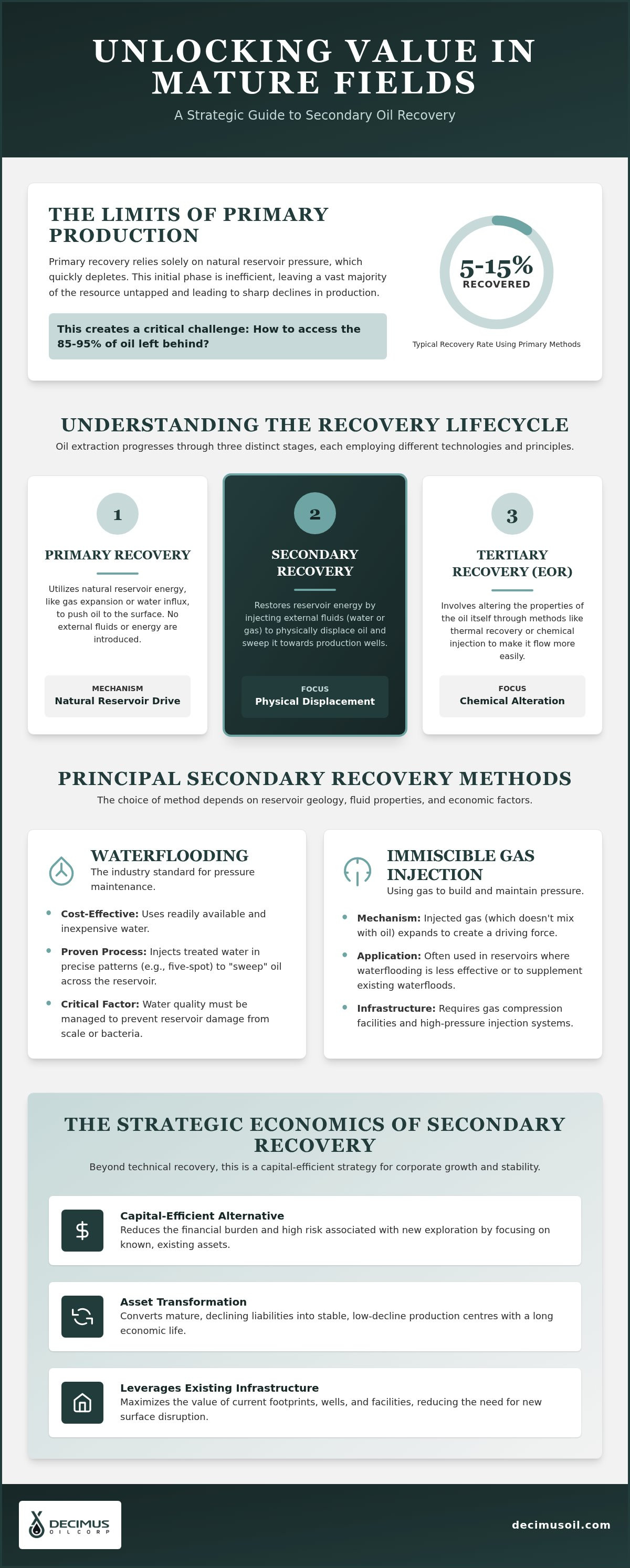
Secondary recovery represents the strategic shift from relying on natural reservoir energy to actively managing the subsurface environment. Primary recovery relies on natural reservoir drive, such as gas expansion or water influx, but these natural forces are finite. In most conventional plays, primary methods typically only extract 5 to 15 percent of the original oil in place (OOIP). Once this natural pressure dissipates, production rates plummet, leaving the vast majority of the resource trapped in the rock. This is where secondary oil recovery methods become vital, serving as an engineered intervention to restore reservoir energy and maintain the commercial viability of the asset.
The Mechanics of Reservoir Pressure Maintenance
Effective pressure maintenance involves the strategic injection of fluids, usually water or gas, to replace the volume of produced hydrocarbons. This process creates a physical drive that displaces the oil toward the production wellbore. However, success depends on rigorous reservoir characterization. Operators must analyze permeability, porosity, and fluid saturations to ensure the injected medium moves efficiently through the formation. By monitoring decline curve signals, such as a sharp drop in bottom-hole pressure or an increase in the gas-oil ratio, technical teams can determine the precise moment to transition into secondary oil recovery methods. This stage often integrates artificial lift systems to assist in moving fluids to the surface, though the primary focus remains on subsurface displacement. It is distinct from Enhanced Oil Recovery (EOR), which focuses on changing the chemical properties of the oil itself.
Historical Context in the Canadian Energy Sector
The Canadian energy landscape has shifted significantly from the era of high-risk greenfield exploration to a more sophisticated model of asset optimization. In the Western Canadian Sedimentary Basin, many mature fields have transitioned through multiple recovery phases over decades. Early secondary programs were often rudimentary, but modern advancements in horizontal drilling and 3D seismic imaging have refined the precision of these techniques. Today, sophisticated operators prioritize maximizing existing footprints over new drilling. This shift is driven by the need for capital efficiency and lower environmental impact. By extending the economic life of conventional assets, secondary recovery provides a stable production base that can weather market volatility. It transforms what might have been a liability into a high-margin, low-decline asset profile that supports long-term corporate growth.
Principal Methods: Waterflooding and Immiscible Gas Injection
The selection of secondary oil recovery methods depends heavily on the reservoir's geological characteristics and fluid properties. While primary recovery leaves significant volumes behind, the transition to secondary methods focuses on maintaining pressure and physically displacing oil toward production wells. The two primary pillars of this phase are waterflooding and immiscible gas injection. Both require sophisticated secondary recovery methods to be implemented with precision to ensure maximum sweep efficiency, which is the measure of how effectively the injected fluid contacts the reservoir's oil-bearing zones.
Successful implementation isn't just about injection; it's an infrastructure-intensive undertaking. Operators must manage complex water treatment facilities to prevent reservoir damage and gas compression stations to handle high-pressure injection. Integrating these components requires a high level of technical proficiency to realize the full economic potential of the asset. For those looking to optimize their portfolio through these proven techniques, exploring resource development opportunities can provide a framework for strategic growth.
Waterflooding Strategies and Implementation
Waterflooding remains the industry standard due to its cost-effectiveness and the high availability of water. Engineers design specific injection patterns, such as five-spot or seven-spot configurations, to ensure uniform displacement across the field. A critical factor in this process is water quality. Injected water must be treated to remove solids and oxygen, preventing scale formation or bacterial growth that could plug the pore spaces. As the field matures, managing the 'water cut', the ratio of water to oil produced, becomes a primary operational focus to maintain profitability and extend the economic life of the wellbore.
Gas Injection: When and Why to Use It
Immiscible gas injection is often preferred in reservoirs where waterflooding might cause formation damage or where natural gas is readily available. Unlike miscible injection used in EOR, this method maintains a distinct phase between the gas and the oil, primarily serving to provide pressure support. Operators may use natural gas or immiscible CO2 to displace hydrocarbons. The operational challenges here involve managing recycled gas and maintaining high-capacity compression infrastructure. While more complex than water handling, gas injection can be superior in certain geological formations where gravity drainage can be exploited to enhance recovery rates.
Secondary vs. Enhanced Oil Recovery (EOR): Understanding the Distinction
In the energy sector, the terms "secondary recovery" and "enhanced oil recovery" are frequently conflated, yet they represent distinct technical and economic milestones. While secondary oil recovery methods rely on physical displacement to maintain reservoir pressure, EOR (often termed tertiary recovery) involves a fundamental change in the reservoir's fluid properties. Understanding this distinction is essential for operators aiming to optimize recovery factors and manage capital expenditures effectively. Modern operations in the Western Canadian Sedimentary Basin increasingly blur these lines, integrating both stages to ensure maximum resource extraction.
Technical Framework: Physical vs. Chemical Changes
The primary objective of secondary methods is to provide a physical "push." By injecting water or immiscible gas, operators displace hydrocarbons toward the production well without altering the oil's chemical composition. In contrast, tertiary methods focus on "releasing" trapped oil that physical displacement alone cannot reach. This is achieved through thermal, chemical, or miscible gas injection which reduces oil viscosity or lowers interfacial tension. For a deeper look at these advanced methodologies, see our guide on Enhanced Oil Recovery Techniques: Maximizing Asset Value in the WCSB. Because EOR requires specialized chemicals or high-energy thermal inputs, the economic threshold for implementation is higher, necessitating a sophisticated cost-benefit analysis before transitioning from secondary oil recovery methods.
The Lifecycle of a Conventional Asset
Asset revitalization is a multi-phase journey that begins long before primary production fades. Sophisticated operators map the recovery stages from initial discovery to eventual abandonment, identifying the precise triggers for capital investment. Timing is everything. The transition usually occurs when water cuts rise or incremental gains from pressure maintenance stall. Decimus Oil Corp. utilizes its collective management experience to evaluate these critical junctures. We analyze reservoir performance data to determine if an asset is better served by continued pressure maintenance or a more intensive EOR program. This methodical approach ensures that infrastructure is utilized to its fullest extent while minimizing the risks associated with premature technology shifts.
Strategic Economics of Secondary Recovery in Canada
Capital efficiency remains the primary driver of corporate strategy when WTI crude prices trade at $95.58 per barrel. While greenfield exploration offers the allure of new discovery, it carries substantial geological risk and high entry costs. In contrast, secondary oil recovery methods allow operators to realize incremental value from proven reservoirs where the geological characteristics are already well understood. This transition significantly lowers the finding and development (F&D) costs per barrel, making it a superior choice for maintaining production levels without the volatility of high-risk drilling. For a comprehensive overview of how these financial drivers are shaping the industry, consult our report on Oil and Gas Exploration Economics: Strategic Trends and Value Drivers in 2026.
Capital Allocation and Risk Mitigation
Focusing on known reservoirs creates a predictable cash flow profile that is highly attractive to stakeholders and junior producers alike. Secondary recovery transforms high-decline primary production into a "low-decline" asset profile, which provides the financial stability needed for long-term capital appreciation. By reducing the uncertainty of the drill bit, companies can allocate capital more effectively, ensuring that every dollar spent contributes directly to production growth. With Canadian oil production projected to increase by 3.5 percent in 2026, the ability to squeeze more value from existing pools is a competitive necessity. This disciplined approach to resource development ensures that capital is preserved for the most high-potential opportunities within a portfolio.
Operational Efficiency and Infrastructure Synergy
The most sustainable and cost-effective barrel of oil is the one produced through an existing footprint. By leveraging established energy infrastructure, such as pipelines, compression stations, and water handling facilities, operators can drastically reduce their environmental impact and per-barrel operating expenses. Centralizing these facilities creates significant operational synergies, allowing for a higher netback on every produced unit. This integration of infrastructure management with recovery optimization is a hallmark of sophisticated operators. It allows for the revitalization of mature assets that might otherwise be slated for abandonment. To see how these strategies can enhance your portfolio, explore our resource development and investment options. Through technical proficiency and strategic asset management, mature fields are reimagined as high-margin production centres that support robust corporate growth.
Realizing Value: The Decimus Approach to Asset Optimization
Decimus Oil Corp. doesn't just manage assets; we revitalize them through a calculated, visionary approach to resource development. Our strategy centres on identifying specific conventional plays within the Western Canadian Sedimentary Basin where secondary oil recovery methods can be deployed with surgical precision. We prioritize reservoirs characterized by significant original oil in place (OOIP) that have yet to benefit from sophisticated pressure maintenance programs. By focusing on these mature fields, we drastically reduce the capital intensity and geological risk typically associated with greenfield exploration. This methodology ensures a stable, low-decline production base that remains resilient regardless of market fluctuations. Our ability to realize value where others see depletion is a direct result of our technical proficiency and strategic alignment.
A Legacy of Experience in the WCSB
Our management team brings over 100 years of combined experience to the table. This institutional knowledge is vital for navigating the intricate geological nuances of the WCSB. We apply a rigorous methodology to evaluate each asset's revitalization potential, integrating decades of historical performance data with high-intensity modern modelling techniques. This disciplined approach extends to our infrastructure management. We don't simply aim for volume; we focus on the integration of efficient water and gas handling systems to lower per-barrel costs. By maintaining this high level of operational integrity, we transform legacy assets into high-performing production centres that contribute to the long-term stability of our portfolio.
Investment Opportunities in Conventional Energy
For investors and stakeholders, our emphasis on recovery enhancement offers a sophisticated entry point into the Canadian energy landscape. As a publicly traded entity listed on the TSX Venture Exchange (TSXV:WCSB), Decimus Oil Corp. provides a transparent vehicle for capital appreciation. We maintain that the strategic application of secondary oil recovery methods represents the most reliable path to maximizing shareholder value in the current economic climate. Our operations generate predictable cash flows while providing the scalability required to capture upside as global demand evolves. We combine a seasoned leadership perspective with modern methodologies to ensure professional integrity at every stage of the lifecycle. We invite you to explore our strategic approach to energy asset management and learn how we optimize conventional resources for a growth-oriented future.
Advancing Asset Value through Strategic Recovery
The transition from primary production to secondary intervention is a defining moment for any conventional asset. By implementing secondary oil recovery methods such as waterflooding or gas injection, operators can stabilize production and transform mature fields into low-decline, high-margin production centres. This strategic shift doesn't just extend the lifecycle of a reservoir; it optimizes existing infrastructure and maximizes capital efficiency in a volatile market. Success in this phase requires a technical framework that distinguishes between physical displacement and advanced chemical alterations, ensuring the right technology is applied at the right time.
Decimus Oil Corp. combines over 100 years of management experience with a deep technical focus on the Western Canadian Sedimentary Basin to realize this value. As a publicly traded entity (TSXV:WCSB), we're committed to professional integrity and a disciplined approach to resource development. We invite you to learn more about Decimus Oil Corp.'s strategic resource development and see how our expertise can enhance your portfolio. The future of conventional energy lies in the sophisticated optimization of the assets we already hold.
Frequently Asked Questions
What is the primary difference between secondary and tertiary oil recovery?
Secondary recovery focuses on physical displacement and pressure maintenance using immiscible fluids like water or gas. Tertiary recovery, also known as Enhanced Oil Recovery (EOR), involves changing the chemical or physical properties of the oil itself through thermal, chemical, or miscible gas injection. While secondary methods "push" the oil toward the wellbore, tertiary methods "release" it by reducing viscosity or surface tension. This distinction is vital for technical and economic planning.
How much additional oil can be recovered through secondary methods?
Secondary oil recovery methods typically extract an additional 10 to 20 percent of the original oil in place (OOIP) beyond primary production. Since primary recovery often only captures 5 to 15 percent, the implementation of secondary techniques can effectively double the total yield of a conventional asset. These results depend on reservoir permeability and the efficiency of the displacement process. It's a proven strategy for extending a field's economic life.
Is waterflooding the only effective secondary recovery method used in Canada?
Waterflooding is the most prevalent technique, but immiscible gas injection is a highly effective alternative in specific geological settings. In Canadian plays where water might cause formation damage or where gas is readily available, injecting natural gas or CO2 provides necessary pressure support. Both methods serve the same strategic goal of maintaining reservoir energy to ensure consistent production. The choice depends on the specific characteristics of the hydrocarbon pool.
What are the infrastructure requirements for a successful waterflood program?
A successful waterflood program requires a robust network of injection wells, high-capacity pumps, and sophisticated water treatment facilities. Operators must ensure the water is filtered and chemically treated to remove oxygen and solids that could plug the reservoir pores. Additionally, centralized pipelines and monitoring systems are essential for managing the water cycle and tracking displacement efficiency. This infrastructure integration is key to maintaining a low-decline production profile and optimizing operating costs.
How does secondary recovery impact the environmental footprint of an oil field?
Secondary recovery reduces the overall environmental footprint by maximizing production from existing wellbores and infrastructure. Instead of drilling new "greenfield" sites, operators utilize established footprints to access remaining resources. This approach minimizes land disturbance and reduces the intensity of new construction. Additionally, modern water handling systems focus on recycling produced water, which decreases the demand for fresh water and ensures responsible resource management throughout the asset's lifecycle.
Why is secondary recovery considered a lower-risk investment than exploration?
Secondary recovery targets known reservoirs where the geology, fluid properties, and reservoir boundaries are already well defined. Exploration involves significant uncertainty regarding the presence and volume of hydrocarbons, which leads to higher finding and development costs. By focusing on proven plays, operators eliminate the risk of "dry holes" and can generate more predictable cash flows. This strategic focus provides a more stable foundation for long-term corporate growth and capital preservation.
Can secondary recovery methods be applied to all types of oil reservoirs?
Not all reservoirs are suitable candidates for secondary methods; success depends on factors like rock permeability and reservoir depth. Formations with extremely low permeability, such as some unconventional shale plays, may not respond well to traditional fluid injection. Additionally, reservoirs with complex faulting or high heterogeneity may struggle with sweep efficiency. A thorough technical evaluation and reservoir modelling phase are mandatory to determine if a specific asset can benefit from these techniques.
How does Decimus Oil Corp. utilize secondary recovery to drive shareholder value?
Decimus Oil Corp. (TSXV:WCSB) drives value by identifying mature, high-potential conventional assets and applying technical proficiency to optimize their recovery. With over 100 years of combined management experience, the team focuses on capital efficiency and infrastructure synergy to maximize netbacks. By transforming declining fields into stable production centres through secondary oil recovery methods, the company provides shareholders with exposure to low-risk resource development. This disciplined approach ensures long-term capital appreciation and operational integrity.


