
Enhanced Oil Recovery is no longer just a technical solution for declining reservoirs; it's a sophisticated financial instrument that transforms stranded resources into bankable, low-decline reserves. In a market where WTI crude trades near $97.26 per barrel and global EOR demand is projected to reach $57.9 billion by 2026, the strategic implementation of these technologies is vital. Many operators struggle with high initial capital requirements and the difficulty of quantifying the EOR impact on oil asset valuation for their stakeholders. You've likely felt the pressure of justifying these complex projects to reserves auditors who demand rigorous data before reclassifying contingent resources as proven reserves.
We agree that the path from secondary recovery to technical optimization is often clouded by financial uncertainty. This article provides the clarity you need by detailing how EOR techniques fundamentally redefine financial metrics and long-term asset worth. You'll discover a clear framework for assessing EOR-driven growth and understand the critical shift from contingent to proven reserves to improve your investment decision-making. We'll examine how technical proficiency in the Western Canadian Sedimentary Basin translates directly into realized shareholder value through disciplined resource development.
Key Takeaways
- Recognize how Enhanced Oil Recovery functions as a strategic financial instrument to unlock capital in mature fields, moving beyond simple production maintenance.
- Learn to navigate Canadian NI 51-101 standards to quantify the EOR impact on oil asset valuation by reclassifying contingent resources into bankable proven reserves.
- Discover how extending the production tail of a conventional asset through technical optimization significantly enhances terminal value while deferring substantial abandonment liabilities.
- Identify the critical valuation metrics, including NPV-10 and internal rate of return expectations, required to benchmark EOR-driven portfolios against greenfield exploration.
- Understand how sophisticated operators like Decimus Oil Corp. leverage technical proficiency to realize maximum asset value within the Western Canadian Sedimentary Basin.
The Financial Fundamentals of EOR in Asset Valuation
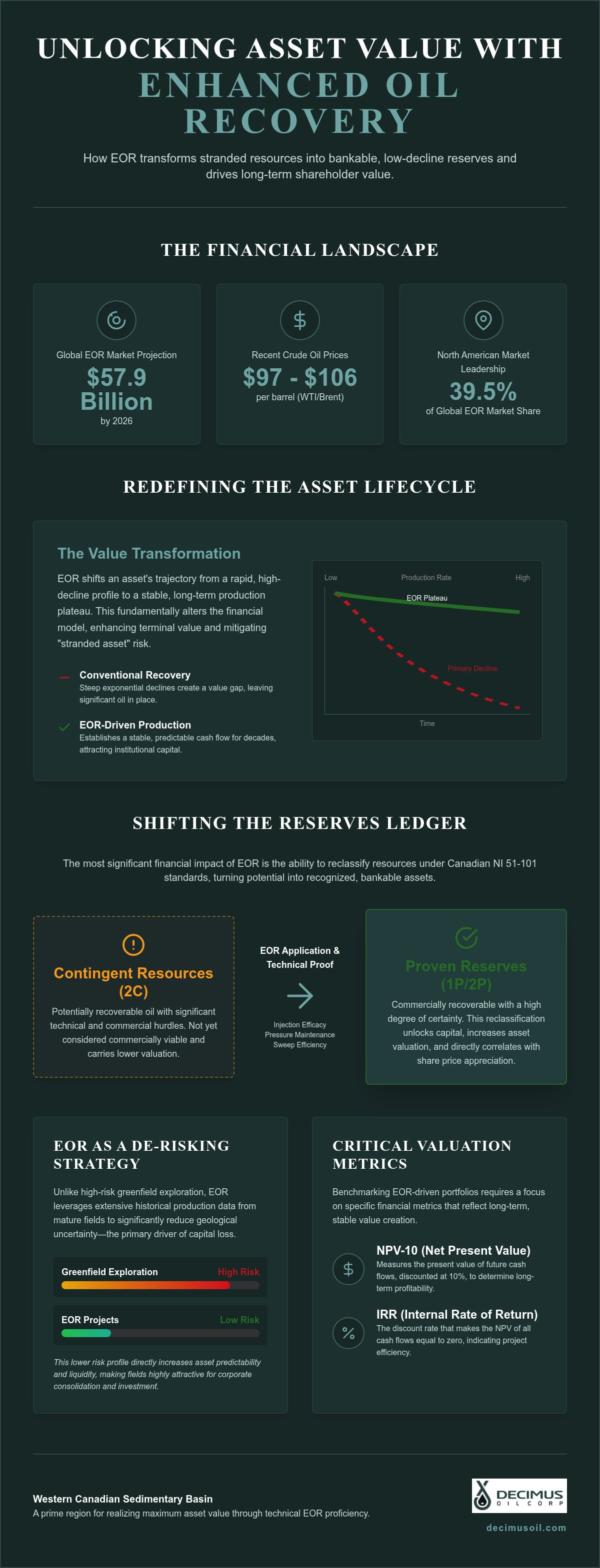
The financial performance of a conventional oil asset is traditionally governed by its decline curve. Primary and secondary recovery methods often leave a substantial portion of the original oil in place, creating a significant gap between potential and realized value. Enhanced Oil Recovery (EOR) serves as a strategic intervention that redefines this trajectory. It isn't merely a tool for production maintenance; it's a sophisticated value-driver that increases the recovery factor and, consequently, the asset's marketability. In technical terms, the EOR impact on oil asset valuation is the delta between the primary depletion value and the enhanced recovery Net Present Value (NPV).
Assets that utilize these techniques often command a valuation premium in the current market. Investors and stakeholders prioritize low-decline, predictable cash flows over the high-risk, front-loaded profiles often associated with greenfield exploration. With Brent crude oil prices reaching $106.12 per barrel as of September 2026, the financial incentive to maximize every barrel through technical proficiency has never been higher. North America is projected to lead the global EOR market with a 39.5% share this year, reflecting a broad shift toward resource development in mature basins where infrastructure is already established.
Beyond Primary Recovery: The Value Gap
Primary production is characterized by rapid initial rates followed by steep exponential declines. This creates a value gap where assets are prematurely classified as late-life or non-core, despite containing vast quantities of mobile oil. EOR bridges this gap by establishing a stable production plateau that can last for several decades. This stability effectively mitigates the "stranded asset" risk that often deters long-term institutional capital. To realize this value, operators must integrate robust energy infrastructure, as the synergy between injection facilities and reservoir management transforms technical potential into bankable, low-risk revenue streams.
EOR as a De-Risking Strategy for Portfolios
EOR projects benefit from an extensive foundation of historical production data. This wealth of information significantly reduces geological uncertainty, which is the primary driver of capital loss in the energy sector. By applying proven EOR technology to fields with known reservoir characteristics, operators can achieve a level of predictability that greenfield projects simply cannot match. This lower risk profile directly increases asset liquidity, making these fields highly attractive during corporate consolidations. For those seeking to understand the specific methodologies involved, we recommend reviewing our analysis on Maximizing Asset Value via Enhanced Oil Recovery. Utilizing these high-intensity methodologies allows firms to realize superior capital appreciation while maintaining professional integrity and operational excellence.
Shifting the Reserves Ledger: From Contingent to Proven
In the Canadian energy sector, the transition of resources across the reserves ledger is a critical driver of capital appreciation. National Instrument 51-101 (NI 51-101) provides the rigorous framework for these disclosures, ensuring that stakeholders receive transparent data regarding an operator's inventory. The EOR impact on oil asset valuation is most visible when technical success allows for the reclassification of contingent resources (2C) into proven (1P) or probable (2P) reserves. This shift isn't just a reporting formality; it represents the formal recognition of an asset's commercial viability and long-term cash flow potential.
Auditors require exhaustive technical proof before authorizing these adjustments. They look for evidence of injection efficacy, pressure maintenance, and sustained sweep efficiency. An economic analysis of CO2-EOR demonstrates that while capital intensity is high, the resulting reserve upgrades provide a significant buffer against market volatility. Understanding the EOR impact on oil asset valuation is essential for investors who want to identify undervalued companies with significant reclassification potential. For sophisticated operators, this reclassification often correlates directly with share price appreciation, as the market rewards the conversion of "possible" oil into "bankable" barrels.
The 1P and 2P Reserves Multiplier
The valuation of a junior or mid-cap producer is frequently tied to its Enterprise Value to Reserves (EV/Reserves) ratio. When EOR techniques move barrels into the 1P category, they immediately enhance the bankable borrowing base, providing the liquidity needed for further resource development. The multiplier effect of reserve reclassification on corporate credit allows firms to secure more favourable lending terms, effectively lowering the weighted average cost of capital. This financial leverage is a direct result of moving beyond the limits of primary depletion and establishing a stable, long-term production profile.
Technical Integrity and Audit Readiness
Achieving a reserve upgrade requires more than just reservoir potential; it demands proven operational excellence. Robust energy infrastructure management is essential for audit compliance, as it demonstrates the physical capacity to execute an EOR scheme. Detailed reservoir modelling serves as the primary justification for valuation increases, providing auditors with the data-driven confidence they require. Operators should first master secondary oil recovery methods to establish the baseline performance necessary for more advanced tertiary interventions. This methodical approach ensures that every technical advancement is reflected on the corporate balance sheet. If you're looking to optimize your portfolio, consider how Decimus Oil Corp. prioritizes technical proficiency to realize maximum asset value.
Extending the Economic Life of Mature Assets
Mature oil fields often face a binary fate: abandonment or revitalization. The EOR impact on oil asset valuation is perhaps most profound in the terminal phase of a field's lifecycle. When a field approaches its economic limit under primary or secondary recovery, its market value often drops toward its salvage value minus decommissioning liabilities. Implementing EOR pivots this narrative. It transforms a liability-heavy asset into a long-term cash flow generator by extending the production tail by decades. This shift moves the asset's terminal value from a near-term certainty to a distant projection, significantly altering the financial profile of the entire field.
This low-decline profile is especially valuable in a volatile price environment. While greenfield projects might struggle with price swings during their high-decline initial phase, EOR-enhanced assets provide a steady baseline that stabilizes corporate portfolios. It's a strategic advantage that allows operators to maintain production levels without the constant need for aggressive, high-risk drilling programs. Comparing the valuation of a field at the end of primary recovery versus its valuation at the start of an EOR program reveals a stark contrast in both risk profile and bankable value.
Delaying Asset Retirement Obligations (ARO)
One of the most significant financial benefits of EOR is the deferral of multi-million dollar abandonment costs. Decommissioning a field is a non-productive capital expenditure that can drain corporate liquidity. By extending the production life of a field, an operator pushes these Asset Retirement Obligations (ARO) further into the future. This improves the asset's Net Present Value by reducing the discounted weight of those eventual costs on today's balance sheet. Successfully executing Mature Oil Field Revitalization allows firms to reallocate capital toward growth and resource development rather than closure. It's a disciplined approach that maximizes the utility of every dollar spent on the field.
Infrastructure Utilization and Fixed Cost Dilution
Mature plays often possess extensive energy infrastructure that is already fully depreciated. EOR leverages this "sunk cost" by spreading ongoing maintenance and operational expenses over a significantly larger volume of enhanced barrels. This synergy between new recovery techniques and existing iron drives a higher margin per barrel. Effective EOR Development Strategies focus on this fixed cost dilution to maximize the bottom line. The EOR impact on oil asset valuation is thus a function of both increased revenue and optimized operational efficiency. It ensures that mature assets remain competitive even as newer plays face rising service costs and logistical hurdles. By focusing on technical proficiency, operators realize the full potential of their existing regional footprint.
Critical Valuation Metrics for EOR-Driven Portfolios
Quantifying the financial performance of enhanced recovery requires a shift from exploration-focused metrics to those that reward longevity and predictability. The industry standard for these evaluations remains NPV-10; however, the EOR impact on oil asset valuation is best understood by looking at the stability of the cash flow stream. While traditional drilling programs rely on high-intensity initial production, EOR focuses on the "Recycle Ratio." This metric measures investment efficiency by comparing the netback per barrel against the capital required to develop those reserves, providing a clearer picture of long-term profitability.
Lifting costs also undergo a significant transformation. Although injection requirements increase the per-barrel cost of production in the short term, the stabilization of decline rates dilutes fixed infrastructure costs over a much larger cumulative volume. This efficiency is critical when Brent crude trades at $106.12 per barrel, as it allows operators to capture higher margins over a longer duration than primary recovery alone would allow. It's this shift from "finding" costs to "optimization" costs that defines the modern approach to conventional assets.
NPV-10 and the Discounted Cash Flow Model
In a standard Discounted Cash Flow (DCF) model, the decline rate of an asset serves as a proxy for risk. A lower, more predictable decline rate justifies a reduced risk premium, which directly increases the present value of future revenues. Valuing the predictability of EOR production offers a stark contrast to the volatility of greenfield exploration. For instance, the Oil Field Waterflooding in Alberta demonstrates how secondary and tertiary methods provide a bankable baseline that supports corporate credit facilities. This technical certainty is what allows reserves auditors to assign higher valuations to mature fields.
Capital Intensity vs. Operational Longevity
EOR projects are characterized by high upfront capital expenditures (Capex). This initial investment is the price of entry for decades of low-maintenance production. When evaluating the EOR impact on oil asset valuation, sophisticated investors look past the initial cash outlay to the low operating expenses (Opex) that define the asset's mature life. This profile provides essential stability in a Canadian energy portfolio, acting as a hedge against the high-decline nature of unconventional plays. Junior oil stocks that successfully transition to EOR-optimized operations often see significant capital appreciation as their "Enterprise Value to Reserves" ratio improves. To see how these metrics drive results, learn more about our resource development strategies.
Strategic Investment in EOR-Optimized Assets
The 2026 Canadian energy landscape marks a definitive shift toward technical optimization. Enhanced Oil Recovery has transitioned from a niche application to a cornerstone of modern conventional oil and gas exploration. The EOR impact on oil asset valuation is no longer a theoretical projection; it's a realized financial reality for operators who prioritize resource development over speculative drilling. With North America projected to command nearly 40% of the global EOR market this year, the Western Canadian Sedimentary Basin remains a premier destination for disciplined capital. Investors are increasingly seeking out low-decline assets that provide stable production tails and deferred decommissioning liabilities, creating a clear valuation premium for technical leaders.
The Decimus Advantage: Technical and Financial Synergy
Decimus Oil Corp. leverages over 100 years of combined energy experience to navigate this complex environment. Our management team focuses on high-potential conventional plays where infrastructure optimization and high-intensity methodologies can be applied to maximize recovery factors. This technical depth allows us to realize asset value that others might overlook, transforming mature fields into high-margin revenue streams. We prioritize the "Recycle Ratio" as our primary measure of investment efficiency, ensuring that capital is deployed where it generates the highest netback per barrel. For those looking to understand the broader market context, our guide on Public Equity in Energy provides essential insights for navigating the Canadian upstream sector.
Realizing Value Through Operational Excellence
Operational excellence is the mechanism through which we maximize shareholder returns. By aligning existing energy infrastructure with advanced EOR strategies, we ensure that every barrel produced contributes to a robust corporate balance sheet. The path forward for Decimus Oil Corp. (TSXV:WCSB) is defined by a commitment to professional integrity and a calculated vision for capital appreciation. We invite stakeholders to explore the unique opportunities within our portfolio, where the EOR impact on oil asset valuation is central to our long-term growth strategy. As the industry moves toward a future of higher efficiency and technical sophistication, our role as a seasoned operator remains vital for realizing the full potential of Canadian energy resources.
Realizing Future Value in the Canadian Energy Sector
The transition toward technical optimization represents a fundamental shift in how assets are priced and managed within the Western Canadian Sedimentary Basin. By understanding the EOR impact on oil asset valuation, operators can move beyond the limitations of primary depletion to establish stable, bankable reserves that command a valuation premium. We've explored how technical success allows for the reclassification of contingent resources into proven reserves, while simultaneously deferring multi-million dollar abandonment costs. This dual benefit creates a superior risk-adjusted profile for mature fields, ensuring they remain competitive and liquid even in volatile global markets.
Decimus Oil Corp. (TSXV:WCSB) brings over 100 years of combined energy leadership experience to this landscape, specializing in the revitalization of high-potential conventional assets. Our focus on operational efficiency and strategic infrastructure management ensures that technical proficiency translates directly into long-term capital appreciation for our stakeholders. We're committed to a future where innovation and financial discipline intersect to realize the full potential of our regional resources. Explore investment opportunities with Decimus Oil Corp. (TSXV:WCSB) and join us as we lead the next era of Canadian energy development.
Frequently Asked Questions
How does EOR specifically increase the Net Present Value (NPV) of an oil asset?
EOR increases NPV by extending production life and increasing the total recovery factor. It replaces high-decline primary production with steady, low-decline cash flows. This predictability reduces the risk premium applied in discounted cash flow models. By capturing more barrels from the same reservoir, the EOR impact on oil asset valuation manifests as a higher net present value compared to primary depletion alone. This technical success transforms stranded resources into bankable revenue.
Can EOR move contingent resources to proven reserves for NI 51-101 reporting?
Yes, EOR implementation is a primary mechanism for reclassifying contingent resources into proven reserves under NI 51-101 standards. Once technical and commercial viability is demonstrated through pilot or full-scale projects, auditors can move these barrels onto the proven reserves ledger. This reclassification is vital for junior producers as it expands their bankable borrowing base. The shift from contingent to proven status directly correlates with corporate valuation growth and improved market liquidity.
What is the typical impact of EOR on an oil field's decline curve?
EOR fundamentally alters the decline curve by establishing a stable production plateau that can last for several decades. While primary recovery follows a steep exponential decline, enhanced recovery maintains reservoir pressure to slow the rate of depletion. This flattening of the curve provides the long-term cash flow stability that institutional investors prioritize. It transforms a late-life asset into a reliable production engine, allowing for more accurate long-term financial planning and capital allocation strategies.
How does EOR implementation affect a company's Asset Retirement Obligations (ARO)?
EOR implementation delays Asset Retirement Obligations by extending the economic life of the field. By pushing decommissioning and abandonment costs further into the future, the discounted present value of these liabilities is significantly reduced on the balance sheet. This deferral preserves corporate liquidity and allows operators to reallocate capital toward further resource development. It effectively turns a near-term financial liability into a distant projection, improving the overall net present value of the asset.
Is EOR more cost-effective than new conventional oil exploration in Canada?
EOR is often more cost-effective because it utilizes existing wellbores and established energy infrastructure. New exploration involves high geological risk and significant finding costs, whereas EOR targets known reservoirs with historical production data. This lower risk profile, combined with the ability to leverage sunk costs in the field, often results in superior recycle ratios. It allows operators to realize value from existing assets without the high-intensity capital requirements of greenfield drilling programs.
What role does energy infrastructure play in EOR asset valuation?
Energy infrastructure is the primary driver of EOR asset valuation. Existing pipelines, processing facilities, and injection wells represent significant capital already deployed. The synergy between this infrastructure and advanced recovery techniques dilutes fixed operational costs over a larger volume of enhanced barrels. A well-maintained network is essential for audit readiness and justifies a higher market price. Infrastructure optimization ensures that technical proficiency in the reservoir translates directly into realized value on the balance sheet.
Why do investors prioritize EOR-enhanced assets in a volatile energy market?
Investors prioritize EOR-enhanced assets because they offer a hedge against price volatility. The low-decline nature of these fields ensures steady revenue even when crude prices fluctuate. Unlike high-decline unconventional plays that require constant drilling to maintain production levels, EOR assets provide a stable baseline. This reliability is attractive in the current energy landscape where operational efficiency is paramount. The EOR impact on oil asset valuation is driven by this predictability and lower geological risk.
How can I invest in Canadian companies focusing on Enhanced Oil Recovery?
You can invest in the Canadian EOR sector through public equity listings on the TSX Venture Exchange. Decimus Oil Corp. (TSXV:WCSB) provides direct exposure to conventional resource development and technical optimization in the Western Canadian Sedimentary Basin. Our firm focuses on realizing value through technical proficiency and operational excellence. With over 100 years of combined energy leadership, we prioritize high-potential conventional plays to drive capital appreciation and long-term shareholder value across our national portfolio.


