
The era of chasing expensive greenfield discoveries is being eclipsed by a more sophisticated, capital-efficient reality: the high-intensity revitalization of existing assets. Asset managers currently face the relentless pressure of high decline rates and the prohibitive costs of new exploration, often while managing legacy reservoirs where bypassed hydrocarbons remain trapped. Understanding the shifting eor project economics Canada is now essential for any Canadian operator looking to maintain a competitive edge.
This article provides the technical and economic roadmap to transform these aging assets into high-yield production centres using modern revitalization strategies. We'll examine how the 2026 expansion of the CCUS Investment Tax Credit, offering a 25% credit for capture equipment, has fundamentally altered the financial viability of secondary and tertiary recovery. We'll preview the strategic framework required to lower your cost-per-barrel production and significantly extend the economic life of your most reliable assets through 2026 and beyond.
Key Takeaways
- Learn why revitalizing brownfield assets often provides a superior ROI compared to high-risk greenfield exploration by leveraging existing infrastructure and proven reserves.
- Understand how to utilize Rate Transient Modelling and precision reservoir synthesis to identify high-value bypassed pay zones within legacy reservoirs.
- Evaluate the shifting eor project economics Canada to determine when a mature asset reaches its true economic limit and becomes a prime candidate for high-intensity revitalization.
- Implement a systematic, phase-based workflow that begins with a comprehensive diagnostic audit of both subsurface data and surface infrastructure to protect capital.
- Discover how professional operators realize shareholder value by bridging the gap between technical revitalization and strategic public equity investment opportunities.
Assessing the Strategic Value of Mature Oil Field Revitalization
The decision to revitalize a legacy asset begins when the cost of production approaches the revenue generated by primary or secondary recovery. This threshold, known as the economic limit, marks the transition point where an operator must decide between abandonment or a high-intensity strategic redeployment of capital. Evaluating the eor project economics Canada requires a shift in perspective from simple maintenance to high-intensity investment. In 2026, the case for the latter is stronger than ever. The brownfield advantage lies in the existing footprint; by utilizing established wellbores, processing facilities, and pipelines, operators can bypass the lengthy permitting cycles and massive capital outlays associated with greenfield projects.
Strategic asset optimization directly supports corporate stability by transforming unpredictable decline curves into reliable production centres. From an environmental perspective, reusing existing sites minimizes new surface disturbances and leverages already-impacted land, aligning with modern ESG expectations and provincial regulatory frameworks. This approach maximizes the utility of every hectare already under lease.
Economic Drivers for Revitalization in 2026
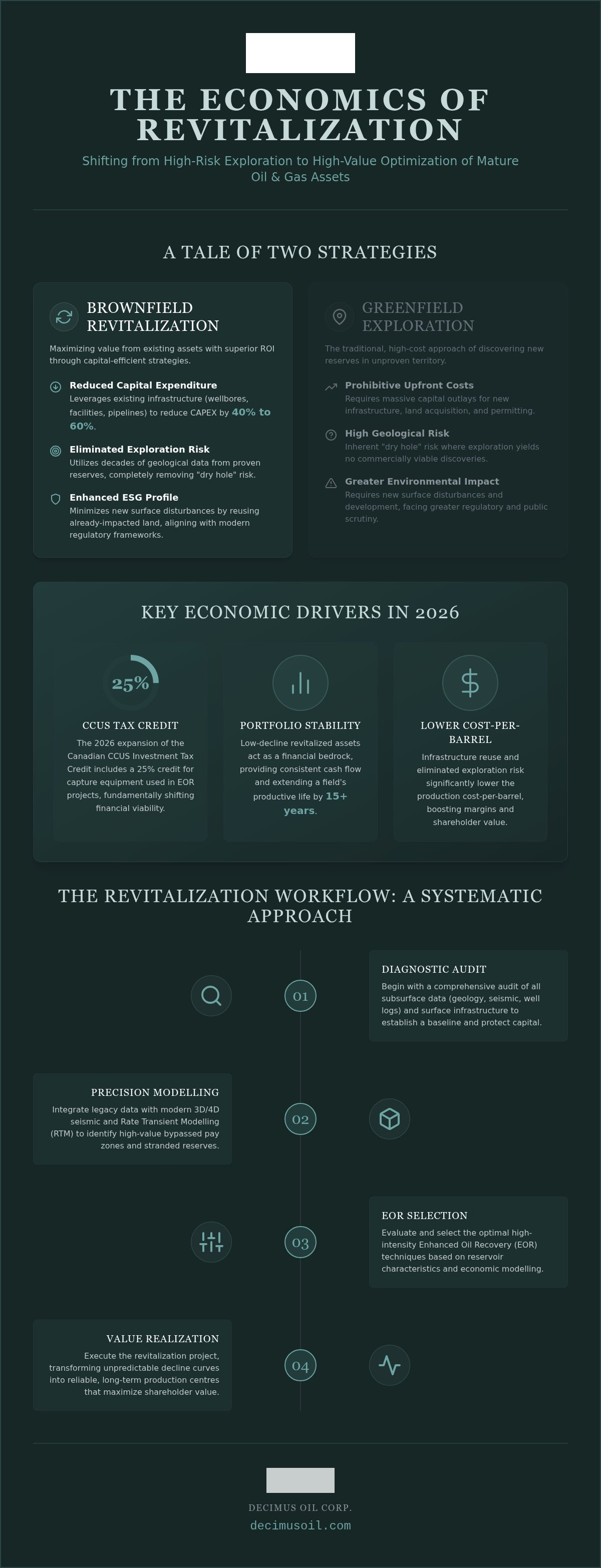
Analyzing oil and gas exploration economics reveals that the cost-per-barrel for revitalized assets is often significantly lower than that of new discoveries. This is largely due to infrastructure reuse, which can reduce CAPEX requirements by 40% to 60% compared to building new facilities. The 2026 expansion of the CCUS Investment Tax Credit, which now includes a 25% credit for capture equipment used in EOR, has fundamentally shifted eor project economics Canada. Operators can now realize tax-advantaged returns while utilizing decades of established geological data to eliminate the dry hole risk inherent in exploration.
The Role of Low-Decline Assets in Portfolio Stability
Low-decline assets act as the financial bedrock of a resilient energy company. These assets provide the consistent cash flow required to fund ongoing resource development and shareholder dividends. By applying Enhanced Oil Recovery (EOR) techniques, companies can flatten decline curves and extend the productive life of a field by 15 years or more. Balancing a portfolio with a mix of high-growth exploration and steady-state revitalization creates a barbell strategy. This approach secures immediate liquidity through optimized recovery while maintaining exposure to long-term growth opportunities. Asset lifecycle management is no longer about managing decline; it's about active value realization and maximizing the recovery factor of every reservoir in the portfolio.
Integrating Subsurface Data for Precision Reservoir Modelling
Precision reservoir modelling serves as the definitive bridge between historical production and future profitability. For operators evaluating eor project economics Canada, this process involves the complex synthesis of legacy well data with modern seismic imaging to pinpoint exactly where previous recovery efforts failed. It's a forensic approach to geology. By utilizing 3D and 4D seismic technology, technical teams can map remaining hydrocarbon saturation with a level of clarity that was impossible during the initial development phase of these fields. This multi-dimensional view allows for the identification of stratigraphic traps and compartmentalized zones that were overlooked by earlier, less sophisticated exploration techniques.
Rate Transient Modelling (RTM) has emerged as a critical diagnostic tool for assets that have underperformed their original projections. It allows engineers to ascertain whether lower-than-expected recovery stems from poor reservoir connectivity, skin damage, or mechanical failures within the wellbore. This technical clarity is essential for justifying the capital expenditure required for tertiary recovery. Integrating sporadic legacy records with real-time production metrics ensures that every new investment is based on corroborated facts. This rigorous data corroboration process reduces the uncertainty that often plagues mature field revitalization projects.
Identifying Bypassed Pay and Stranded Reserves
Locating pockets of oil missed by original vertical drilling requires a combination of high-resolution imaging and advanced analytics. Bypassed pay is defined as hydrocarbons left behind due to reservoir heterogeneity or inefficient primary recovery. Horizontal drilling now allows operators to intersect multiple bypassed zones from a single pad, which improves the overall recovery factor and reduces the environmental footprint. Re-evaluating historical geological surveys with modern AI-driven algorithms often reveals stranded reserves that were previously deemed non-commercial. These algorithms can identify subtle patterns in log data that human interpretation might miss.
Corroborating Legacy Data with Modern Performance Metrics
Cleaning and organizing historic well logs is the first step toward successful digital integration. This process transforms paper records into high-confidence targets for re-entry or infill drilling. By aligning these datasets, operators can build models that predict performance with greater accuracy. As you refine your subsurface strategy, resource development expertise can help translate these technical models into operational success. An Alberta government report on EOR highlights that this data-centric approach is vital for the economic integration of carbon capture and enhanced recovery. This alignment of legacy data and modern metrics is the cornerstone of sustainable asset revitalization.
Selecting High-Intensity Enhanced Oil Recovery (EOR) Techniques
Selecting the appropriate methodology for asset revitalization is a complex decision that balances reservoir physics with financial discipline. Many operators still rely on standard secondary oil recovery methods to maintain production. However, the 2026 landscape demands a shift toward high-intensity tertiary techniques. This transition is essential for reservoirs where primary energy is spent. Optimizing eor project economics Canada requires a precise match between the recovery method and the specific geological characteristics of the WCSB. For many conventional plays, this means moving beyond simple pressure maintenance toward chemical or thermal injections that alter fluid properties within the reservoir.
Waterflooding and Pressure Maintenance
Modern waterflooding remains the backbone of revitalization strategies, yet it differs vastly from legacy techniques through the use of precision injection. Operators now utilize sophisticated sensors to monitor voidage replacement ratios in real time, ensuring that reservoir energy is maintained at optimal levels. This precision prevents the premature breakthrough of injected fluids, which has historically plagued less rigorous secondary efforts. Integrating robust water handling infrastructure into the revitalization plan is essential for managing the increased fluid volumes associated with these projects. By optimizing the sweep efficiency of a waterflood, companies can significantly lower their cost-per-barrel production while extending the asset's economic life.
High-Intensity Completion Technology
A significant shift is occurring in conventional reservoirs where operators are deploying high-intensity completion technology to unlock previously inaccessible reserves. High-intensity completions are defined as the application of increased proppant and fluid volumes to maximize near-wellbore conductivity. The impact of multi-stage fracturing on mature assets is profound. It creates an extensive network of fractures that can intersect bypassed pay zones identified during the modelling phase. Re-fracking existing horizontal wells has also become a viable strategy for realizing value without the expense of drilling new wellbores. This approach allows for a high-intensity redeployment of capital into proven assets, providing a predictable path to production growth. When executed correctly, these advanced completions ensure that eor project economics Canada remain favourable even in a volatile pricing environment.
A Step-by-Step Workflow for Mature Field Revitalization
Success in mature field revitalization depends on a rigorous, phase-based execution model that prioritizes capital protection. Operators cannot afford to deploy capital based on antiquated geological assumptions; they must instead adopt a systematic approach that validates every technical claim before full-scale investment. Analyzing eor project economics Canada reveals that a phased workflow significantly reduces the risk of project failure by identifying mechanical or subsurface bottlenecks early in the lifecycle. This methodical process ensures that every C$1 invested in the reservoir is backed by corroborated data and operational readiness.
Phase 1: Diagnostic and Integrity Audit
The first stage of any revitalization project is a comprehensive diagnostic audit of both the subsurface assets and the existing surface facilities. Wellbore integrity is the primary concern during this phase. Engineers must evaluate whether legacy casings and cement jobs can withstand the increased pressures associated with modern enhanced oil recovery techniques. Simultaneously, a thorough assessment of surface infrastructure determines if existing separators, pumps, and pipelines can manage the higher fluid volumes or corrosive chemicals required for tertiary recovery. A detailed cost-benefit analysis at this stage compares the long-term value of equipment upgrades against the immediate cost of replacement, providing a clear financial roadmap for the project.
Phase 2: Implementation and Optimization
Once the audit confirms the technical viability of the asset, the project moves into pilot testing and realignment. This phase involves executing the first stage of the EOR program, such as realigning a waterflood pattern to better address the bypassed pay zones identified in the modelling stage. Precision is vital here. Operators utilize real-time telemetry to monitor reservoir response, tracking pressure changes and fluid movements as they happen. This immediate feedback loop allows technical teams to adjust injection rates and pressures based on early performance data, ensuring the program remains optimized for the specific reservoir heterogeneity. As you refine these operational parameters, leveraging professional energy infrastructure management ensures your facilities remain resilient under high-intensity conditions.
Phase 3 involves full-scale deployment across the entire field. This transition only occurs once the pilot data confirms that the eor project economics Canada meet the required internal rate of return. Continuous production monitoring remains a permanent fixture of the operation, allowing the team to realize sustained value through incremental improvements. This workflow transforms a declining legacy asset into a predictable, high-yield production centre that contributes long-term stability to the corporate portfolio.
Decimus Oil: Realizing Value Through Operational Excellence
Decimus Oil Corp. (TSXV:WCSB) operates at the intersection of technical engineering and disciplined financial management. Our strategy focuses on identifying undervalued, conventional assets within the Western Canadian Sedimentary Basin that possess significant revitalization potential. By applying over 100 years of combined team experience, we transition these legacy reservoirs from declining liabilities into high-performing production centres. This approach ensures that we don't just maintain existing production; we actively enhance it. Our commitment to maximizing the recovery factor of every asset is central to our mission of realizing long-term value from Canada's proven resources.
The Decimus Advantage in Asset Revitalization
The core of our operational success lies in the execution of high-intensity completions and the active management of energy infrastructure. We understand that technical success is the primary driver of financial performance. By maintaining a lean, high-intensity operational model, Decimus Oil Corp. optimizes the eor project economics Canada for every asset within its portfolio. This optimization is achieved through several strategic pillars:
- Internal Expertise: Utilizing a deep understanding of WCSB geology to execute complex re-fracking and patterns realignment.
- Infrastructure Synergy: Owning and managing the infrastructure necessary to support EOR operations, which reduces third-party costs and improves uptime.
- Capital Appreciation: A relentless focus on lowering cost-per-barrel production to drive shareholder returns.
Our methodology prioritizes risk mitigation. By focusing on low-decline oil assets with established production histories, we provide a more stable investment profile compared to pure-play exploration companies. We believe that the most efficient way to grow is through the precise application of modern technology to known hydrocarbon accumulations.
Investing in the Future of Canadian Conventional Oil
Mature field revitalization provides a stable foundation for growth that is often overlooked in the broader energy market. There is a powerful synergy between technical asset optimization and public equity in the energy sector. As a TSXV-listed operator, Decimus Oil Corp. offers investors transparency and direct exposure to the high-yield potential of revitalized conventional plays. We maintain a high level of professional integrity, supported by a significant 27% insider ownership that aligns our leadership's interests directly with those of our stakeholders.
Investing in Decimus Oil Corp. means participating in the strategic optimization of the Canadian energy landscape. As the eor project economics Canada continue to improve with new federal tax credits and streamlined regulatory environments, we are positioned to lead the next wave of brownfield development. We invite you to join us as we continue to realize the untapped potential of the WCSB through operational excellence and strategic capital deployment. It's a future built on the stability of the past and the innovation of the present.
Advancing the Next Generation of Canadian Energy Recovery
The transition from greenfield exploration to high-intensity brownfield revitalization is a defining trend for the 2026 energy landscape. By leveraging precision subsurface modelling and modern completion technologies, operators can effectively mitigate risk while maximizing the recovery factor of proven reservoirs. This strategic framework demonstrates that eor project economics Canada are increasingly favourable for those who prioritize operational excellence and infrastructure efficiency. The roadmap provided here ensures that legacy assets are viewed as growth opportunities rather than liabilities.
Decimus Oil Corp. (TSXV:WCSB) applies these methodologies with professional integrity and a focus on shareholder value. Our leadership brings over 100 years of combined experience to high-potential conventional plays, ensuring we're positioned to capitalize on the stability of low-decline assets. As a publicly traded company on the TSX Venture Exchange, we offer a transparent path for investors to engage with the sophisticated optimization of Canadian energy resources.
Invest in Strategic Energy Growth with Decimus Oil Corp. (TSXV:WCSB)
The potential within the Western Canadian Sedimentary Basin remains vast for those with the technical vision to unlock it. It's time to realize the full value of our conventional legacy.
Frequently Asked Questions
What is mature oil field revitalization?
Mature oil field revitalization is the strategic process of redeploying capital and technology into legacy assets to extract hydrocarbons that primary and secondary methods missed. This approach focuses on extending the economic life of proven reservoirs rather than abandoning them. By utilizing modern engineering and high-intensity completion techniques, operators can transform declining fields into high-yield production centres, maximizing the recovery factor while leveraging existing surface infrastructure and established geological data.
How does enhanced oil recovery (EOR) differ from primary production?
Primary production relies on the reservoir's natural pressure to drive oil to the wellbore, typically recovering only a small fraction of the total resource. Enhanced oil recovery (EOR) is a tertiary phase that involves injecting external substances, such as carbon dioxide, chemicals, or steam, to alter the fluid's properties or restore pressure. This method is essential for optimizing eor project economics Canada, as it targets the significant volumes of oil left behind after initial extraction phases.
Is revitalizing an old field more cost-effective than drilling new wells?
Revitalizing a mature field is often more cost-effective because it utilizes the brownfield advantage. Existing roads, pipelines, and processing facilities are already in place, which significantly reduces capital expenditure compared to greenfield exploration. Additionally, the availability of decades of geological data reduces the technical risk. While new wells involve high-risk exploration, revitalization focuses on proven accumulations, leading to a lower cost-per-barrel and more predictable returns for stakeholders and investors.
What are the main risks associated with mature field revitalization?
The primary risks include wellbore integrity issues in legacy infrastructure and the technical complexity of reservoir heterogeneity. Old casings or cement may not withstand the high pressures required for modern EOR. There's also the risk that bypassed pay zones aren't as productive as models suggest. Operators mitigate these risks through comprehensive diagnostic audits and pilot testing phases before committing to full-scale deployment, ensuring that capital remains protected throughout the asset's lifecycle.
How long does it take to see results from a revitalization project?
Timelines for revitalization vary based on the project's scope, but initial results from pilot testing are often observed within six to twelve months. The process begins with a diagnostic phase lasting several months, followed by the implementation of specific recovery techniques. Full-scale production increases typically realize their peak over several years as the reservoir responds to pressure maintenance or chemical injections. A disciplined, phase-based workflow ensures that operational adjustments are made in real-time to optimize performance.
What role does data play in modern oil field optimization?
Data is the cornerstone of modern optimization, providing the forensic evidence needed to locate stranded reserves. Technical teams synthesize legacy well logs with modern 3D and 4D seismic to create precision reservoir models. Techniques like Rate Transient Modelling (RTM) help engineers understand why previous recovery efforts failed and where bypassed pay remains. This data-centric approach is vital for justifying the eor project economics Canada, transforming historical production records into actionable strategies for future growth.
How does Decimus Oil Corp. identify fields for revitalization?
Decimus Oil Corp. utilizes over 100 years of combined team experience to identify undervalued assets within the Western Canadian Sedimentary Basin. We focus on low-decline oil assets where historical data suggests significant bypassed hydrocarbons. Our team looks for fields with existing infrastructure that can be strategically managed to support EOR operations. By combining geological proficiency with a disciplined financial lens, we select projects that offer the highest potential for capital appreciation and long-term production stability.
Can revitalization techniques be applied to gas fields as well as oil fields?
Revitalization techniques are highly effective for conventional gas fields, though the specific methods differ from oil recovery. For gas assets, optimization often involves installing advanced compression, executing infill drilling to tap into compartmentalized zones, or improving water handling systems to manage liquid loading. These strategies focus on lowering the abandonment pressure of the reservoir, allowing for a higher ultimate recovery factor. This ensures that conventional gas resources contribute steady cash flow to a diversified energy portfolio.


