
The highest returns in upstream energy aren't coming from multi-billion-dollar megaprojects; they belong to disciplined conventional assets. Across modern oil and gas exploration drilling Canada presents exceptional opportunities for operators who prioritize swift cycle times and steady netback margins over deep, capital-intensive acreage.
You already know the operational friction that comes with the territory. Extended cycle times, volatile field service costs, and evolving federal emissions frameworks create persistent uncertainty. At the same time, separating genuinely accretive conventional drilling programs from capital-heavy unconventional ventures has never been more difficult for leadership teams and investors.
Discover how modern exploration drilling drives Canadian energy reserves, mitigates capital risk, and unlocks conventional development opportunities. This guide examines modern exploration lifecycles across key formations, establishes practical criteria for evaluating high-margin programs, and outlines capital allocation strategies that position Canadian upstream operators for substantial equity upside.
Key Takeaways
- Understand the modern lifecycle stages of oil and gas exploration drilling Canada utilizes to de-risk subsurface assets before deploying significant field capital.
- Differentiate the capital efficiency and faster payout profiles of conventional drilling programs from resource-intensive unconventional developments.
- Review essential environmental compliance frameworks, including federal methane mandates and groundwater protection standards, that govern domestic drilling operations.
- Establish rigorous financial evaluation metrics to accurately measure finding and development costs against long-term reservoir recovery.
- Examine how integrated energy infrastructure ownership protects operating netbacks and maximizes shareholder value from drilled reserves.
The Modern Landscape of Oil and Gas Exploration Drilling in Canada
Exploration drilling represents the definitive physical validation of subsurface hydrocarbon prospects across the country. While remote sensing identifies prospective acreage, only the drill bit confirms effective porosity, fluid saturation, and initial reservoir drive mechanisms. As documented in this Canadian petroleum industry overview, domestic upstream operations rely on a sophisticated synthesis of field geology and optimized drilling execution to transform speculative targets into productive assets. Contemporary operators no longer spud exploratory wildcats based on legacy trend analysis alone; they demand comprehensive geoscientific alignment to safeguard capital.
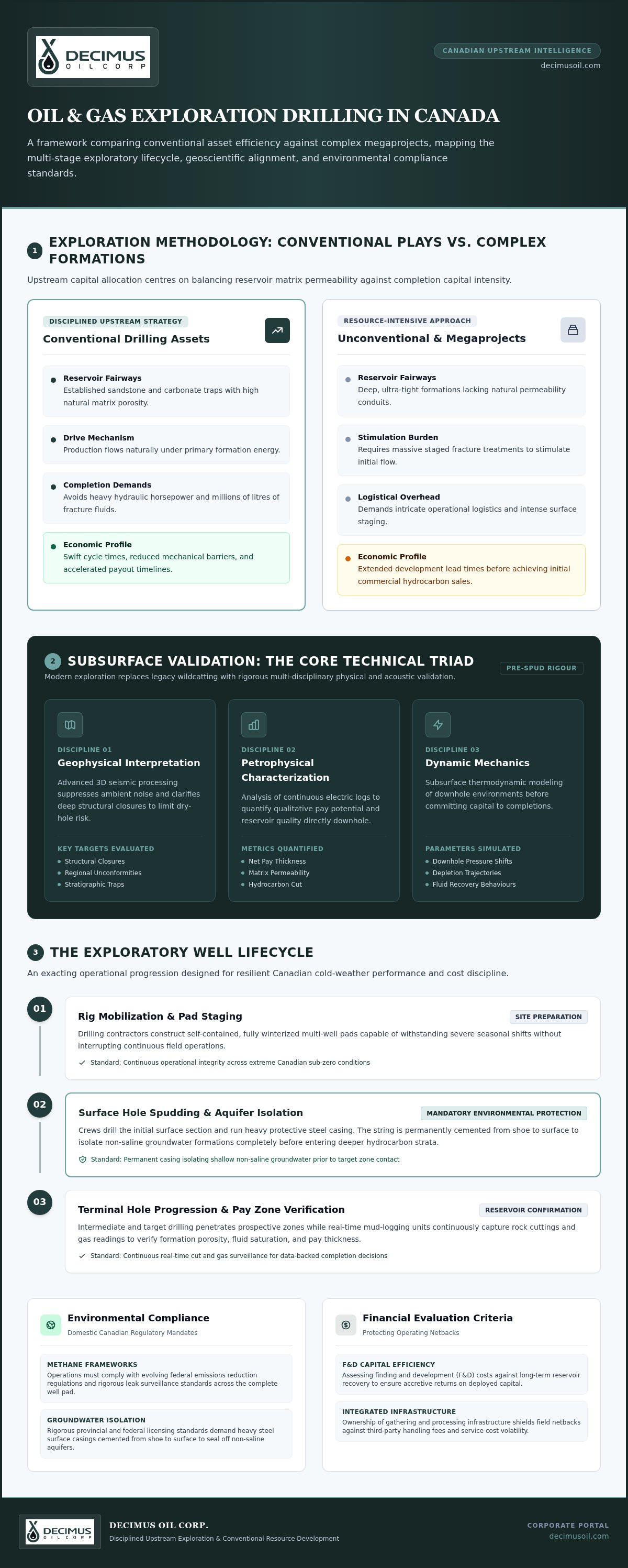
Precision execution defines modern programs. High-resolution three-dimensional seismic modeling and automated rig configurations ensure that exploration expenditures remain tightly managed. In the sector of oil and gas exploration drilling Canada rewards disciplined operators who combine advanced geological analytics with systematic risk mitigation. Rather than pursuing capital-intensive megaprojects blindly, agile producers validate strategic development plays by integrating three core technical disciplines:
- Geophysical interpretation: Identifying structural closures, unconformities, and stratigraphic traps before staging heavy drilling assets.
- Petrophysical characterization: Evaluating continuous electric logs to quantify net pay thickness, effective matrix permeability, and hydrocarbon cut.
- Dynamic reservoir mechanics: Modeling downhole pressure transitions, depletion trajectories, and fluid recovery behaviours prior to completing the wellbore.
Geophysical Reconnaissance and Well Planning Fundamentals
Subsurface mapping pinpoints subtle stratigraphic traps and porosity anomalies across prospective acreage. Advanced 3D processing suppresses seismic noise and clarifies deep structural closures, dramatically reducing dry-hole incidence before operators commit to civil lease preparation. Rigorous licensing frameworks mandate meticulous casing and cementing programmes, ensuring heavy protective steel isolates shallow non-saline groundwater formations well before the bit touches hydrocarbon-bearing target zones.
The Step-by-Step Exploratory Well Lifecycle
Exploratory drilling follows an exacting operational schedule designed for resilient cold-weather performance. Moving from initial site development to final reservoir penetration requires systematic execution:
- Rig mobilization and pad staging: Drilling contractors construct self-contained, winterized multi-well pads capable of withstanding severe seasonal shifts without interrupting operations.
- Surface hole spudding: Crews drill the initial hole section and run heavy surface casing, permanently cementing it from shoe to surface to protect freshwater aquifers.
- Terminal hole progression: Intermediate drilling penetrates deeper formations while real-time mud-logging units continuously capture rock cuttings and gas readings to verify pay zones.
This systematic lifecycle establishes operational control over drilling expenditures, ensuring that conventional exploration programs evaluate reservoir potential safely and cost-effectively.
Evaluating Exploration Methodologies: Conventional Plays Versus Complex Formations
Exploration strategy hinges upon balancing reservoir permeability against completion capital intensity. While deep, ultra-tight formations dominated the headlines of the past decade, upstream operators face a stark operational reality: complex reservoirs demand massive fracture treatments, intricate logistics, and long lead times before generating initial sales. In contrast, conventional exploration prioritizes permeable sandstone and carbonate reservoirs that flow under primary formation energy, substantially lowering mechanical barriers to entry.
Conventional Reservoir Exploration and Technical Advantages
Targeted exploration across established carbonate and sandstone fairways delivers marked operational advantages. By selecting structural and stratigraphic traps characterized by high natural matrix porosity, operators avoid the substantial hydraulic horsepower requirements and millions of litres of completion fluid demanded by tight plays. This operational distinction fundamentally improves project economics; detailed analysis in oil and gas exploration economics demonstrates that conventional wells routinely reach corporate payout faster due to lower upfront drilling and completion expenditures.
Capital Allocation: Conventional Assets Versus Unconventional Megaprojects
Capital allocation decisions ultimately dictate corporate resilience and equity upside. Unconventional multi-stage horizontal programs suffer from aggressive initial decline curves, often losing 50% to 70% of their initial production rate within the first twelve months. This dynamic creates a capital treadmill, forcing operators to reinvest cash flows constantly just to maintain base production. Conventional development presents a disciplined operational counterweight:
- Predictable decline profiles: Flatter, more stable depletion rates allow dependable reservoir forecasting and consistent cash flow generation.
- Compressed operational cycles: Shorter drilling intervals enable teams to move from spudding to pipeline sales in a fraction of the time.
- Insulation from service inflation: Lower reliance on complex hydraulic fracturing equipment shields operators from cyclical pumping cost spikes.
When executing oil and gas exploration drilling Canada provides distinct geological horizons where conventional techniques yield superior capital efficiency. Operators don't need to chase capital-intensive megaprojects to build sustainable corporate reserves. Strategic investors evaluating low-cost resource upside can review corporate opportunities with Decimus Oil Corp. to see how disciplined conventional development delivers long-term shareholder value.
Environmental Governance and Safety Standards Guiding Canadian Drilling
Canada maintains one of the most comprehensive regulatory environments in the global upstream sector, ensuring that asset development operates under strict environmental and structural safeguards. Regulatory oversight operates across both federal and provincial jurisdictions, meaning operators must execute wellbore designs that satisfy dual-tier compliance frameworks. For companies active in oil and gas exploration drilling Canada mandates rigorous engineering controls, closed-loop fluid management, and complete mechanical containment from the moment an exploratory spud begins.
Operating responsibly preserves corporate license and protects bottom-line capital. Forward-looking operators treat regulatory compliance not as an administrative hurdle, but as a framework for protecting corporate liability ratings and safeguarding project equity. Demonstrating operational discipline across environmental governance demands specific, auditable field protocols:
- Closed-loop drilling systems: Utilizing high-efficiency solids-control centrifuges and specialized shale shaker screens from a reputable industrial vibratory screens manufacturer to separate cuttings mechanically, enabling full mud recycling while preventing drilling fluids from touching the ground.
- Mandatory baseline testing: Conducting verifiable pre-spud geochemical water surveys within regional perimeters to benchmark aquifer conditions ahead of rig mobilization.
- Continuous liability auditing: Active management of asset retirement obligations through timely remediation schedules that keep corporate liability scores intact.
Aquifer Isolation and Subsurface Wellbore Integrity
Safeguarding groundwater remains the absolute priority of Canadian downhole engineering standards. Multi-barrier casing designs deploy high-strength steel strings through all non-saline potable intervals. Before drillers can advance toward deeper formations, the surface casing must be cemented to surface. Specialized logging tools run radial acoustic cement bond logs across intermediate intervals, confirming a continuous hydraulic seal against formation migration. Meanwhile, surface blowout prevention equipment undergoes mandatory pressure-testing cycles to ensure wellbore pressure containment under any reservoir condition.
Surface Disruption Mitigation and Emissions Control
Modern Canadian drilling locations look nothing like the sprawling operations of previous generations. Pad layouts concentrate multi-well programs onto single cleared lease footprints, minimizing aggregate surface disruption and preserving regional topsoil integrity. On the emissions front, modern rigs integrate automatic vapour recovery units on active mud tanks and tie directly into localized field electrification grids where available, drastically reducing diesel combustion. These engineering mitigations work hand in hand with progressive site reclamation, allowing operators to return peripheral surfaces to their native ecology long before the production phase concludes.
Core Economic and Technical Metrics for Assessing Drilling Programs
Institutional evaluation of Canadian drilling programs demands moving past raw initial flow announcements to examine standardized capital efficiency metrics. High headline rates mean little if excessive completion costs erode program economics or if steep downhole declines quickly deplete reservoir pressure. When allocating capital across oil and gas exploration drilling Canada requires technical screening models that benchmark operational execution against proven reserve additions. Savvy energy investors track these exact dynamics; our junior oil and gas producers guide details how equity analysts isolate high-performing operators from balance-sheet-constrained drillers.
Rigorous operational benchmarking relies on a concise set of financial ratios and production measurements:
- Finding and development (F&D) costs: Measuring all land acquisition, exploratory drilling, and facilities capital divided by the proven reserves added.
- Operating recycle ratio: Dividing operating netback per barrel of oil equivalent by proven F&D costs to quantify capital turnover efficiency.
- Stabilized production rates: Benchmarking thirty-day (IP30) and ninety-day (IP90) production to determine sustainable deliverability under choke management.
Finding and Development Costs and Capital Efficiency
Finding and development metrics serve as the definitive acid test for exploration discipline. Low F&D costs confirm precise subsurface targeting, efficient drilling operations, and controlled casing execution. When an operator posts an operating recycle ratio above 2.0x, the asset generates twice the capital required to replace the produced barrel. This level of return enables an upstream company to self-fund exploratory growth internally rather than continuously tapping capital markets for debt or dilutive equity financings.
Analyzing Initial Production and Decline Profiles
Initial production metrics provide early confirmation of reservoir deliverability, but unadjusted 24-hour test rates frequently mislead outside observers. Analysts prioritize IP30 and IP90 data, which reveal true formation drawdown, continuous fluid mix, and pressure maintenance. In deep, complex plays, hyperbolic depletion curves often mask severe second-year production declines. Conversely, conventional development programs exhibit flatter harmonic depletion profiles, preserving steady operating cash flows over multi-year operational cycles. For an in-depth breakdown of basin-wide operational models, read our analysis on WCSB resource development.
To evaluate how low-cost conventional exploration translates directly into resilient shareholder value, explore public investment opportunities with Decimus Oil Corp. (TSXV:WCSB) today.
Strategic Resource Development: Capitalizing on Canadian Drilling Opportunities
Successful drilling represents only the initial phase of maximizing full lifecycle asset value. Striking hydrocarbons validates the subsurface model, but commercial success depends entirely on post-discovery execution. In the execution of oil and gas exploration drilling Canada rewards operators who systematically integrate exploratory spuds with owned processing infrastructure and secondary recovery planning from day one. Without strategic infrastructure access, even prolific discoveries suffer from diminished netbacks and delayed revenues.
The Multiplier Effect of Midstream Infrastructure Integration
Connecting newly drilled conventional wells directly into operator-controlled pipeline systems accelerates first-sales timelines significantly. When producers depend on third-party gathering systems and third-party processing plants, escalating handling fees quickly erode operating margins. Owning midstream infrastructure insulates operators from third-party tariff volatility, optimizes fluid handling, and enables field teams to manage gas-to-oil ratios to capture high-value liquids at the wellhead.
Extending Reservoir Value Through Secondary Recovery
Exploratory discoveries provide foundational assets that sustain enterprise growth when paired with active pressure maintenance strategies. Implementing waterflooding or pressure support stabilizes reservoir energy early, preventing premature deliverability decline. Applying established enhanced oil recovery techniques transforms successful exploratory penetrations into durable, multi-decade cash-flow generators that sustain corporate payouts.
Participating in Canadian Conventional Upstream Growth
Public markets reward operators that demonstrate disciplined capital deployment alongside tangible management alignment. Canadian public energy vehicles provide transparent pathways for investors to capture resource expansion; review our evaluation frameworks within public equity in energy.
Decimus Oil Corp. pairs over 100 years of collective technical and managerial experience with high-margin conventional exploration and integrated energy infrastructure. With over 27 percent insider ownership, management remains aligned directly with public shareholders to maximize capital efficiency across every drill program. Investors evaluating conventional energy development can access Decimus Oil Corp. public equity trading under the ticker TSXV:WCSB.
Unlocking Resilient Value Through Disciplined Upstream Drilling
Disciplined conventional exploration has emerged as the definitive driver of sustainable upstream capital efficiency. By targeting high-permeability reservoirs, prudent operators compress project cycle times, minimize completion expenditures, and avoid the punishing decline curves typical of capital-heavy megaprojects. When supported by direct pipeline access and proactive secondary recovery, oil and gas exploration drilling Canada transforms prospective subsurface geology into durable, long-term cash generation.
Achieving superior returns in this operating environment demands both proven field expertise and rigorous corporate governance. Decimus Oil Corp. pairs over 100 years of combined technical leadership with a focused strategy centered on high-margin conventional development and integrated energy infrastructure. With over 27 percent insider equity ownership, our management team's incentives are directly aligned with public shareholders through every phase of exploration. Explore strategic growth and public equity investment with Decimus Oil Corp. (TSXV:WCSB) to participate in the future of Canadian conventional energy.
Frequently Asked Questions
What is the primary difference between exploratory drilling and development drilling in Canada?
Exploratory drilling tests unproven geological traps to discover new reserves, whereas development drilling drains known, delineated pools. When conducting oil and gas exploration drilling Canada operators evaluate wildcat or delineation wells under higher technical risk, demanding rigorous petrophysical logging, mud-gas monitoring, and core extraction. Once reservoir boundaries, rock porosity, and initial flow rates are verified, companies transition to lower-risk development drilling focused on pad optimization and predictable extraction.
How do Canadian exploration operators mitigate dry-hole risk before mobilizing drilling rigs?
Operators mitigate dry-hole exposure by integrating high-resolution three-dimensional seismic data with regional petrophysical offset modeling before licensing well sites. Advanced seismic amplitude processing reveals structural closures, fault traps, and subtle stratigraphic pinch-outs. Exploration teams also correlate historic open-hole wireline logs, hydrodynamic pressure gradients, and geological core samples from nearby historical penetrations. This exhaustive technical review confirms trap integrity and reservoir quality before staging drilling rigs on lease.
Why is conventional exploration drilling considered more capital-efficient than deep shale megaprojects?
Conventional exploration targets permeable formations that flow under native reservoir energy without requiring massive hydraulic fracture treatments. Deep shale programs demand intensive multi-stage fracturing, substantial fluid volumes, and continuous reinvestment just to combat steep initial decline rates. In contrast, conventional wells require simpler casing completions and experience gentler decline curves. This operational profile lowers initial capital expenditure, compresses corporate payout periods, and insulates operators from service cost inflation.
What environmental regulations govern casing integrity and groundwater protection in Canadian drilling?
Canadian drilling directives mandate multi-barrier steel casing strings permanently cemented to surface through all non-saline potable groundwater zones. Provincial and federal frameworks require surface casing to reach deep below fresh aquifer formations. In addition, exploration teams must run acoustic cement bond logs to prove impermeable barriers between the casing and formation rock, while surface blowout preventers undergo regular mandatory pressure testing to guarantee mechanical integrity.
How long does it take from exploratory well licensing to first production in Canada?
The typical timeline from licence approval to initial hydrocarbon sales spans three to six months for conventional drilling projects. Environmental baseline assessments and permit approvals precede civil lease preparation, which takes roughly one to two weeks depending on seasonal surface ground conditions. Active drilling requires seven to twenty days, followed by completion logging and testing. If pipeline gathering infrastructure is already accessible, tie-in happens almost immediately.
What role does enhanced oil recovery play following a successful exploratory drilling campaign?
Enhanced oil recovery provides vital pressure support to maximize total hydrocarbon recovery long after primary production slows. Initial exploratory penetrations prove the existence of original hydrocarbons in place, but primary depletion typically recovers only a fraction of conventional oil. Implementing secondary recovery methods, such as strategic waterflooding, sustains reservoir drive energy early. This moderates decline curves and transforms an exploratory success into a multi-decade cash-flow asset.
How can investors gain direct market exposure to Canadian conventional oil and gas drilling?
Investors can gain liquid exposure to conventional upstream expansion by investing in publicly traded exploration and production equities. Canadian energy vehicles like Decimus Oil Corp., trading on the TSX Venture Exchange under ticker TSXV:WCSB, offer focused participation in conventional drilling and resource development. Backing operators that combine substantial technical experience with high insider ownership and integrated infrastructure allows shareholders to participate in exploration growth while mitigating downside operational risk.


