
Chasing aggressive drilling growth is often the quickest path to balance sheet destruction in the Canadian upstream sector. Long-term outperformance among junior oil and gas producers rarely comes from debt-fuelled expansion; it demands disciplined operating netbacks, low-decline conventional reserves, and strategic control over regional infrastructure.
Evaluating small-cap energy equities in Canada can be difficult when shifting liability regulations, egress constraints, and complex decline curves obscure true commercial strength. You already recognize that distinguishing resilient, cash-generative operators from over-leveraged juniors is the difference between durable returns and capital destruction during commodity downturns.
This evaluation guide delivers a clear framework to evaluate Canadian junior energy equities using balance sheet stress tests, technical upstream metrics, and disciplined asset development models. We examine the exact operational benchmarks, liability assessments, and conventional optimization strategies required to screen top-tier operators with complete confidence.
Key Takeaways
- Screen Canadian junior oil and gas producers effectively by prioritizing operating netback resilience, predictable decline rates, and conservative leverage over unhedged volume growth.
- Differentiate high-cost resource play drilling from targeted conventional exploration, where existing gathering infrastructure and enhanced recovery techniques unlock higher capital efficiency.
- Apply a structured due diligence framework to quantify hidden balance sheet liabilities, specifically provincial asset retirement obligations and evolving liability management benchmarks.
- Identify shareholder-aligned management teams that utilize substantial insider equity ownership to eliminate dilutive equity financings and protect small-cap capital.
Defining the Junior Oil and Gas Producer Landscape in Canada
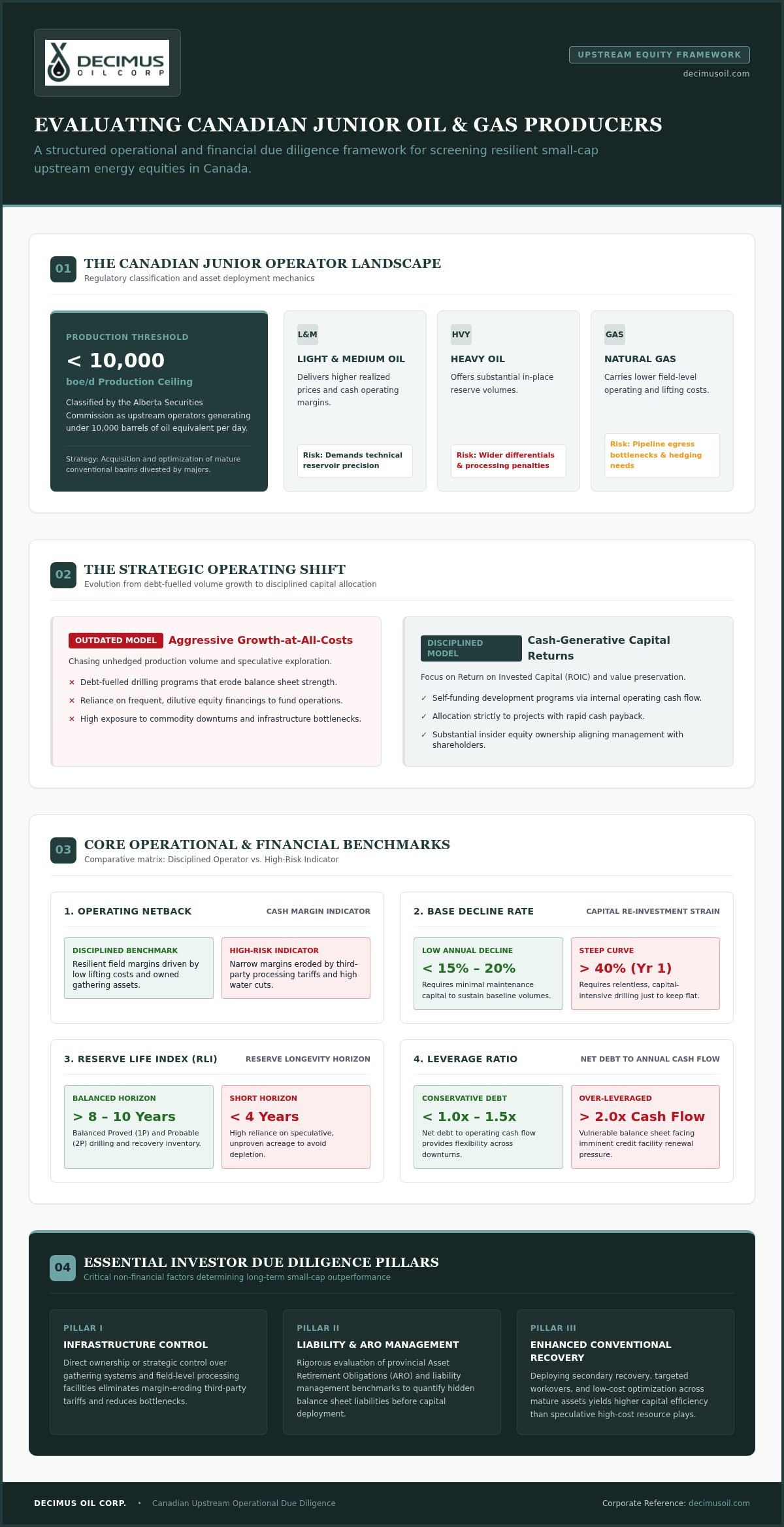
Within the broader petroleum industry in Canada, market regulators like the Alberta Securities Commission classify upstream operators producing under 10,000 barrels of oil equivalent per day (boe/d) as juniors. Rather than pursuing massive, capital-intensive shale programs, agile junior oil and gas producers carve out competitive advantages by acquiring, optimizing, and extending the life of mature conventional basins. Intermediate and major producers routinely divest these steady, lower-tier assets to fund large-scale megaprojects. This divestment cycle creates high-margin runway for disciplined small-cap operators who understand local geology and hold existing gathering infrastructure.
Operational Criteria and Production Thresholds
Production scale among junior operators spans a wide spectrum, from early-stage entities generating a few hundred boe/d to established operators approaching the 10,000 boe/d ceiling. Commodity weighting dictates operational risk across this cohort:
- Light and Medium Oil: Delivers higher realized prices and cash operating margins, though reservoir management requires technical precision.
- Heavy Oil: Offers substantial reserve volumes but exposes cash flow to wider quality differentials and processing penalties.
- Natural Gas: Carries lower field-level operating costs, yet regional pipeline egress bottlenecks demand robust hedging programs.
Working capital liquidity dictates how quickly a company can react to operational bottlenecks. A healthy balance sheet gives operators the flexibility to execute workovers, install secondary recovery systems, and optimize field facilities without waiting on external financing approvals.
The Shift from Growth-at-All-Costs to Disciplined Returns
The historical model of using aggressive debt to drill speculative exploration wells has been replaced. High-performing junior oil and gas producers now focus primarily on return on invested capital (ROIC), maintaining conservative leverage ratios, and protecting equity value. Instead of targeting production expansion for its own sake, disciplined leadership teams allocate capital strictly toward projects with immediate cash payback.
Self-funding development programs through internal operating cash flow shields small-cap enterprises from dilutive share offerings. When capital discipline takes precedence over speculative exploration, junior energy companies retain operating flexibility across full commodity cycles. They deliver repeatable value, manage environmental obligations methodically, and position themselves as reliable vehicles for long-term equity growth.
How to Evaluate Junior Oil and Gas Producers: Core Criteria
Assessing small-cap energy operators requires looking past top-line production volumes. A producer delivering 3,000 boe/d with high lifting costs and heavy debt often carries far greater downside risk than a lean operator producing 500 boe/d with owned processing infrastructure. Investors analyzing junior oil and gas producers must assess full-cycle capital efficiency, asset decline stability, and balance sheet endurance across volatile market cycles.
| Evaluation Metric | Disciplined Operator Benchmark | High-Risk Indicator |
|---|---|---|
| Operating Netback | Resilient field margins driven by low lifting costs and owned gathering assets | Narrow margins eroded by third-party processing tariffs and high water cuts |
| Base Decline Rate | Low annual decline (under 15% to 20%) requiring minimal maintenance capital | Steep first-year decline curves (exceeding 40%) requiring relentless drilling |
| Reserve Life Index (RLI) | Balanced Proved (1P) and Probable (2P) inventory extending beyond 8-10 years | Short reserve horizon under 4 years with high reliance on unproven acreage |
| Leverage Ratio | Net debt to annualized operating cash flow below 1.0x to 1.5x | Net debt exceeding 2.0x cash flow with imminent credit facility renewals |
Operating Netbacks and Field-Level Efficiencies
Operating netback represents the cash generated per barrel after subtracting royalties, lifting expenses, and transportation charges from gross revenue. According to Canada Energy Regulator data, structural egress limits and regional basis differentials directly impact realized Canadian prices. Operators that control proprietary gathering lines and battery facilities preserve their field margins by avoiding third-party tariffs. Understanding these core drivers within oil and gas exploration economics allows investors to identify resilient cash generation during price pullbacks.
Decline Profiles and Reserve Replacement
Reservoir mechanics dictate capital intensity. Unconventional shale wells typically exhibit steep initial declines, forcing operators onto a high-capex treadmill simply to hold output steady. Conventional pools, by contrast, offer predictable, shallow decline trajectories. This lower decline burden allows junior oil and gas producers to direct cash flow toward debt retirement or share buybacks instead of non-stop drilling. A robust Reserve Life Index across 1P and 2P categories ensures long-term viability without taking on speculative wildcat risk.
Balance Sheet Health and Debt Serviceability
Restricted access to public debt capital makes balance sheet discipline essential for junior operators. Regional lenders reassess borrowing bases bi-annually, meaning over-leveraged companies risk severe credit curtailments when benchmark energy prices soften. Reviewing credit facility terms and working capital provides clarity on whether a company commands real operational autonomy. Investors tracking capital-disciplined operators can review Decimus Oil's low-leverage model to see how balance sheet strength protects equity value throughout commodity cycles.
Strategic Operating Models Across Canadian Junior Producers
Operating strategies across the Western Canadian Sedimentary Basin reveal a sharp divergence in how small-cap operators generate returns. While large-cap entities commit vast balance sheet resources to multi-well pad drilling in deep unconventional formations, top-tier junior oil and gas producers establish durable competitive advantages through targeted execution. These agile operators focus on three interconnected operating models: low-cost conventional exploration, secondary field recovery, and proprietary infrastructure ownership.
Conventional Oil and Gas Exploration
Targeting conventional reservoirs provides small operators with distinct economic advantages over capital-intensive shale programs. Because conventional formations lie at shallower depths, drilling and completion expenditures remain comparatively low. Junior teams leverage reprocessed 3D seismic data and modern subsurface mapping to identify bypassed pay zones within mature fields. These projects feature brief cycle times from initial licensing to sales pipeline tie-in, allowing operators to adjust field activity swiftly when regional commodity dynamics shift.
Enhanced Oil Recovery and Secondary Extraction
Secondary extraction strategies eliminate the high risks tied to wildcat exploration by revitalizing proven producing pools. Implementing advanced enhanced oil recovery techniques, including reservoir pressure maintenance and waterflood optimization, allows operators to recover significant hydrocarbons left behind by primary production. These methods flatten corporate decline profiles, extend reserve life indices, and establish predictable baseline cash flows that shield operators from cyclical volatility.
Infrastructure-Integrated Development
Controlling processing batteries and gathering pipelines transforms upstream economics for small-cap producers. Operating without proprietary facilities exposes small operators to escalating third-party processing tariffs and pipeline shut-ins during periods of high regional line pressure. Strategic energy infrastructure management gives operators direct commercial control over their production routing while lowering operating costs per barrel. In addition, processing third-party equity volumes through wholly owned facilities generates steady, fee-based handling revenue, establishing non-dilutive income that strengthens overall corporate liquidity.
Risk Management and Due Diligence for Energy Investors
Evaluating risk within the public equity energy sector requires a systematic screening process. Because small-cap equities offer asymmetric upside paired with operational sensitivity, institutional investors rely on a structured five-step due diligence framework:
- Liability Assessment: Quantify inactive well inventories and calculate total asset retirement obligations (ARO) relative to active cash-generating production.
- Netback Stress-Testing: Model field-level cash margins against widened quality differentials and shifting transportation tolls.
- Decline Audit: Verify corporate decline trajectories against historical production curves to confirm ongoing capital reinvestment demands.
- Infrastructure Control: Measure proprietary gathering access against high third-party handling dependencies.
- Governance Screening: Audit executive compensation structures and equity ownership to confirm real balance sheet stewardship.
Auditing Liability Management and Regulatory Standing
Provincial regulators across Western Canada enforce rigorous liability management frameworks that track inactive well reclamation. For junior oil and gas producers, unmanaged abandonment obligations represent a serious balance sheet hazard. When operators carry extensive non-producing liabilities without dedicated closure spending, regulators can mandate substantial cash security deposits. Forward-looking management teams actively fund remediation schedules each year, protecting their licenses, banking facilities, and equity value from regulatory encumbrances.
Commodity Exposure and Risk Mitigation
Widening pipeline differentials and regional maintenance outages can compress realized prices overnight. Prudent operators insulate their cash flows by executing systematic hedging programs using collars and swap contracts. Locking in defensive price floors ensures that capital development programs remain fully funded without tapping external debt during market downturns, while retaining upside participation when benchmark commodity pricing accelerates.
Management Alignment and Insider Equity Stake
Significant insider equity ownership serves as the most reliable indicator of genuine shareholder alignment. When corporate officers and technical directors hold sizable equity positions, capital allocation shifts from dilutive volume growth to per-share cash flow expansion. Executive teams focused on building net asset value prioritize disciplined reinvestment over cash-heavy executive compensation. Explore Decimus Oil's corporate strategy to evaluate how high insider alignment and technical expertise drive sustainable capital execution in the Canadian market.
Spotlight on Decimus Oil Corp: The Disciplined Conventional Model
Operating as a benchmark among Canadian upstream operators, Decimus Oil Corp. demonstrates how targeted conventional development generates resilient value. Rather than chasing high-cost, speculative acreage, the company focuses on proven reservoirs, secondary extraction, and strategic midstream integration across the Western Canadian Sedimentary Basin. This disciplined framework separates leading junior oil and gas producers from capital-destructive peers, establishing stable per-share growth without burdening balance sheets with dangerous leverage.
A successful track record reinforces this focused approach. Decimus has achieved and sustained production growth tracked continuously since 2021. Backed by over 100 years of combined executive and technical experience, corporate leadership applies sophisticated engineering methodologies to optimize legacy fields, ensuring development targets yield high-margin, low-decline production.
Conventional Exploration Paired with Infrastructure Control
Field-level margins depend directly on facility ownership. Decimus pairs targeted conventional drilling with owned gathering lines and processing facilities, insulating operations from third-party tariff inflation. Proprietary infrastructure access ensures that operated barrels flow smoothly to sales lines, lowering operating costs and defending netbacks through regional price swings.
Applying modern completion techniques to bypassed pay sections unlocks meaningful reserve potential from established formations. Rather than bearing the immense capital outlays tied to multi-mile shale pads, the company revitalizes existing wells and installs secondary pressure systems. This methodology achieves rapid payback intervals, protects reservoir integrity, and secures reliable base cash flows across multiple operational cycles.
Shareholder-Centric Strategy on the TSX Venture Exchange
Trading under the ticker TSXV:WCSB, the company gives public equity investors direct commercial exposure to disciplined Canadian upstream execution. Alignment between executive leadership and public market stakeholders remains foundational:
- Insider Equity Ownership: Management and board members hold over 27% insider equity ownership, ensuring capital decisions mirror the financial interests of external shareholders.
- Anti-Dilutive Capital Discipline: Substantial insider alignment discourages the dilutive share issuances that historically eroded small-cap equity value.
- Execution Focus: Capital allocation centres strictly on cash-generative operational enhancements, debt discipline, and long-term asset value optimization.
For institutional and retail market participants evaluating high-efficiency Canadian small caps, visit Decimus Oil Corp to examine corporate presentations, technical operations, and TSXV:WCSB investment data.
Positioning Capital for the Next Upstream Growth Cycle
Evaluating small-cap Canadian energy equities requires looking past top-line production growth. Sustainable performance among junior oil and gas producers is built on resilient operating netbacks, low-decline conventional reservoirs, and proactive liability management. Operators that secure direct ownership over regional processing infrastructure while funding capital projects through internal cash generation remain best equipped to withstand commodity price swings.
Decimus Oil Corp. demonstrates the commercial strength of this focused operational approach. Led by an executive and technical team with over 100 years of combined energy industry experience, the company has delivered production growth sustained and tracked continuously since 2021. With over 27% insider equity ownership ensuring direct alignment with public shareholders, management maintains strict discipline to avoid dilutive capital measures while optimizing high-margin conventional pools. Explore investment opportunities in Canadian energy with Decimus Oil Corp to participate in a proven, infrastructure-backed growth model built for long-term equity value.
Frequently Asked Questions
What defines a junior oil and gas producer in the Canadian energy sector?
Canadian securities regulators and market conventions classify junior oil and gas producers as upstream exploration and production companies generating under 10,000 barrels of oil equivalent per day (boe/d). These entities focus primarily on conventional resource exploration, asset optimization, or targeted play development. Their lean corporate structures allow them to exploit niche geological assets that intermediate or senior operators divest to focus on large-scale development programs.
How do junior oil and gas companies differ from intermediate and senior producers?
Junior operators differ from larger peers across scale, operational flexibility, and capital allocation models. While senior and intermediate producers manage massive multi-billion-dollar budgets and deep unconventional portfolios, juniors focus on targeted operational efficiency. They possess faster decision-making cycles and lower corporate overheads. This structural agility allows junior firms to generate meaningful per-share production growth from mature or conventional pools that wouldn't impact the balance sheets of intermediate producers.
Why is insider equity ownership critical when evaluating junior energy stocks?
High insider equity ownership confirms that management's financial incentives mirror those of public shareholders. When executives hold a substantial equity stake, such as over 20% or 27%, they prioritize per-share value creation over speculative growth. This high level of insider alignment discourages dilutive equity offerings, excessive corporate salaries, or reckless debt accumulation during cyclical peaks, protecting shareholder capital through full commodity cycles.
What role does enhanced oil recovery play in a junior producer's portfolio?
Enhanced oil recovery (EOR) provides junior operators with low-risk reserve additions and predictable cash generation. Techniques like waterflooding and pressure maintenance extract additional hydrocarbons from established, mature reservoirs. Unlike greenfield exploration, secondary recovery avoids dry-hole risk and dampens asset decline curves. This operational approach extends field lifespans and generates consistent, high-margin production without requiring heavy ongoing drilling expenditures.
How do pipeline egress and takeaway capacity affect Canadian junior operators?
Regional pipeline capacity and egress limits directly influence realized pricing at Canadian delivery hubs. When trunklines experience maintenance outages or structural bottlenecks, regional price discounts widen. Junior operators without firm shipping commitments or processing access bear the brunt of these differentials. Prudent operators mitigate this risk through strategic hedging programs and by securing direct ownership of processing facilities to maintain continuous takeaway options.
What is an operating netback and why is it essential for energy investors?
An operating netback measures field-level profitability by deducting royalties, lifting costs, and transportation expenses from gross realized revenue on a per-barrel basis. For investors evaluating junior oil and gas producers, this metric reveals genuine operating efficiency independent of capital structures. High, resilient netbacks prove that an operator's underlying assets generate robust cash flow even during periods of cyclical commodity pricing pressure.
How can investors purchase shares in Canadian junior oil and gas producers?
Investors can access junior Canadian upstream equities directly through registered retail brokerage accounts and institutional investment platforms. Most Canadian junior energy firms trade publicly on the TSX Venture Exchange (TSXV) or the Toronto Stock Exchange (TSX). Publicly traded operators like Decimus Oil Corp., listed under ticker TSXV:WCSB, offer market participants liquid commercial exposure to conventional asset development and energy infrastructure in Western Canada.


