
What if a junior oil company’s strongest growth opportunity lies not in drilling more wells, but in improving the value of assets it already controls? For investors considering investing in junior oil companies, that distinction matters. Small-cap energy stocks can be highly volatile, and geological reports or ambitious production plans don’t always reveal whether a business can convert its resource base into durable value.
It’s reasonable to approach the sector cautiously: weak capital discipline, operational setbacks or misaligned management can erode investment value quickly. A more structured review can help separate a credible growth case from a speculative story. This article sets out a practical due-diligence checklist for assessing technical potential, financial resilience and insider alignment in Canadian junior oil producers.
You’ll learn how to interpret key geological and operating metrics, compare conventional and unconventional assets, and assess the role of enhanced oil recovery in improving asset efficiency. We’ll also consider what management expertise and ownership alignment can signal, using Decimus Oil Corp. (TSXV:WCSB) as an example, while recognizing that every junior carries material risk.
Key Takeaways
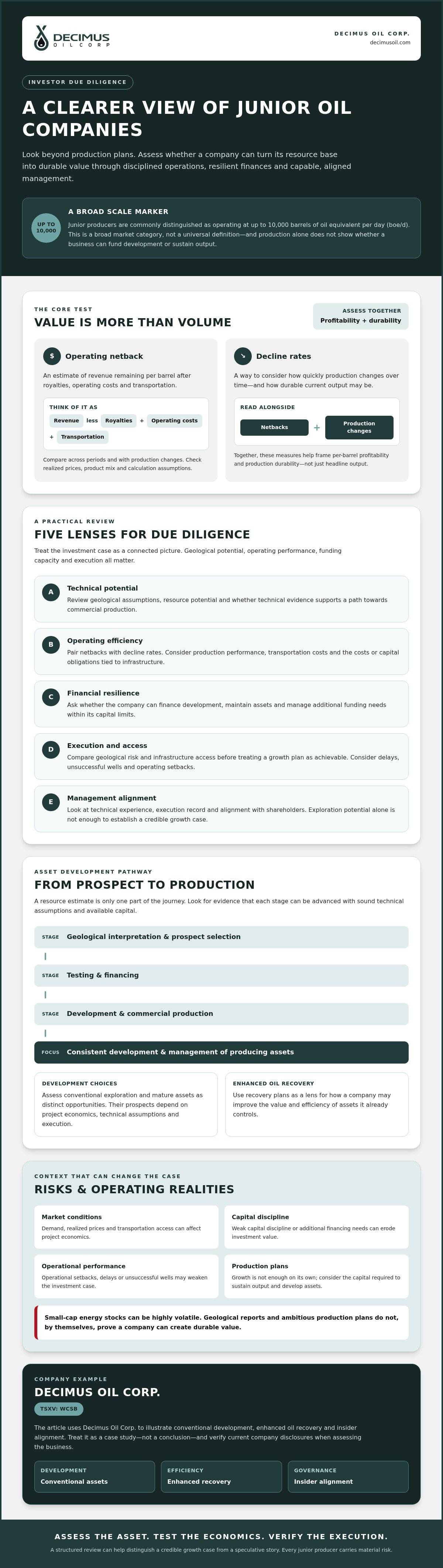
- When investing in junior oil companies, assess operating netbacks and decline rates together to gauge both per-barrel profitability and the durability of production.
- Compare geological risk and infrastructure access before treating a production-growth plan as achievable; either can materially affect development prospects.
- Evaluate management through its technical experience, execution record and alignment with shareholders, rather than relying on exploration potential alone.
- Use enhanced oil recovery as a lens for assessing how a company may improve the value of existing assets, alongside its plans for conventional exploration.
- Review Decimus Oil Corp. (TSXV:WCSB) as a case study in conventional development, enhanced oil recovery and insider alignment, while verifying current company disclosures.
Defining the Junior Oil Sector in Canada’s 2026 Energy Landscape
Junior oil companies occupy an important place in Canada’s energy sector by pursuing exploration, resource development and opportunities to improve mature assets. Their focused scale can allow teams to concentrate on specific prospects or production areas, while larger firms may prioritize broader portfolios. That focus can create room for growth, but smaller operators often have fewer financial and operational resources to absorb setbacks. For anyone investing in junior oil companies, understanding a company’s role in the development cycle is as important as looking at its production figures.
A useful working distinction places junior producers at up to 10,000 barrels of oil equivalent per day (boe/d), with intermediate producers generally operating at a larger scale. These are broad market categories rather than universal definitions. Production alone doesn’t tell investors whether a company can fund development, maintain assets or convert geological potential into durable output. Consider the company’s operating stage, resource base, financial capacity and ability to execute its stated plans.
The Junior Lifecycle: From Exploration to Resource Development
Juniors may identify conventional prospects or mature assets that larger companies consider non-core, then evaluate whether targeted exploration or enhanced oil recovery could create value. The lifecycle moves from geological interpretation and prospect selection to testing, financing and development. A successful transition requires more than a promising resource estimate: investors should look for evidence that technical assumptions can support commercial production and that management can advance projects within its capital limits. This work sits within the Upstream sector, which covers exploration and production.
As a company moves towards steady production, its priorities can shift from identifying resources to developing them consistently and managing the assets already in operation. Potential capital appreciation depends on progress, execution and market conditions; exploration results alone can’t establish future returns. Delays, unsuccessful wells or additional financing needs may weaken the investment case.
Market Dynamics: Why Junior Energy Stocks are Gaining Traction
In 2026, the case for agile operators is grounded in their ability to focus on specific assets and adapt development plans, not in an assumption that smaller companies will necessarily outperform. As established U.S. shale plays mature, investors may consider whether Canadian conventional producers can compete through disciplined operations and efficient recovery. The outlook still depends on demand, realized prices, transportation access and the economics of each project.
Production growth is only one measure of progress. Investors should also consider the capital required to sustain output, the performance of existing assets and whether development plans can improve operating efficiency. These questions help frame the role of junior companies in Canada’s energy sector. For a broader evaluation framework, see this guide to junior oil and gas producers.
Essential Metrics for Evaluating Junior Oil Stocks
For investors assessing junior producers, commodity prices are only part of the picture. Operational efficiency and financial resilience help show whether a company can turn production into cash flow and sustain development. In investing in junior oil companies, examine several measures together rather than relying on a single headline ratio or a conventional price-to-earnings multiple, which may offer limited insight when earnings are small, volatile or negative.
Operational Efficiency: Netbacks, Decline Rates and Reserves
An operating netback estimates how much revenue remains per barrel after royalties, operating costs and transportation. Compare netbacks across periods and against production changes to understand whether higher output is creating value or simply adding costs. Results are sensitive to realized prices, product mix and accounting assumptions, so check how the company calculates and reports them. Ownership or control of relevant infrastructure may reduce transportation costs, but assess any associated operating expenses and capital obligations too.
Decline rates indicate how quickly production from existing wells falls over time. A lower-decline asset base can reduce the pace of replacement drilling needed to maintain output, supporting more predictable planning, though it doesn’t eliminate operational or price risk. The reserve life index (RLI), commonly calculated by dividing booked reserves by annual production, offers a simplified view of how long reserves might support current output. It depends on reserve estimates and assumes production remains constant, so interpret it alongside development plans and reserve disclosures.
Financial Health: Debt, Liquidity and Reinvestment
Net debt to cash flow can help indicate how debt compares with a company’s ability to generate cash, but there is no single sustainable threshold for every junior. Cash flow may shift with commodity prices, production interruptions and spending requirements. Review debt maturities, interest costs, available liquidity and the capital needed to maintain or grow production. In a high-interest environment, limited liquidity or near-term repayment pressure can restrict a junior’s options even when its assets appear promising.
Recycle ratio compares operating netbacks with the cost of replacing or adding reserves, indicating how efficiently management converts development capital into resource value in 2026. Treat it as a comparative tool, not a guarantee of returns; underlying assumptions and time periods matter.
For wider context on global supply and demand, consult the IEA’s Global Energy Review 2026, then test how macro conditions could affect the company’s own realized prices and cash flow. For more on the economics behind exploration decisions, read this guide to oil and gas exploration economics. Investors can also review Decimus Oil Corp.’s public company information as part of their independent due diligence.
Risk Assessment: Navigating the Volatility of Small-Cap Energy
For a small-cap producer, one setback can affect more than a single project: it may delay planned work, raise financing needs or limit the company’s ability to respond to changing conditions. Assess risks as connected pressures, not isolated checklist items. A technically promising asset, for example, still needs a workable development plan, reliable market access and sufficient financial capacity to withstand delays.
Geological and Operational Risks in the WCSB
Conventional prospects depend on the presence and flow characteristics of hydrocarbons within a geological trap. Unconventional formations generally require more intensive development methods, including horizontal drilling and high-intensity completions. In either case, actual results can differ from geological interpretations and production forecasts. Read technical disclosures for the assumptions behind resource estimates, planned well locations and recovery expectations; note what remains untested and what evidence would change the company’s development decision.
Enhanced oil recovery (EOR) may help access additional production from an existing reservoir, but it is not a universal remedy for weak performance. Suitability depends on reservoir conditions, the selected method and the operator’s ability to execute and monitor the project. Investors can review the company’s rationale and reported outcomes alongside this overview of enhanced oil recovery techniques.
Infrastructure, Compliance and Price Exposure
Infrastructure arrangements can shape a junior’s ability to bring production to market. Owning or controlling gathering or processing assets may offer operating flexibility, but also requires attention to upkeep, capital commitments and utilization. Reliance on third-party systems brings a different exposure: outages, capacity limits or service interruptions may constrain production or delay sales. Examine the company’s disclosed access terms, capacity and contingency planning. For additional context, see this overview of energy infrastructure management.
Environmental and regulatory compliance also belongs in the risk review. Check company disclosures for applicable obligations, planned compliance work and any identified liabilities; requirements and costs can vary by operation and jurisdiction. Avoid assuming that a general industry statement describes a particular issuer’s circumstances.
Price hedging can reduce exposure to certain commodity-price movements for a defined portion of production and period, but it doesn’t eliminate price risk. Hedge positions may limit gains, while changes in production volumes or the difference between benchmark and realized prices can affect results. Review disclosed hedge volumes, terms and timing, then consider how much unhedged production remains. This helps clarify how exposed cash flow may be if market conditions shift.
A Buyer’s Checklist for High-Growth Junior Producers
Assess a junior as an operating business, not just a geological prospect. A practical checklist should connect leadership capability, ownership alignment, asset quality and a credible route to growth. For investors investing in junior oil companies, these factors can help distinguish a disciplined development strategy from a story built mainly on potential.
The Human Element: Evaluating Management Pedigree
Start with the people responsible for allocating capital and delivering the technical plan. Review management biographies, prior company roles, operating experience and the outcomes of past projects. Successful exits can indicate experience creating value, but examine the circumstances and each person’s specific contribution rather than treating a transaction as proof of future performance. Combined experience matters when it is relevant to the company’s assets and development stage. Decimus Oil Corp. reports more than 100 years of combined leadership experience, a useful prompt for investors to investigate the team’s individual track records.
Also look beyond credentials. Compare stated growth objectives with budgets, capital raises and actual operating decisions. A company focused on maintaining a small operation may have a different strategy from one pursuing active resource development; neither label alone determines investment quality. The key is whether management’s actions, funding needs and stated plans align.
Ownership, Assets and Technical Capability
Insider ownership of 20% or more is sometimes treated as a strong alignment benchmark, not a universal gold standard. Confirm the current percentage in company disclosures, and check whether ownership is held directly, whether it has changed, and how insider interests compare with shareholder dilution and compensation practices. High insider ownership can strengthen shareholder alignment because leaders have more personal capital exposed to decisions that affect the company’s value, though it can’t eliminate conflicts or protect an investment from losses. Decimus reports insider ownership above 27%; verify the latest filings before relying on that figure.
Next, weigh asset type and technical execution. Conventional assets may offer opportunities to develop known formations or revitalize mature production, while unconventional plays can require more intensive drilling and completion programmes. Review the evidence supporting recoverable resource estimates, the infrastructure available and the capital required to advance the assets. Where horizontal drilling, high-intensity completions or enhanced oil recovery are part of the plan, look for clear technical rationale and measurable operating results, not technology claims alone.
A coherent path to capital appreciation should connect asset potential to funded, staged development and realistic production objectives. Review Decimus Oil Corp.’s public information to examine its conventional exploration and enhanced oil recovery focus alongside your independent due diligence: review Decimus Oil Corp.’s company information.
Decimus Oil Corp.: Realizing Value Through Strategic Development
Decimus Oil Corp. (TSXV:WCSB) offers investors exposure to conventional oil and gas exploration, resource development, energy infrastructure and enhanced oil recovery. The investment case rests on how effectively the company advances these activities, not simply on the presence of a resource or a stated growth strategy. Investors can use company updates to track whether operational plans translate into measurable progress and whether capital allocation remains consistent with stated priorities.
The TSXV:WCSB Investment Thesis
Decimus reports more than 27% insider ownership and a management team with over 100 years of combined energy-sector experience. These are useful starting points for further diligence, rather than guarantees of alignment or execution. Verify current ownership in public filings and examine management’s relevant experience, company updates and financial disclosures. The company also describes a portfolio of energy infrastructure; review its filings to understand the assets, their role in operations and any related obligations. For additional context, see this guide to resource development strategy.
Future Outlook: Growth and Capital Appreciation
Rather than assume what comes next, investors can monitor Decimus’s published development plans and subsequent disclosures for exploration results, production performance, infrastructure updates and EOR progress. These details help assess whether the company is advancing its resource base and optimizing existing assets. EOR may support recovery from suitable reservoirs, but project outcomes depend on technical execution and economics. Capital appreciation is possible, not assured, and should be assessed alongside financial capacity and the risks described throughout this guide.
For a broader framework on evaluating publicly traded energy companies, consult the Public Equity in Energy Guide and compare its due-diligence principles with Decimus’s latest public disclosures.
Build a More Disciplined Junior Oil Investment Case
Strong due diligence looks beyond production targets. Netbacks, decline rates, reserve life, liquidity and infrastructure access help reveal whether a junior can develop its assets efficiently, while geological and commodity-price risks remain central to the investment decision. For anyone investing in junior oil companies, management’s technical record and alignment with shareholders deserve equal scrutiny.
Decimus Oil Corp. (TSXV:WCSB) brings together a conventional exploration and enhanced oil recovery focus in the WCSB with a management team reporting more than 100 years of combined energy-sector experience. The company also reports insider ownership above 27%, a meaningful alignment indicator to verify against current disclosures, not a guarantee against investment risk.
Use the checklist in this guide to compare company plans with documented financial capacity and operating results. To learn more about Decimus and its publicly traded equity, explore investment opportunities with Decimus Oil Corp. (TSXV:WCSB). A measured, evidence-led approach can help you assess potential with greater confidence.
Frequently Asked Questions
What is considered a junior oil company in Canada?
A junior oil company is generally a smaller exploration or production business, but there’s no single definition used across the industry. A practical working guide classifies producers with output up to 10,000 barrels of oil equivalent per day (boe/d) as juniors, while larger producers may be considered intermediates. Production is only one measure: asset maturity, operating scale, access to capital and development stage also help distinguish companies.
How does investing in junior oil companies differ from large-cap energy stocks?
Investing in junior oil companies typically involves greater exposure to individual projects, financing needs and operational setbacks than investing in a diversified large-cap producer. A junior may have fewer producing assets and less flexibility to absorb delays, weak prices or unexpected costs. In return, successful resource development may create growth potential, but outcomes are uncertain. Compare financial capacity, production performance and project evidence, and consider whether the higher risk suits your portfolio. For accredited investors seeking to balance volatile equity holdings with tax-advantaged property solutions, Cornerstone Real Estate Investment Services provides guidance on managing full-cycle exit strategies and capital preservation.
Why is insider ownership important when evaluating junior energy producers?
Insider ownership can indicate that executives and directors have a financial interest in the company’s performance alongside public shareholders. It doesn’t guarantee sound decisions or prevent losses, so review the percentage in current disclosures and check for changes over time. Consider ownership alongside executive compensation, share dilution, governance and capital-allocation decisions. For example, Decimus Oil Corp. reports insider ownership above 27%, a figure investors should verify against its latest filings.
What are the primary risks associated with junior oil and gas exploration?
Key risks include geological uncertainty, unsuccessful drilling, cost overruns, production underperformance and limited access to infrastructure. A resource estimate or promising formation doesn’t prove that a project can be developed economically. Juniors may also face financing constraints, regulatory and environmental obligations, and commodity-price volatility. Before investing, examine technical disclosures, cash resources, development plans and infrastructure arrangements, then consider how the company could respond if results fall short of its assumptions.
How do commodity price fluctuations affect junior oil companies differently than majors?
Price changes can affect all producers, but a junior may have less production diversification, liquidity and borrowing capacity to cushion weaker revenue. Its share price can also react sharply to changes in expected cash flow or financing prospects. Some companies hedge a portion of future production to manage price exposure, though hedges can limit gains and don’t remove operational or basis-price risks. Review hedge volumes, contract periods and financial disclosures rather than assuming protection is complete.
What is the role of the TSX Venture Exchange (TSXV) in the energy sector?
The TSX Venture Exchange is a Canadian public market where investors can trade shares of listed companies, including smaller resource and energy issuers. This market environment provides capital access for a wide range of natural resource developers, from junior oil producers to mineral explorers such as Golden Pursuit Resources Ltd. A listing gives a company a public equity market presence, but it isn’t an endorsement of investment quality or a guarantee of liquidity. Review an issuer’s continuous disclosure, financial statements and material updates, and understand that trading volumes and share-price movements can vary considerably among junior companies.
Assess management by verifying relevant technical and operating experience, prior company roles, capital-allocation decisions and the outcomes of earlier projects. Distinguish individual contributions from broad claims about a team’s history, and compare current plans with reported results and financing needs. Decimus Oil Corp. reports more than 100 years of combined leadership experience; investors should examine the team members’ backgrounds and determine how that experience relates to the company’s assets and strategy.
What is Enhanced Oil Recovery (EOR) and why does it matter to investors?
Enhanced Oil Recovery (EOR) refers to methods intended to increase the amount of oil recovered from a reservoir, often after conventional production has begun. It may help an operator pursue additional value from existing assets rather than relying only on new exploration. Results depend on reservoir characteristics, technical execution, required investment and operating economics. Investors should look for a clear rationale, disclosed project evidence and realistic expectations, not assume EOR will automatically increase profitable production.


