
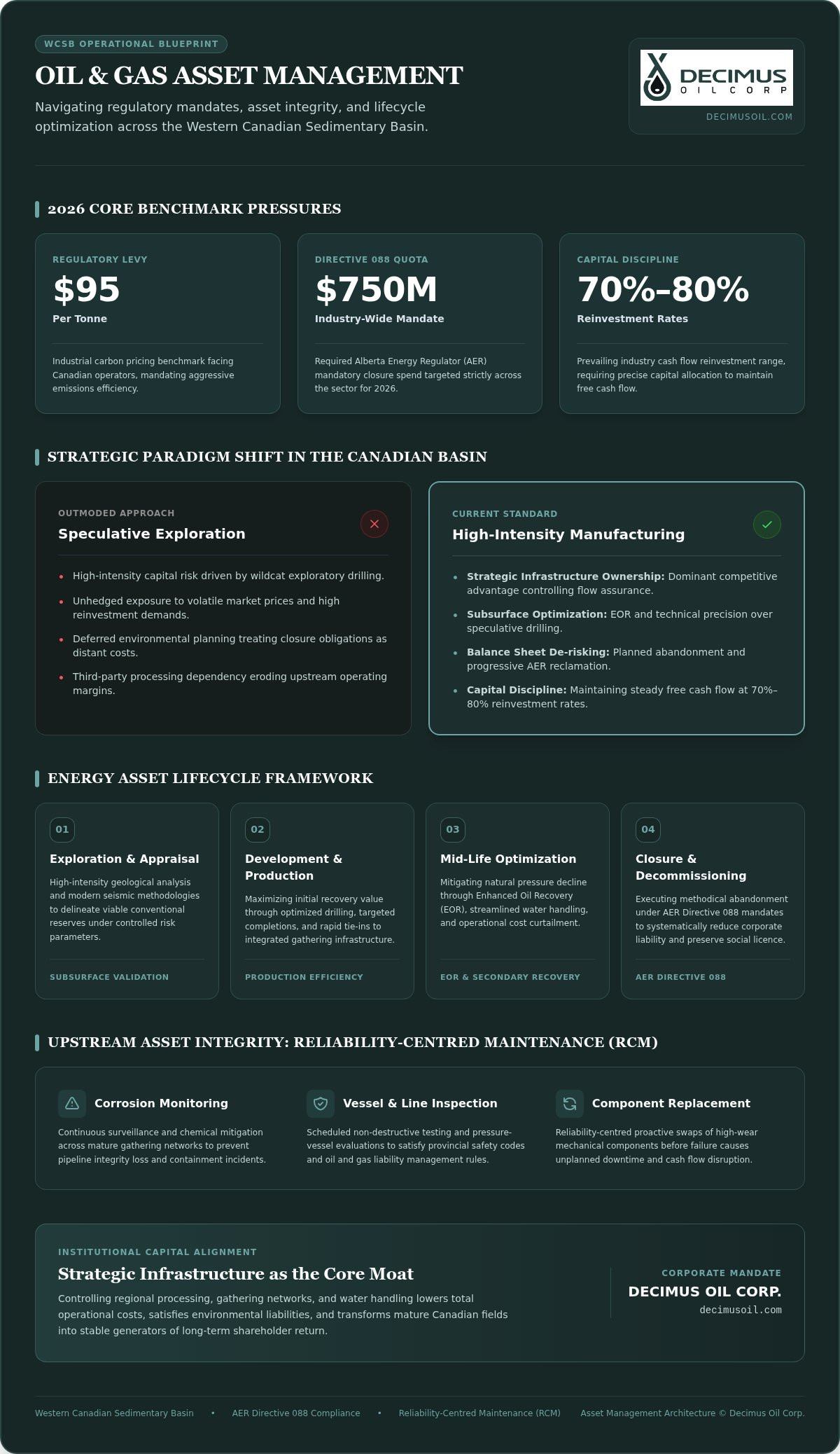
The era of speculative exploration in the Canadian basin has been replaced by a high-intensity manufacturing model where infrastructure ownership is the ultimate competitive advantage. You likely recognize the mounting pressure of industrial carbon prices, currently at $95 per tonne, alongside stringent AER mandatory closure quotas that require a $750 million industry-wide investment for 2026. Balancing these regulatory complexities with the high operational costs of mature fields is a constant challenge for even the most seasoned operators. This guide demonstrates how sophisticated oil and gas asset management transforms these hurdles into opportunities for production efficiency and long-term shareholder value.
It's clear that success in the current landscape requires a synthesis of technical precision and financial stewardship. We'll explore the lifecycle of Canadian resource development, focusing on how enhanced recovery techniques revitalize existing plays and why strategic infrastructure is the primary value driver for modern energy investments. By the end of this analysis, you'll understand how to optimize your portfolio for the 2026 regulatory environment while maintaining the capital discipline that today's equity markets demand.
Key Takeaways
- Master the complexities of the Canadian regulatory environment, including industrial carbon pricing trajectories, to ensure long-term operational resilience.
- Explore how Enhanced Oil Recovery (EOR) and high-intensity completion techniques revitalize mature fields and maximize reservoir recovery.
- Develop a sophisticated framework for oil and gas asset management that balances infrastructure maintenance with strategic exploration risk.
- Learn to leverage existing energy infrastructure as a primary driver for reducing operational costs and enhancing project economics.
- Discover how managing energy assets within a public company framework provides the transparency and alignment necessary to realize superior shareholder returns.
Foundations of Oil and Gas Asset Management in Canada
Within the Canadian petroleum industry, success is dictated by how effectively an operator manages the interplay between subsurface potential and surface constraints. Oil and gas asset management represents the systematic coordination of engineering, financial, and regulatory activities to optimize the entire lifecycle of a resource. In the Western Canadian Sedimentary Basin (WCSB), where mature plays coexist with emerging opportunities, this discipline is the primary driver of institutional stability and growth. It's no longer enough to simply extract hydrocarbons; operators must now prove they can do so with a level of technical precision that satisfies both shareholders and regulators.
The Lifecycle of an Energy Asset
The journey of a Canadian energy asset begins with exploration and appraisal, a phase characterized by high-intensity geological analysis and significant capital risk. Identifying viable reserves requires a blend of seasoned experience and modern seismic methodologies. Once a discovery is proven, the focus shifts to development and production. During this stage, the objective is to realize the maximum value of conventional reserves through optimized drilling and completion techniques. As a field matures, mid-life optimization becomes the priority. This is the point where management shifts toward operational efficiency, water handling, and cost control to maintain profitability as reservoir pressure naturally declines.
Regulatory Compliance and HSE Standards
Canadian operators face a rigorous regulatory framework that demands proactive stewardship. Managing assets in 2026 requires navigating a complex industrial carbon price of $95 per tonne while adhering to the Alberta Energy Regulator (AER) Directive 088. This directive currently mandates a $750 million industry-wide closure spend, making decommissioning planning a core balance-sheet consideration rather than a distant obligation. Integrating Health, Safety, and Environment (HSE) standards into daily operations isn't just a compliance requirement; it's a fundamental component of long-term asset integrity. Sophisticated oil and gas asset management ensures that environmental liabilities are mitigated through planned abandonment and reclamation, protecting the company's social licence to operate.
Strategic management is the differentiator between a stagnant portfolio and a high-performing enterprise. By viewing every wellbore and pipeline as a strategic component of a broader infrastructure network, operators can reduce the reinvestment rates required to maintain production. This approach allows for the revitalization of mature plays, turning legacy assets into reliable engines of free cash flow. In a market that values capital discipline and total shareholder return, a methodical foundation in asset management is essential for long-term viability.
Core Components of an Upstream Management Framework
A robust upstream framework synthesizes technical proficiency with rigorous financial oversight. In the context of oil and gas asset management, this means moving beyond simple maintenance toward a model of continuous optimization. By integrating subsurface data with surface operational metrics, operators can realize the full potential of existing wellbores while minimizing the capital intensity of new production. With industry reinvestment rates currently sitting between 70% and 80%, maintaining this balance is critical for sustaining the free cash flow that modern energy markets demand.
Asset Integrity and Operational Reliability
Asset integrity is the bedrock of safe, long-term operations. As conventional fields in Western Canada age, implementing rigorous inspection schedules becomes mandatory to ensure infrastructure remains functional under high-intensity use. Reliability-centred maintenance (RCM) allows teams to prioritize critical components, preventing unplanned downtime that erodes profitability. This proactive stance is essential for adhering to the oil and gas liability management framework, which emphasizes the containment of environmental risks through diligent oversight. Key focus areas for maintaining infrastructure include:
- Corrosion monitoring and mitigation in mature gathering systems to prevent leaks.
- Pressure vessel and pipeline integrity inspections to satisfy provincial safety standards.
- Strategic replacement of high-wear components before they impact production cycles.
Enhanced Recovery and Reservoir Revitalization
Enhanced oil recovery (EOR) and reservoir revitalization represent the most capital-efficient path to growth in a mature basin. Rather than relying solely on primary extraction, sophisticated operators utilize secondary and tertiary methods to access bypassed reserves. The economic benefits are clear; revitalizing a mature field through enhanced oil recovery techniques often yields a higher return on investment than high-risk greenfield exploration. These strategies extend the economic life of the asset, delaying decommissioning costs and maximizing the total recovery factor of the reservoir.
Ultimately, production optimization is a data-driven exercise. By analyzing real-time flow rates and pressure data, management teams can make informed decisions that drive capital appreciation for shareholders. This level of execution is what defines a sophisticated operator in the Western Canadian Sedimentary Basin. Investors looking for exposure to this disciplined approach can explore how strategic resource development provides a foundation for long-term value and institutional stability.
Conventional Exploration vs. Strategic Infrastructure Management
The strategic deployment of capital in the Canadian energy sector requires a delicate balance between the high-growth potential of exploration and the steady-state reliability of infrastructure. In a mature basin, oil and gas asset management is less about wildcatting and more about the surgical identification of conventional reserves that can be tied into existing processing networks. While unconventional plays often dominate headlines, conventional exploration remains a vital component of a diversified portfolio, offering lower capital intensity and predictable decline curves that support long-term institutional stability.
Optimizing Energy Infrastructure
Existing gathering systems and processing facilities are the lifeblood of resource transportation, functioning as both a source of operational stability and a significant barrier to entry. By leveraging regulated energy infrastructure in Canada, operators can significantly improve the netbacks of new production. Success depends on strategic energy infrastructure management, where every facility is treated as a profit centre rather than just a cost of doing business. This approach ensures that transportation bottlenecks don't erode the value of upstream discoveries, allowing for a seamless transition from the wellhead to the market.
Conventional Play Economics
The economic profile of conventional drilling differs fundamentally from the high-decline, capital-intensive nature of unconventional alternatives. Conventional plays often require less upfront investment in completions, making them ideal candidates for a manufacturing-style development model. To maximize returns, exploration goals must be strictly aligned with existing facility capacity. Understanding oil and gas exploration economics is essential for identifying plays where the subsurface potential matches the surface infrastructure's ability to handle fluids and gas.
Low-decline assets serve as the bedrock of a stable energy company, providing the predictable cash flow necessary to fund future growth and shareholder returns. By managing the risk profile of high-potential conventional plays through a lens of infrastructure optimization, companies can maintain a competitive edge. This integrated approach to oil and gas asset management ensures that every dollar of capital expenditure is directed toward assets that reinforce the company's overall financial health and operational footprint.
Implementing High-Intensity Completion and Recovery Strategies
Transitioning from strategic planning to operational execution requires a methodical approach to reservoir stimulation. Effective oil and gas asset management begins with a comprehensive geological re-evaluation of existing assets using modern 3D and 4D seismic data. This technical foundation allows operators to identify bypassed pay zones that were previously overlooked by legacy vertical drilling. By visualizing the subsurface with greater clarity, management teams can precisely place horizontal wells, ensuring that capital is only deployed where the contact with the hydrocarbon resource is maximized.
Horizontal Drilling and Modern Completions
Horizontal drilling has fundamentally redefined the management of conventional reservoirs across Western Canada. High-intensity completion techniques, characterized by tight stage spacing and significant proppant volumes, are now the standard for unlocking value in complex formations. In the Montney fairway, average horizontal laterals routinely span between 8,800 and 10,500 feet, with some operators pushing "super-laterals" even further. These methodologies don't just increase initial production rates; they fundamentally alter the asset lifecycle by accelerating the recovery of reserves and improving the overall return on investment. Managing these high-intensity operations requires a sophisticated understanding of geomechanics to ensure the long-term integrity of the wellbore.
Data-Driven Operational Efficiency
Once a well is online, the focus shifts to secondary recovery and production maintenance to mitigate natural declines. Implementing secondary recovery methods, such as waterflooding or gas injection, helps stabilize reservoir pressure and extends the economic life of the field. This stage relies heavily on continuous monitoring and data-driven interventions. By using real-time production data, operational teams can optimize pump performance and adjust flow rates with surgical precision. Reducing lifting costs through targeted chemical and mechanical interventions is a critical component of energy infrastructure management in Alberta and the wider basin.
The integration of high-intensity completions with secondary recovery ensures that the maximum volume of hydrocarbons is recovered from every section. By triggering interventions the moment a production decline deviates from the forecast, operators maintain a lean, high-performing portfolio that produces consistent results. This level of operational rigour allows a company to thrive even in volatile market conditions. If you're looking to align your investment strategy with a company that prioritizes technical excellence, you can explore our approach to resource development and see how we realize value across our Canadian assets.
The Role of Public Equity in Driving Asset Value
Effective oil and gas asset management serves as the essential bridge between technical field performance and capital appreciation for stakeholders. Within a public company framework, every operational efficiency realized at the wellhead is transparently accounted for, providing investors with clear evidence of value creation. This governance structure ensures that management remains strictly accountable for meeting production targets and managing environmental liabilities. For those seeking exposure to the Canadian energy sector, public vehicles like Decimus Oil Corp. (TSXV:WCSB) offer a direct path to optimized portfolios. High levels of insider alignment, evidenced by the 27% ownership held by our team, ensure that the board's interests are identical to those of the shareholders, fostering a culture of disciplined, results-oriented growth.
Investment Opportunities in Managed Energy Assets
Evaluating a management team's track record is the first step in identifying superior resource development potential. A leadership group with over 100 years of combined experience understands the specific geological and regulatory nuances of the Western Canadian Sedimentary Basin. The strategic benefits of public equity in the energy sector include access to deep capital pools and the liquidity required to execute high-intensity completion projects. Low-decline production assets provide the predictable cash flow necessary to support long-term growth potential. Investors often prioritize companies that can maintain these stable production profiles while simultaneously identifying new opportunities for expansion.
Growth Through Strategic Acquisitions
Identifying undervalued assets that would benefit from modern enhanced recovery techniques is a core strategy for sophisticated operators. Many legacy fields in Western Canada still hold significant remaining reserves that can be unlocked through surgical re-evaluations and infrastructure optimization. The public market plays a vital role in funding these revitalisation projects, providing the capital necessary to transform aging wells into high-performing assets. By acquiring assets with established infrastructure, junior producers can bypass the high costs of greenfield development and move straight to production optimization. This approach reduces the overall risk profile of the portfolio while accelerating the timeline to free cash flow generation.
The future outlook for junior producers in the Canadian basin is increasingly positive. As infrastructure de-bottlenecking continues and heavy crude discounts stabilize, well-capitalized operators are positioned to realize significant value from their existing footprints. Success in this environment requires a relentless focus on oil and gas asset management and a commitment to professional integrity. By combining technical excellence with the transparency of a public listing, companies can build a foundation of institutional stability that thrives throughout the energy cycle.
Realizing Value Through Strategic Resource Development
The Canadian energy sector has transitioned into an era defined by technical precision and capital discipline. Success in this landscape requires a sophisticated approach to oil and gas asset management that synthesizes high-intensity completions with long-term infrastructure optimization. We've explored how revitalizing mature plays through enhanced recovery and maintaining asset integrity provides the necessary foundation for growth within the Western Canadian Sedimentary Basin. By aligning subsurface potential with surface operational efficiency, operators can navigate complex regulatory frameworks while delivering consistent shareholder value.
Decimus Oil Corp. brings decades of combined experience to the table, focusing on high-intensity completion techniques and professional integrity. Our publicly traded transparency ensures that every operational milestone is aligned with the interests of our stakeholders. We invite you to learn more about Decimus Oil Corp.'s strategic asset management on the TSX Venture Exchange (TSXV:WCSB) and discover how we're positioning our portfolio for the future of the Canadian energy landscape. The path forward is one of strategic optimism and proven capability.
Frequently Asked Questions
What is the primary goal of oil and gas asset management?
The primary goal of oil and gas asset management is to maximize the total value of a resource throughout its entire lifecycle. This involves a systematic process of developing, operating, and maintaining energy assets to ensure production efficiency and capital appreciation. By integrating technical engineering with financial oversight, operators can extend the economic life of a reservoir and realize superior returns for stakeholders. It's about balancing short-term output with long-term reservoir health.
How does asset integrity management differ from simple maintenance?
Asset integrity management is a comprehensive, risk-based approach that ensures infrastructure remains safe and functional under high-intensity use. While simple maintenance often focuses on reactive repairs or routine servicing, integrity management looks at the long-term reliability and safety of the entire system. It involves implementing rigorous inspection schedules and reliability-centred maintenance (RCM) to prevent unplanned downtime. This strategic oversight protects the company's social licence and operational continuity through professional stewardship.
Why is enhanced oil recovery (EOR) considered an asset management strategy?
Enhanced oil recovery (EOR) is a core pillar of modern asset management because it revitalizes mature fields without the high risk of greenfield exploration. By moving beyond primary extraction to secondary and tertiary recovery methods, operators can access bypassed reserves and maximize the recovery factor of a reservoir. This strategy is highly capital-efficient, utilizing existing infrastructure to drive incremental production and improve the overall return on investment for shareholders and institutional investors.
What role does technology play in managing conventional oil assets?
Technology enables data-driven operational efficiency across conventional oil assets. Modern 3D and 4D seismic data allow for a precise geological re-evaluation of existing plays, while real-time production monitoring optimizes pump performance and flow rates. These high-intensity completion techniques and digital interventions reduce lifting costs and allow for surgical precision in resource development. Utilizing these advanced methodologies is essential for maintaining a competitive edge and driving growth within the Western Canadian Sedimentary Basin.
How do Canadian regulations impact energy asset management?
Canadian regulations create a rigorous framework that demands proactive stewardship and environmental responsibility. Upstream operators must navigate industrial carbon pricing, currently at $95 per tonne, and adhere to mandatory closure spend quotas under AER Directive 088. These requirements integrate decommissioning liabilities directly into the balance sheet. Effective oil and gas asset management ensures that compliance becomes a strategic advantage rather than a mere cost, protecting the long-term viability of energy investments.
Can effective asset management reduce the environmental footprint of oil production?
Yes, effective management directly reduces the environmental footprint of oil production through improved efficiency and proactive maintenance. By ensuring asset integrity, operators prevent leaks and spills that could lead to significant environmental liabilities. Strategic optimization also reduces the energy intensity of extraction and facilitates planned reclamation and abandonment. This disciplined approach aligns with modern ESG standards and the transparency requirements expected of a publicly traded company like Decimus Oil Corp.
Why should investors look at asset management when evaluating energy stocks?
Investors should evaluate asset management because it's the primary indicator of a management team's ability to create value from their resource base. Sophisticated management translates into capital appreciation and predictable cash flow. For a company like Decimus Oil Corp. (TSXV:WCSB), the 27% insider ownership signals a strong alignment between leadership and shareholders. Professional integrity and a proven track record in resource development are essential factors for ensuring long-term institutional stability and growth.
What is the difference between upstream and midstream asset management?
Upstream asset management focuses on the identification, extraction, and production of hydrocarbons from the reservoir. It prioritizes drilling techniques and reservoir stimulation. Midstream management involves the transportation, gathering, and processing of those resources through pipelines and facilities. Both are deeply integrated; existing midstream infrastructure often dictates the economics of upstream exploration. Managing this interplay is critical for maximizing netbacks and ensuring a seamless transition from the wellhead to the market.


