
In the Western Canadian Sedimentary Basin, the difference between a stranded resource and a high-yield asset is rarely found in the geology alone; it's found in the strategic steel and sophisticated engineering that connect the wellhead to the global market. While many focus on drilling results, the most seasoned operators understand that precise energy infrastructure asset valuation is the true cornerstone of institutional stability and long-term growth. You likely recognize the difficulty of evaluating midstream resilience when upstream volatility creates uncertainty, making it hard to distinguish between mere maintenance and genuine value creation.
This guide provides the clarity you need by illustrating how strategic infrastructure functions as the essential link between raw hydrocarbon resources and capital appreciation. We'll explore the value drivers that support public equity growth and provide a framework for evaluating operational efficiency in the conventional sector. By the end, you'll understand why integrated infrastructure is the mechanism that transforms geological potential into realized, low-decline shareholder value for the Canadian market.
Key Takeaways
- Identify the critical distinction between general utility assets and strategic infrastructure that serves as a high-value link in the hydrocarbon supply chain.
- Understand how sophisticated energy infrastructure asset valuation models, such as tolling and fee-for-service, directly influence operational netbacks and cash flow stability.
- Learn how proactive asset management and modern technical methodologies prevent capital erosion while maximizing the throughput of legacy systems.
- Explore the strategic alignment between tangible infrastructure ownership and the ability of junior operators to secure debt financing and drive public equity growth on the TSXV.
- Recognize the ongoing importance of conventional exploration and the necessity of future-proofing infrastructure for the 2026 Canadian energy landscape.
Defining Strategic Energy Infrastructure in the Modern Market
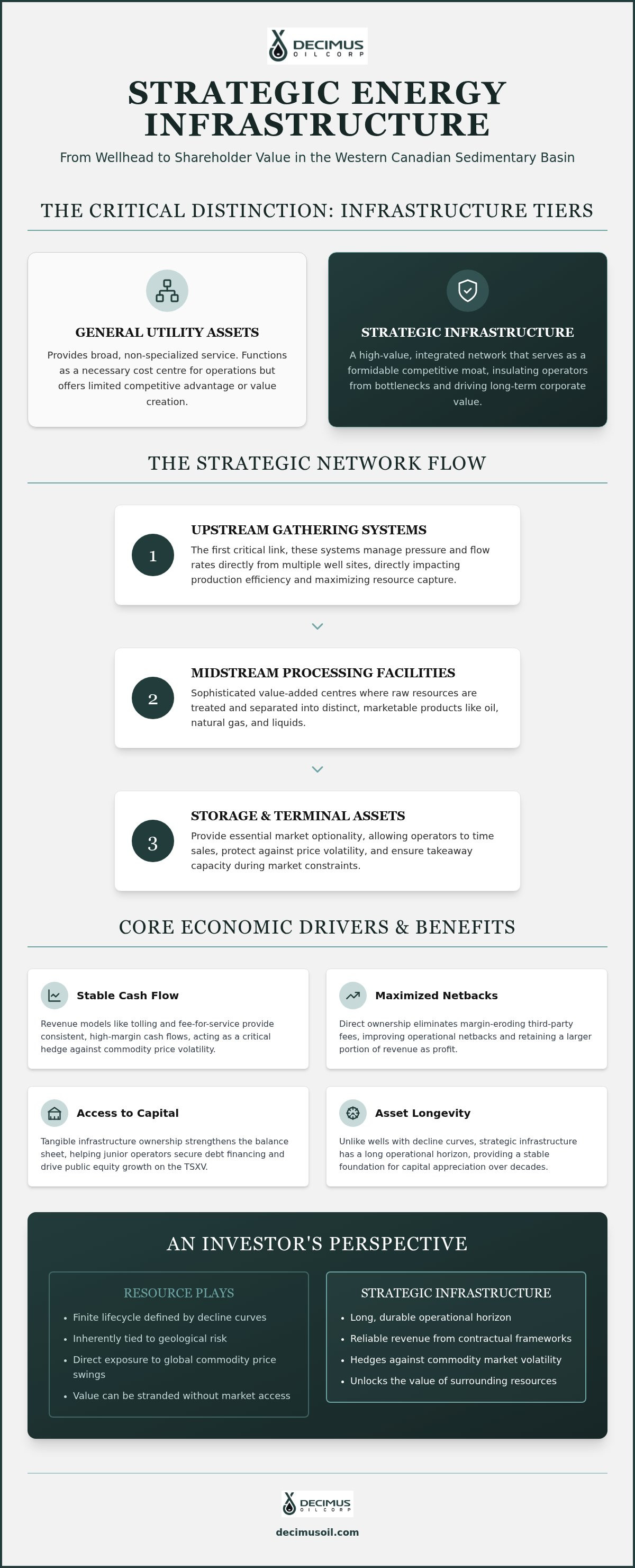
Strategic energy infrastructure represents the critical physical networks required to extract, process, and transport hydrocarbons across the Western Canadian Sedimentary Basin. While general utility infrastructure provides broad service, strategic assets are distinguished by their high-value placement and deep integration into specific production flows. These networks reduce operational friction, allowing resources to move from the wellhead to the market with minimal loss of value. For junior energy producers, infrastructure acts as a formidable competitive moat. By controlling the gathering and processing stages, companies insulate themselves from third-party bottlenecks and fluctuating service costs, ensuring that energy infrastructure asset valuation remains a core driver of their corporate balance sheet.
The Components of a Strategic Network
A comprehensive network is composed of three primary segments that work in tandem to optimize resource flow. Upstream gathering systems are the first link, directly impacting production efficiency by managing pressure and flow rates from multiple well sites. Midstream processing facilities serve as sophisticated value-added centres where raw resources are treated and separated into marketable products. Finally, storage and terminal assets provide essential market optionality. These facilities allow operators to time their sales, providing price protection during periods of temporary market oversupply or pipeline constraints. A well-placed storage asset ensures that a producer is never forced to accept a sub-optimal price due to lack of immediate takeaway capacity.
Infrastructure as a Strategic Asset Class
Investors must view infrastructure through a different lens than the underlying resource. While an individual oil field has a finite lifecycle defined by decline curves, strategic infrastructure often possesses a much longer operational horizon. This shift in perspective transforms infrastructure from a necessary cost centre into a reliable revenue driver. In many cases, the strategic placement of a processing plant or pipeline determines the economic viability of conventional exploration in a specific region. Without proximity to these assets, even high-quality geological plays remain stranded. Effective energy infrastructure asset valuation accounts for this longevity, recognizing that these assets provide a stable foundation for capital appreciation even as specific drilling programs evolve. By owning the path to market, an operator secures the long-term relevance of their entire resource portfolio.
Economic Drivers of Energy Infrastructure Asset Valuation
The financial performance of energy assets in Western Canada is defined by the reliability of their revenue structures. Unlike pure exploration, which is inherently tied to geological risk, energy infrastructure asset valuation is underpinned by throughput volumes and contractual frameworks. Revenue models such as tolling and fee-for-service arrangements provide consistent, high-margin cash flows that serve as a critical hedge against global commodity price volatility. This structural stability provides the foundation for oil and gas exploration economics in the WCSB, where owning the primary takeaway capacity allows for more disciplined and predictable capital allocation strategies.
Maximizing Netbacks Through Ownership
Direct ownership of the infrastructure chain grants an operator unparalleled control over their cost structure. By managing the flow of molecules from the wellhead through the processing plant and into the pipeline, companies effectively eliminate the margin-eroding impact of third-party fees. This vertical integration significantly improves operational netbacks, ensuring that a larger portion of every dollar earned is retained as profit. It's a strategic shift from being a price-taker to a price-maker in the midstream space.
Beyond immediate cost savings, strategic infrastructure allows for the identification of "behind the pipe" opportunities. These are proved, developed, non-producing resources that can be tied into existing systems with minimal capital outlay. Maximizing utilization rates in this manner ensures that the fixed costs of infrastructure are spread across greater volumes, which is a vital component of energy infrastructure asset valuation. Investors looking for this level of operational control often monitor the growth of Decimus Oil Corp. as a benchmark for infrastructure-led value realization.
Stability in Low-Decline Asset Portfolios
Infrastructure-heavy portfolios provide a level of fiscal predictability that pure exploration plays often lack. These tangible assets extend the economic viability of mature reservoirs by ensuring that operational costs remain low even as production naturally declines. This infrastructure is also the primary enabler for enhanced oil recovery techniques, which rely on specialized injection and processing facilities to maximize the ultimate recovery from legacy fields. The result is a low-decline, high-visibility production profile that supports long-term capital appreciation. This integrated approach ensures that the company remains resilient during market downturns while staying positioned to capture upside when prices recover.
Operational Excellence: Managing Assets for Longevity
Operational excellence is the bridge between owning a physical asset and realizing its full economic potential. In the Canadian Sedimentary Basin, proactive maintenance isn't just a safety protocol; it's a financial imperative designed to prevent capital erosion. When engineering teams are strategically aligned with corporate growth goals, the result is a network that operates with surgical precision. A rigorous approach to energy infrastructure asset valuation must account for this operational integrity, as well as the ability of the management team to extend the useful life of legacy steel. Effective Canadian energy infrastructure management ensures that facilities remain viable and safe through every stage of the basin's development, protecting the long-term interests of stakeholders.
Enhanced Recovery and Infrastructure Synergy
Strategic infrastructure is rarely static. To maximize the recovery factor of conventional plays, operators must adapt existing systems for secondary and tertiary recovery methods. This often involves repurposing gathering lines and processing facilities for waterflooding or gas injection. Such technical adaptations require high-intensity completion techniques and a deep understanding of fluid dynamics within the network. By integrating these enhanced recovery methods directly into the infrastructure strategy, companies significantly reduce the cost per barrel. This synergy ensures that mature fields remain profitable even as production volumes shift, directly enhancing the underlying energy infrastructure asset valuation by proving the asset's versatility.
Efficiency Through Modernization
Modernization is the primary tool for optimizing throughput and reducing environmental risk. Integrating digital monitoring systems across a network allows for real-time data acquisition, which helps operators identify and resolve potential issues before they lead to costly downtime. It's about ensuring that every facility operates at peak economic capacity year-round, regardless of seasonal variations or market shifts. This level of control doesn't just improve the bottom line; it also has a direct impact on the corporate carbon footprint. By reducing venting, leaks, and energy consumption through modern methodologies, operators improve their ESG ratings and institutional appeal. Strategic modernization transforms legacy infrastructure into a high-performance engine for reliable capital appreciation.
Strategic Infrastructure and Public Equity Performance
For junior producers on the TSX Venture Exchange (TSXV), the presence of physical infrastructure on the balance sheet is a primary differentiator. While exploration-only firms are often valued on speculative prospective resources, companies that own their gathering and processing networks benefit from a more sophisticated energy infrastructure asset valuation. These tangible assets provide a functional safety net for public equity energy sector investments, offering a floor to corporate valuations that drilling results alone cannot provide. Investors increasingly demand transparency in how these assets are reported, looking for a clear link between capital expenditures in infrastructure and long-term cash flow stability.
The TSXV Perspective: Growth vs. Stability
Junior oil and gas producers are frequently evaluated based on their infrastructure-to-production ratio. A high ratio suggests that a company has the internal capacity to scale production without incurring prohibitive third-party processing costs. This structural advantage supports steady capital appreciation by fostering consistent, low-decline production growth. In the case of infrastructure-focused firms like Decimus Oil Corp. (TSXV:WCSB), the alignment of interest is further reinforced by significant insider ownership, which remains above 27%. This level of skin in the game, combined with a leadership team possessing over 100 years of combined experience, instills confidence that asset management is oriented toward shareholder value rather than just operational maintenance.
Risk Mitigation via Asset Control
Asset control is the most effective way to reduce reliance on third-party operators. When a junior producer owns the midstream component of their operations, they control their own corporate destiny and protect their margins from external fee hikes. Beyond operational independence, infrastructure assets serve as high-quality collateral for securing debt financing. Lenders are far more likely to provide capital for resource development when it's backed by commissioned, revenue-generating facilities. This correlation between disciplined asset management and financial flexibility creates a foundation for long-term shareholder confidence. By integrating energy infrastructure asset valuation into the broader corporate strategy, companies ensure they have the liquidity needed to fund future exploration while maintaining a stable fiscal position.
The Future of Energy Infrastructure in the WCSB
The future of the Western Canadian Sedimentary Basin is defined by a pragmatic integration of legacy stability and forward-looking adaptability. As we move toward 2026, conventional hydrocarbon exploration continues to be a primary pillar of Canada's energy security and economic strategy. Investors must recognize that energy infrastructure asset valuation in this era is increasingly tied to resilience and the ability to pivot. Future-proofing these networks involves implementing modular designs and maintaining flexible capacity to accommodate emerging market needs. Decimus Oil Corp. (TSXV:WCSB) is actively positioning its portfolio to thrive in this environment, ensuring its infrastructure remains a high-performance link in the regional energy chain for the 2026-2030 period. This strategic optimism is grounded in the reality that conventional plays provide the base-load energy required to support a modern economy.
Adapting to New Regulatory Environments
Operating in the Canadian midstream sector requires a sophisticated approach to compliance and stakeholder alignment. Realizing efficiency while navigating evolving standards is a hallmark of a seasoned operator. Strategic value is often found in the ability to secure permits and maintain social licence through transparent engagement with all regional partners. One of the most effective ways to minimize environmental footprints while maximizing throughput is through the optimization of "brownfield" infrastructure sites. By utilizing existing disturbed land and legacy facilities, companies can expand capacity with lower regulatory hurdles and reduced capital intensity. This disciplined approach ensures that infrastructure remains a high-value asset rather than a liability in a shifting landscape, providing a clear path for future resource development.
Conclusion: The Logical Case for Infrastructure Focus
The link between physical energy assets and superior financial outcomes is undeniable for the informed Canadian investor. Strategic infrastructure serves as the essential mechanism that transforms geological potential into realized, low-decline shareholder value. While the broader market may fluctuate, the enduring utility of conventional energy infrastructure provides a stable foundation for any diversified portfolio. It's a fact that energy infrastructure asset valuation remains the most reliable metric for assessing the true strength of an integrated operator. By focusing on tangible assets that control the flow of energy to market, investors can insulate themselves from the high-risk volatility of pure-play exploration. We invite you to review the strategic potential of infrastructure-backed energy equity and consider the long-term resilience offered by established, expertly managed networks in the WCSB.
Realizing the Strategic Potential of Infrastructure-Led Growth
The integration of midstream assets with conventional exploration represents the most robust path to capital appreciation in the Western Canadian Sedimentary Basin. By prioritizing operational excellence and modernizing legacy systems, operators secure predictable cash flows and insulate themselves from broader market volatility. It's clear that a precise approach to energy infrastructure asset valuation ensures tangible assets remain the cornerstone of institutional stability and shareholder confidence for years to come.
Decimus Oil Corp. (TSXV:WCSB) leverages over 100 years of combined industry experience to optimize these critical networks. With insider ownership exceeding 27%, management's interests are strictly aligned with those of our shareholders through a proven track record in conventional exploration and infrastructure management. We invite you to explore strategic investment opportunities with Decimus Oil Corp. (TSXV:WCSB) and join us in realizing the full potential of our regional landscape. The future of the basin is bright for those who own the path to market.
Frequently Asked Questions
What is the difference between upstream and midstream energy infrastructure?
Upstream infrastructure includes gathering systems and flow lines directly connected to the wellhead for initial resource extraction. Midstream infrastructure involves larger processing facilities, storage tanks, and regional pipelines that treat and transport hydrocarbons to market. This distinction is vital for energy infrastructure asset valuation, as midstream assets typically offer more stable, fee-based revenue compared to the production-dependent nature of upstream equipment. Both are essential for a vertically integrated energy strategy.
How does owning infrastructure improve an oil company’s netback?
Owning infrastructure improves a company's netback by eliminating the need to pay third-party processing and transportation fees. When a producer manages its own gathering and processing facilities, it retains the margins that would otherwise be paid to external service providers. This vertical integration reduces the cash cost per barrel, ensuring that a larger portion of the sale price is realized as profit. It also allows for better control over operational uptime.
Why is strategic energy infrastructure important for junior producers on the TSXV?
Strategic infrastructure provides junior producers on the TSXV, such as Decimus Oil Corp. (TSXV:WCSB), with a tangible asset base that supports corporate valuation. It acts as a competitive moat, protecting margins and providing operational independence from larger players. Companies with high infrastructure-to-production ratios are often viewed as more stable investments. Their revenue isn't solely dependent on new drilling results, but is supported by existing, revenue-generating physical assets.
Can infrastructure be used for enhanced oil recovery (EOR) projects?
Infrastructure is essential for the implementation of enhanced oil recovery (EOR) projects. Specialized injection facilities, water handling systems, and gas processing plants are required to manage the fluids used to increase reservoir pressure. By utilizing and repurposing existing infrastructure, operators can maximize the ultimate recovery of a field with lower capital intensity. This synergy between physical assets and technical recovery methods is a primary driver of long-term value realization in the basin.
What are the main risks associated with energy infrastructure management?
The main risks include regulatory compliance costs, environmental liability, and technical maintenance requirements. Maintaining legacy steel requires proactive schedules to prevent leaks and ensure safety, which can be capital-intensive. Experienced management teams, like the leadership at Decimus Oil Corp. with over 100 years of combined experience, mitigate these risks through disciplined asset management. They integrate modern digital monitoring technologies to identify potential issues before they impact the bottom line or the environment.
How does infrastructure ownership affect a company’s ability to secure financing?
Infrastructure ownership significantly enhances a company's ability to secure debt and equity financing. Lenders view commissioned, revenue-generating facilities as high-quality collateral compared to speculative underground reserves. This tangible asset base provides a clearer energy infrastructure asset valuation for financial institutions, often leading to better borrowing terms. For junior producers, these assets provide the fiscal flexibility needed to fund exploration programs while maintaining a stable balance sheet through various market cycles.
What role does the Western Canadian Sedimentary Basin (WCSB) play in Canadian infrastructure?
The WCSB is the primary hub for Canada's energy infrastructure, housing a vast network of pipelines, processing plants, and storage facilities. It serves as the critical link between the country's hydrocarbon resources and global markets. The basin's established infrastructure allows for the efficient development of conventional plays, making it a focal point for strategic investment. Its mature nature means that much of the required steel is already in the ground, providing a foundation for optimization.
Is conventional energy infrastructure still a viable long-term investment?
Conventional energy infrastructure remains a highly viable long-term investment as hydrocarbons continue to be a necessary component of the global energy mix. These assets provide essential services that cannot be easily replicated, ensuring long-term utility and cash flow stability. As operators focus on low-decline production and enhanced recovery, the strategic value of existing infrastructure only increases. The ability to optimize legacy assets for higher throughput ensures they remain relevant and profitable for decades.


