
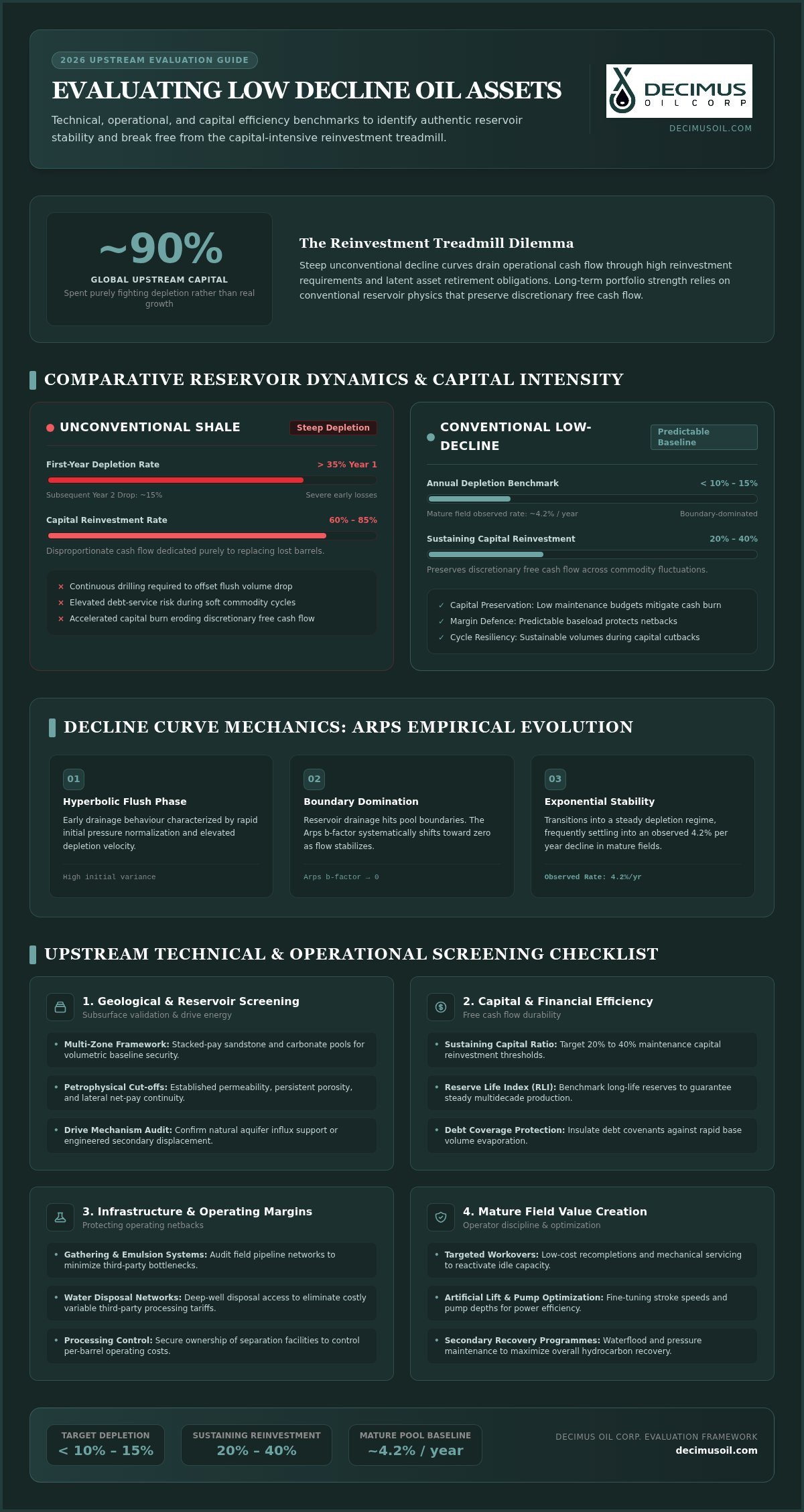
Nearly 90% of all global upstream capital investment is spent purely to fight natural reservoir depletion rather than drive real growth. For investors seeking durable returns, the capital treadmill of steep unconventional decline curves has proven exhausting. It's frustrating to watch cash flow vanish into 60% to 85% reinvestment rates, latent asset retirement obligations, and the challenge of separating authentic reservoir stability from temporary flush production. Long-term portfolio strength relies on reservoir physics, making high-quality low decline oil assets an essential cornerstone for predictable capital generation.
This 2026 evaluation guide details the precise technical, operational, and financial benchmarks used to screen conventional upstream opportunities. You will discover how secondary recovery strategies, steady decline dynamics, and strategic infrastructure control safeguard netback margins against volatile commodity environments. The following actionable checklist delivers the analytical clarity needed to evaluate asset stability and allocate capital to sustainable, long-life producers with complete confidence.
Key Takeaways
- Screen for authentic low decline oil assets with annual depletion rates below 10% to 15% to eliminate the capital-intensive reinvestment treadmill of unconventional drilling.
- Evaluate primary reservoir drive mechanisms and historical pressure performance to distinguish genuine base stability from brief periods of flush production.
- Benchmark sustaining capital metrics alongside the reserve life index to ensure the asset produces durable free cash flow across shifting commodity price cycles.
- Audit gathering systems, emulsion separation, and deep-well water disposal networks to protect operating netbacks from variable third-party processing tariffs.
- Identify seasoned operators utilizing targeted workovers, pump optimization, and secondary recovery programmes to unlock incremental value from mature production bases.
What Are Low Decline Oil Assets and Why Do They Anchor Resilient Portfolios?
In upstream energy evaluation, low decline oil assets represent producing conventional reservoirs characterized by annual production losses below 10% to 15%. Unlike modern unconventional shale wells, which often suffer severe first-year declines exceeding 35% and another 15% drop in Year 2, mature conventional pools exhibit flat, boundary-dominated drainage. These reservoirs establish an operational foundation that reduces debt-service risk. Because cash flow does not evaporate through rapid volume drops, operators maintain predictable debt coverage and protect capital distributions across all phases of the commodity cycle. Within Canada, conventional sandstone and carbonate pools offer superior base stability, delivering consistent volumetric baselines that form the foundation of institutional energy portfolios.
Understanding Decline Curve Analysis and Hyperbolic Base Production
Reservoir engineers employ empirical decline curve analysis to model fluid extraction over time using Arps equations. During early drainage, production displays hyperbolic behaviour where the decline rate slows as reservoir pressure normalizes. As boundary-dominated flow takes over, the Arps b-factor shifts toward zero, transitioning the pool into a predictable exponential depletion regime. In mature conventional fields, annual depletion often settles into an observed rate of 4.2% per year. This transition removes steep volumetric uncertainty, allowing management teams to plan corporate cash generation without relying on aggressive forecasting models.
The Strategic Advantage: Free Cash Flow vs. The Capital Treadmill
Shale operators must continuously reinvest massive capital outlays simply to replace declining volumes, with reinvestment rates routinely climbing between 60% and 85%. Conventional low-decline fields decouple cash flow from this persistent drill-bit treadmill. By requiring sustaining capital reinvestment rates of only 20% to 40% to maintain steady production, these operations preserve discretionary free cash flow.
- Capital Preservation: Low maintenance requirements prevent rapid cash burn when commodity prices soften.
- Margin Defence: Predictable baseload volumes protect per-barrel netbacks without requiring speculative drilling budgets.
- Cycle Resiliency: Production remains stable even if capital expenditures are temporarily reduced during downturns.
By prioritizing reservoir physics over continuous drilling outlays, disciplined conventional operators isolate their margins from cyclical volatility, establishing durable corporate performance.
The Technical Evaluation Checklist: Geological and Reservoir Screening Criteria
Differentiating genuine baseline stability from temporary flush volumes requires a systematic review of petrophysical data. Investors screening low decline oil assets must prioritize reservoirs with established permeability, persistent porosity cut-offs, and lateral net-pay continuity across the target formation. Drawing on the multi-zone frameworks outlined in our analysis of WCSB Resource Development, analyzing stacked-pay conventional pools provides the necessary subsurface validation before capital commitment. High-quality conventional reservoirs display distinct petrophysical markers that ensure prolonged flow regimes.
Reservoir Drive Mechanisms and Pressure Maintenance Viability
Natural drive physics dictate whether an asset sustains economic production rates over multi-decade lifespans. As documented in an authoritative IEA study on oil and gas field decline rates, post-peak conventional fields can average modest single-digit decline profiles, whereas mismanaged solution-gas drives experience sharp drops in reservoir energy. Technical due diligence must verify:
- Aquifer Influx: Confirm natural edge or bottom water support capable of displacing hydrocarbons without severe pressure drops.
- Voidage Replacement Ratio (VRR): Ensure active secondary recovery operations maintain a VRR close to 1.0, preserving native bottom-hole pressures.
- Pressure Survey Histories: Analyze historical buildup tests to confirm steady drainage without deep regional pressure depletion.
Secondary Recovery and Enhanced Oil Recovery (EOR) Upside
Optimizing existing waterfloods unlocks trapped reserves without the financial exposure of grass-roots drilling programmes. Operators must audit patterns for sweep efficiency, water breakthrough timelines, and injection profile balance. Deploying modern enhanced oil recovery techniques allows technical teams to maximize pool recoveries and flatline natural depletion. Technical reviews must confirm that secondary reserves classifications rest on established injector-producer connectivity rather than theoretical models.
Wellbore Integrity and Mechanical Asset Inventories
Subsurface potential means little if physical completions fail prematurely. A rigorous asset audit reviews acoustic casing inspection logs, remedial cementing histories, and mean time between pump failures. Artificial lift systems should be tailored to formation fluids, utilizing heavy-duty pump jacks or progressive cavity pumps suited for high-viscosity extraction. Maintaining high active-to-inactive well ratios is critical to prevent carrying uncapitalized idle inventories. Discerning investors evaluating high-calibre corporate allocators can learn more about Decimus Oil Corp. and its disciplined approach to conventional energy development.
Financial and Capital Efficiency Checklist: Metrics That Matter
Evaluating upstream capital efficiency requires moving beyond standard corporate EBITDA multiples to dissect per-barrel economics. When assessing low decline oil assets, analysts focus on sustaining capital efficiency: the precise reinvestment rate needed to hold production volumes flat. As outlined in our strategic guide to Western Canadian Sedimentary Basin investment, high-grade conventional assets convert top-line revenue into distributable cash because baseline maintenance demands remain exceptionally low.
Sustaining Capital Requirements and Recycle Ratios
Sustaining capital reflects the routine development expenditure required to counter natural reservoir decline. For conventional pools exhibiting annual depletion rates below 15%, flatlining base production demands far less capital than high-decline plays. Financial due diligence must focus on two vital metrics:
- Recycle Ratio: Divide operating netback per barrel of oil equivalent (boe) by finding and development (F&D) costs per boe. A ratio exceeding 2.0x demonstrates that an asset comfortably generates enough margin to replace extracted reserves at a commercial profit.
- Free Cash Flow Yield: Superior capital efficiency expands free cash flow conversion, creating a self-funding business model that shields the balance sheet from external credit markets.
Netback Durability and Operating Cost Structure Analysis
An asset's operating netback measures gross realized commodity revenue minus royalties, operating expenditures (OPEX), and gathering or transportation fees. As highlighted by regional operating cost data in the Dallas Fed Energy Survey, lifting costs for mature operations are heavily influenced by mechanical power consumption and fluid handling. Investors must systematically evaluate the entire cost stack:
- Fixed vs. Variable Cost Separation: Delineate non-negotiable surface lease rentals and maintenance costs from variable power, chemical treatment, and fluid hauling expenses.
- Royalty Regime Alignment: Confirm how provincial sliding-scale royalty frameworks affect mature wells, verifying whether low production volumes benefit from reduced statutory royalty burdens.
- Differential Sensitivity: Measure regional quality discounts between light sweet benchmark prices and realized heavy or medium crude sales to verify bottom-line netback durability.
By screening for resilient margins and rigorous sustaining capital metrics, allocators can identify low decline oil assets that deliver steady returns across shifting commodity environments.
Operational and Infrastructure Due Diligence: Protecting Operating Margins
Subsurface continuity establishes stable production, but surface facilities dictate how much realized revenue reaches the balance sheet. For low decline oil assets, where fluids often run high water cuts, infrastructure ownership operates as an essential economic buffer. Operators who lack pipeline access or dedicated treating capacity face mounting processing tariffs that compress netbacks. To maintain long-term profitability, technical teams must conduct comprehensive audits across surface facilities, treating flowlines, and liability structures, applying the standards outlined in our guide to Alberta oil field lifecycle management.
Facility Ownership, Midstream Access, and Processing Fees
Equity control over field batteries and gas dehydration facilities prevents margin leakage to third-party midstream providers. In unoptimized arrangements, midstream fees can quickly erode wellhead netbacks. Investment teams must verify:
- Ownership Working Interests: Confirm whether the operator controls majority working interest in centralized oil batteries, water injection hubs, and compression units.
- Third-Party Tariffs: Audit legacy processing contracts to identify variable fee escalators or punitive minimum volume commitments.
- Firm Interconnects: Review direct sales pipeline connections to verify egress access and avoid production curtailments during regional takeaway disruptions.
Produced Water Management and Disposal Economics
Conventional fields supporting steady pressure regimes routinely run water cuts between 90% and 98%, handling anywhere from 9 to 20 barrels of water for every barrel of oil produced. Commercial third-party disposal fees can add $0.35 to $1.50 per barrel of water, drastically hurting cash flow. Operating captive, pipeline-connected deep injection wells eliminates trucking costs and lowers fluid handling expenses to basic mechanical pumping power. Technical teams must confirm regulatory mechanical integrity tests and casing annulus logs to guarantee that disposal zones provide ample long-term volume headroom.
Asset Retirement Obligations (ARO) and Liability Management
Unmanaged environmental liabilities can undermine the economics of mature conventional production. Transparent operators actively mitigate these balance sheet obligations through systematic wellbore retirements. Due diligence must confirm:
- Liability Management Ratios: Verify that deemed asset values comfortably exceed corporate abandonment liabilities under provincial regulatory frameworks.
- Closure Spend Mandates: Check that annual budgets regularly allocate capital to plug inactive wellbores and reclaim surface sites rather than deferring costs.
Investors seeking disciplined portfolio management backed by strategic infrastructure control can explore investment opportunities with Decimus Oil Corp.
Strategic Execution: How Disciplined Operators Unlock Value in Mature Fields
Extracting compounding returns from mature hydrocarbon basins demands technical precision rather than speculative exploration programmes. When managed with operational discipline, low decline oil assets transform from legacy holdings into predictable cash-generation engines. By applying modern engineering rigour to existing wellbores, seasoned technical teams unlock substantial incremental value while avoiding the capital intensity of high-decline resource plays.
Low-Risk Field Workovers and Operational Optimization
Mature conventional fields present recurring opportunities for capital-efficient operational enhancements. Rather than funding costly grass-roots drilling, operators allocate capital to targeted wellbore interventions:
- Targeted Workovers: Executing chemical cleanouts, re-perforating bypassed intervals, and right-sizing artificial lift assemblies flatlines base decline rates at a fraction of new drilling costs.
- Digital Automation: Deploying real-time acoustic fluid-level sensors and automated pump-off controllers mitigates equipment stress and reduces mechanical downtime.
- Selective Infill Drilling: Drilling high-angle or horizontal infill wells into bypassed conventional pay zones accesses undrained reserves without frontier geologic hazards.
Capital Allocation Discipline and Investor Alignment
Technical capability must be matched by rigorous balance sheet stewardship. Sustainable cash generation requires management teams to maintain conservative debt metrics, protecting equity value across commodity pricing cycles. Public equity investment in focused conventional operators gives investors direct exposure to durable free cash flows. Corporate alignment is strongest when leadership teams hold significant equity; insider corporate ownership exceeding 27% ensures that executive decisions prioritize per-share netback growth over raw volumetric expansion.
By anchoring development strategies with low decline oil assets, management teams decouple corporate distributions from continuous drilling cycles. Backed by over a century of combined technical experience and a production growth track record sustained consistently since 2021, Decimus Oil Corp. applies disciplined operational methodologies to optimize conventional energy assets. Through enhanced oil recovery, strategic infrastructure ownership, and low-risk field enhancements, disciplined operators consistently prove that conventional reservoir physics deliver superior long-term capital preservation.
Positioning Portfolios for Durable Cash Flow Through Conventional Execution
Building an upstream portfolio insulated from cyclical commodity volatility requires prioritizing reservoir physics over hyper-depletion drilling. Rigorous technical screening, owned midstream infrastructure, and disciplined reservoir pressure maintenance eliminate the exhausting capital reinvestment treadmill common in unconventional shale plays. High-grade low decline oil assets anchor balance-sheet strength by steadily converting base production into distributable, self-funding free cash flow across every price environment.
Capitalizing on these opportunities demands seasoned subsurface leadership and strict capital allocation discipline. As a publicly traded resource developer on the TSX Venture Exchange (TSXV:WCSB), Decimus Oil Corp. leverages over 100 years of combined conventional engineering and geological experience to optimize mature assets across the basin. With insider corporate ownership exceeding 27%, management maintains direct equity alignment with shareholders, focusing on per-share value creation and operational durability rather than speculative growth. Explore how Decimus Oil Corp. creates long-term value through conventional asset development and discover the compounding power of disciplined conventional stewardship.
Frequently Asked Questions
What is considered a low decline rate in oil and gas production?
In conventional upstream production, an annual depletion rate below 10% to 15% qualifies as low decline. Highly mature conventional pools often settle into predictable annual depletion rates near 4% to 5%. In contrast, modern unconventional shale plays frequently decline by 35% or more during their first year. Identifying genuine low decline oil assets allows operators to model long-term reservoir behaviour with minimal volumetric variance and sustained recovery.
How do low decline oil assets insulate producers from crude oil price volatility?
Stable assets insulate operators by removing the necessity to drill new wells during market downturns. Because baseline depletion is modest, operators can halt expansion drilling without suffering severe corporate volume collapses. Operating cash flow can pivot directly toward balance sheet protection or debt service. This resilience allows producers to preserve capital and wait out commodity dips comfortably until realized crude prices rebound.
What is the difference between base decline rate and corporate decline rate?
The base decline rate measures the natural volumetric decline of legacy wells without any new capital investment. The corporate decline rate blends that existing base with newly drilled, high-decline production. If a producer relies heavily on aggressive drilling programmes, its corporate decline rate spikes dramatically. Conventional producers prioritize keeping their corporate rate closely aligned with their low base decline, preserving capital efficiency.
Why is sustaining capital efficiency superior to initial production rates when evaluating mature fields?
Initial production rates offer only a brief snapshot of flush volumes that quickly drop. Sustaining capital efficiency evaluates the precise capital required to replace depleted reserves and maintain flat production over time. Evaluating the recycle ratio alongside sustaining capital provides a true measure of operational longevity, ensuring that free cash flow is authentic rather than subsidized by continuous equity dilution or debt.
How do enhanced oil recovery (EOR) techniques stabilize mature field production?
Enhanced oil recovery techniques, such as targeted waterflooding or solvent injection, re-pressurize mature formations and improve subsurface sweep efficiency. Rather than drilling expensive new wellbores, EOR mobilizes bypassed hydrocarbons through existing patterns. This active reservoir management flattens production curves, increases ultimate recovery factors, and extends reserve life indices for decades without the high geological risks of exploration.
What role do asset retirement obligations (ARO) play in evaluating low decline asset portfolios?
Asset retirement obligations represent the discounted future liability required to abandon wells and restore surface leases. Because mature fields carry higher well counts, unmanaged ARO can quickly erode net asset values. Rigorous investors audit corporate liability management ratings and confirm that operators actively fund abandonment programmes annually, ensuring environmental liabilities are retired in step with ongoing extraction cash flows.
How does owning surface infrastructure impact the economic viability of low decline wells?
Controlling centralized batteries, gathering lines, and disposal facilities eliminates third-party processing tolls and fluid trucking expenses. Mature conventional wells produce high water cuts, making water disposal and emulsion separation primary operating cost drivers. Infrastructure ownership keeps lifting costs low and predictable, widening per-barrel netbacks so that marginal wells remain commercially profitable even during lower price cycles.


