
A basin-wide oil-reserve figure can be accurate and still mislead. Western Canadian Sedimentary Basin oil reserves are often discussed as though they represent one fixed volume, but estimates vary according to their date, commodity and classification. Readers looking for a clear answer to how much oil the basin holds may find that figures from different sources do not match.
This guide explains what reserve estimates measure, how reserves differ from resources and production, and why a large geological estimate does not mean every barrel is commercially recoverable. You’ll also learn how reporting scope and assumptions shape the numbers, so you can judge whether two estimates are genuinely comparable.
We’ll look at the basin’s mix of conventional oil, tight oil, heavy oil and oil sands, then connect those geological differences to recovery methods and resource development. For companies focused on conventional exploration, enhanced oil recovery and energy infrastructure, the distinction matters: geology indicates potential, while development depends on what can be recovered under defined conditions.
Key Takeaways
- Interpret Western Canadian Sedimentary Basin oil reserves as estimates tied to defined conditions, not as a count of every discovered or produced barrel.
- See how reservoir characteristics influence whether oil may be recoverable, and why geology alone does not establish commercial potential.
- Compare reserve figures by source, reporting date, commodity, category, geography and estimation basis before drawing conclusions.
- Understand why reserve estimates can change and why they do not directly predict future production or supply.
- Follow how geological understanding, exploration, recovery methods and infrastructure connect resource potential with development, including Decimus Oil Corp.’s areas of focus.
What Western Canadian Sedimentary Basin oil reserves actually describe
Oil reserves are estimated quantities of oil considered recoverable from known accumulations under specified technical, economic and operating conditions. They are not a count of every hydrocarbon molecule underground. An estimate reflects the evidence available, the recovery methods considered, the assumptions used to assess commercial viability and the assessment date.
A reserve estimate is a dated, classified estimate, not all the oil underground. This distinction is central to interpreting Western Canadian Sedimentary Basin oil reserves: a large regional total does not automatically represent oil that can be produced today, or under current conditions at all.
Reserves, resources, and production: what is the difference?
Resources describe a broader range of estimated quantities, including oil that may not yet be technically or commercially recoverable. Discovered accumulations are known occurrences of oil, but discovery alone does not make their volumes reserves. Reserves are the portion assessed as recoverable under specified conditions. Production records oil already extracted over a stated period; it does not measure what remains underground.
Consider a hypothetical reservoir. Geological evidence may indicate oil across a broad area, but further evaluation may identify only part of it as recoverable under the assumptions in use. That assessed portion may be classified as reserves. As oil is produced, production records rise and the remaining reserve estimate is reassessed. These figures describe different things, so they should not be substituted for one another.
Why the word “oil” needs a clear scope
The basin contains distinct types of oil, including conventional oil and oil sands bitumen. Their geology, fluid properties and recovery approaches differ, so an overall total needs to state which commodities it includes. The Western Canada Sedimentary Basin overview describes the basin’s geological setting and its conventional and oil-sands deposits, providing context for why one broad label can cover different resource types.
Keep natural gas separate from oil when comparing totals. Some reports present both commodities or combine them using a common energy-equivalent unit. That can be useful for specific comparisons, but it is not an oil-only figure. Check the units and whether the reported total includes gas or converted gas volumes.
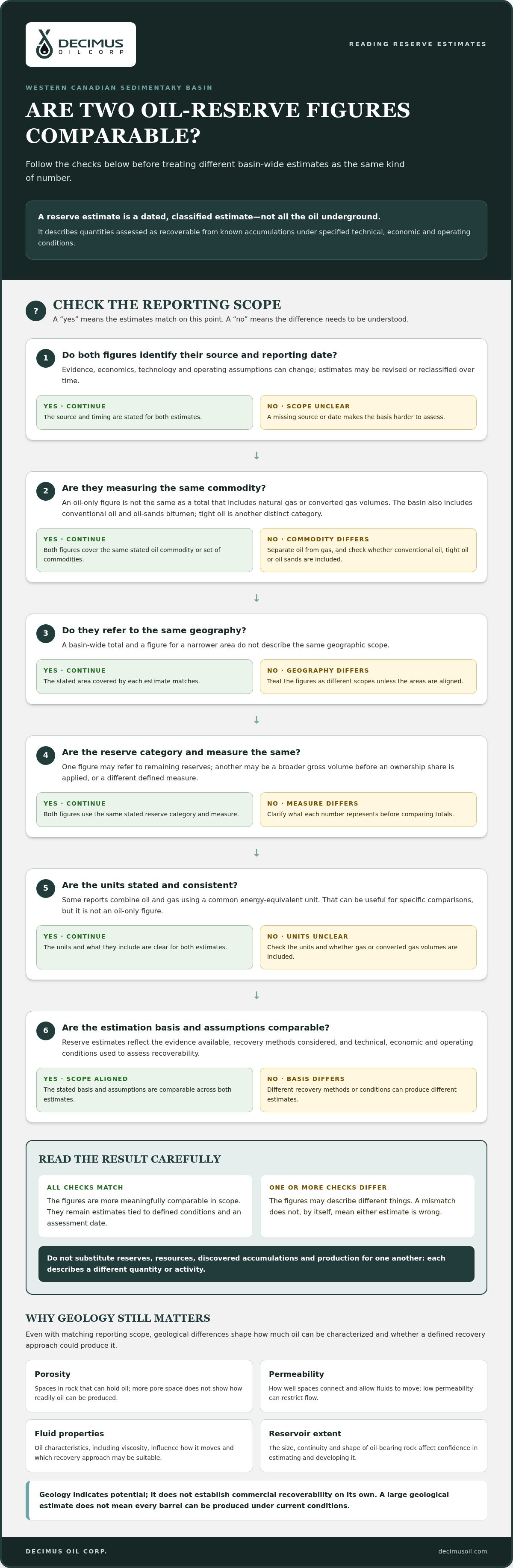
Also identify what the estimate measures. A figure may refer to remaining reserves, a broader gross volume before an ownership share is applied, or another defined measure. The reporting date matters too: evidence, economics, technology and operating assumptions can change, prompting estimates to be revised or reclassified. Before comparing figures, note the source, date, commodity, category, geography, units and stated basis. Without those details, two apparently conflicting numbers may simply describe different scopes.
How geology shapes the WCSB’s oil-reserve estimates
The Western Canadian Sedimentary Basin is not one continuous oil-filled space. Its sedimentary rocks hold hydrocarbons in different formations and geological settings, from conventional reservoirs to tight rock and oil-sands deposits. For a reserve estimate, the key question is not simply whether oil is present. It is how the oil occurs, how much of the reservoir can be characterized, and whether a defined recovery approach could produce it under the conditions being assessed.
Four geological factors help explain why potential and recoverability can vary from one deposit to another:
- Porosity: the spaces within rock that can hold oil. More pore space may provide greater storage, but it does not show how readily oil can be produced.
- Permeability: how well those spaces connect and allow fluids to move. Low permeability can restrict flow, even where oil is present.
- Fluid properties: oil characteristics, including viscosity, influence how it moves and which recovery approach may be suitable.
- Reservoir extent: the size, continuity and shape of the oil-bearing rock affect how confidently its volume can be estimated and developed.
Reserve estimates emerge from geological evidence interpreted through recovery assumptions; neither geology nor scale alone determines what is commercially recoverable. The basin’s broad footprint contains highly variable reservoirs, so a single basin-wide recovery factor would obscure differences in rock, fluid and development conditions.
Conventional oil and oil sands are not one uniform resource
Conventional oil is held in reservoir rock and produced through wells, while oil sands contain bitumen in deposits with different fluid properties and recovery requirements. Tight oil occurs in another geological setting, where hydrocarbons are found in low-permeability rock. These categories should not be merged without explanation. If a published total combines conventional oil, tight oil and oil sands, read its definitions to establish which deposits and estimation methods are included.
From geological evidence to a reserve estimate
Estimates draw on evidence such as drilling results, production history and geological interpretation. Drilling can reveal the rock layers and fluids encountered. Production records help show how a reservoir behaves over time, while interpretation connects individual observations into a model of the deposit. The USGS Assessment of WCSB Oil and Gas Resources addresses undiscovered conventional resources through geological assessment, a different measure from classified reserves.
Recovery assumptions matter. A model may estimate oil in place, but only a portion may be considered recoverable using the methods and operating conditions assessed. Changes in technology or development plans can lead to a different estimate, and estimates for separate formations should not be treated as interchangeable. Decimus Oil focuses on conventional exploration and resource development, an approach that evaluates potential in its geological and development context. Explore Decimus Oil’s conventional exploration to learn more.
How to compare Western Canadian Sedimentary Basin oil-reserve figures
Two figures can both be credible and still answer different questions. One may cover Alberta oil-sands reserves, while another estimates undiscovered conventional resources across a broader geological area. Compare their scope and method before comparing their scale. In particular, do not compare oil in place, which describes oil contained in a formation, directly with remaining recoverable reserves.
The table below shows how to assess source scope. It does not present unlike measures as comparable reserve totals. Use the relevant report edition to confirm publication dates, units and any numerical estimate before citing it.
| Source | Publication date | Commodity | Category | Geography | Estimate basis |
|---|---|---|---|---|---|
| Alberta Geological Survey / Alberta regulator data compilation | Edition-specific | Check whether oil only or oil and gas | Reserve and production data; confirm classifications | Alberta | Use the edition’s stated methodology and reporting cut-off |
| U.S. Geological Survey assessment of the WCSB | Confirm in the report record | Conventional oil and gas | Undiscovered resources, not remaining reserves | Western Canadian Sedimentary Basin assessment area | Geological assessment; not directly comparable with classified reserves |
A checklist for reading reserve data
Before interpreting a number, record its category, reporting date, commodity, geographic boundary, units and estimate basis. Check whether it is proved, probable or possible reserves, or a broader resource estimate. Then establish whether it describes remaining quantities, cumulative production, or gross or net volumes. These terms define what the figure represents; they are not interchangeable labels.
Next, review the source methodology and cut-off date. A report may use data available at a different point in time or apply a different classification approach. Those differences can explain why estimates diverge without either source being incorrect. If the source combines oil and gas, determine whether it reports separate quantities or converts them to a common unit.
Where Canadian reserve and production data come from
For Alberta-focused information, the Alberta Geological Survey and regulator-published materials provide geological, reserves and production data. Coverage and methods depend on the specific publication. A regulator compilation may track reported reserves and production, while a geological assessment may estimate undiscovered resources. Check the original publication, not just a summary or a number repeated elsewhere.
For a reliable comparison, cite each source by its exact title and edition, and pair the publication date with the data’s reporting date when both are available. If a date, category or scope is missing, mark the figures as not directly comparable rather than forcing them into a basin-wide total. That discipline is essential when interpreting Western Canadian Sedimentary Basin oil reserves.
What reserve estimates can and cannot tell us about future supply
A reserve estimate is not a production schedule. It describes quantities assessed as recoverable under defined conditions, but it does not show how quickly operators will develop them, how much oil will reach markets in a given year, or whether a particular project will proceed. Future supply also depends on development decisions, infrastructure, operating capacity and market conditions.
This distinction matters when interpreting Western Canadian Sedimentary Basin oil reserves. A large reserve base can indicate substantial assessed potential, but it cannot establish annual output or a company’s commercial performance on its own. Project-level economics and operational decisions affect whether and when particular reserves are developed.
Why estimates change over time
Estimates may be revised as new drilling provides information, production history improves understanding of a reservoir, or geological interpretations are updated. Economic inputs, technology and operating assumptions can also affect which quantities are considered recoverable under the conditions assessed. Production changes the remaining quantity, while new evidence may refine the estimate of what remains.
A higher or lower estimate does not automatically mean that new oil was discovered or that oil disappeared. It may reflect a change in data, interpretation, assumptions or the volume already produced. To understand a revision, compare the reporting dates and methodology, not just the headline figures.
Reserve estimates are not investment forecasts
Geological and engineering estimates address quantities associated with an accumulation or asset. They do not determine a company’s valuation or predict its share price. Company-level reserves are specific to the company’s disclosed assets and reporting date; basin-wide resource potential cannot be attributed to an individual operator without supporting company disclosures.
For an investor, a reserve figure is one piece of information, not a guarantee of returns or a complete measure of business performance. Read it alongside the company’s own dated disclosures and other relevant information. For publicly traded energy companies, basin context and company-specific results are distinct.
Limitations to keep in view
- Uncertainty: Estimates depend on available geological and operating evidence, which may be incomplete or revised.
- Changing assumptions: Economics, technology and operating conditions can affect assessed recoverability.
- Date sensitivity: A figure applies to its stated reporting date and should not be treated as a current supply forecast without updated evidence.
Decimus Oil focuses on conventional exploration, resource development, enhanced oil recovery and energy infrastructure, connecting geological potential with the work of developing resources. Learn more about Decimus Oil’s resource development focus.
How resource development connects basin reserves with Decimus Oil
Basin-wide estimates describe geological potential across a large area. Development takes place at the asset level, where operators evaluate specific formations and decide how to explore, produce and recover oil. The distinction matters: a basin total does not describe Decimus Oil’s holdings, and no share of regional reserves should be attributed to the company without company-specific disclosure.
The development process links geology to operations in stages:
- Build geological understanding. Interpret available information about rock formations, reservoirs and the hydrocarbons they may contain.
- Explore and evaluate. Use exploration and drilling results to test the geological interpretation and inform decisions about a specific asset.
- Produce and assess performance. Production data provides evidence about how a reservoir responds under operating conditions.
- Consider recovery and infrastructure. Evaluate whether recovery approaches and supporting systems can help develop the resource.
Each stage produces information for the next, but none guarantees a particular outcome. Operational data can refine understanding of an asset and inform future decisions; results depend on that asset’s characteristics and circumstances. For a broader explanation of how basin potential translates into development considerations, see the WCSB resource development guide.
From basin-scale potential to asset-level decisions
A regional geological estimate combines information across a broad area; an asset-level assessment focuses on the evidence and development choices relevant to a defined property or reservoir. Decimus Oil focuses on conventional exploration and resource development. Understand its approach through its own dated disclosures and operating context, rather than inferring company-level reserves from the scale of Western Canadian Sedimentary Basin oil reserves.
Why recovery methods and infrastructure matter
Enhanced oil recovery is one approach to optimizing existing oil-field assets, while infrastructure supports the movement and handling of production. These activities can influence how a resource is developed, but they are not reserve classifications or substitutes for geological evidence. Recovery methods are considered in relation to reservoir conditions; infrastructure addresses operational requirements. For an educational overview of recovery approaches, explore enhanced oil recovery techniques.
Decimus Oil’s focus spans conventional exploration, resource development, enhanced oil recovery and energy infrastructure. Together, these areas connect evaluation with the practical work of developing resources, while keeping geological estimates distinct from project decisions. When assessing an operator, examine the asset-specific evidence, stated development approach and reporting dates behind company disclosures. This provides a more grounded starting point than drawing conclusions from basin-wide totals alone.
Carry reserve insights into the next development decision
The practical value of understanding Western Canadian Sedimentary Basin oil reserves lies in asking better questions about the assets, evidence and decisions behind each estimate. For industry observers, that means looking beyond headline totals and considering how geological understanding informs resource development over time.
This perspective also connects basin-wide context with the work of operators. Decimus Oil focuses on conventional oil and gas exploration and resource development, alongside enhanced oil recovery and energy infrastructure. These areas contribute to the broader work of evaluating and developing resources, while each asset’s potential remains specific to its own evidence and operating context.
Explore Decimus Oil’s approach to resource development to learn how the company connects resource potential with development. Clear definitions and a sound understanding of development choices are a useful starting point for considering Canada’s energy sector.
Frequently Asked Questions
How much oil is in the Western Canadian Sedimentary Basin?
There is no single basin-wide figure that can be quoted responsibly without defining the category, commodity, geography and reporting date. Canada’s oil reserves are estimated at 171 billion barrels, with the majority in Alberta’s oil sands within the WCSB. That national estimate is not a precise WCSB-only total. For a basin figure, use a dated source that clearly states which deposits and reserve categories it includes.
What is the difference between oil reserves and oil resources?
Reserves are a narrower, classified estimate; resources cover a broader range of oil quantities and may include volumes that are not considered recoverable under the assumptions used for reserves. For example, a regional assessment may describe potential across several formations, while an operator evaluates a particular accumulation for development. Check the report’s terminology before treating a resource figure as oil that can be produced or compared with reserves.
Does the WCSB reserve estimate include oil sands?
It may, but the wording “WCSB reserve estimate” alone does not establish that oil sands are included. Some reports focus on conventional oil or a specific geological assessment, while others may cover oil-sands bitumen. Look for explicit commodity and deposit definitions in the source notes. If a report combines categories, keep its combined total separate from estimates that cover only conventional oil or another subset.
Why do Western Canadian Sedimentary Basin oil-reserve estimates change?
Estimates can change when new drilling or production data becomes available, when geological interpretations are revised, or when economic and technical assumptions are updated. A revision does not necessarily mean a discovery has added oil. For example, applying new reservoir information to an existing field could alter the assessed quantity without any new accumulation being found. Compare report dates and stated methods to understand what changed.
Are oil reserves the same as oil production?
No. Production is the oil extracted during a defined period, such as a month or year; reserves refer to quantities assessed as recoverable and remaining under stated conditions. A production report may show current output, while a reserve report presents an estimate at a specific date. Check the unit and time basis too: a daily production rate and a reserve volume answer different questions and cannot be directly compared.
How can I check whether a WCSB oil-reserve figure is reliable?
Start with the original publication, then confirm its publication date, data cut-off, geography, commodity, reserve category, units and estimation method. Trace any secondary article back to its cited report, since a headline may omit qualifications. Check whether the figure is independently assessed or presented as an estimate by its publisher, and ensure a revised figure has not been mistaken for a different category or reporting period.
Do basin-wide oil reserves show how much oil a particular company owns?
No. Basin-wide estimates describe a geological region, not the assets attributable to an individual company. To assess a company’s reported reserves, use its own dated disclosure and note the stated categories and whether figures are gross or net to the company. A company’s activities in the basin do not establish ownership of a share of basin reserves; asset-level figures need company-specific support.


