
What if drilling is only one decision in a much longer journey from geological prospect to producing asset? Upstream oil and gas resource extraction brings geology, engineering and commercial judgement together at every stage. A promising formation must be assessed, tested and developed before hydrocarbons can be produced, and each decision can shape what happens next.
Exploration, drilling, production and transportation are related but distinct activities. Exploration evaluates where resources may lie; drilling creates access to a target; completion prepares a well for production; and production operations manage ongoing recovery of oil or gas. Transportation moves produced hydrocarbons onward, rather than identifying or extracting them.
This article follows the lifecycle step by step, explaining how technical choices connect and where opportunities and constraints arise. It provides a framework for understanding the work, from geological evaluation to producing operations, including the complementary roles of enhanced oil recovery and energy infrastructure. These stages reflect Decimus Oil’s focus on conventional exploration and resource development in Canada.
Key Takeaways
- Understand how upstream oil and gas resource extraction moves from prospect assessment through development, with stages that may overlap or vary by asset.
- See how geological interpretation and seismic data inform prospect evaluation without guaranteeing a discovery.
- Compare resource-development approaches and consider how reservoir characteristics, access and project design influence method selection.
- Assess factors that shape a project’s path forward, including geology, engineering, infrastructure, capital discipline and environmental requirements.
- Explore how Decimus Oil’s conventional exploration focus, enhanced oil recovery and infrastructure management relate to developing producing assets.
What upstream oil and gas resource extraction includes
Upstream oil and gas resource extraction covers finding, evaluating, developing and producing oil or natural gas from underground formations. It turns subsurface evidence into operational decisions: teams assess whether a geological prospect merits further work, plan how to access it and, if development proceeds, manage the wells and facilities that bring hydrocarbons to the surface.
Upstream is the part of the oil and gas industry that finds and develops subsurface resources and produces them at the well site. Drilling is one important activity in this process, not another name for the entire upstream sector. Exploration may identify a prospect, while appraisal and development decisions determine whether and how it can move toward production. These stages connect, but they don’t guarantee a discovery or a producing project.
Where upstream fits in the oil and gas value chain
The value chain can be understood as a simple flow: upstream work finds and produces the resource; midstream activities transport production; downstream activities process it into products. These are distinct industry segments, and a company may focus on one or participate in more than one. The Upstream Petroleum Industry Overview also describes upstream’s place in the broader petroleum industry.
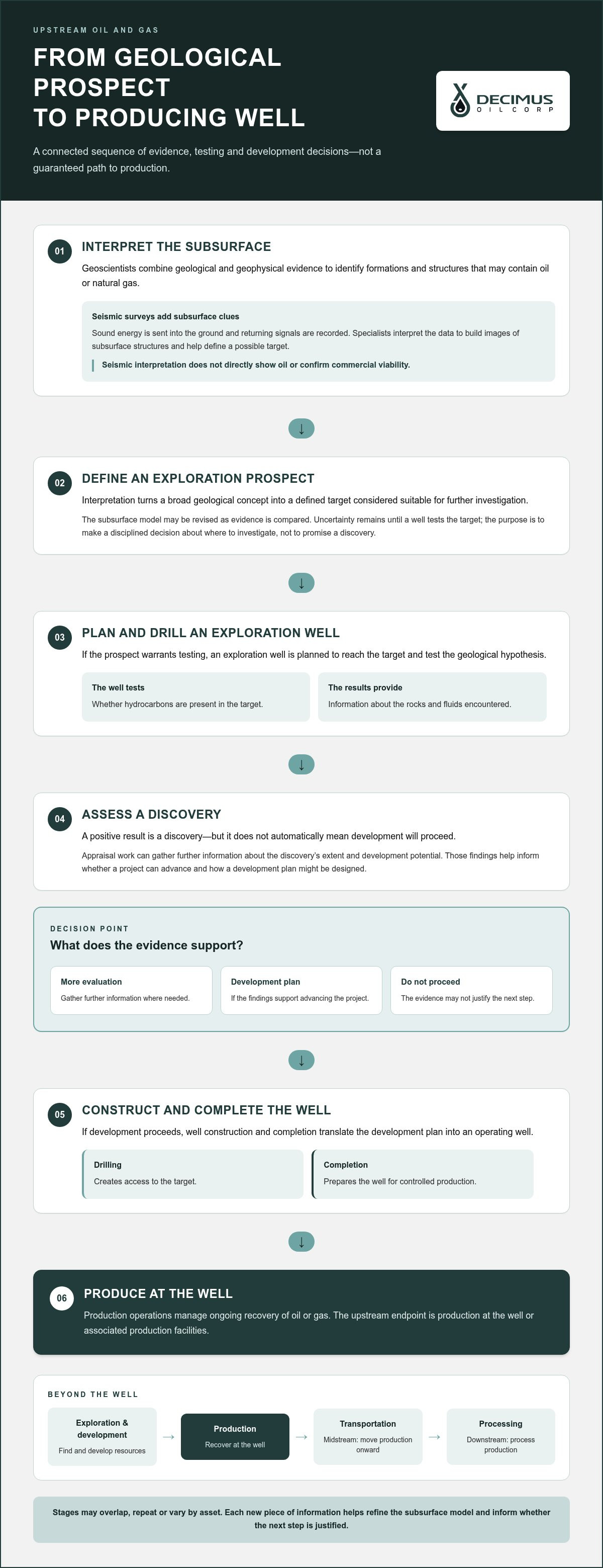
Value chain: Exploration and development → production → transportation → processing
In this flow, the upstream endpoint is production at the well or associated production facilities. Moving oil or gas onward belongs to the midstream segment; processing production into usable products belongs to downstream. This distinction explains why a well can produce hydrocarbons without its operator necessarily managing every subsequent step.
What counts as an oil or gas resource?
A subsurface accumulation is a geological occurrence that needs evaluation before its potential can be understood. A hydrocarbon is a compound made primarily of hydrogen and carbon; oil and natural gas are hydrocarbons. A reservoir is underground rock that contains and can transmit fluids, such as oil or gas, under suitable conditions.
Evidence of hydrocarbons is not the same as an established producing asset. A discovery indicates that resources occur in a particular geological setting. Further assessment considers the accumulation’s characteristics and extent, whether it can be accessed and which development approach may be appropriate. The evidence may support more evaluation, a development plan or a decision not to proceed.
A producing asset, by contrast, is a developed operation that brings hydrocarbons to the surface. Reaching that point involves linked choices: geological interpretation informs the target, engineering translates it into a well and development plan, and operating decisions shape how production is managed. The sequence can vary by asset, and activities may overlap. Viewing upstream as a connected lifecycle, rather than as drilling alone, helps explain how early uncertainty carries into later decisions.
How exploration and well development move a prospect toward production
Moving from a geological idea to a producing well involves a series of decisions, not a guaranteed progression from discovery to development. The workflow below is illustrative: stages can overlap, repeat or differ depending on the asset and the evidence gathered. At each point, new information helps teams refine the subsurface model, assess uncertainty and decide whether the next step is justified.
From geological interpretation to an exploration prospect
Geoscientists combine available geological and geophysical evidence to identify formations and structures that may contain oil or natural gas. Seismic surveys send sound energy into the ground and record returning signals. Specialists interpret those data to build images of subsurface structures. Seismic interpretation can help locate a possible trap or define a target, but it doesn’t directly show oil or confirm that a prospect will be commercially viable.
This evaluation turns a broad geological concept into a prospect: a defined target considered suitable for further investigation. The interpretation may be revised as evidence is compared, and uncertainty remains until a well tests the subsurface. The purpose is to make a disciplined decision about where to investigate, not to promise a discovery.
Drilling, appraisal and well construction
If a prospect warrants testing, an exploration well is planned to reach the target and test the geological hypothesis. Results help establish whether hydrocarbons are present and provide information about the rocks and fluids encountered. A positive result is a discovery, but it doesn’t automatically mean development will proceed.
Appraisal work can gather further information about the discovery’s extent and development potential. The findings inform whether a project can advance and how a development plan might be designed. If development proceeds, well construction and completion translate that plan into an operating well. Completion is the work that prepares a well for controlled production; it follows drilling but serves a different purpose.
A simplified workflow is:
- Interpret available geological and geophysical evidence to define a possible prospect.
- Plan and drill an exploration well to test the target.
- Assess the results and, if warranted, gather appraisal information.
- Use the evidence to decide whether and how to develop and complete wells for production.
These steps aren’t always strictly sequential. Appraisal and planning, for example, can inform one another, and results may lead to further evaluation rather than an immediate development decision. A prospect is a target being evaluated; a discovery is evidence of hydrocarbons; a producing asset is a developed operation bringing them to the surface.
This decision-led process is central to upstream oil and gas resource extraction: evidence gathered early shapes the well plan, while later results help determine whether development makes sense. Decimus Oil’s focus on conventional exploration and resource development is one example of how companies participate in this lifecycle. Learn more about Decimus Oil’s exploration and development focus.
How extraction methods and production choices shape upstream operations
When a prospect advances to development, the extraction approach must fit the geology and the asset’s operating conditions. Conventional development generally produces hydrocarbons from a reservoir through wells. Other resource-development approaches may be designed for formations with different characteristics or may require different ways to reach and produce the target. These approaches aren’t interchangeable, and no single method suits every asset.
Conventional extraction and other development approaches
In conventional development, hydrocarbons flow from a reservoir into a well, supported by the reservoir’s natural properties and the well design. In formations where hydrocarbons are less able to move through the rock, development may require different reservoir access or completion designs. Enhanced oil recovery is distinct from both: it refers to techniques used to support recovery from an asset, rather than a separate geological resource type. Suitability depends on asset-specific geological and engineering evaluation.
The comparison below shows how the approaches differ in purpose and what shapes their use:
Approach
Purpose and context
Key considerations
Conventional well development
Produces hydrocarbons from a reservoir through wells.
Reservoir properties, well placement, access and development design.
Other resource-development approaches
Formation characteristics, engineering requirements and project design.
Enhanced oil recovery
Supports recovery from a producing or developed oil asset.
Asset conditions and the technical fit of the recovery approach.
The categories serve different purposes: conventional and other approaches describe broad development contexts, while enhanced oil recovery concerns how recovery from an asset may be supported. Geology, reservoir characteristics and access influence well design. Project design brings those technical choices together with the facilities and operating plan required for production.
From completed well to ongoing production
A completed well provides a controlled route for hydrocarbons to move from the reservoir to the surface. Surface equipment supports separation of produced fluids, measurement and safe handling. The exact configuration depends on what the well produces and how the asset is designed; a completed well is one part of a wider operating system.
Production performance can change over an asset’s life as reservoir and operating conditions evolve. Operators monitor production and manage the well and associated equipment in response. This work can include adjusting operating practices or considering enhanced recovery where appropriate. The objective is to manage the asset in line with its technical characteristics, rather than assume its initial production pattern will remain unchanged.
These choices give upstream oil and gas resource extraction its asset-specific character: method selection connects subsurface conditions to well construction and ongoing operations. Decimus Oil’s focus includes conventional exploration, resource development and enhanced oil recovery, complementary ways to develop and support assets. Its resource development focus is one example of how these activities fit within upstream operations.
What determines whether an upstream extraction project can advance
A promising geological indication is only one part of a development decision. Before a prospect moves toward a project, the evidence must support a workable technical plan, infrastructure needs must be understood, capital must be allocated with discipline, and applicable environmental requirements must be addressed. These considerations interact: a change in the reservoir model, for example, may affect well design, facilities and the project’s overall rationale.
A resource discovery alone doesn’t establish a producing project; development depends on whether technical, infrastructure, commercial and environmental considerations can be addressed together. This distinction separates geological potential from commercial viability. A discovery may warrant further study without supporting immediate development, and uncertainty can remain as new information becomes available.
A practical assessment considers how the following factors fit together:
- Geology: What does the available evidence indicate about the resource and reservoir?
- Engineering: Can the well and operating plan be designed for the asset’s characteristics?
- Infrastructure: What access to gathering, processing and transportation infrastructure would the project need?
- Capital discipline: Does the evidence support committing resources to the next stage?
- Environmental requirements: What assessments, approvals and operating obligations apply in the project’s jurisdiction?
Technical and infrastructure considerations
Understanding the reservoir informs choices about well placement, construction and operating plans. Engineers consider how the proposed design fits the subsurface evidence and practical project conditions. If appraisal information changes the understanding of the reservoir, the development concept may need to change too. The aim is to align the plan with the evidence, rather than assume a discovery can be developed using a standard template.
Infrastructure is part of that planning. Project teams consider access to gathering, processing and transportation connections when shaping facilities and development design. If infrastructure access is a constraint, it may influence the project configuration or the decision about whether to advance. This is a planning consideration, distinct from midstream operations.
Environmental responsibilities and project uncertainty
Environmental assessment, approvals and ongoing operating obligations depend on the applicable jurisdiction and project circumstances. Plans may need to consider land disturbance, emissions, water management and eventual site closure. These factors belong alongside technical design and project sequencing, rather than being treated as separate matters after development choices have been made.
Uncertainty also affects timing and scope. Further evidence may strengthen the case to proceed, prompt a revised plan or show that a constraint remains unresolved. A balanced decision weighs what is known against what still needs to be demonstrated, including whether the project can meet relevant requirements through its operating life and closure planning.
In upstream oil and gas resource extraction, project readiness is a combined assessment, not a single geological result. Decimus Oil’s work in conventional exploration, resource development, enhanced oil recovery and energy infrastructure reflects complementary parts of asset development. Explore Decimus Oil’s resource development activities.
How Decimus Oil connects upstream resource development with asset value
The upstream lifecycle connects geological prospects to producing assets through evaluation, development and operating decisions. Decimus Oil Corp. is a Canadian energy company focused on conventional oil and gas exploration and resource development. Its activities relate to the stages where companies assess prospects, determine how resources may be developed and manage assets through production.
Asset value is shaped by how geological potential, technical choices and operating considerations come together. Exploration can identify an opportunity, but development depends on evidence and project-specific decisions. For an overview of factors that can influence project economics and value, see this oil and gas exploration economics guide.
A conventional exploration and resource-development focus
Conventional exploration seeks and evaluates oil and gas prospects that may be developed through wells. Geological interpretation informs where a prospect may lie, while drilling and subsequent evaluation provide evidence to guide decisions about advancing it. Resource development connects these stages to the planning and execution needed to establish producing assets.
Decimus Oil’s focus on conventional exploration and resource development reflects this progression from prospect evaluation toward asset development. A prospect is an opportunity to assess, not a confirmed producing asset; the outcome depends on evidence and project decisions. Understanding the relevant upstream oil and gas resource extraction stages helps explain how exploration and development relate without assuming that every prospect will proceed.
Developing producing assets through recovery and infrastructure
Exploration and initial development are not the only ways to support an asset. Decimus Oil uses enhanced oil recovery techniques as part of its resource-development activities. At a high level, enhanced recovery refers to approaches intended to support oil recovery from an asset; the appropriate technique depends on the asset and its technical characteristics. It complements development, but does not guarantee additional production or replace evaluation of project conditions.
Energy infrastructure is another part of Decimus Oil’s focus. Infrastructure management can support resource development by connecting asset planning with the facilities and logistics associated with production. Its role is distinct from exploration and well development, yet infrastructure considerations can influence how a producing asset is supported. For a dedicated discussion of recovery methods, explore this enhanced oil recovery techniques overview.
Together, conventional exploration, resource development, enhanced oil recovery and energy infrastructure represent complementary areas of activity. Decimus Oil is publicly traded on the TSX Venture Exchange as TSXV:WCSB. For an educational overview of the company’s focus and approach to resource development, learn more about Decimus Oil.
Carry a lifecycle perspective into your next decision
When assessing an upstream opportunity, examine how assumptions connect across the asset’s life. Ask what evidence supports the geological interpretation, which decisions remain open and how new information could change the development plan. This perspective helps distinguish a promising concept from a project with a clearly considered path forward.
That discipline matters throughout upstream oil and gas resource extraction. Technical choices, infrastructure needs and operating considerations are linked, so evaluating them together gives a more grounded view of potential and constraints. As projects evolve, revisiting those connections can keep expectations aligned with the evidence, without treating a discovery or initial plan as a guaranteed outcome.
To explore how these principles relate to a Canadian resource-development company, learn about Decimus Oil’s resource-development approach. A clearer view of the decisions behind an asset is a strong starting point for understanding its potential.
Frequently Asked Questions
Can oil and natural gas be produced from the same well?
Yes, a well can produce oil along with associated natural gas. Associated gas occurs with crude oil in the same reservoir, either dissolved in the oil or present as a separate gas phase. Gas-only production comes from a reservoir where natural gas is the principal target, rather than being produced alongside oil. The mix of fluids encountered influences how production is handled and measured at the surface.
What is the difference between a petroleum resource and a reserve?
A petroleum resource is an estimated quantity of oil or gas associated with a geological accumulation, while a reserve is the portion assessed as recoverable under defined technical, commercial and project conditions. Classification depends on the quality of geological evidence and the likelihood that recovery is feasible. It can change as drilling, appraisal, engineering plans or commercial conditions provide new information. A resource estimate alone doesn’t mean production is assured.
How long does it take to move from discovery to first production?
There’s no single timeline from discovery to first production. The duration depends on how much evaluation is needed, the approval process applicable to the project, engineering and well planning, and whether required infrastructure is accessible or must be developed. Project scale, location and operating conditions also matter. A discovery needing further appraisal may take a different path from one with a defined development plan, so early estimates can change as decisions progress.
Is every oil or gas discovery commercially recoverable?
No. A discovery confirms that oil or gas is present, but it doesn’t establish that the resource can be produced safely, technically or commercially under the project’s conditions. Reservoir properties may limit flow, for example, or the required well design and infrastructure may not support a viable development plan. In upstream oil and gas resource extraction, geological evidence is an important starting point; technical analysis and commercial assessment determine whether development is justified.
What happens to an oil or gas well when production declines?
Declining production prompts operators to review well and asset performance, operating data and the condition of relevant equipment. They may adjust operating practices or assess whether further work, including recovery techniques, is suitable for the asset. If continued production is no longer appropriate, planning turns to closure and the applicable end-of-life obligations. A decline doesn’t by itself determine the next step; decisions depend on technical evidence and project circumstances.
How is production from an upstream well monitored?
Operators monitor production by measuring produced oil, gas and, where relevant, water, then reviewing those results alongside operating data. Comparing measurements over time can help identify changes in well performance or operating conditions. Surveillance may include reviewing equipment and well behaviour to inform operating decisions. The specific measurement and monitoring approach depends on the asset and its design; no particular system is universal across upstream operations.
What does well abandonment mean in upstream oil and gas?
Well abandonment is the end-of-life process for a well that will no longer produce or be used for another approved purpose. At a high level, it involves safely closing the well and addressing the site in line with applicable requirements. The required work and documentation depend on the well, site and jurisdiction. Abandonment is distinct from a temporary pause in production, which may leave a well inactive rather than permanently closed.
Explore Decimus Oil’s conventional exploration, resource development and enhanced oil recovery focus at Decimus Oil.


