
What determines whether a conventional discovery can become a producing asset? Conventional reservoir development in Canada depends on more than finding oil or gas. It requires evidence that hydrocarbons can flow through the reservoir, a development plan suited to its properties and infrastructure that can support production. Unlike shale and tight resources, conventional reservoirs generally rely more on natural permeability than intensive stimulation, but development still involves technical, operational and commercial risks.
Subsurface evidence helps teams make practical decisions, but it never gives a complete picture. Well logs, seismic surveys and geological mapping help assess reservoir size, continuity and quality. The next step is to identify what remains uncertain and consider how it could affect well placement, expected production, infrastructure needs and project economics.
This article follows the development sequence from exploration and discovery through drilling, production and ongoing asset management. It explains how reservoir characteristics and infrastructure shape development choices, and what to consider when comparing plans. The aim is a practical overview of conventional resource development in Canada that recognizes the potential of a discovery without treating it as a guarantee of production or commercial success.
Key Takeaways
- Understand how porous, permeable reservoir rock, a hydrocarbon trap and an effective seal work together to support conventional production.
- See how seismic interpretation, well data and pressure information help assess a discovery and shape a development plan.
- Compare single-well, staged and broader field-development approaches by weighing infrastructure needs, flexibility and uncertainty.
- Follow the sequence from approvals and construction through drilling, completion and production, recognizing that requirements vary by project and jurisdiction.
- Learn how conventional reservoir development in Canada links subsurface decisions with infrastructure management and enhanced recovery over an asset’s lifecycle.
What conventional reservoir development means in Canada
Conventional reservoir development is the process of evaluating and producing hydrocarbons that have accumulated in connected pore spaces within rock that allows fluids to flow to a well. Applying that definition means understanding how the petroleum system fits together. Source rock generates hydrocarbons; reservoir rock stores them in pores; a trap gathers them in a geological structure; and a seal helps prevent them from escaping. If these elements don’t align, hydrocarbons may be absent, dispersed or difficult to produce.
Conventional oil and gas resources are part of Canada’s wider production picture, which includes different geological settings and extraction approaches. The overview of Petroleum production in Canada provides broader historical and industry context. For a development decision, the practical question is more specific: do the reservoir’s connected pore spaces, fluid properties and geological boundaries support a viable production plan?
Conventional does not mean uncomplicated. Reservoir thickness, pressure, fluid content and connectivity can vary, sometimes over a relatively small area. Those characteristics affect how much of the resource may be recoverable and how wells should be designed. A general definition is a useful starting point, not a substitute for technical classification or project-specific evidence. Regulatory requirements also depend on the project and jurisdiction.
How a conventional reservoir differs from a tight resource
The distinction centres on how readily fluids move through the rock. Conventional reservoirs generally have sufficient natural permeability for oil or gas to flow towards a well, although flow rates and conditions vary. Tight resources have much lower permeability, so development may rely on methods such as horizontal drilling and hydraulic fracturing to reach and connect more of the resource. Neither category is automatically easier or more predictable to develop.
These are broad comparisons, not fixed recipes. Geological setting, reservoir properties, well design and project objectives all influence the approach. A method that suits one development may not suit another, even when the resources appear similar.
Why reservoir development is more than drilling a well
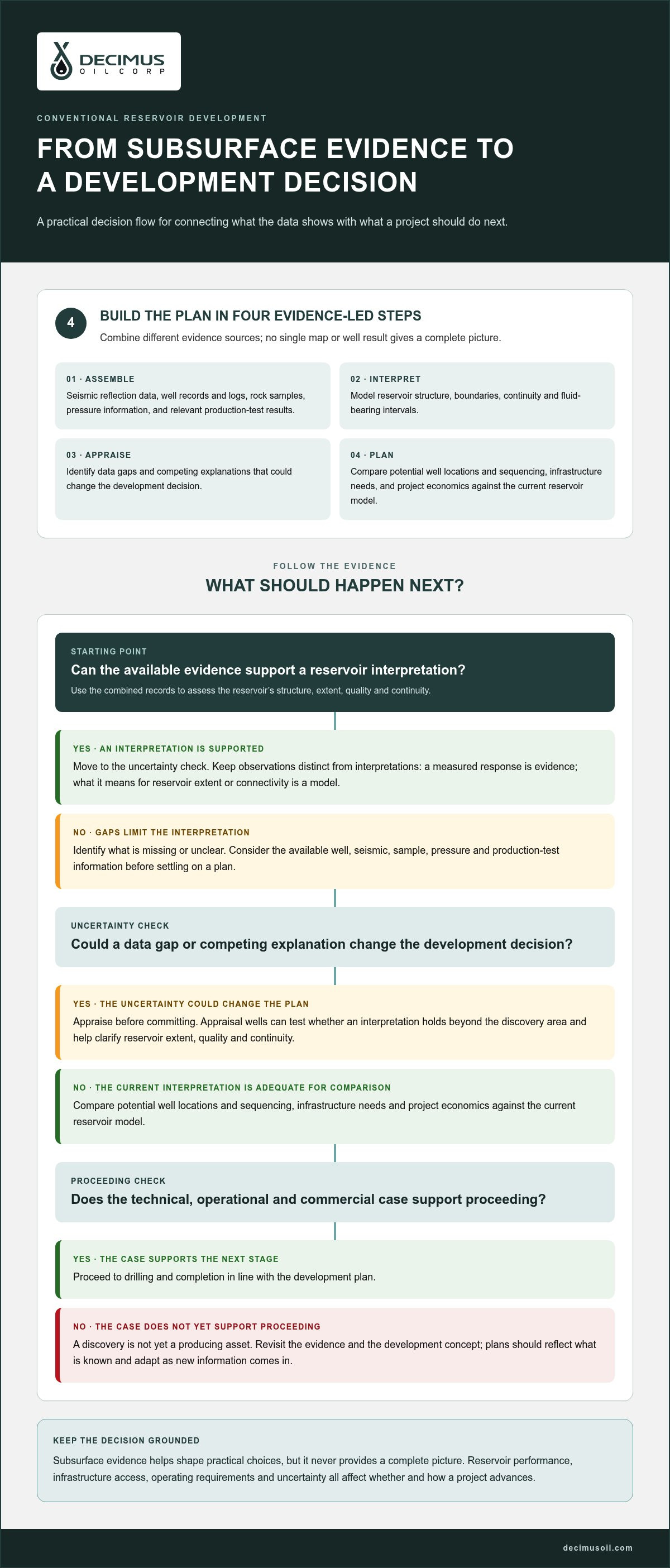
A discovery is a starting point, not a producing asset. Development connects assessment, appraisal, planning and production. Teams evaluate the available evidence, identify uncertainty and select a development concept that reflects what is known. Drilling and completion follow when the technical, operational and commercial case supports proceeding.
Commercial potential depends on more than the volume of hydrocarbons in place. Reservoir performance, access to suitable infrastructure, operating requirements and the ability to manage uncertainty all shape whether and how a project advances. In conventional reservoir development in Canada, sound decisions connect subsurface evidence with the practical steps required to bring an asset into production.
How subsurface evidence shapes a conventional reservoir development plan
A development plan is built by combining evidence, not by treating one map or well result as a complete picture. Teams assemble available data, interpret the geology, assess what remains uncertain and choose a plan that can adapt as new information comes in. Keeping observations distinct from interpretations helps decision-makers understand what the evidence supports and where judgment is involved.
- Assemble the evidence. Bring together seismic reflection data, existing well records, well logs, rock samples, pressure information and relevant production-test results.
- Interpret the geology. Use the records to model the reservoir’s structure, boundaries, continuity and fluid-bearing intervals.
- Appraise uncertainty. Identify where the data supports the interpretation and where gaps or competing explanations could change the development decision.
- Plan the next step. Compare potential well locations and sequencing, along with infrastructure needs, against the current reservoir model and project economics.
What geological and engineering evidence can reveal
Seismic reflection data can help map underground layers and structures by recording how energy waves reflect from boundaries between rock types. It provides a broad view, but does not directly reveal every reservoir property. Well logs measure characteristics around a borehole; samples provide physical material for analysis; and production tests show how fluids behave under test conditions. Pressure data can add clues about reservoir communication and fluid movement.
Each source provides a different kind of information. A recorded pressure or measured log response is an observation. An interpretation of what that observation means for reservoir extent or connectivity is a model, and it carries uncertainty.
How appraisal reduces uncertainty before development
Appraisal wells can test whether an interpretation holds beyond the discovery area and help clarify reservoir extent, quality and continuity. The results may support a proposed well location, point to a staged development or show that the reservoir model needs revision. Appraisal does not guarantee a particular outcome; its value is in providing more evidence for the next decision.
Better evidence can strengthen decision confidence, but it cannot eliminate subsurface uncertainty. Consider both the quality of the data and the consequences if a key interpretation proves wrong.
Porosity describes the space within rock that can hold fluids; permeability describes how readily fluids move through connected spaces. Along with fluid properties and reservoir continuity, these factors influence well placement and expected flow. For example, a porous interval may still be difficult to produce if its pores are poorly connected. If a plan assumes continuity where none exists, well placement or development sequencing may need to change.
Subsurface choices also affect project economics. Drilling sequence, infrastructure access and uncertainty all influence how a project is evaluated. The Canadian oil and gas exploration economics guide offers further context on the factors that shape exploration economics. This evidence-led approach aligns with Decimus Oil Corp.’s focus on conventional oil and gas exploration and resource development.
How to compare development choices without assuming conventional means low-risk
“Conventional” describes the reservoir and how fluids may flow through it. It doesn’t guarantee straightforward drilling, reliable production or commercial viability. Compare development concepts against the evidence for the specific reservoir, the infrastructure available and the uncertainty the project can accommodate.
The options below are planning frameworks, not fixed technical recipes. Recovery methods and infrastructure needs depend on reservoir conditions, project design and available information.
| Development concept | Recovery approach and infrastructure | Flexibility and uncertainty |
|---|---|---|
| Single-well | One well is developed to test or produce a defined target. It may use existing connections where suitable or require dedicated facilities to handle and move production. | Limits the initial scope and can provide operating evidence. However, one well may not show whether the reservoir is representative across a wider area. |
| Staged | Wells or development areas are brought forward in phases. Facilities and connections can be sized or expanded to match the sequence. | Later stages can reflect information from earlier work. The plan still depends on assumptions about reservoir continuity, timing and future development needs. |
| Broader field development | A coordinated plan addresses multiple wells or areas, with shared infrastructure where practical. Production may draw on natural reservoir energy, pressure management or, where appropriate, enhanced recovery. | A field-wide plan can coordinate operations, but requires a broader understanding of reservoir behaviour and infrastructure needs. Uncertainty in one area may affect the wider plan. |
Which factors can change the preferred development approach?
Reservoir continuity affects whether wells may draw from connected rock or separate compartments. Fluid properties and pressure influence production behaviour and the design choices used to manage it. Infrastructure also affects the practical sequence: nearby capacity may support an incremental plan, while limited access may require a different scope or timing. These factors help establish technical suitability, but don’t determine commercial viability on their own. Project assumptions and operating requirements matter too.
When an existing asset may benefit from additional recovery methods, assess the fit against its specific conditions. Decimus Oil uses enhanced oil recovery techniques to optimize output from existing oil and gas fields and manages infrastructure to support resource development and transportation.
Why conventional development still involves uncertainty
Subsurface conditions can vary between wells, and actual production may differ from early expectations. New drilling, pressure or production evidence can refine estimates of reservoir extent and connectivity, prompting changes to well locations, sequencing or facilities. Project assumptions may also change as technical and operating information develops.
A disciplined comparison makes uncertainty visible instead of treating it as a reason to favour one concept automatically. In conventional reservoir development Canada, no development option ensures recovery, production targets or returns. The objective is to choose a technically appropriate plan whose scope and flexibility reflect the evidence and the risks decision-makers must manage. Decimus Oil’s work in conventional exploration, resource development, energy infrastructure and enhanced oil recovery connects these choices across an asset’s lifecycle. Learn more about its conventional resource development focus.
How conventional reservoir development moves from planning to production
Once a development concept is selected, the work shifts from evaluating the resource to preparing and operating an asset. The overall sequence is recognizable, but approvals, engineering, construction and operating requirements depend on the project and jurisdiction. In Canada, regulatory responsibilities can differ across provinces and territories and between onshore and offshore contexts. Confirm current requirements with the relevant authorities before project decisions.
- Prepare the project. Define the proposed work, assess land and infrastructure needs, complete applicable review processes and secure required approvals before proceeding.
- Prepare the site. Construction establishes the access and working area needed for drilling and related operations. Planning considers surface use and how activities will be managed.
- Drill and complete the well. Drill to the target and complete the well so it can produce from the intended interval. Configuration follows project-specific engineering and reservoir evidence.
- Commission and produce. Bring equipment and connections into operation, then monitor production in line with the asset and its operating plan.
What happens during well construction and start-up?
Before drilling, the operator coordinates site preparation and construction with the project design and applicable approvals. Drilling creates the wellbore; completion prepares it to communicate with the selected reservoir interval and produce under planned operating conditions. Commissioning checks that connected systems are ready for operation. The sequence and equipment are not universal: engineering decisions depend on the well, reservoir, surface setting and project design.
How production management supports the asset lifecycle
Start-up is a transition, not the finish line. Operators track production and operating conditions, compare performance with expectations, and plan maintenance or adjustments as new evidence develops. A change in production can prompt investigation, but its cause needs to be assessed in context rather than assumed. Operating data can also inform decisions about future work across the asset.
Initial development establishes the producing asset; ongoing management responds to how that asset performs over time. A plan that was appropriate at start-up may need to evolve as operating evidence accumulates.
Environmental planning is part of project design and operations, not a blanket claim about performance. Depending on the project, teams consider land disturbance, water and waste handling, emissions and operational risks. Measures and obligations vary by location and activity, so assess them against current rules and project conditions. Planning for safe operations and eventual site closure is also part of responsible asset management, with applicable requirements determined by the jurisdiction.
This lifecycle perspective connects conventional reservoir development in Canada with infrastructure planning and long-term resource development. Explore Decimus Oil’s conventional resource development focus to learn how the company’s priorities span exploration, infrastructure and enhanced oil recovery.
How Decimus Oil connects conventional resource development with asset value
Conventional resource development connects subsurface potential with the practical work of developing and managing an energy asset. Decimus Oil is a Canadian energy company focused on conventional oil and gas exploration, resource development, energy infrastructure and enhanced oil recovery. These priorities span an asset’s lifecycle, from assessing resources to managing infrastructure and optimizing output from existing fields.
This integrated perspective matters because a resource can’t be evaluated in isolation from how it may be developed. Geological evidence informs the development concept; the concept shapes infrastructure requirements, sequencing and operational planning. Economic assumptions also influence whether a technically suitable opportunity can advance. Each link requires project-specific assessment rather than the assumption that a discovery alone creates value.
How an integrated asset perspective supports development
Resource assessment helps frame an opportunity, while development planning translates that understanding into decisions about wells, timing and facilities. Infrastructure management is part of the same picture: capacity, connections and operating needs can influence the scope and sequence of work. Considering these elements together helps clarify an asset’s requirements without implying that one development model fits every reservoir.
Enhanced recovery can be considered as a way to optimize an existing asset when its conditions and project objectives make the approach suitable. It isn’t a universal solution or an automatic next step. The decision depends on the reservoir, available evidence, operating context and case for proceeding. Decimus Oil implements enhanced oil recovery techniques and manages energy infrastructure as part of its resource development focus.
What readers should take away about Canadian conventional development
Across Canada, conventional development brings geology, subsurface evidence, engineering, infrastructure and economics into a sequence of connected decisions. A sound interpretation can guide planning, but uncertainty remains as new information emerges and operating conditions become clearer. Development choices need to reflect the specific resource and project context, with assumptions reviewed as evidence changes.
That is the central lesson of conventional reservoir development in Canada: resource potential is only one part of the development case. A strong plan also aligns technical understanding with infrastructure, operational requirements and commercial considerations. Responsible asset development means assessing these factors together, recognizing uncertainty and avoiding promises about production or financial outcomes.
Decimus Oil’s focus brings conventional exploration, resource development, energy infrastructure and enhanced oil recovery into one corporate context. For an overview of the company and its priorities, explore Decimus Oil. This provides information about its business focus, not a prediction of results.
Make the next development decision with perspective
To understand conventional reservoir development in Canada, look beyond the label and examine how an opportunity is assessed, advanced and managed over time. For readers evaluating the sector, that means distinguishing technical potential from commercial certainty and considering how a company’s priorities fit into the broader asset-development lifecycle.
Decimus Oil identifies conventional oil and gas exploration and resource development as areas of focus. The company also reports more than 100 years of combined team experience. These details provide context about the company, not a guarantee of project outcomes or investment returns.
Continue your research by reviewing how Decimus Oil describes its business and priorities. Explore Decimus Oil’s conventional resource development focus to learn more about the company. A measured understanding of opportunity and uncertainty is a useful foundation for an informed perspective on Canada’s energy sector.
Frequently Asked Questions
Is conventional reservoir development still relevant in Canada?
Yes. Conventional resources remain part of Canada’s oil and gas industry, and their development can contribute to production and the use of existing energy infrastructure. Relevance depends on the specific opportunity: reservoir evidence, operating context, infrastructure access and commercial assumptions all matter. When assessing conventional reservoir development in Canada, ask whether a particular project can be developed responsibly and on a sound basis, rather than relying on the resource category alone.
Can a conventional reservoir have low permeability?
Yes. “Conventional” doesn’t mean every part of a reservoir has high permeability. Rock properties can vary between layers or across the reservoir, restricting fluid movement in some intervals. Engineers assess whether the formation can produce under the proposed well design and operating conditions. Some conventional wells may use stimulation, while tight-resource development more commonly relies on methods such as hydraulic fracturing to improve flow from very low-permeability rock.
How long does it take to develop a conventional oil or gas discovery?
There’s no single timeline for every discovery. The schedule can depend on how much appraisal is needed, engineering complexity, required approvals, construction, infrastructure access and the sequence of drilling and completion work. A discovery near usable infrastructure may involve different planning needs from one that requires new connections. Without assessing these project-specific factors, a precise timeline would be speculative.
What is a reservoir drive mechanism?
A reservoir drive mechanism is the natural energy that helps move oil or gas through the reservoir and towards a well. It may involve expansion of gas dissolved in oil, a separate gas cap, water entering the producing zone or gravity acting on fluids of different densities. More than one mechanism can contribute. Understanding the dominant drive helps engineers interpret pressure and production changes and assess how a reservoir may behave as it is produced.
Can oil and natural gas occur in the same conventional reservoir?
Yes. Oil and natural gas can occur together in a reservoir. Gas may be dissolved in the oil, form a separate gas zone above it, or occur in both ways, depending on reservoir conditions and fluid composition. A well can therefore produce oil with associated gas. The proportions and behaviour of each fluid are established through subsurface evaluation and production data, rather than assumed from the discovery alone.
What does an oil-water contact indicate in a reservoir?
An oil-water contact is the interpreted boundary or transition between oil-bearing and water-bearing parts of a reservoir. It can help geologists estimate fluid distribution and select a well target. In practice, the transition may not be a perfectly sharp, level line: rock variation and capillary effects can influence it. Logs, pressure measurements and other evidence help refine the interpretation.
Does a discovery automatically become a commercial reserve?
No. A discovery confirms hydrocarbons are present, but that alone doesn’t establish that they can be produced commercially. Evaluation considers whether a technically feasible development approach exists and whether estimated recoverable volumes meet applicable reserve-classification criteria under defined assumptions. Data quality, project plans and economic conditions can affect the assessment. Reserve estimates are qualified evaluations, not a guarantee that production will occur or that a project will earn a particular return.


