

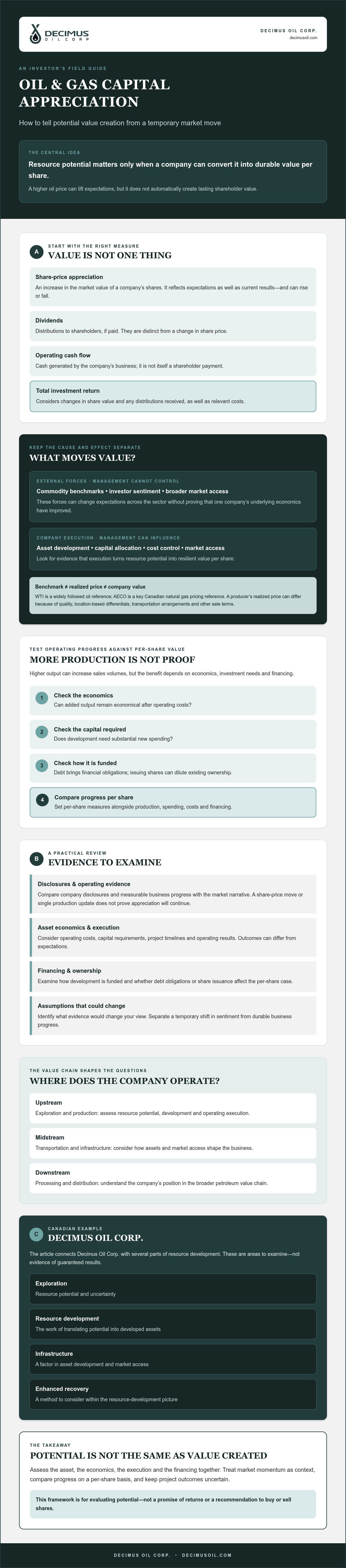
A higher oil price doesn’t automatically create lasting shareholder value. In 2026, geopolitical disruptions can drive sharp market swings, while producers are emphasizing capital discipline and the performance of existing assets. That distinction is central to oil and gas capital appreciation: resource potential matters only when a company can convert it into durable value per share.
Commodity prices, production and reserves can all influence an energy company’s market value. The challenge is separating measurable business progress from temporary market sentiment, especially when capital needs are substantial and project outcomes uncertain. This article outlines potential sources of value creation, the evidence to examine in company disclosures and the risks that can weaken an investment case.
We’ll consider how commodity exposure, reserve development, operational execution, infrastructure and recovery methods can shape a company’s prospects, alongside 2026 trends in capital allocation and energy demand. Decimus Oil Corp. provides a Canadian example of how exploration, resource development, infrastructure and enhanced recovery fit into that analysis. The aim is to offer a clearer framework for assessing potential, not a promise of returns or a recommendation to buy or sell shares.
Key Takeaways
- Separate share-price appreciation from dividends, operating cash flow and total investment return when assessing an energy investment.
- Assess oil and gas capital appreciation by distinguishing market forces from factors management can influence, such as costs, capital allocation and market access.
- Compare per-share measures with production, spending, costs and financing to test whether operating progress supports the market narrative.
- Use a consistent review of company disclosures, asset economics and execution risks, and identify what evidence could change your assumptions.
- Consider how exploration, existing infrastructure and enhanced recovery may contribute to resource development, while treating outcomes as uncertain.
What Oil and Gas Capital Appreciation Means for Energy Investors
Oil and gas capital appreciation is an increase in the market value of an energy asset or a company’s shares. It describes potential value growth, not a guaranteed investment return. For a public company, the term often refers to a rising share price. That price can reflect expectations about future performance as well as current results, and it can fall as well as rise.
Share-price appreciation is only one part of an investor’s outcome. Dividends, if paid, are distributions to shareholders. Operating cash flow is generated by the company’s business, but it isn’t itself a shareholder payment. Total investment return considers changes in share value and any distributions received, as well as relevant costs. These measures answer different questions, so one shouldn’t stand in for the others.
Energy equities can respond to company fundamentals, commodity markets and investor sentiment. The global petroleum industry spans upstream exploration and production, midstream transportation and infrastructure, and downstream processing and distribution. A company’s position in that value chain helps frame what assets it holds, where it may face costs and which market factors could affect its prospects.
How appreciation differs from production growth
Higher production can increase sales volumes, but it doesn’t automatically increase value for each share. Consider whether the added output is economical after operating costs, whether it requires substantial new capital and how the company will fund that investment. Debt adds financial obligations, while issuing shares can dilute existing ownership. Production growth is evidence to assess, not proof of per-share value creation.
For example, a hypothetical producer might report rising output while also taking on debt or issuing shares to fund development. Whether that progress supports stronger value depends on the economics and financing, not volume alone. Market valuation can also shift independently of short-term operating results as expectations change.
Why oil and gas shares can be volatile
Commodity-price exposure can affect expected revenue. Changing expectations about supply, demand or market access can also influence how investors value future cash flows. A shift in outlook may move a share price even when current production hasn’t changed.
Projects add another layer of uncertainty. Timelines, capital requirements and operational results can differ from expectations, prompting investors to reassess potential value. Compare company disclosures and operating evidence with market sentiment. Neither recent share-price momentum nor a single production update proves that appreciation will continue.
The Main Drivers of Oil and Gas Capital Appreciation
Potential value creation reflects two interacting forces: external market conditions and company execution. Management can influence how assets are developed, how capital is allocated and how costs are controlled. It can’t control commodity benchmarks, investor sentiment or broader market access. For oil and gas capital appreciation, ask whether the company can convert resource potential into resilient value per share, rather than simply benefit from a favourable market move.
Asset potential creates an opportunity; disciplined execution determines whether that potential can translate into lasting value. A rising benchmark price may lift expectations across the sector without proving that a particular company has improved its underlying economics. The International Energy Agency’s discussion of global energy investment trends provides broader context for considering how capital is allocated across energy markets.
Commodity markets and operating context
Oil and natural gas benchmarks help investors understand market conditions and frame revenue expectations. WTI crude is a widely followed reference for oil, while AECO is a key Canadian natural gas pricing reference. Neither benchmark necessarily matches the price a producer receives. Realized pricing can differ because of product quality, location-based differentials, transportation arrangements and other terms of sale. A benchmark movement is context, not a direct measure of a company’s revenue or value.
Operating costs also shape the effect of market prices. If costs rise or transportation limits access to stronger markets, higher benchmark prices may not translate proportionately into stronger cash generation. Review company disclosures for realized prices, cost trends and stated commodity exposure rather than relying on a benchmark alone.
Asset development and operational execution
Resource quality and reserve confidence influence how investors assess a company’s asset base, but estimates need technical and commercial context. Consider the assumptions behind reported resources or reserves, the development plan, expected capital requirements and the market available for the produced commodity. Estimates aren’t the same as developed, producing assets, and potential outcomes depend on execution.
Drilling results can refine understanding of a formation. Recovery methods may affect how much of a resource can be produced, while infrastructure can influence operating efficiency and market access. Look for evidence about each factor in company disclosures. A credible plan requires more than geological promise: timing, funding, costs and operational results matter too.
Capital discipline connects these factors. Staged investment and clear priorities can help a company manage uncertainty, while poorly supported expansion can increase financing needs without establishing stronger per-share value. For a closer look at project-level considerations, read this oil and gas exploration economics guide. You can also review Decimus Oil’s public company information to learn about its focus on conventional exploration, resource development, infrastructure and enhanced recovery. This is educational context, not a recommendation to buy or sell shares.
How to Separate Durable Value Creation from Market Momentum
A share-price rise can reflect stronger company results, changing commodity expectations or a shift in investor sentiment. These forces can overlap, but they aren’t interchangeable. To assess whether progress may support oil and gas capital appreciation, compare the market narrative with company disclosures. Then check whether operating gains are translating into stronger measures per share.
Look beyond headline production. Review production trends alongside operating costs, capital spending, financing and project milestones. Per-share measures help show whether growth is accruing to existing shareholders or being offset by new share issuance. Acquisitions can add assets but may also bring funding needs and integration risks. Debt increases obligations, while issuing shares can dilute ownership. The terms and expected benefits matter as much as the announcement.
| Movement | What it may reflect | What to check |
|---|---|---|
| Fundamental progress | Operational or financial change at the company | Production, costs, capital allocation, project milestones and per-share measures |
| Commodity effect | Changing expectations for oil or natural gas prices | Realized pricing, differentials, market access and the company’s commodity exposure |
| Sentiment-driven movement | Changing investor expectations or attention | Whether disclosures and operating results support the market’s narrative |
Signals that may support a fundamental case
Compare disclosed production and cost trends over time. Then assess whether capital allocation and project milestones align with the company’s stated plans. Read reserve and resource disclosures with their assumptions, qualifications and technical context. Stronger evidence comes when operational progress shows up not only in total output, but also in relevant per-share measures and the company’s financing position.
Signals that require additional scrutiny
Treat promotional projections as scenarios, not established outcomes, unless current technical and financial disclosures support them. Check whether planned work depends on new financing, whether debt obligations could constrain development and whether share issuance may dilute ownership. Delayed milestones or changing plans can also weaken the case. For a broader framework, see this junior oil company evaluation guide.
No single indicator settles the question. Test whether operating evidence, financing capacity and per-share progress support the same conclusion as the share-price trend. Keep in mind that none can establish future appreciation with certainty.
A Practical Framework for Assessing Appreciation Potential and Risk
A sound assessment of oil and gas capital appreciation starts with evidence, not a target share price. Use a consistent review to test how an issuer’s assets, economics and funding fit together. Identify which assumptions could change your view. Base assumptions should reflect currently disclosed information; label upside scenarios as possibilities, not expected outcomes.
- Review issuer disclosures. Start with current company filings and announcements. Check dates and qualifications, and whether claims are supported by technical disclosures prepared by qualified professionals.
- Assess the assets and plans. Identify what the issuer owns or is developing, the stage each asset has reached and the evidence supporting resource or reserve estimates. Review the assumptions and limitations, not just headline figures.
- Test the economics. Consider expected prices, operating costs, transportation or market access, and the capital required to advance development. Ask which assumptions are most sensitive to change.
- Examine financing and execution. Determine how planned work will be funded, whether additional financing may be needed, and how debt or new share issuance could affect existing shareholders. Compare stated milestones with reported progress.
- Map the risks and update your view. Record key dependencies, possible delays and the evidence that would strengthen or weaken the case. Revisit your assessment when new disclosures change an important assumption.
Questions to ask about the issuer
What assets and development plans are disclosed, and what technical or operating evidence supports them? How will the work be funded, and could future financing increase debt or dilute existing ownership? Which milestones depend on approvals, infrastructure, market access or other parties? Clear answers help distinguish a documented plan from an optimistic projection.
Risks that can interrupt a value-creation thesis
Commodity-price changes, operating disruptions, capital constraints and project delays can alter economics or timing. Depending on the assets and location, environmental requirements, regulatory processes, Indigenous consultation and market access may also affect development. Check their relevance and status against current issuer disclosures and authoritative sources instead of assuming they apply based on general commentary.
Potential appreciation is uncertain. Assess it alongside downside risks, funding needs and evidence that could invalidate your assumptions. For further educational context, consult this junior oil company investment framework. To apply the same disclosure-focused approach to Decimus, review Decimus Oil’s public company information. This framework supports independent analysis and isn’t a recommendation to buy or sell shares.
How Decimus Oil Connects Resource Development with Value Creation
Decimus Oil Corp. offers a Canadian example of how exploration, existing assets and recovery methods can fit into a resource-development strategy. The company focuses on conventional oil and gas exploration, resource development, energy infrastructure and enhanced recovery. These areas provide context for assessing the business, but they don’t establish that assets will be developed successfully or that shareholders will realize oil and gas capital appreciation.
Decimus Oil’s areas of focus
Exploration can help identify and evaluate resource potential. Development decisions then depend on technical evidence, commercial economics, financing and execution. Existing infrastructure may be relevant to how assets are developed and connected to markets, while enhanced recovery methods may be considered in efforts to produce from existing resources. Neither infrastructure nor a recovery approach guarantees higher production or improved economics. Assess their potential contribution against project-specific disclosures, costs, timelines and results.
Decimus Oil is publicly traded on the TSX Venture Exchange as TSXV:WCSB. Confirm current listing details using exchange and issuer information before relying on them. Apply the same care to claims about assets, reserves, production, insider ownership or team experience. Review current company disclosures for the latest operating results and technical estimates.
Where to continue your research
Use the company’s current public disclosures as a starting point, then compare stated plans with independent technical and financial information. Check when documents were published, what assumptions they use and whether subsequent filings update or qualify earlier claims. This helps distinguish disclosed facts from general analysis about how exploration, infrastructure and enhanced recovery may contribute to resource development.
For broader context on evaluating energy issuers, read this Canadian energy public equity guide. Then explore Decimus Oil’s company information and review the latest available disclosures. This is an invitation to conduct further research, not a forecast of returns or a recommendation to buy or sell shares.
Make Your Next Review Evidence-Led
The central lesson is straightforward: oil and gas capital appreciation depends on more than a rising commodity price or production figure. Assess whether operating progress, disciplined financing and asset development support value per share, while weighing market conditions and risks that could change the outlook.
Decimus Oil focuses on conventional exploration, resource development, infrastructure and enhanced recovery. Treat these as a starting point for research, not evidence of future performance. Verify the company’s current listing, ownership, management experience and operational details against its latest public disclosures. Distinguish company-reported facts from your own analysis.
For a closer look, review Decimus Oil’s company information. Use current disclosures to inform your own assessment, and remember that potential appreciation is never assured. A careful, evidence-led approach can help you follow developments with greater clarity.
Frequently Asked Questions
What does capital appreciation mean in oil and gas investing?
Capital appreciation is an increase in an asset’s market value, such as a company’s share price. In oil and gas investing, oil and gas capital appreciation may reflect changing expectations about a company’s assets, finances or future performance, as well as broader market conditions. It’s distinct from dividends and doesn’t guarantee an investor’s total return. Share prices can decline, and past movements don’t establish what will happen next.
What can drive capital appreciation in oil and gas companies?
Potential drivers include improved asset economics, successful development, disciplined spending and stronger access to markets. Commodity prices can influence revenue expectations, but a company’s realized prices and costs affect how that market backdrop translates into results. Investors can also consider financing choices and changes in share count. These factors are evidence to examine, not a formula for predicting future share-price gains.
Can oil and gas shares appreciate when commodity prices are falling?
Yes, a company’s shares can rise even as commodity prices fall, although no outcome is assured. Investors may respond to company-specific developments, such as improved operating performance, a stronger financial position or progress on a disclosed project. The effect depends on the company’s exposure, realized pricing, costs and market expectations. A falling benchmark may still pressure economics, so assess the issuer’s disclosures instead of assuming either trend will continue.
How do production growth and capital appreciation differ?
Production growth describes an increase in the volume of oil or gas produced; capital appreciation describes an increase in an asset’s market value. One doesn’t prove the other. Additional output may require substantial capital, increase costs or be funded through debt or new share issuance. To understand the relationship, compare production trends with financing, costs and ownership changes, and consider whether progress is reflected per share.
Are junior oil and gas companies more likely to appreciate in value?
Not necessarily. A smaller issuer may have development opportunities, but it may also face greater uncertainty around funding, project timing, operating results and market access. Company size alone doesn’t show whether a share is likely to appreciate. Review the issuer’s assets, evidence supporting development plans, financing requirements and risks. Treat projections as scenarios, and don’t assume that potential resource growth will translate into shareholder gains.
What should investors review before assessing an oil and gas company’s potential?
Start with current issuer filings and qualified technical disclosures. Review the assets, production and cost information, development plans, financing, debt and share count, then identify dependencies that could affect timing or economics. Check the assumptions and qualifications behind resource or reserve estimates. Compare newer disclosures with earlier statements, and distinguish company information from commentary or promotional projections that may not reflect current evidence.
Does enhanced oil recovery guarantee higher asset value?
No. Enhanced oil recovery may be used to support development of existing resources, but it doesn’t guarantee greater production, improved economics or higher asset value. Outcomes depend on the specific asset, technical approach, costs, financing and execution. Assess the issuer’s disclosures for evidence about the method, expected requirements and reported results. Consider how those details fit the broader development plan rather than treating the recovery technique alone as proof of value.


