
In 2026, the most resilient upstream oil and gas investment strategies have pivoted away from chasing raw unconventional volume in favour of high-margin conventional asset optimization. While the broader market remains fixated on shale, sophisticated operators realize that the true path to capital appreciation lies in low-decline resources and proven infrastructure. You've likely felt the pressure of global price volatility and the mounting complexity of federal methane regulations, which can make the stability of junior producers feel increasingly precarious. It's a challenging environment where the distinction between conventional and unconventional returns is often blurred by shifting fiscal policies.
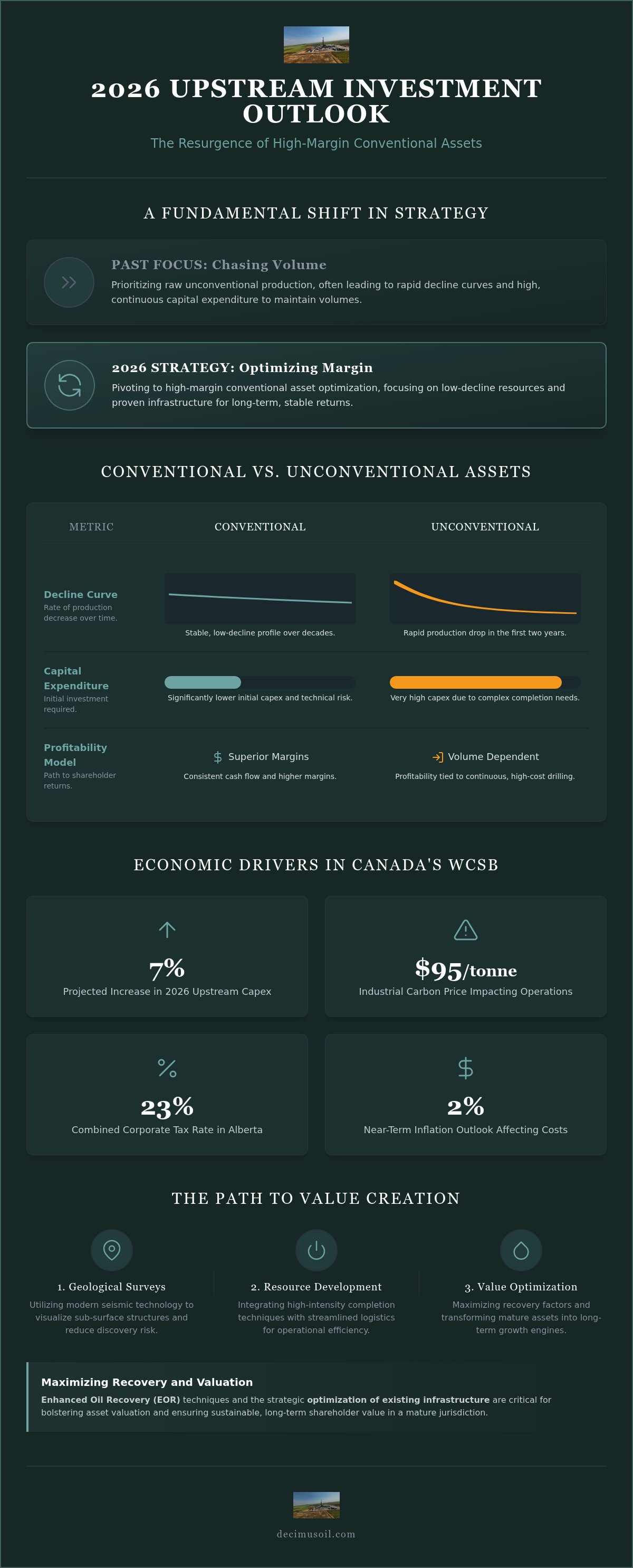
This strategic outlook provides the clarity required to identify high-potential conventional exploration opportunities and understand how enhanced oil recovery (EOR) techniques can significantly bolster asset valuation. We will analyze the economic drivers behind the projected 7% increase in 2026 capex, including the impact of the CAD $95 per tonne industrial carbon price and the 23% combined corporate tax rate in Alberta. By examining the latest trends in the Western Canadian Sedimentary Basin (WCSB), you'll gain the confidence to navigate this mature jurisdiction as a calculated visionary focused on long-term shareholder value and operational excellence.
Key Takeaways
- Analyze the shifting global capex requirements for 2026 and their direct impact on the stability of Canadian energy supply.
- Evaluate the economic advantages of conventional drilling methods, focusing on how superior decline curves outperform unconventional tight oil assets.
- Discover the role of enhanced oil recovery and infrastructure optimization in maximizing recovery factors and transforming mature assets into growth engines.
- Identify high-potential opportunities for upstream oil and gas investment within the junior energy market to drive strategic capital appreciation.
- Master risk mitigation techniques to quantify geological uncertainty and maintain a balanced portfolio of diversified resource development assets.
The Evolving Landscape of Upstream Oil and Gas Investment
The Upstream (petroleum industry) represents the foundational phase of the energy value chain, encompassing the complex capital requirements for exploration, drilling, and extraction. As we move through 2026, the global energy sector is witnessing capex requirements reach new heights to stabilize supply against a backdrop of geopolitical uncertainty. In Canada, the upstream sector is projected to increase capital expenditure by 7% this year. This growth signals a robust commitment to resource development, though it's tempered by a focus on strategic alignment. Producers are now required to harmonize production goals with rigorous shareholder value mandates, ensuring that every dollar invested generates a measurable return.
North America remains the primary driver of this incremental capex growth, offering a stable regulatory framework and proven geological potential. Within this environment, upstream oil and gas investment is increasingly directed toward assets that offer long-term reliability rather than short-term volume spikes. This shift reflects a broader industry realization that sustainable value is built through disciplined asset management and the strategic optimization of existing infrastructure.
Key Stages of Exploration and Production (E&P)
The lifecycle of an energy asset begins with sophisticated geological surveys. Modern seismic technology has revolutionized this stage, allowing operators to visualize complex sub-surface structures with unprecedented clarity. This technical proficiency reduces discovery risk and informs the transition to the resource development phase. During development, the focus shifts to operational efficiency. The success of these projects is dictated by an operator's ability to integrate high-intensity completion techniques with streamlined logistics, ensuring that the path from discovery to production is both rapid and cost-effective.
Upstream Trends to Watch in 2026
Several emerging trends are shaping the 2026 investment horizon, requiring operators to remain agile and technologically advanced. The rising costs of service and equipment, influenced by a 2% near-term inflation outlook, have made capital discipline a non-negotiable trait for successful firms. To counter these pressures, many are integrating digital oilfield technologies. These tools optimize drilling parameters in real-time, significantly enhancing recovery factors. Additionally, there's a pronounced shift toward low-decline conventional assets. These resources provide the portfolio stability necessary to weather commodity price volatility, making them a cornerstone of modern upstream oil and gas investment strategies.
The Resurgence of Conventional Exploration Economics
While unconventional plays dominated the narrative for over a decade, 2026 marks a decisive shift back toward conventional exploration. This pivot is driven by the pursuit of superior margins in an environment where capital discipline is paramount. Traditional drilling methods are regaining favour because they offer a more efficient path to profitability without the massive water and pressure requirements of large-scale hydraulic fracturing. For those evaluating upstream oil and gas investment, the economic allure of conventional assets lies in their ability to generate consistent cash flow with lower operational complexity.
The strategic value of these assets becomes evident when comparing decline curves. Unconventional tight oil wells typically experience a rapid production drop within the first two years, necessitating continuous, high-cost drilling to maintain volumes. Conventional reservoirs, however, provide a stable production profile that can span decades. This longevity is essential for long-term resource development. According to the data in Canada's Energy Future 2026, conventional production remains a critical component of the national energy mix, offering lower break-even prices that protect against global price volatility.
Cost Advantages of Conventional Extraction
Conventional extraction requires significantly lower initial capital expenditure than its unconventional counterparts. By utilizing proven drilling methodologies, operators reduce technical risk and avoid the astronomical costs associated with massive multi-stage fracking. This capital efficiency allows junior producers to realize value more rapidly, directing funds toward further exploration or shareholder returns. The resulting production stability is a key driver for capital appreciation, as it provides a predictable foundation for asset valuation in the junior energy market.
Resource Growth in the Western Canadian Sedimentary Basin
The Western Canadian Sedimentary Basin (WCSB) remains a world-class jurisdiction for upstream oil and gas investment due to its vast, bypassed hydrocarbon reserves. Modern operators are now leveraging historical data and high-intensity completion techniques to revitalize mature basins. By strategically positioning assets within existing energy infrastructure networks, firms like Decimus Oil Corp. can optimize recovery factors while minimizing new surface disturbance. This approach identifies high-potential opportunities in areas previously thought to be depleted, transforming legacy fields into modern growth engines through sophisticated engineering and decades of collective expertise.
Realizing Value Through Enhanced Oil Recovery and Infrastructure
Enhanced Oil Recovery (EOR) has emerged as a cornerstone of sophisticated upstream oil and gas investment, offering a lower-risk alternative to greenfield exploration. While primary recovery typically extracts only a fraction of a reservoir's potential, EOR techniques allow operators to maximize the recovery factor by targeting the significant volumes of oil left behind. In the context of 2026, these mature assets are no longer viewed as declining liabilities. They're growth engines that provide predictable production profiles and institutional stability. By utilizing secondary and tertiary recovery methods, producers can effectively hedge against the geological uncertainty inherent in new drilling projects, ensuring a more consistent return on capital.
The success of these recovery strategies is deeply intertwined with energy infrastructure management. Extraction efficiency isn't just about what happens downhole; it's about the synergy between the reservoir and the surface facilities that process and transport the product. Producers who control their own infrastructure can optimize injection cycles and processing pressures in real-time, directly impacting the economic life of the field. This integrated approach ensures that resource development remains profitable even when global commodity prices fluctuate, as the cost per barrel is minimized through operational excellence.
Infrastructure as a Strategic Asset
Direct ownership of pipelines and processing facilities provides a significant competitive advantage for junior producers. By managing these assets internally, firms reduce the third-party fees that often erode margins, leading to a much stronger corporate netback. Infrastructure also acts as a catalyst for accelerating resource development timelines. When the gathering systems and battery sites are already in place, bringing new or revitalized wells online becomes a matter of weeks rather than months. This strategic positioning allows for rapid capital recycling and improves the overall valuation of the company's portfolio.
Techniques for Production Enhancement
Modern reservoir management relies on precise waterflooding and gas injection strategies to maintain optimal pressure. These methodologies are now being augmented by high-intensity completion techniques designed to bypass near-wellbore damage in older wells, effectively opening up new flow paths in legacy formations. Enhanced Oil Recovery (EOR) in 2026 represents a sophisticated suite of thermal, chemical, and gas injection methodologies that significantly increase reservoir pressure and fluid mobility, enabling operators to extract a higher percentage of original oil-in-place while maintaining strict compliance with federal methane regulations. This evolution in technical proficiency ensures that upstream oil and gas investment remains focused on realizing the full potential of Canada's proven conventional reserves.
Strategic Risk Mitigation in Hydrocarbon Resource Development
Strategic risk mitigation is the essential bridge between speculative exploration and institutional-grade resource development. In the current market, identifying and quantifying geological risk is a rigorous process that relies on high-intensity data analysis rather than traditional guesswork. For those pursuing upstream oil and gas investment, success is defined by the ability to manage these uncertainties through a diversified portfolio of assets. By balancing high-potential exploration with low-decline conventional production, operators can maintain capital stability while positioning themselves for significant upside. This methodical approach ensures that geological setbacks in one area don't compromise the enterprise's overall financial health.
Regulatory compliance and environmental stewardship have transitioned from peripheral concerns to primary value drivers. The federal industrial carbon price of $95 per tonne in 2026 necessitates a proactive approach to operational emissions and carbon intensity. Operators who prioritize these factors don't just avoid penalties; they gain a competitive edge in asset valuation and investor appeal. Junior producers in the TSX Venture market must be particularly diligent, as their ability to access capital is increasingly tied to their proven capacity for responsible resource development and adherence to evolving methane regulations.
Technical Risk Reduction Strategies
Technical proficiency is the most effective tool for reducing drilling risk. Utilizing advanced seismic data allows engineering teams to visualize complex reservoir structures, significantly improving success rates and optimizing well placement. Horizontal drilling has also become a standard requirement for maximizing reservoir contact, ensuring that each wellbore captures the greatest possible volume of hydrocarbons. By collaborating with experienced technical teams, firms can refine their completion designs to suit specific geological nuances, turning challenging formations into predictable production streams that support long-term capital appreciation.
The Role of Insider Ownership and Management
Management alignment is a critical indicator of a company's strategic integrity. Significant insider ownership ensures that the leadership team's interests are fundamentally linked to those of the shareholders, fostering a culture of disciplined growth and fiscal responsibility. In the WCSB, the value of combined decades of experience cannot be overstated. A leadership group with a proven track record understands the technical and regulatory landscape of the Canadian energy sector, providing the steady hand required to navigate market volatility. For investors seeking exposure to this expertise, you can learn more about our strategic approach to conventional asset management and production growth. This institutional knowledge allows for the execution of a corporate strategy that prioritizes high-level execution and the realization of long-term shareholder value through meticulous resource development.
Capital Appreciation Trends in the Canadian Junior Energy Market
Junior energy stocks represent a specialized segment of the market where upstream oil and gas investment can yield significant returns through targeted resource development. Unlike diversified global majors, junior producers offer pure-play exposure to specific basins and high-intensity completion technologies. The path to capital appreciation in 2026 is driven by an operator's ability to transition from successful exploration to consistent production growth. This lifecycle often culminates in asset monetization or strategic acquisitions, providing multiple exit points for disciplined investors who understand the technical nuances of the Western Canadian Sedimentary Basin.
The 2026 outlook for energy public equity on the TSX Venture Exchange (TSXV) remains optimistic, supported by a projected 7% increase in upstream capex across the Canadian sector. While gas producers are eyeing LNG export potential, oil producers are focusing on disciplined growth with an anticipated production increase of 4.6%. For investors, the strategic opportunity lies in identifying conventional oil and gas producers that maintain high reinvestment rates. In the conventional sector, these rates reached 94% in 2025, signaling a robust commitment to expanding asset bases and maximizing shareholder value in a stable jurisdiction.
Evaluating Junior Producers for Growth
Successful junior producers are identified through a rigorous analysis of specific financial and operational metrics. Production per share and reserve replacement ratios are the primary indicators of a company's ability to sustain growth without diluting shareholder value. In addition, net debt levels must be managed with extreme caution. As the Bank of Canada's near-term inflation outlook holds at 2%, rising service and equipment costs can quickly erode the margins of over-leveraged firms. Operational efficiency isn't just a technical goal; it's a financial requirement that directly dictates the scale of shareholder returns.
Decimus Oil Corp. (TSXV:WCSB) positions itself for market growth by leveraging a low-decline conventional asset base and over 100 years of combined industry experience. By focusing on infrastructure management and enhanced oil recovery, the firm creates a foundation for stability that is often missing in the high-volatility junior space. This strategic alignment ensures that capital is deployed into projects with proven geological potential, reducing technical risk while maximizing the opportunity for capital appreciation.
The Future of Energy Equity Portfolios
Small-cap energy stocks play a vital role in a diversified investment portfolio, offering a growth profile that often outpaces broader market indices during periods of commodity price stability. With Western Canadian Select (WCS) prices forecast to average $56.00 per barrel in 2026 under base case scenarios, efficient operators can still realize substantial netbacks. Realizing value in this environment requires a commitment to professional integrity and the sophisticated application of modern engineering. To understand the specific opportunities available in this evolving landscape, you can Explore the investment potential of Decimus Oil Corp. and see how our calculated visionary approach translates into long-term strategic advantage.
Positioning for Strategic Growth in the 2026 Energy Market
The landscape of 2026 demands a decisive shift toward disciplined conventional exploration and the sophisticated application of enhanced oil recovery. The analysis demonstrates that infrastructure management and technical risk reduction are no longer optional; they're the primary drivers of capital appreciation in the junior energy sector. Success in upstream oil and gas investment hinges on identifying operators who prioritize high-margin stability over rapid, high-decline volume. By focusing on proven reservoirs and maximizing recovery factors through modern engineering, investors can secure a position in a resilient and modernized WCSB.
Decimus Oil Corp. leverages over 100 years of combined industry experience to realize value through high-potential conventional plays and strategic infrastructure management. Our team's commitment to operational excellence ensures that assets are optimized for maximum production efficiency and long-term shareholder value. We don't just maintain assets; we advance them through strategic optimism and a results-oriented narrative that prioritizes the bottom line.
Invest in the future of Canadian energy with Decimus Oil Corp. (TSXV:WCSB) and join a team dedicated to institutional stability and growth. The opportunities within the Canadian upstream sector have never been more clearly defined for the calculated visionary.
Frequently Asked Questions
What is upstream oil and gas investment?
Upstream oil and gas investment involves allocating capital to the initial stages of the energy lifecycle, specifically exploration, drilling, and production. It's the process of identifying hydrocarbon reserves and establishing the infrastructure necessary to bring them to the surface. In 2026, these capital flows are increasingly focused on high-margin conventional plays that offer predictable cash flows and institutional stability. This foundational phase ensures a reliable supply of energy before it's transported for refining or distribution.
Why is conventional oil exploration still relevant in 2026?
Conventional exploration remains vital because it offers superior economic margins and more manageable decline curves than unconventional alternatives. These assets require lower initial capital expenditure and benefit from decades of established engineering data. In a market focused on capital discipline, the ability to produce oil and gas using traditional methods provides a hedge against the high costs and rapid depletion rates associated with tight shale formations, making conventional drilling a preferred strategy for 2026.
How does Enhanced Oil Recovery (EOR) increase the value of an energy company?
Enhanced Oil Recovery (EOR) increases corporate value by significantly extending the productive life of mature reservoirs. By implementing secondary and tertiary recovery methods, an operator can extract a much higher percentage of the original oil-in-place that primary methods leave behind. This process transforms legacy fields into low-decline growth engines, providing the predictable production profiles that institutional investors value. It effectively reduces discovery risk by realizing additional value from already proven and characterized hydrocarbon deposits.
What are the risks associated with investing in junior oil and gas companies?
Investing in junior producers involves managing geological uncertainty and commodity price volatility, which can impact the stability of smaller operators. Junior firms often face higher technical risks during exploration and might be more sensitive to shifts in federal methane regulations. These risks don't compromise the enterprise when a company maintains significant insider ownership and a diversified portfolio. Technical proficiency and experienced management teams are essential for navigating these complex financial and operational challenges.
What is the significance of the TSX Venture Exchange for energy investors?
The TSX Venture Exchange (TSXV) is a critical platform for energy investors seeking exposure to high-growth junior producers. It provides the liquidity and transparency necessary for growth-oriented firms like Decimus Oil Corp. (TSXV:WCSB) to fund their exploration and development programs. For shareholders, the exchange offers a regulated environment to participate in the capital appreciation of pure-play energy stocks, which often outperform larger cap peers during periods of strategic resource expansion and asset monetization.
How does energy infrastructure impact the profitability of upstream projects?
Energy infrastructure is a primary determinant of profitability because it dictates the operational netback for every barrel produced. Ownership of gathering systems, batteries, and pipelines allows a producer to avoid third-party processing fees and accelerate development timelines. This control minimizes operational costs and ensures that production can reach market efficiently. In 2026, integrated infrastructure management is recognized as a strategic asset that protects margins against inflation and the rising costs of equipment and services.
What is the difference between conventional and unconventional resource development?
Conventional development targets hydrocarbons trapped in porous rock that flow naturally or with standard pumping; unconventional development focuses on tight formations like shale. Unconventional projects require high-intensity hydraulic fracturing and experience steep production declines shortly after completion. Conventional assets offer greater long-term stability and lower capex requirements. Understanding this distinction is essential for upstream oil and gas investment, as conventional plays currently provide a more sustainable path to consistent shareholder returns.
Why is the Western Canadian Sedimentary Basin (WCSB) a focus for upstream investment?
The Western Canadian Sedimentary Basin (WCSB) is a world-class focus for upstream oil and gas investment due to its mature infrastructure and vast bypassed reserves. It offers a stable regulatory environment and a wealth of historical geological data that reduces exploration risk. With the expansion of export capacity and the integration of modern completion techniques, the basin remains a premier jurisdiction for realizing value from high-potential conventional plays and sophisticated enhanced oil recovery projects across the national landscape.


