

A large resource estimate isn’t, by itself, a development case. Upstream energy resource evaluation must establish whether geological evidence supports a technically recoverable volume, whether engineering can turn it into a workable project, and whether the economics justify advancing. These measures can be difficult to compare, and an estimate can look more certain than the evidence behind it.
That’s why operators assess resources in stages, refining the evidence as new data, technical analysis and commercial conditions shape the opportunity. This practical guide explains the main evaluation approaches, what each can establish, and where uncertainty and classification limits matter. You’ll see how geological interpretation, engineering feasibility and economic analysis connect to decisions such as further appraisal, development, enhanced recovery or infrastructure investment. The aim is to help you judge whether an upstream opportunity is credible and ready to advance, or whether important questions remain unresolved.
Key Takeaways
- Upstream energy resource evaluation brings geological, engineering and economic evidence together to inform development decisions.
- Seismic interpretation, well data and geological models each contribute different evidence, with different limitations.
- A repeatable review framework helps teams examine data provenance, assumptions and decision relevance before advancing an opportunity.
- Lower, base and higher cases are scenarios for testing uncertainty, not forecasts or guarantees.
- Disciplined evaluation can guide conventional exploration, resource development and decisions about existing assets and infrastructure.
What upstream energy resource evaluation measures, and what it does not
Upstream energy resource evaluation integrates subsurface evidence to estimate petroleum quantities and inform decisions about whether, how and when to advance a project. It brings geological interpretation together with engineering and economic analysis, making clear what the evidence supports and where uncertainty remains.
Resource evaluation is the analytical process used to assess subsurface potential. It is distinct from exploration operations that acquire information and production operations that extract hydrocarbons. An evaluation can guide those activities, but it does not itself discover, develop or produce a resource. Nor does an estimate alone prove that a project is commercially viable.
How resource evaluation fits within upstream oil and gas
Evaluation changes as a project advances. During exploration, available geological and geophysical evidence is used to screen for potential and identify what information is still needed. Appraisal adds evidence, often from wells, to refine understanding of an accumulation. Development planning tests whether a technically workable project can be designed, while production reviews use operating results to update assumptions and inform future decisions. At every stage, the decision may be to proceed, gather more evidence, revise the plan or stop.
Resource estimates, recoverable resources, and reserves
These terms describe different things and are not interchangeable. An in-place estimate represents the quantity of petroleum believed to exist in a subsurface accumulation before accounting for how much can be produced. Recoverable resources refer to quantities estimated to be producible under specified technical and project assumptions. The term can cover opportunities at different stages of maturity. Reserves are the portion associated with a discovered accumulation and a defined project that is considered recoverable and commercial under the applicable classification framework.
A producing asset is broader still. It can include wells, facilities, infrastructure, rights and operating arrangements, alongside estimates of remaining recoverable volumes. A resource estimate is not a production promise, and a reserve classification is not a guarantee of future performance.
Recoverability depends on reservoir characteristics, technology, development design, costs, product prices and other assumptions. Each estimate also reflects the data, methods and uncertainty available at the time it is prepared. The Oil and gas reserves and resource quantification overview introduces common concepts and classification approaches, including PRMS. For Canadian disclosure, formal definitions and their applicability depend on the relevant reporting framework. Check terminology against current requirements before using it in public reporting.
How upstream energy resource evaluation builds evidence
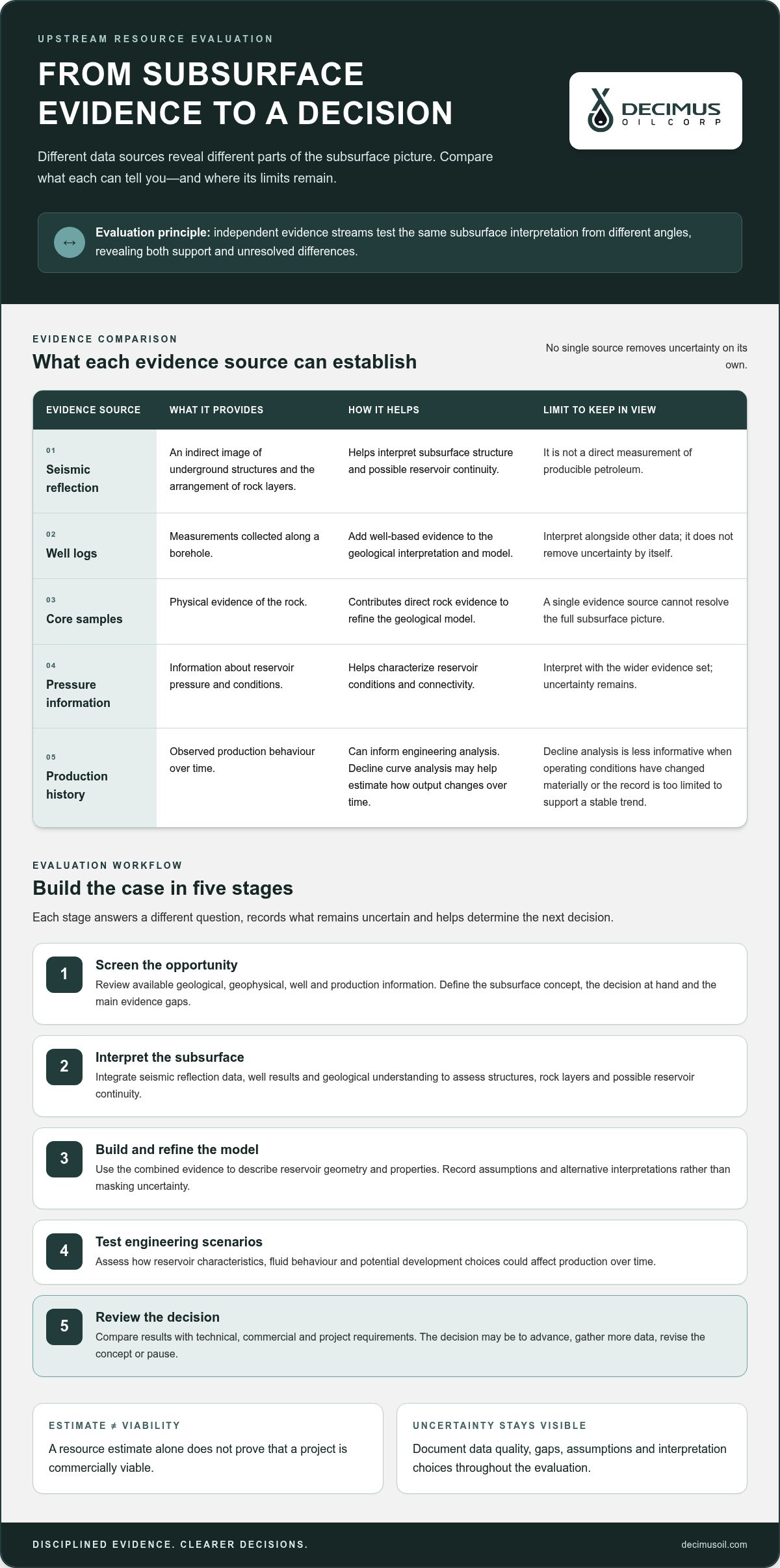
A decision-ready assessment develops in stages, with each step answering a different question and identifying what remains uncertain. In upstream energy resource evaluation, the objective is not to make every dataset agree. It is to test whether independent evidence supports a coherent interpretation and document where it does not.
- Screen the opportunity. Review available geological, geophysical, well and production information. Define the subsurface concept, the decision at hand and the main evidence gaps.
- Interpret the subsurface. Integrate seismic reflection data, well results and geological understanding to assess structures, rock layers and possible reservoir continuity.
- Build and refine the model. Use the combined evidence to describe reservoir geometry and properties. Record assumptions and alternative interpretations rather than masking uncertainty.
- Test engineering scenarios. Assess how reservoir characteristics, fluid behaviour and potential development choices could affect production over time.
- Review the decision. Compare results with technical, commercial and project requirements. Determine whether to advance, gather more data, revise the concept or pause.
From geological and geophysical data to a subsurface model
Seismic reflection data can help interpret underground structures and the arrangement of rock layers, but it is an indirect image, not a direct measurement of producible petroleum. Well logs provide measurements along a borehole; core samples offer physical evidence of rock; and pressure information can help characterize reservoir conditions and connectivity. Together, these sources can refine a geological model, but none removes uncertainty on its own. Document data quality, gaps and interpretation choices at each stage.
Independent evidence streams strengthen an evaluation because they test the same subsurface interpretation from different angles, revealing both support and unresolved differences.
How engineering analysis tests resource potential
Reservoir engineering tests whether the interpreted rock and fluid system could support a workable production profile. Analysts consider properties such as porosity and permeability, fluid characteristics, pressure and observed production behaviour. Where a suitable production history exists, decline curve analysis can help estimate how output may change over time. It is less informative when operating conditions have changed materially or the record is too limited to support a stable trend.
Model outputs are estimates, not measured outcomes. Their interpretation depends on inputs such as reservoir boundaries, well performance and development assumptions, which should be stated alongside the results. Classification frameworks such as the Petroleum Resources Management System (PRMS) provide a structured basis for describing resources and project maturity. For an operator, this evidence-led process supports disciplined exploration and resource development. Decimus Oil Corp.’s resource development focus includes conventional oil and gas exploration.
Comparing upstream evaluation methods, evidence, and uncertainty
No single method establishes the full case for an oil or gas opportunity. Seismic interpretation can help map subsurface structure, while well data provides measurements from specific locations. Reservoir models combine inputs to test possible behaviour, and production-history analysis can show how an existing asset has performed. In upstream energy resource evaluation, the right approach depends on the question, the quality and maturity of available data, and the decision being considered.
Which evaluation methods answer which questions?
Use the comparison to distinguish the evidence each method contributes from the uncertainty it leaves unresolved. Geological uncertainty concerns the presence, extent and properties of the accumulation. Engineering uncertainty concerns how it may perform under a proposed development approach. Commercial assumptions relate to whether a project can proceed economically.
| Method | Principal evidence | Appropriate use | Key limitation and uncertainty |
|---|---|---|---|
| Seismic interpretation | Reflection patterns that indicate subsurface structure and stratigraphy. | Assessing geological features and developing structural interpretations. | Indirect evidence; interpretation may leave uncertainty about rock properties, fluids and reservoir continuity. |
| Well-based analysis | Logs, core, pressure and other measurements from drilled locations. | Characterizing formation properties and testing geological interpretations at the well. | Evidence is location-specific; properties between wells may remain uncertain. |
| Reservoir modelling | Integrated geological, petrophysical and engineering inputs. | Testing possible development and production scenarios. | Results depend on model design, input quality and assumptions; a model does not remove uncertainty. |
| Production-history analysis | Recorded output and operating history. | Assessing observed performance and, where data is suitable, informing future production estimates. | Historical trends may not represent future performance if operating conditions or development plans change. |
How uncertainty and classification shape conclusions
Confidence should reflect evidence maturity, not a universal threshold. A seismic-led interpretation with no well control leaves different questions open than an evaluation informed by wells and relevant operating history. Even mature geological evidence cannot, by itself, establish that development is commercially viable.
Ranges and scenarios help communicate how results may change under different assumptions. They are not guarantees or forecasts of outcomes. Keep geological uncertainty, engineering uncertainty and commercial assumptions visible rather than combining them into a single confidence label. For classification context, the Society of Petroleum Engineers’ Petroleum Resources Management System (PRMS) provides a project-based framework. Canadian public disclosure may also involve NI 51-101 and the Canadian Oil and Gas Evaluation Handbook. Check current definitions and applicability before using them in formal reporting.
A practical review framework for upstream resource evaluation
A useful evaluation makes its evidence, assumptions and decision purpose easy to trace. This checklist can help teams review an opportunity consistently, whether they are screening exploration potential, considering an appraisal programme or reassessing an existing asset. For additional context on commercial drivers, see oil and gas exploration economics.
Questions to ask when reviewing an evaluation
- Where does the evidence come from? Record data sources, coverage, vintage and known limitations. Check whether the evidence represents the area and interval being evaluated.
- Are the assumptions visible? Identify the geological interpretation, reservoir properties, recovery approach, development design and operating context used. Check that assumptions are internally consistent and tested across scenarios.
- What does each method establish? Separate observations from interpretations and model outputs. Note where conclusions rely on indirect evidence or extrapolation beyond wells and operating history.
- Does the analysis address a defined decision? Connect findings to a specific next step, such as further appraisal, development planning, infrastructure assessment or a decision to defer.
Consider project-specific constraints alongside subsurface potential. Infrastructure access, the proposed recovery approach and operating conditions can affect whether a technically plausible concept is practical. Make the economic context explicit too. A change in an assumption may alter project ranking without changing the underlying geological interpretation.
Turning findings into a staged decision
Keep screening, appraisal, development planning and operating decisions distinct. Screening asks whether the opportunity merits more work. Appraisal targets material gaps in the subsurface picture. Development planning tests a defined project concept, while operating reviews use performance evidence to update decisions on an existing asset.
Compare a base case with higher and lower cases by varying stated assumptions, such as reservoir extent, recovery performance or operating conditions. These are structured scenarios for testing sensitivity, not forecasts or promises. If a gap could materially change the next decision, additional appraisal or analysis may be justified. If it would not, further work may add detail without changing the action.
For producing assets, review operating evidence alongside recovery options and facility constraints. Evaluation can help determine whether further analysis of enhanced oil recovery techniques is relevant to the decision. This staged approach supports disciplined resource development. Decimus Oil Corp.’s resource development focus includes enhanced oil recovery and energy infrastructure.
How Decimus approaches resource development through disciplined evaluation
For a conventional oil and gas operator, evaluation is useful when it connects subsurface evidence to a clear development question. Decimus Oil Corp. focuses on conventional exploration and resource development. Geological and engineering analysis can help frame which opportunities warrant further work, how development activities might be sequenced, and what information is still needed before a decision.
From resource evidence to development priorities
Geological interpretation can indicate where an accumulation may extend and how it relates to existing wells. Engineering analysis can then help assess possible production behaviour and the implications of different development concepts. Together, these inputs can inform priorities such as whether to advance appraisal, refine a development plan or focus on another opportunity. The conclusions remain asset-specific and depend on data quality, assumptions, infrastructure access and operating context.
Disciplined evaluation also supports operational efficiency by making the decision and its evidence explicit. It can help identify a material information gap before committing to the next stage of work, or show where existing evidence is sufficient for a more focused review. It cannot guarantee production growth, commercial success or investment performance.
Applying evaluation principles across the asset lifecycle
Across exploration, appraisal and development planning, the question changes from whether a subsurface opportunity merits attention to what further evidence and project design are needed. For existing producing assets, reviews can consider observed performance, operating conditions and options for production optimisation. Enhanced oil recovery and energy infrastructure may also be relevant to asset-management decisions, depending on the reservoir and project context. An assessment of enhanced oil recovery techniques can provide related context.
Economic analysis is another part of weighing development priorities, alongside technical evidence and project assumptions. For a broader discussion of those considerations, see oil and gas exploration economics. Decimus Oil Corp. is publicly traded on the TSX Venture Exchange as TSXV:WCSB, and its team brings more than 100 years of combined experience. These company details provide context alongside the project-specific evidence that informs resource development. Readers seeking separate investment background can review this guide to Canadian energy public equity.
More information about Decimus Oil Corp. and its resource-development approach is available at Decimus Oil Corp.
Make the next resource decision with greater clarity
Sound upstream energy resource evaluation connects geological evidence with engineering analysis and commercial assumptions while keeping uncertainty visible. Estimates are only as useful as the data, methods and project context behind them. Comparing evidence streams and testing scenarios can help clarify whether an opportunity merits further appraisal, development planning or a different course of action.
That discipline also applies to producing assets, where operating evidence, infrastructure and recovery options can inform priorities. It supports better-grounded decisions, not guaranteed production or investment outcomes. Decimus Oil Corp. focuses on conventional oil and gas exploration and resource development, with a team that brings more than 100 years of combined experience.
Clear assumptions and staged evaluation provide a stronger foundation for assessing opportunity and moving forward with purpose.
Frequently Asked Questions
What is upstream energy resource evaluation?
Upstream energy resource evaluation is the process of integrating subsurface, engineering and economic evidence to estimate petroleum potential and inform project decisions. It can help an operator decide whether to investigate an opportunity further, plan appraisal or consider development. Evaluation is not the same as exploration or production operations, and an estimate alone doesn’t prove that a resource can be recovered commercially. Its conclusions depend on available data, methods and assumptions.
How do oil and gas companies evaluate an upstream resource?
Companies typically combine geological and geophysical interpretation with well information, engineering analysis and economic assumptions. They first screen the opportunity and identify evidence gaps, then build or refine a subsurface interpretation and test possible development and production scenarios. The review should connect its findings to a decision, such as whether further appraisal is justified. As new well or operating data becomes available, assumptions and estimates may be updated.
What is the difference between a resource estimate and reserves?
A resource estimate describes quantities of petroleum believed to exist or potentially be recoverable, depending on the estimate’s scope and classification. Reserves are a more specific category: quantities tied to a discovered accumulation and a defined project that are considered recoverable and commercial under the applicable framework. The terms aren’t interchangeable. Classification depends on evidence, project maturity and assumptions, so public reporting should use current Canadian definitions and requirements.
Which data is used to evaluate an oil or gas resource?
Evaluation may draw on seismic reflection data, well logs, core samples, pressure measurements, geological interpretations and production records. Each provides a different perspective: seismic can help interpret underground structure, while well data provides measurements at drilled locations. Production history can inform performance analysis where relevant operating data exists. Data coverage, quality, age and limitations matter; a larger dataset isn’t automatically more conclusive if it doesn’t address the key uncertainty.
How reliable are upstream resource estimates?
Reliability depends on the quality and maturity of the evidence, the methods used and the assumptions applied. An estimate supported by relevant well and operating data may address different uncertainties than an early interpretation based mainly on indirect evidence. No estimate should be treated as an exact measurement of future production. Review the stated range, classification, data limitations and project assumptions, and consider whether new evidence could materially change the decision.
Can seismic data confirm that an oil or gas resource is commercially viable?
No. Seismic data can help interpret subsurface structures and rock-layer patterns, but it’s indirect evidence and cannot by itself establish recoverable volumes, production performance or commercial viability. Those questions require additional geological, well-based, engineering and economic analysis. Even a compelling seismic interpretation leaves uncertainties to test, including reservoir properties and the feasibility of a development concept. Seismic is one input to an evaluation, not a standalone commercial decision.
How do operators account for uncertainty in resource evaluation?
Operators document data gaps and assumptions, distinguish observations from interpretations, and test how results change under different cases. Lower, base and higher scenarios can show the effect of varying inputs such as reservoir extent, recovery performance or operating conditions; they aren’t guarantees or necessarily forecasts. It’s also useful to separate geological uncertainty from engineering uncertainty and commercial assumptions, since each can affect a project decision in a different way. Explore Decimus Oil Corp.’s conventional exploration and resource-development focus.


