
What if the best way to improve a field isn’t to push for more production from every well? Oil field optimization starts by identifying the constraint that is limiting the whole system. The reservoir, a well, or the facilities handling production can each restrict performance. Increasing a well’s rate doesn’t necessarily improve the overall outcome if another part of the system can’t handle the added flow.
Production volume matters, but it is only one indicator. Operators also need to interpret pressure, downtime, recovery potential, and facility capacity together. A single data point can raise a question; a pattern across the asset can help show where investigation is most useful.
This guide explains the main dimensions of oil field optimization and provides a repeatable process for identifying constraints, assessing possible interventions, and weighing trade-offs. It also shows how reservoir insight, well performance, enhanced recovery, and infrastructure decisions connect to conventional resource development and asset management.
Key Takeaways
- Assess the reservoir, wells, surface systems, and operations together to understand how constraints interact.
- Compare production, pressure, downtime, and equipment data to investigate potential bottlenecks, rather than treating one metric as a diagnosis.
- Use a repeatable oil field optimization workflow: set an objective, establish a baseline, identify constraints, evaluate interventions, and review results.
- Compare possible actions with the field’s goals, operating limits, and trade-offs before making changes.
- Understand how conventional resource development, enhanced oil recovery, and energy infrastructure contribute to broader asset management.
What Is Oil Field Optimization, and What Does It Improve?
Oil field optimization is the coordinated process of making reservoir, well, surface-system, and operating decisions to improve how an asset performs as a whole. Depending on the field’s condition and development strategy, the objective may be steadier production, greater recovery potential, more effective use of equipment and resources, or stronger overall asset value.
Oil field optimization is the ongoing process of aligning reservoir, well, facility, and operating decisions with an asset’s objectives and constraints. It isn’t a single technology or a one-time intervention. Teams assess performance, identify what may be limiting the system, choose a suitable response, and review the results. The disciplines involved are interconnected. Petroleum engineering provides an overview of the field, including reservoir and production engineering.
How field-wide optimization differs from improving one well
A change that improves one well can affect shared gathering lines, processing equipment, or other connected production. For example, increasing a well’s flow could make shared facility capacity the next bottleneck. The well-level result may look favourable while the field-wide outcome remains limited elsewhere. Assess an intervention in the context of the complete production system, not only the well where it begins.
Maximum instantaneous production isn’t automatically the best field-wide outcome. A short-lived rate increase may be less useful than steadier performance if it strains equipment, contributes to interruptions, or conflicts with recovery objectives. Ask not only, “Can this well produce more now?” but also, “How does this change support the asset’s goals across the system?”
Which outcomes should an optimization effort consider?
Choose measures that reflect the asset’s objectives and the evidence available. Assess several dimensions rather than treating one production reading as a complete measure of success:
- Production stability: whether performance is consistent over a meaningful period.
- Recovery potential: whether decisions support efficient reservoir development over time.
- Equipment reliability: whether wells and surface systems operate as intended, and whether avoidable interruptions can be identified.
- Resource utilization: whether available capacity and operating resources are being used in line with field priorities.
These measures help frame decisions, but they don’t determine them. A change that supports one objective may involve a trade-off elsewhere. Make that trade-off explicit, then assess whether the chosen action advances the asset’s priorities.
How Reservoir, Wells, and Facilities Shape Oil Field Performance
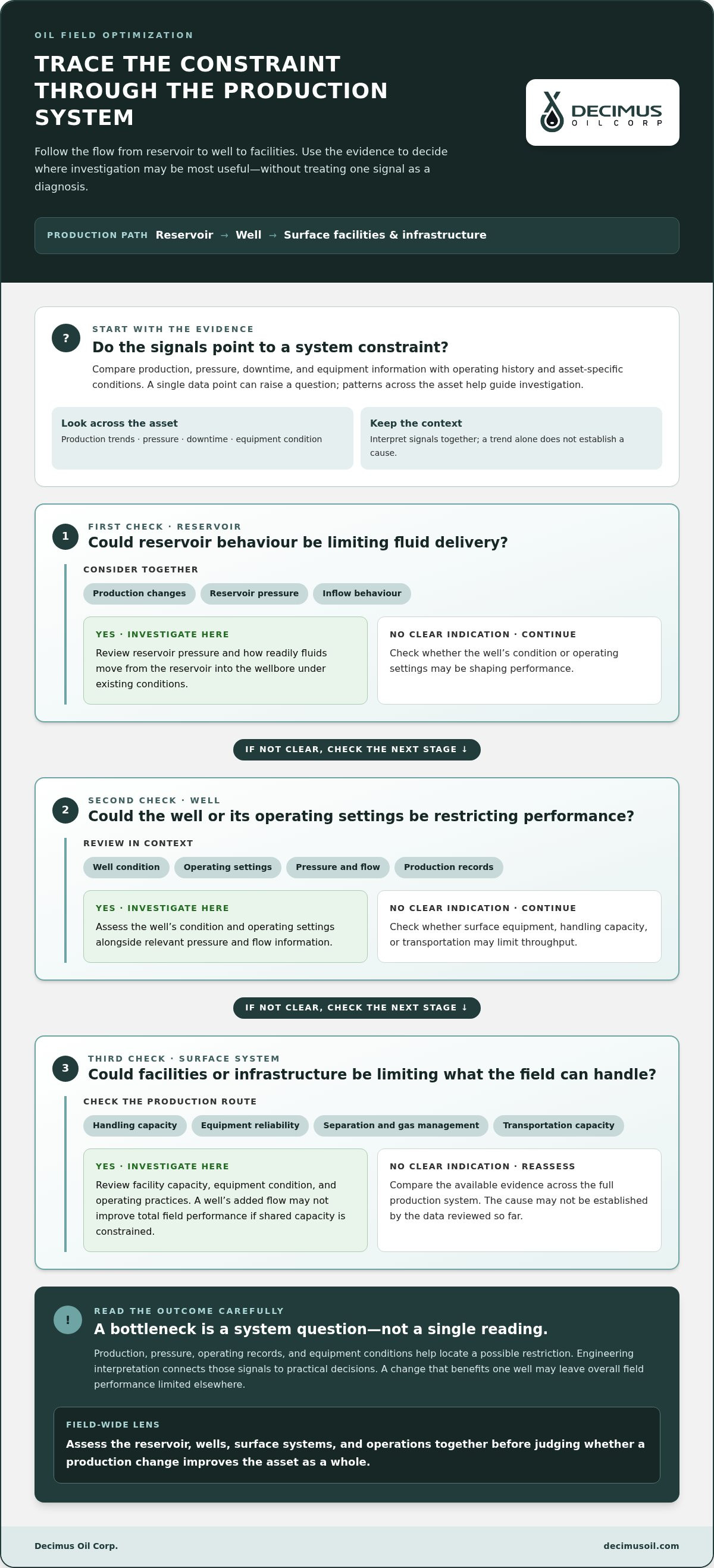
Production follows a connected path. Fluids move from the reservoir into a well, travel through downhole and surface equipment, then pass through infrastructure for separation, handling, compression, and transportation. Conditions at every stage influence how much can be produced and how consistently the field can operate. A restriction in one part of the system can affect total field performance even when other parts have capacity to spare.
Understanding these connections is central to oil field optimization. Reservoir, well, and facility data help teams test explanations and identify patterns, but data alone doesn’t provide a strategy. Its value depends on how it is interpreted alongside operating history, asset-specific conditions, and engineering judgement.
Reservoir behaviour and well performance
Reservoir pressure helps move fluids through the rock and towards a well. As production continues, pressure and the reservoir’s ability to deliver fluids may change, contributing to a decline in production. Inflow describes how readily fluids move from the reservoir into the wellbore under existing conditions. These behaviours vary by asset, so a production change needs context before it can be linked to a specific cause.
The well’s condition and operating settings also shape observed performance. Changes in pressure or flow may relate to reservoir behaviour, the well itself, or both. Production records can point to a question for investigation, but a trend alone doesn’t establish a diagnosis. Interpret relevant well and reservoir information together, using the evidence available for that asset.
Surface facilities and infrastructure constraints
Once fluids reach the surface, production depends on equipment and infrastructure that can separate and handle them, manage gas where required, and move production onward. Capacity limits, equipment reliability, and operating practices can all restrict throughput. A surface bottleneck differs from a reservoir limitation: the reservoir may be able to supply fluids while equipment or transportation capacity limits what the field can process or move.
For example, a well may have potential for greater flow, but increasing it may not improve total field performance if shared handling capacity is already constrained. The right response depends on the cause and the asset. Reviewing flow, pressure, operating records, and equipment conditions can help locate a restriction; engineering interpretation connects those signals to practical decisions.
These system relationships also matter in conventional resource development. Explore Decimus Oil’s resource development to learn how the company’s focus connects with asset management.
How to Identify the Constraint That Limits Oil Field Optimization
A useful diagnosis starts with competing explanations, not the assumption that one metric reveals the cause. Production, pressure, downtime, and equipment records can help locate a constraint, but their meaning depends on data quality, the period being reviewed, and what was happening in the field. Missing readings, inconsistent reporting, or operating changes can distort apparent trends.
Compare reservoir, well, facility, and operating constraints
Use the comparison below to organize an investigation. These signals are indicative, not universal thresholds. Each may have more than one explanation and needs to be assessed against the asset’s history and conditions.
| Constraint type | What it means | Evidence to investigate | Questions to ask |
|---|---|---|---|
| Reservoir | The formation may not be supplying fluids at the expected rate or under the expected conditions. | Pressure and production trends, interpreted with reservoir history. | Does the trend align with expected reservoir behaviour, or has something else changed? |
| Well | The well or its operating settings may be limiting flow between the reservoir and surface. | Well-level production, pressure, and downtime records. | Did performance change after an operating adjustment or interruption? |
| Facility | Surface equipment or shared infrastructure may restrict handling or movement of production. | Equipment capacity, operating records, and signs of interruptions. | Is the well constrained, or is the system receiving or moving its output? |
| Operating | Practices, settings, or coordination may be affecting otherwise available system capacity. | Operating schedules, configuration changes, and downtime context. | Do records show a link between operating changes and the observed pattern? |
For instance, a production decline could reflect changing reservoir behaviour, a well issue, restricted facility handling, or an operating change. Pressure and downtime records add context, but neither settles the question alone. Compare similar periods, check whether readings are complete and consistent, and note equipment or operating changes before drawing conclusions. More sensors or analytics may address a specific information gap, but adding technology or increasing throughput isn’t automatically the right first step. First define what decision the information needs to support.
Choose measures that reflect the asset objective
Production volume is only one measure. Consider it alongside uptime, decline behaviour, recovery objectives, and facility utilization. A rate increase may coincide with more downtime, while steady production may occur alongside spare facility capacity. Reading these measures together helps show whether an apparent improvement supports the intended outcome.
Decline-curve analysis can help assess production history and characterize decline, but it doesn’t independently explain the cause or select an intervention. Use it as one input alongside operating evidence and engineering interpretation, with measures chosen to match the asset objective.
A Practical Oil Field Optimization Workflow: From Baseline to Review
A disciplined workflow turns a performance issue into a decision that can be assessed and refined. It helps teams avoid treating a symptom as a confirmed cause or making a change without clear review criteria. Adapt the following sequence to the asset and decision at hand.
Set a baseline and test the diagnosis
Start by agreeing on the asset objective. The team might prioritize steadier production, improved equipment reliability, better use of facility capacity, or another defined outcome. Choose measures that reflect the objective, then establish a dependable baseline using relevant production and operating history.
Before interpreting trends, check whether records are complete and comparable. Note operating changes, downtime, equipment conditions, and other context that could affect the period under review. Keep the observed symptom separate from the suspected cause: a change in production is evidence to investigate, not a diagnosis by itself.
Implement, measure, and refine the response
After testing the diagnosis against available evidence, compare potential responses. Document why an action is being considered, what effect is expected, and which risks or unintended impacts to monitor. This makes assumptions visible and gives the post-change review a clear reference point.
- Define the objective. Agree on the outcome the work is intended to support and how it will be assessed.
- Establish the baseline. Select relevant measures and confirm the data and operating context are suitable for comparison.
- Review the evidence. Examine production history, pressure, downtime, and equipment records, noting gaps or changes that could influence interpretation.
- Test the constraint. Compare possible explanations and identify what evidence supports or challenges each before selecting a response.
- Record and implement the action. Document the intervention, expected effect, assumptions, operating considerations, and signals that could indicate an unintended outcome.
- Review and adjust. Compare post-change observations with the baseline, then retain, refine, or reconsider the approach as the evidence warrants.
The review period and success criteria depend on the asset, the type of change, and the objective. A short observation may not capture a meaningful operating pattern, while waiting too long can delay an adjustment. Compare like conditions where possible, record relevant differences, and revise the plan if new evidence changes the diagnosis. This measured cycle is central to effective oil field optimization.
For context on how this framework relates to an operator’s development priorities, explore Decimus Oil’s resource development focus.
How Decimus Oil Connects Optimization With Resource Development
For a conventional resource developer, field performance is part of a wider asset-development decision. Exploration identifies opportunities; resource development considers how to advance them; ongoing assessment informs how an asset is managed as operating conditions evolve. The oil field optimization framework in this guide offers a way to approach those decisions: define the objective, understand system constraints, and assess potential actions against evidence rather than assuming that more production is always the best outcome.
Optimization within conventional resource development
Performance assessment can inform decisions throughout an asset’s lifecycle, from development priorities to the management of producing wells and shared infrastructure. Enhanced oil recovery may be one consideration in assessing recovery potential, while infrastructure affects how production can be handled and moved. The relevance of each depends on the asset, its constraints, and its objectives. Enhanced oil recovery is one part of the broader resource-development picture.
This wider view connects reservoir potential with the practical systems needed to develop resources. A recovery approach needs to be considered alongside well performance and facility capacity; infrastructure decisions should reflect the requirements of the assets they support. Assessing these elements together helps operators weigh trade-offs across production, reliability, recovery potential, and asset management without treating any single measure as the whole picture.
A company perspective grounded in operations and stewardship
Decimus Oil Corp. is a Canadian energy company focused on conventional oil and gas exploration, resource development, energy infrastructure, and enhanced oil recovery. These areas connect with asset management: exploration and development establish the resource context, while recovery considerations and infrastructure form part of how an asset is evaluated and advanced.
For readers, the practical takeaway is to view optimization as a decision-making discipline within resource development. Understand how the reservoir, wells, facilities, and operating context fit together, then assess possible actions against the asset’s evidence and priorities. This keeps operating decisions tied to the broader work of developing hydrocarbon resources and managing assets over time.
To learn more about Decimus Oil and its resource-development focus, explore the company’s corporate information.
Make Field Decisions With the Whole Asset in View
Oil field optimization is most useful when it starts with the constraint shaping field-wide performance, not an isolated production figure. Reservoir, well, facility, and operating evidence can help teams develop a diagnosis, while a clear baseline and post-change review keep decisions grounded in what the asset shows.
Define the objective before selecting an intervention, weigh trade-offs across production, reliability, recovery, and infrastructure, and adjust the plan when new evidence warrants it. Optimization is an ongoing part of conventional resource development and asset management, not a guaranteed result of adopting a particular technology or increasing throughput.
Decimus Oil is a Canadian public company listed on the TSX Venture Exchange as TSXV:WCSB. The company reports more than 100 years of combined team experience. Its focus on conventional exploration, resource development, enhanced oil recovery, and energy infrastructure connects to the broader decisions involved in managing producing assets.
Explore Decimus Oil’s resource development focus to learn more about the company’s approach to developing hydrocarbon resources.
Frequently Asked Questions
What does oil field optimization mean?
Oil field optimization is the coordinated assessment of reservoir, well, facility, and operating decisions in support of an asset’s objectives. Those objectives may include stable production, recovery potential, equipment reliability, or effective use of resources. It isn’t a single technology or a push for the highest possible rate at every moment. Operators use field evidence to identify constraints, assess possible responses, and review whether decisions support overall performance.
How do operators identify an oilfield production bottleneck?
Operators identify a potential bottleneck by comparing production, pressure, downtime, equipment, and operating records across the system. They establish what changed, when it changed, and whether the data is complete and comparable. A production decline, for example, could reflect reservoir behaviour, a well issue, facility limits, or an operating change. Treat each as a possible explanation and test it against asset-specific evidence rather than assuming one signal proves the cause.
Can digital tools improve oil field optimization?
Digital tools can support oil field optimization by organizing operational information, monitoring trends, and helping teams identify changes that merit investigation. Their value depends on data quality and how the insights inform decisions. A dashboard or analytical model can highlight an unusual pressure or production pattern, but it doesn’t establish the cause or select the right response by itself. Engineering interpretation and operating context remain essential to deciding what action, if any, is appropriate.
What is the difference between oil field optimization and enhanced oil recovery?
Oil field optimization is a broad decision-making approach for aligning reservoir, well, facility, and operating performance with asset objectives. Enhanced oil recovery refers to approaches intended to support oil recovery from a reservoir. It can be considered within an optimization or development strategy, but it isn’t synonymous with optimization and isn’t automatically suitable for every asset. Its relevance depends on reservoir characteristics, operating conditions, infrastructure, and the objectives being evaluated.
Which metrics are useful for evaluating oil field performance?
Useful measures depend on the asset objective, but often include production trends, pressure, uptime, downtime, decline behaviour, equipment reliability, and facility utilization. No single metric gives a complete performance assessment. Consider a production increase alongside operating stability and available facility capacity. Teams may also use decline-curve analysis to assess production history, while recognizing that it is one evaluation method, not a standalone diagnosis or intervention plan.
Why do surface facilities matter to oil field optimization?
Surface facilities matter because production must be handled, processed, and moved after it leaves the well. Separation, fluid handling, compression, and transportation capacity can limit field throughput even when reservoir and well conditions allow supply. Shared equipment can also connect the performance of multiple wells. Reviewing facility capacity and operating records alongside well and production data helps distinguish a surface-system constraint from a reservoir or well limitation.


