
The most compelling prospect on paper may be the least persuasive opportunity once its assumptions are examined. Comparing conventional crude oil exploration projects takes more than weighing resource estimates or confident project language. A geological prospect is not a commercial discovery, and a technical update may leave important details unstated.
If seismic interpretations, drilling plans and commercial claims are difficult to assess without exploration context, start by asking what evidence supports each claim and what work remains. A project’s potential depends on its stage, technical and operational requirements, and the assumptions behind its commercial case. Comparing opportunities consistently means looking beyond headline potential.
This article outlines the main stages of a conventional exploration project and the decisions that shape its progress. You’ll learn how to assess geological evidence, operational readiness and commercial considerations using a consistent framework, then identify which public disclosures and project details to verify. The aim is a clearer basis for comparison, not a promise of discovery or investment performance.
Key Takeaways
- Trace an exploration project from geological review and prospect generation through drilling and post-well evaluation.
- Understand what seismic interpretation can indicate, and why it cannot confirm hydrocarbons on its own.
- Compare conventional crude oil exploration projects using consistent criteria: geological evidence, project stage, execution needs and market context.
- Separate disclosed facts from company interpretation and unresolved questions when reviewing project updates.
- Use dated, attributable disclosures to check company and project details, including how exploration, infrastructure and enhanced oil recovery fit together.
What Defines a Conventional Crude Oil Exploration Project?
Conventional exploration evaluates and tests subsurface prospects for potentially recoverable hydrocarbons. Geoscientists use geological information to develop a model of where oil or gas may have accumulated, then assess whether more investigation, including drilling, is justified. Hydrocarbon exploration methods can include geological analysis and geophysical techniques such as seismic surveys. These methods help assess a hypothesis; they do not prove that hydrocarbons are present or commercially recoverable.
In conventional crude oil exploration projects, “conventional” generally refers to the characteristics of the reservoir and how hydrocarbons can be produced from it. The term does not guarantee simpler geology, lower risk or stronger economics. Each prospect needs to be assessed using its own evidence and the technical and commercial assumptions behind the evaluation.
How Is Conventional Exploration Different from Unconventional Development?
The distinction is useful, but not absolute. Reservoirs vary, and extraction methods depend on geology, engineering design and economics. Neither approach is universally superior. Use the comparison below as a starting point, then check how the company describes the specific reservoir and production plan.
| Consideration | Conventional | Unconventional |
|---|---|---|
| Reservoir | Often a porous, permeable rock formation where hydrocarbons can move through connected pore spaces. | Often a lower-permeability formation where hydrocarbons move less readily through the rock. |
| Production approach | A well accesses an accumulation; reservoir pressure and, where needed, engineering methods help bring fluids to the well. | Production may require methods such as hydraulic fracturing to create or improve flow pathways. |
| Key evaluation question | Is there a credible trap, reservoir and hydrocarbon accumulation, and could it be developed commercially? | Can the resource be produced effectively across the formation under project-specific conditions? |
What Do Prospect, Discovery, and Reserves Mean?
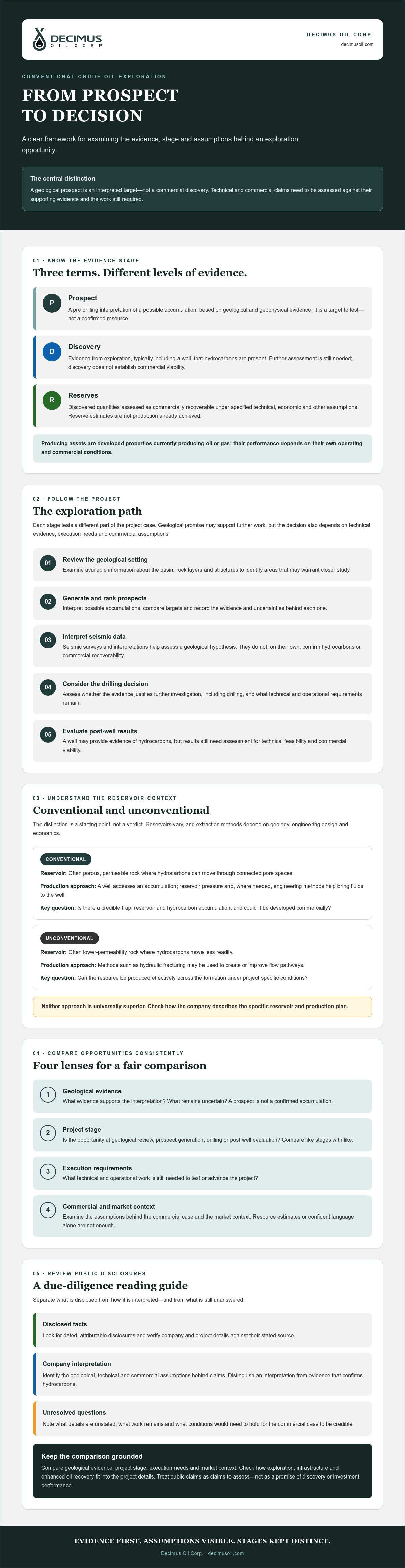
Prospect: A pre-drilling interpretation of a possible accumulation, based on geological and geophysical evidence. It is a target to test, not a confirmed resource.
Discovery: Evidence from exploration, typically including a well, that hydrocarbons are present. A discovery still requires assessment; it does not prove that development is technically feasible or commercially viable.
Reserves: Quantities of discovered hydrocarbons assessed as commercially recoverable under specified technical, economic and other assumptions. Reserve estimates are not the same as production already achieved.
Producing assets are developed properties currently producing oil or gas. Their performance and value depend on their own operating and commercial conditions.
A prospect is an interpreted target, a discovery is evidence of hydrocarbons, and reserves are estimated commercially recoverable quantities under stated assumptions. Treat each term as a different evidence stage. Base conclusions on project-specific disclosures, not prospect language alone.
How Conventional Crude Oil Exploration Projects Progress from Prospect to Decision
Each exploration stage tests a different part of the project case. Geological promise may justify further work, but proceeding depends on whether the technical evidence, execution requirements and commercial assumptions remain credible as uncertainty is reduced. Understanding oil and gas exploration economics helps connect subsurface potential to the conditions required for a viable project.
Which Technical Steps Build an Exploration Case?
A typical sequence moves from regional context to a specific drilling decision, then to evaluation of the results:
- Review the geological setting. Assess available information about the basin, rock layers and structures to identify areas that may warrant closer study.
- Generate and rank prospects. Develop an interpretation of a possible accumulation. Compare it with other targets and note the evidence and uncertainties behind each one.
- Interpret seismic data. Seismic reflection data can help map subsurface layers and structures, supporting an assessment of whether the interpretation is coherent. It cannot confirm hydrocarbons by itself.
- Assess the proposed well. Consider the target, drilling plan, equipment and operational dependencies. A technical case needs a credible execution plan, not just an attractive subsurface model.
- Drill and evaluate. An exploratory well tests the interpretation. Review the results to determine what the well encountered and whether more work is justified.
At each stage, pair technical review with operational and commercial scrutiny. A prospect may proceed if the evidence supports the next commitment, be revised if the model or plan needs adjustment, be deferred while key dependencies remain unresolved, or be stopped if the case no longer holds. Check project terms and claims against dated company disclosures and their stated assumptions.
What Decisions Follow Drilling and Evaluation?
Post-well evaluation may support further appraisal, which gathers additional information about a discovery’s extent and characteristics. If the evidence and commercial assumptions support development planning, the project may advance to that decision stage. Results may also lead to a revised interpretation, a pause in further work or a decision not to proceed.
Read preliminary updates carefully. A reported show or encouraging initial result is not, by itself, proof of commercially recoverable reserves or sustained production. Look for the underlying evidence, the status of any estimates and clear attribution of claims. For an existing conventional field, Enhanced Oil Recovery technologies may form part of a separate evaluation of how additional recovery could be pursued. Their applicability depends on the field and its technical and economic conditions.
For a company-level view of conventional exploration and related activities, review Decimus Oil Corp. company information alongside current public disclosures.
How to Compare Conventional Oil Exploration Projects Fairly
A fair comparison applies the same questions to every opportunity instead of treating confident prospect language as evidence of equal quality. Conventional crude oil exploration projects can be at very different stages, so compare their supporting information, execution requirements and commercial assumptions side by side. Label each detail as disclosed fact, company interpretation or unresolved uncertainty. This makes information gaps visible rather than hiding them inside a headline estimate.
Which Geological and Operational Factors Should Readers Compare?
Start with the basis for the geological case. Is the interpretation supported by identified data and an explanation of how that data informs the prospect? Is the project still an early interpretation, or has drilling tested the target? Record what the disclosures actually state. Don’t infer certainty from technical terminology alone.
- Geological evidence: Note the data described, the maturity of the interpretation and the uncertainties the company identifies.
- Project stage: Distinguish an undrilled prospect from a drilled discovery or a project undergoing further evaluation. A later stage may provide more evidence, but does not automatically establish commerciality.
- Execution needs: Compare disclosed drilling plans, operational requirements and dependencies. Assess infrastructure access only when project materials provide a basis for doing so.
- Information quality: Track the disclosure date, source and level of detail. If a key claim lacks context, record it as unknown rather than filling the gap with an assumption.
These checks also help frame risk mitigation in exploration projects: identify which uncertainties further work could reduce and which remain material to the decision. Avoid assigning technical rankings or assuming results, recovery rates or timelines that are not disclosed.
How Do Commercial Context and Uncertainty Affect Comparisons?
Geological potential is only one input. Review commodity exposure, capital needs and infrastructure requirements as project-specific variables. Check the assumptions behind any commercial case. Those assumptions may change with market conditions, operating requirements or new technical information. Two prospects that sound similar can therefore have very different paths to a viable development decision.
For consistency, ask the same questions about each project: What is known? What does the company infer from the evidence? What remains unresolved? Are commercial claims based on a preliminary interpretation or supported by later-stage information? This helps distinguish an attractive narrative from a case tested across technical, operational and commercial dimensions.
Exploration potential describes what a project might deliver; demonstrated commercial performance depends on evidence that it can be developed and operated economically. Keep that distinction clear. Treat missing or preliminary information as uncertainty, not confirmation.
A Due-Diligence Checklist for Conventional Crude Oil Exploration Projects
Use a consistent checklist to assess what a company has disclosed, what remains an interpretation and which questions are unanswered. For conventional crude oil exploration projects, a polished presentation is not a substitute for dated, attributable information. Compare project materials with current public filings and company disclosures. Don’t treat missing details as evidence of a positive result.
What Should You Verify in Company Disclosures?
For each claim, record its source and date, then check whether the disclosure explains its limitations. Separate preliminary updates from later-stage evidence, and confirm that details refer to the same project and reporting period.
- Project stage: Is the opportunity a prospect, a drilled discovery, an appraisal project or a producing asset? What evidence supports the stated stage?
- Technical information: What geological or operational data is described? Are assumptions and limitations explained, or is the statement an interpretation?
- Capital plans: Does the company disclose how the next phase may be funded and what work the funding would support? Don’t assume a project has secured capital unless the disclosure says so.
- Ownership and claims: Verify any stated project interest, reserves, production or exploration result against current company disclosures. Note the basis and date of any estimate.
- Open questions: List unresolved technical, operational and commercial matters, including details that are preliminary or not disclosed.
This record makes comparisons more disciplined: label each item as disclosed fact, company interpretation or unknown. If sources conflict or a claim lacks context, flag it for clarification rather than choosing the more favourable version.
Which Risks Should a Project Review Acknowledge?
A project-level review should consider geological uncertainty, execution challenges, capital requirements, commodity-market exposure and relevant regulatory uncertainty. Their importance varies by project, and available disclosures may not resolve them. Don’t assume a risk is absent simply because it has not been discussed.
Project risk and investment risk are related but distinct. A technically credible opportunity may still face execution or commercial challenges. An investment in a company also involves company-level factors that aren’t captured by a single prospect, including its broader financial position and portfolio. Readers researching Canadian oil and gas equity should assess both levels using current, attributable information.
This checklist is educational and isn’t personalized financial advice. For company information and current disclosures, review Decimus Oil Corp.’s company information.
How Decimus Oil Fits into the Conventional Exploration Landscape
Decimus Oil Corp. is a Canadian energy company focused on conventional oil and gas exploration and resource development. Its business also includes energy infrastructure and enhanced oil recovery. These activities can be related within an energy business, but each represents a distinct consideration: exploration evaluates potential subsurface opportunities, infrastructure supports energy activity, and enhanced recovery seeks additional production from existing fields.
That distinction matters. A company’s stated focus does not, by itself, confirm ownership of a particular project, establish a discovery or prove that an opportunity is commercially viable. Apply the same evidence-based approach used to compare conventional crude oil exploration projects: identify what is disclosed, what is interpretation and what still requires verification.
What Is Confirmed About Decimus Oil Corp.?
Decimus Oil Corp. is publicly traded on the TSX Venture Exchange under TSXV:WCSB. The company reports more than 100 years of combined team experience and over 27% insider ownership. As with any time-sensitive company information, check current company materials and public filings before relying on these details.
Do not attribute a specific project, asset, exploration result or production figure to Decimus Oil Corp. without confirmation in current company disclosures. Keep company-level descriptions separate from project evidence, and treat neither exploration potential nor a market listing as an endorsement of the company’s securities.
What Can Readers Review Before Taking the Next Step?
Start with current company materials and public filings. Check when each disclosure was published, which claims it supports and whether the information is preliminary. Then apply the checklist: confirm the project stage, examine the technical evidence, identify stated capital plans and record unresolved uncertainties. If information is absent, mark it as unknown rather than filling the gap with an assumption.
Company information can provide a useful starting point, but it is not a substitute for independent research or a complete assessment of project and investment risks. To review the company’s published information, visit Decimus Oil Corp. company information. This educational overview is not personalised financial advice or a recommendation to buy or sell securities.
Make the Next Comparison Evidence-Led
Assess conventional crude oil exploration projects by the evidence behind each decision, not by prospect language alone. A prospect, a discovery and commercially recoverable reserves represent different stages of knowledge. Compare geological support, project stage, execution requirements and commercial assumptions, while recording what is disclosed, interpreted or still unknown.
Decimus Oil Corp. focuses on conventional oil and gas exploration, resource development, energy infrastructure and enhanced oil recovery. The company is listed on the TSX Venture Exchange as TSXV:WCSB and reports more than 100 years of combined team experience and over 27% insider ownership. Check current company materials and filings before relying on these time-sensitive details.
For a closer look, review Decimus Oil Corp. company information and compare its current disclosures with the checklist in this article. Treat this as a starting point for independent research, not a recommendation to buy or sell securities. A consistent, evidence-led review can help you ask sharper questions and make better-informed decisions.
Frequently Asked Questions
What is a conventional crude oil exploration project?
A conventional crude oil exploration project evaluates and tests a subsurface prospect that may contain recoverable oil or gas. Teams interpret geological information and geophysical data to decide whether a target merits further investigation, including exploratory drilling. Conventional reservoirs generally allow hydrocarbons to flow through connected pore spaces more readily than low-permeability formations, though reservoir characteristics vary. A prospect is an interpretation to test, not confirmation of hydrocarbons, reserves or commercial potential.
How do conventional crude oil exploration projects work?
Conventional crude oil exploration projects typically move from geological review and prospect generation to data interpretation, drilling decisions and post-well evaluation. Seismic information can help map subsurface structures, but it cannot confirm hydrocarbons on its own. An exploratory well tests the interpretation. Results may support further appraisal or development planning, prompt a revised assessment, or lead a company to defer or stop work. Each decision depends on the available evidence and project-specific assumptions.
What is the difference between a prospect and an oil discovery?
A prospect is a pre-drilling interpretation of a possible hydrocarbon accumulation. An oil discovery means exploration work, commonly including drilling, has found evidence of oil. Discovery does not automatically establish recoverable reserves or commercial viability; additional evaluation may be needed to assess the accumulation and development case. Reserves refer to estimated quantities considered commercially recoverable under stated assumptions. These terms describe different evidence stages and shouldn’t be used interchangeably.
What makes a conventional oil exploration project commercially viable?
Commercial viability depends on whether the project can potentially generate sufficient value under its technical, operational and economic assumptions. Assessment may consider estimated recoverable volumes, the expected production profile, development and operating requirements, access to infrastructure, commodity prices and other market conditions. The quality and maturity of evidence matter: an undrilled prospect carries different uncertainty from an evaluated discovery. Viability is project-specific and can change as new information or assumptions emerge.
How much capital does a conventional exploration project require?
There’s no reliable single capital figure for conventional exploration. Requirements depend on the project’s stage, geological setting, proposed work, well design, operational complexity and access to infrastructure. Review the company’s disclosed budget, planned use of funds, funding sources, contingencies and expected decision points. Check the date and currency of any reported amount. Don’t assume a preliminary estimate covers every phase or that required funding is already available.
What risks should I consider when comparing oil exploration projects?
Consider geological uncertainty, drilling and execution challenges, capital requirements, commodity-market exposure, infrastructure needs and relevant regulatory uncertainty. A project may face risks even if its geological interpretation appears promising, and disclosed information may not resolve them. Also distinguish project-level risks from company-level investment risks, such as the company’s broader financial position and portfolio. Review current disclosures, note unanswered questions and avoid treating potential discovery or returns as guaranteed.
How can I verify claims about an exploration project?
Start with dated, attributable company disclosures and current public filings. Check whether each statement identifies the project, stage, evidence and assumptions, then distinguish reported facts from company interpretation and preliminary results. Verify ownership, reserves, production and exploration claims against current disclosures rather than relying on promotional summaries alone. Record missing or conflicting information as unresolved. This process supports independent research, but it doesn’t replace professional advice or guarantee that a claim predicts future results.


