

Canada’s oil reserves are not a ready-made emergency fuel supply. Headline figures for oil reserves in Canada are geological estimates of recoverable oil, not barrels held by the government for immediate release. That distinction matters: a large number can suggest more supply than can be produced at once.
Reserve figures can differ because sources use different dates, classifications and assumptions about what can be recovered technically and economically. Canada’s oil sands dominate many discussions of the country’s resources, but conventional oil reserves have different development profiles and need to be considered separately.
This article explains what qualifies as a reserve, how reserves differ from broader resources, and why estimates can change as knowledge, technology and project economics evolve. It puts oil-sands and conventional figures in context, explains how recoverability relates to development and supply resilience, and clarifies why geological reserves are not a government-held emergency stockpile.
Key Takeaways
- Understand how oil reserves in canada differ from oil in place and broader resource estimates, and why recoverability is central to the distinction.
- Learn how geological evidence, engineering assessments and stated assumptions shape reserve classifications and reported figures.
- Compare oil-sands and conventional reserves by their characteristics and recovery approaches, rather than treating headline totals as directly equivalent.
- See why geological reserve estimates are not the same as physically held emergency supplies, including how a 2026 CBC report addressed Canada’s stockpile context.
- Recognize how reserve estimates inform resource-development decisions alongside infrastructure and recovery methods, without guaranteeing commercial outcomes.
Oil Reserves in Canada: What the Term Means, and What It Does Not
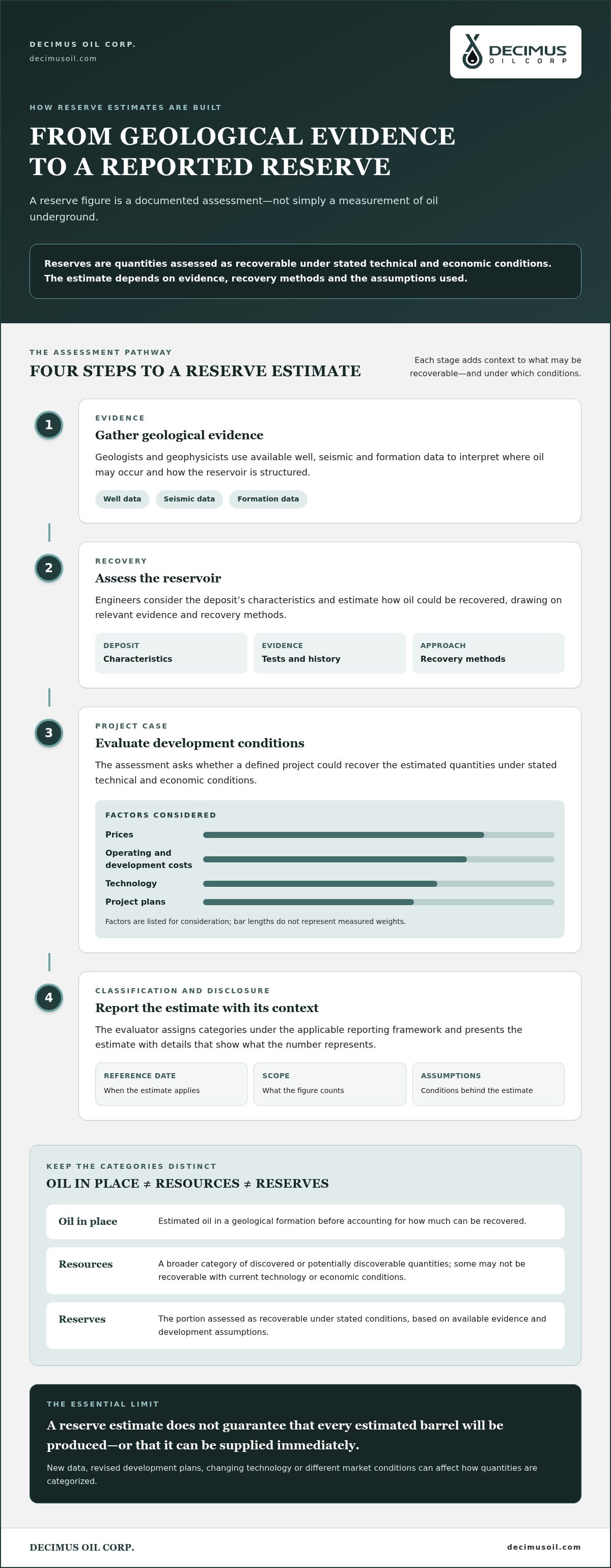
Oil reserves are estimated quantities assessed as recoverable under stated technical and economic conditions. The term describes a categorized estimate, not a count of barrels already produced or stored. For anyone assessing oil reserves in canada, the distinction is essential: a reserve figure depends on what is known about the deposit, how recovery is expected to work and which assumptions are used.
Three related terms describe different stages of understanding a deposit. Oil in place is the estimated quantity in a geological formation before accounting for how much can be recovered. Resources are a broader category of discovered or potentially discoverable quantities. Some may not be recoverable with current technology or under current economic conditions. Reserves are the portion assessed as recoverable under stated conditions, based on available evidence and development assumptions. These measures are not interchangeable.
A geological reserve is also not a government emergency stockpile. A stockpile consists of physical oil held for use during a supply disruption; a reserve estimate describes oil underground. A CBC report in 2026 discussed Canada’s emergency-stockpile position, but that policy context does not change the meaning of geological reserves. As a broad historical overview, Oil reserves in Canada also illustrates why figures need context about the types of oil included.
A reserve estimate is not a promise of immediate production. It assesses recoverability under defined assumptions, not a schedule for bringing every estimated barrel to market.
How oil reserves differ from oil resources
Classification depends on the strength of geological evidence, the engineering case for recovery, project plans and economic assumptions. New data, revised development plans, changing technology or different market conditions can affect how quantities are categorized. A broader resource estimate may therefore include oil that has not qualified as reserves.
Illustrative example, not a Canadian reserve estimate: Imagine a formation believed to contain 100 units of oil. If testing and a defined recovery plan support extracting 20 units under the assumptions used, those 20 could be classified as reserves, while the remainder stays outside that category. The example shows why oil in place does not equal recoverable reserves.
Why Canada’s oil-reserve figures can vary
Before comparing totals, check the reporting date, classification system, commodity scope and source. One figure may cover oil sands, while another reports conventional crude or uses a broader resource measure. Even estimates labelled “reserves” can rely on different definitions or assumptions, so a headline comparison may not be like for like.
Start by separating oil-sands estimates from conventional oil figures. Then confirm what each source counts and when it was published. A figure is most useful when read alongside its classification basis and reference date. Without those details, differences may reflect scope or methodology rather than a change in the amount considered recoverable.
How Canadian Oil Reserves Are Estimated, Classified and Reassessed
A reserve estimate is the outcome of a documented assessment, not simply a geological measurement. For oil reserves in canada, the reported classification depends on the available evidence, the evaluation framework and the technical and economic assumptions disclosed by the source. To interpret a figure, trace how it moves from subsurface evidence to an assessed estimate.
- Gather geological evidence. Geologists and geophysicists use available well, seismic and formation data to interpret where oil may occur and how the reservoir is structured.
- Assess the reservoir. Engineers consider the deposit’s characteristics and estimate how oil could be recovered, using well tests, production history where available and relevant recovery methods.
- Evaluate the development case. The assessment considers whether a defined project could recover the estimated quantities under stated technical and economic conditions. Prices, operating and development costs, technology and project plans can affect the analysis.
- Classify and disclose. The evaluator assigns categories under the applicable reporting framework and presents an estimate with its reference date, scope and assumptions. These details help readers understand what the number represents.
Reporting sources may use different frameworks or disclose different levels of detail. The U.S. Energy Information Administration’s overview of Canada provides broader context on Canadian oil production and exports. It is not a substitute for a reserve estimate’s classification basis.
What makes a quantity a proved or probable reserve
In commonly used petroleum reporting terminology, proved reserves are quantities estimated with a high degree of confidence to be recoverable under defined conditions. Probable reserves are additional quantities with less certainty than proved reserves, but are assessed as more likely than not to be recovered when considered with proved reserves. Exact wording and criteria depend on the reporting framework. Neither category guarantees that every estimated barrel will be produced. A national total should not be assigned either label unless its source explicitly does so.
Why reserve estimates change over time
New drilling can reveal more about a reservoir’s size and behaviour. Production history can test earlier forecasts, while updated engineering analysis may revise expected recovery. Changes in commodity prices, costs or available recovery methods can also shift the economic assumptions behind a project. A quantity may move between categories, increase, decrease or cease to qualify as a reserve, even without a new discovery.
Reserve estimates can change as geological evidence, engineering analysis and project conditions change. When comparing figures, keep the source, date and classification alongside the headline number. For more context on how costs, prices and project decisions shape development, see this oil and gas exploration economics guide. Understanding recoverability is also a foundation for resource development, including the exploration and enhanced oil recovery work of Decimus Oil Corp.
Oil Sands and Conventional Oil: How to Compare Canadian Reserve Figures
Canadian reserve totals can combine oil from deposits that differ substantially in geology and recovery. A headline number is meaningful only when its source explains what it includes, how the quantities are classified and which recovery assumptions apply. Compare oil-sands and conventional estimates on a like-for-like basis, rather than assuming a barrel in one type of deposit is automatically equivalent to a barrel in another.
| Comparison point | Oil sands | Conventional oil |
|---|---|---|
| Resource characteristics | Bitumen occurs with sand, clay and water in deposits. | Oil is held in porous reservoir rock, often with natural fluids or gas. |
| Recovery approach | Depending on deposit depth and characteristics, recovery may use surface mining or in-situ methods such as thermal techniques. | Wells bring oil to the surface, using natural pressure, artificial lift or other recovery methods as the reservoir requires. |
| Development requirements | Projects require deposit-specific production systems and supporting infrastructure. | Projects require wells, gathering and transport systems, with plans tailored to reservoir behaviour. |
| Estimate caveats | Reported quantities depend on classification, recovery assumptions, project scope and reporting date. | Estimates depend on reservoir evidence, well performance, recovery plans and the same reporting details. |
The table describes broad differences, not a ranking. Neither resource type is automatically easier or more commercially attractive to develop. For both, a reserve estimate is not a production forecast: volume alone does not establish the extraction rate, project viability or when supply could reach market. Development also depends on engineering, infrastructure, project decisions and economic conditions.
What distinguishes oil-sands resources
Oil sands contain bitumen, a dense form of petroleum that does not flow like lighter crude under ordinary reservoir conditions. Recovery methods vary with deposit characteristics. Surface mining is used for some shallower deposits, while in-situ techniques can recover bitumen from deeper formations. Check a reported oil-sands figure’s publication date and classification basis. It may describe estimated resources or reserves, and should not be read as a volume ready for immediate extraction.
How conventional oil development fits the comparison
Conventional exploration uses geological evidence to identify prospects, followed by drilling and engineering assessment to determine whether a reservoir can support development. Existing fields may also use enhanced recovery methods to seek additional production, with results depending on the asset and its conditions. Decimus Oil Corp. focuses on conventional oil and gas exploration, resource development and enhanced oil recovery. This company focus does not imply a specific reserve holding. For wider basin-development context, see the WCSB resource development guide.
To interpret a national comparison, record the source and date, confirm whether it reports resources or reserves, and check which oil categories it includes. This helps prevent large geological estimates from being mistaken for immediately available production.
Geological Oil Reserves Are Not Canada’s Emergency Stockpile
The word “reserve” can describe two very different things in energy discussions. Geological oil reserves are estimates of quantities recoverable underground under stated conditions. A strategic stockpile, by contrast, is a physical supply held for use during an emergency. Confusing the two can make an estimate of long-term resource potential sound like fuel that could be released immediately.
Underground reserves describe estimated recoverable oil; stockpiles describe stored supply. The distinction is practical as well as technical: an underground resource must be developed and produced, while oil in a stockpile has already been extracted and held for potential use.
A 2026 CBC account discussed Canada’s position on strategic emergency stocks and the policy debate around relying on production and trade instead. Read it as a dated account, not a timeless description of policy. As of October 2026, the research available for this article indicates that Canada does not maintain a government-owned Strategic Petroleum Reserve. This does not mean geological reserves are unavailable as a long-term source of supply. It means they are not a government-held emergency inventory.
Why a country may choose whether to hold strategic oil stocks
Holding physical stocks can provide a direct supply buffer during a disruption, but requires acquiring and maintaining inventory and arranging how it would be released. A different policy approach may emphasize domestic production, trade relationships and infrastructure. Canada’s position as a major producer and net exporter is part of the rationale reported in public discussion, but it is not the only factor governments may weigh when considering energy security.
The International Energy Agency context also requires care. EnergyNow reported on October 11, 2026, that Canada committed to increasing oil supply by 23.6 million barrels between April and September 2026, contributing to a coordinated 400-million-barrel release by IEA member countries. This was described as a supply contribution, not as barrels withdrawn from a Canadian government stockpile. Production capacity and stored inventory are distinct parts of an emergency response.
Why geological reserves cannot solve an immediate disruption
A reserve estimate alone does not show how quickly oil can be supplied during a sudden shortfall. Developing a resource involves investment decisions, approvals, facilities, wells and recovery methods. The pace and feasibility depend on the project; a national underground estimate cannot specify a universal response time.
Supply also depends on what happens after extraction. Production must connect to transportation and relevant processing capacity before it can serve particular markets. Constraints at any stage can limit how much reaches buyers, even when geological potential is substantial. Long-term resource development and short-term emergency readiness both relate to energy security, but they are not interchangeable solutions.
For a perspective grounded in exploration, infrastructure and resource development, explore Decimus Oil Corp.’s approach to Canadian energy development.
What Canada’s Oil Reserves Mean for Long-Term Resource Development
Reserve estimates help decision-makers understand the scale and potential recoverability of an oil deposit, but they do not determine whether or when a project will proceed. Development requires a connected assessment: geological evidence must support an engineering plan, recovery methods must fit the deposit, and infrastructure must be able to move production to market. Commercial decisions also depend on costs, expected revenues, project priorities and other conditions that can change over time.
From reserve estimates to development decisions
Before advancing a resource, an operator considers more than the size of an estimate. The work may involve assessing reservoir characteristics, selecting a recovery approach, evaluating facilities and transportation needs, and considering how project economics respond to different assumptions. These factors interact. A technically recoverable quantity does not automatically establish a viable development plan, while infrastructure or recovery improvements may change how an existing asset is assessed.
Recovery techniques depend on geology and operating context. Enhanced oil recovery, for example, refers to methods used to seek additional production from an oil reservoir. It does not guarantee a particular volume or result. The enhanced oil recovery techniques guide provides further context on how recovery approaches can support the assessment of existing assets.
- Geological evidence informs what may be present and how the deposit is understood.
- Engineering analysis assesses how recovery could work under defined conditions.
- Infrastructure influences whether production can be gathered and transported.
- Project economics and decisions shape whether and how development advances.
Decimus Oil Corp. is a Canadian energy company focused on conventional oil and gas exploration, resource development and enhanced oil recovery. These are examples of activities involved in developing and optimizing hydrocarbon resources, not claims about a specific reserve volume, project result or production outcome.
A measured next step for readers
Keep the categories distinct when assessing long-term potential: resources cover a broader range of estimated quantities, reserves refer to quantities assessed as recoverable under stated conditions, and strategic stockpiles are physically held supplies intended for emergency use. For any figure about oil reserves in canada, note its publication date, reporting source, classification and assumptions. These details make it easier to compare estimates responsibly and separate geological potential from near-term supply.
To explore how resource development connects with recovery methods and project assessment, explore Decimus Oil Corp.'s resource-development approach.
Turn Reserve Data Into Better Development Questions
For anyone tracking oil reserves in canada, consider what new evidence, recovery options and infrastructure decisions could shape how a resource is developed over time. This keeps long-range energy planning grounded in ongoing assessment, rather than assuming geological potential translates directly into supply. It also draws attention to how technical understanding informs decisions as operating conditions evolve.
For industry observers, the practical question is how resource knowledge can guide disciplined exploration and asset optimization. Decimus Oil Corp., listed on the TSX Venture Exchange as TSXV:WCSB, focuses on conventional oil and gas exploration and enhanced recovery. Its work is part of the broader development conversation, without turning geological estimates into claims about company reserves or forecasts of outcomes.
Explore how a Canadian energy company approaches resource development and the decisions that connect technical potential with execution. Explore Decimus Oil’s resource-development approach and continue building an informed perspective on Canada’s energy future.
Frequently Asked Questions
How much oil does Canada have in reserves?
There isn’t one figure that can be quoted accurately without its date, source and classification. A total may count oil-sands reserves, conventional crude or a broader resource category, and those figures aren’t interchangeable. To interpret a reported number, check whether it refers to proved reserves or another classification, which types of oil it includes and its reporting date. A large resource estimate should not be presented as the amount ready for production.
Is Canada one of the countries with the largest oil reserves?
Yes. Canada is widely recognized as having one of the world’s largest reported oil-reserve bases, largely because of its oil sands. Exact rankings depend on the source, reference date and whether the comparison uses proved reserves or a broader estimate. For a sound comparison, use figures prepared under comparable definitions and avoid ranking countries by totals that mix different classifications or commodities.
What percentage of Canada’s oil reserves can be recovered?
There is no single recovery percentage that applies to all Canadian oil. Recovery depends on the deposit, the method used and the assumptions behind an estimate. Oil in place includes quantities that may not be technically or economically recoverable, while reserve figures represent quantities assessed as recoverable under stated conditions. A recovery percentage is meaningful only when it identifies the deposit, measurement basis and method. Applying one rate nationally can mislead.
Can oil resources become reserves later?
Yes. A resource may be reclassified as reserves if additional geological evidence and engineering work support recovery under defined technical and economic conditions. Further drilling might clarify a reservoir, while a viable project plan or improved recovery method could change the assessment. The reverse can also happen: revised evidence, costs or project assumptions may mean quantities no longer meet reserve criteria. Reclassification reflects an updated assessment, not necessarily a new discovery.
What is the difference between proved and probable oil reserves?
Under commonly used petroleum reporting frameworks, proved reserves carry a higher level of confidence in estimated recovery than probable reserves. Probable quantities have more uncertainty, but are assessed as more likely than not to be recovered when considered with proved reserves. Exact definitions depend on the applicable framework and its assumptions. Neither category guarantees production, and a national estimate should not be called proved or probable unless its source assigns that classification.
Do oil reserves mean oil is ready to be produced?
No. A reserve estimate does not indicate that wells, facilities, transportation capacity or a production schedule are already in place. An undeveloped field, for example, may require further engineering, investment and infrastructure before production can begin. Even for an operating asset, an estimated reserve volume doesn’t specify how quickly oil can be produced. Assess reserve figures alongside development status and production data to understand what may be available in a particular period.
How often are Canada’s oil-reserve estimates updated?
There is no single update schedule for every Canadian reserve estimate. Companies and agencies may publish figures on different cycles, while an estimate can also be revised when new drilling, production information, engineering analysis or economic assumptions warrant reassessment. For a current comparison, identify the publisher’s latest reporting date and determine whether the underlying methodology or scope has changed. A newer figure isn’t automatically comparable with an older one if definitions differ.


