
The shortest route from a well to a market isn’t automatically the best one. Hydrocarbon transportation infrastructure Canada relies on connects production with processing, storage and markets, but each route has different requirements. Comparing pipelines, rail, trucks and marine transport means looking beyond distance to product compatibility, connections, capacity, access and delivery needs.
This guide explains how the main transportation modes fit into Canada’s hydrocarbon supply chain and how to compare their practical trade-offs. It also outlines federal and provincial regulatory roles to make the oversight framework easier to understand.
We’ll follow hydrocarbons from production toward end markets, compare transport options using project-relevant criteria and consider how infrastructure decisions relate to resource development and asset management. For developers, understanding these connections can clarify how transportation supports a project’s route to market and broader planning.
Key Takeaways
- Understand where transportation fits in the hydrocarbon supply chain and how it differs from production, processing, refining and retail distribution.
- See how pipelines, rail, trucks and marine transport serve different roles, with suitability shaped by the product, route, connections and delivery needs.
- Use a practical sequence to assess hydrocarbon transportation infrastructure Canada, from defining the product and route to evaluating capacity and delivery requirements.
- Distinguish physical infrastructure from operational access, commercial arrangements and regulatory approvals when evaluating a transportation option.
- Consider how transportation access and infrastructure management inform resource development planning and connections to markets.
What hydrocarbon transportation infrastructure in Canada includes
Hydrocarbon transportation infrastructure in Canada is the network of facilities and transport equipment that moves oil and natural gas between stages of the energy supply chain, from producing sites toward markets. It is a sector-specific system, not a synonym for public infrastructure generally. Hydrocarbon transport assets are designed or used to gather, transfer, store or deliver energy products.
Transportation connects other activities in the supply chain. Upstream production brings oil and gas to the surface, and processing prepares them for movement or further use. Transportation moves products between facilities and markets. Downstream refining converts crude oil into other products, while retail distribution delivers fuel to end users. These stages may connect operationally, but they serve different functions.
How oil and natural gas move through the supply chain
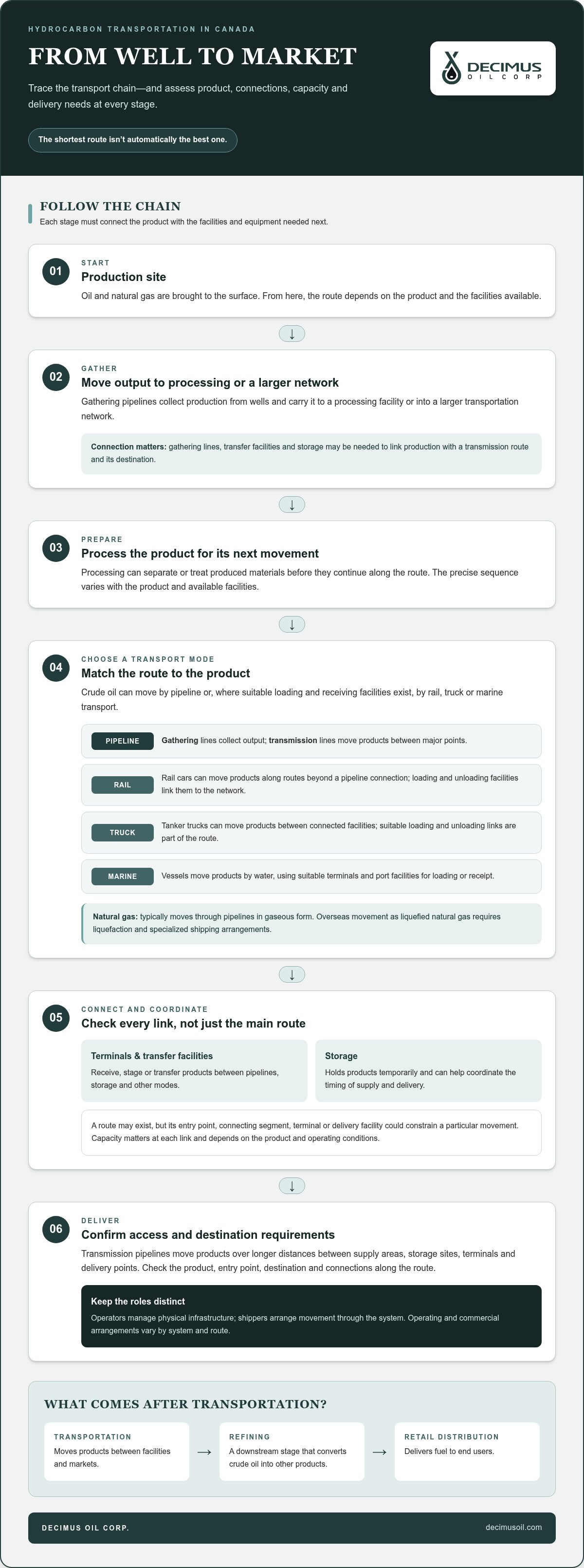
A typical route begins at a producing site. Gathering pipelines collect output from wells and carry it to a processing facility or into a larger transportation network. Processing can separate or treat produced materials before they continue along the route. The precise sequence depends on the product and available facilities.
Transmission pipelines move products over longer distances between supply areas, storage sites, terminals and delivery points. They are only one part of the chain. Gathering lines, transfer facilities and storage may also be needed to connect production with a transmission route and its destination. The Pipelines in Canada overview provides additional context on the pipeline network’s history and role.
Crude oil and natural gas require different handling. Crude can move through pipelines or, where suitable loading and receiving facilities exist, by rail, truck or marine transport. Natural gas typically moves through pipelines in gaseous form. Transporting it overseas as liquefied natural gas requires liquefaction and specialized shipping arrangements. A route must match the product’s physical form and delivery requirements.
Which assets make up the transportation network?
Infrastructure combines fixed facilities with transport equipment. Connection points enable transfers between assets or modes, but a route won’t necessarily use every component.
- Pipelines: Gathering lines collect production, while transmission lines carry products between major points.
- Terminals and transfer facilities: These receive, stage or transfer products between pipelines, storage and other modes.
- Storage facilities: These hold products temporarily, helping coordinate the timing of supply and delivery.
- Rail and trucks: Rail cars and tanker trucks move products along routes that may extend beyond a pipeline connection. Loading and unloading facilities link them to the wider network.
- Marine transport: Vessels move products by water, using suitable terminals and port facilities for loading or receipt.
Pipelines, terminals and storage sites are generally fixed network assets. Rail cars, trucks and vessels are transport equipment that can support movement between connected facilities. Evaluate how these pieces link together rather than treating any one asset as the entire transportation chain.
How Canadian hydrocarbon transportation systems operate
Hydrocarbon transportation works as a coordinated chain: each asset must connect the product at one stage with the facilities and equipment needed at the next. A producing site may feed a gathering line, then a processing facility, a transmission route and a storage or delivery point. The sequence varies by product and route. Some movements bypass stages or use another mode.
Operators manage the physical infrastructure, while shippers arrange the movement of their products through the system. Coordination involves practical details such as where a product enters and leaves, how it must be handled and whether connected assets can accommodate the planned movement. The relevant operating and commercial arrangements vary by system and route.
Pipeline transportation: gathering and transmission
Gathering lines bring production from wells or producing areas to processing facilities or larger pipeline networks. Transmission pipelines move products between major points. Oil and natural gas systems are designed for different products and operating requirements, so a connection suited to one movement may not serve another. When assessing a route, look beyond whether a pipeline is nearby. Check the product, entry point, destination and connections along the route.
Storage, terminals, and intermodal connections
Storage can help align the timing of production, transportation and delivery. Terminals and other transfer facilities connect stages or modes, though their functions and configurations vary. Where infrastructure allows, a shipment may transfer between pipeline and rail, truck or marine transport. The available connections determine which transfers are practical.
Capacity matters at each link, not just across the system as a whole. A pipeline route may exist, but its entry point, connecting segment, terminal or delivery facility could constrain a particular movement. Capacity also depends on the product and operating conditions, so a broad system figure alone may not describe access for a specific shipper or route.
Connection points are where a transport plan meets operating reality. A movement needs compatible facilities at both ends, as well as any intermediate transfers. If one link is unavailable or lacks suitable capacity, spare capacity on another segment may not resolve the constraint. Assessing the full path from origin to delivery point is more informative than focusing on a single asset.
Mode comparisons also depend on the criteria being assessed. The Railway Association of Canada’s Canadian Crude Oil Transportation: Pipelines vs. Railways examines safety comparisons for crude oil transport. It is one reference point. A project assessment should also consider route connections, product requirements, operational access and delivery needs.
For resource developers, this systems view connects infrastructure management with production planning and potential market access. Decimus Oil Corp. focuses on conventional exploration, resource development, enhanced recovery and energy infrastructure management. Learn about Decimus Oil’s energy infrastructure focus and how connected assets support resource development.
Pipelines, rail, trucks, and marine transport: comparing the options
No transportation mode is the best fit for every hydrocarbon movement. A pipeline provides a fixed connection between points, while rail, trucks and marine transport may suit movements where their networks and transfer facilities align with the product and destination. Start with the complete journey: what is being moved, how much, where it needs to go and which connections are available.
| Mode | Typical role and flexibility | Connection needs | Relevant limitations |
|---|---|---|---|
| Pipeline | Moves compatible products through a fixed, dedicated route; the route itself offers limited flexibility. | Requires suitable entry, exit and connecting facilities along the network. | Availability depends on route alignment, product requirements and capacity at relevant points. |
| Rail | Moves crude oil and other suitable products along rail routes; can serve movements beyond pipeline connections. | Needs appropriate loading and unloading facilities, plus access to connected rail infrastructure. | Movement depends on rail routes, terminal access and coordination at transfer points. |
| Truck | Offers route flexibility and can connect sites with other transport links or delivery points. | Needs suitable road access and facilities for loading and receipt. | Route conditions, logistics and the requirements of a particular movement can constrain its role. |
| Marine | Moves products by water where a suitable route and receiving or loading facilities exist. | Requires appropriate terminals and connections to the wider transportation chain. | Its use depends on access to navigable routes and compatible facilities at both ends. |
This comparison describes general roles, not a universal ranking for cost, safety, emissions or capacity. Those measures depend on the route, product, operating conditions and evidence used. A mode’s suitability for one crude oil movement, for example, doesn’t establish its performance for another product or delivery requirement.
Where pipelines, rail, and trucks differ
Pipelines are fixed networks, so their value for a project depends on whether the route connects to the required supply and delivery points. Rail can provide an alternative when suitable terminals and rail connections are available. Trucks can serve as a flexible link, including between a producing site and a larger network, but road access, distance and logistics shape their practical role.
When marine transport and intermodal links matter
Marine transport is relevant when the product, route and terminal connections support movement by water. Intermodal routes can extend market access by transferring product between modes, but each handoff adds coordination, facility and scheduling requirements. For hydrocarbon transportation infrastructure across Canada, compare the complete route rather than selecting a mode in isolation.
Ask whether every leg can handle the product and connect to the next one. A pipeline may suit a fixed corridor, while rail, truck or marine transport may address a different routing need. The appropriate option is the one whose network, transfer points and delivery arrangements align with the planned movement.
How to assess Canadian hydrocarbon transportation infrastructure
A practical assessment starts with the movement to be served, not a preferred mode or asset. A nearby pipeline, rail line or terminal is only a potential connection until product requirements, access, capacity and delivery needs align. For hydrocarbon transportation infrastructure across Canada, separate what physically exists from what can be accessed and approved for a specific project.
Checklist: assess the product, route, connections, usable capacity, delivery requirements, operating considerations, commercial access and applicable regulatory approvals.
- Define the product. Identify whether the movement involves crude oil, natural gas or another hydrocarbon product. Product characteristics affect handling and which infrastructure can serve the movement.
- Map the route. Set out the origin, destination and potential transfer points. Consider whether the route reaches the intended market and supports the required delivery timing.
- Identify required connections. Trace each link from the production or supply point to delivery. A route may depend on gathering infrastructure, terminals, storage or transfers between modes.
- Evaluate capacity and access. Distinguish an asset’s stated design capacity from capacity available for a particular movement. Maintenance, operating conditions, other system demands and connection constraints can affect practical availability.
- Confirm delivery and approval needs. Define the expected delivery schedule and identify the regulatory jurisdiction and approvals that apply to the asset and project.
Match infrastructure to product, route, and market
Map the complete path before comparing alternatives. A crude oil route may need different handling and connections from a natural gas movement. Note where the product enters or changes transport mode, and identify points that could constrain timing or access. Existing infrastructure is useful only if its connections serve the intended destination and delivery requirements.
Physical proximity alone doesn’t establish access. An asset may be near a project, while operational access, commercial arrangements or approval requirements remain separate considerations. Keep the questions distinct: Is there a suitable facility? Can it accommodate the movement in practice? What arrangements govern access? Which approvals apply?
Assess capacity, reliability, and regulatory context
Capacity figures need context. A stated or nameplate figure describes an asset’s rated capability under defined conditions. Capacity available for a particular movement may differ. Assess the relevant segment and connection points, then consider maintenance, operational continuity and contingency options without assuming uninterrupted service.
Regulatory responsibility depends on the asset and jurisdiction. In broad terms, the Canada Energy Regulator oversees federally regulated interprovincial and international pipelines, while provincial regulators oversee many systems contained within one province. Other modes and project activities can have different oversight. Identify the applicable regulator and current requirements through official federal or provincial guidance. The presence of infrastructure alone doesn’t establish approval.
Sound infrastructure evaluation brings physical, operational, commercial and regulatory factors together. Decimus Oil Corp. focuses on resource development and energy infrastructure management. Explore Decimus Oil’s resource development focus to see how infrastructure considerations relate to connecting energy assets with markets.
Why transportation infrastructure matters to resource development and Decimus Oil
Resource development involves more than identifying and producing hydrocarbons. A project also needs a practical path from production toward processing, storage and potential markets. Transportation access can inform development planning, operating decisions and potential market connections. Hydrocarbon transportation infrastructure Canada relies on is part of the broader context for evaluating energy assets, not a guarantee of a particular project outcome.
Infrastructure belongs in the same planning conversation as geology, operating requirements and asset management. The location of a potential connection, the product a route can handle and the timing of delivery can all affect how a development is planned. These considerations are project-specific. Sector-level observations about Canada’s transportation networks don’t determine the access or results of any individual project.
Infrastructure as a resource-development consideration
Resource development involves linked decisions: assess the resource, plan production, identify suitable transportation connections and consider how product could reach a potential delivery point. Each stage informs the next. A route that doesn’t align with the product or delivery requirements may affect the practical development plan, while suitable connections can support consideration of potential market access.
Consider transportation alongside resource potential and operational planning, rather than leaving it until after production decisions are made. When examining WCSB resource development, consider infrastructure as part of the wider development picture while distinguishing sector-level context from the particulars of any one asset.
Decimus Oil Corp.’s infrastructure and asset-management perspective
Decimus Oil Corp. focuses on conventional oil and gas exploration, strategic resource development and enhanced oil recovery. The company also manages energy infrastructure to support resource development and transportation. Its work brings infrastructure management into the same context as exploration and resource development.
In the wider sector, infrastructure management is one consideration in how energy assets connect production with potential markets. It sits alongside resource planning and operational decisions, while actual access and project outcomes depend on specific circumstances. Decimus Oil Corp. reports more than 100 years of combined team experience across its exploration, development and infrastructure focus.
Readers exploring energy infrastructure management can consider how asset oversight relates to transportation and resource development. For company information and an overview of Decimus Oil Corp.’s energy-sector focus, explore Decimus Oil Corp.’s energy-sector focus.
Plan for changing routes and market needs
Transportation decisions aren’t static. As resource plans evolve, product requirements, delivery timing, available connections and market priorities can shift. Treating hydrocarbon transportation infrastructure Canada as a long-term planning consideration means revisiting assumptions as projects advance, rather than relying indefinitely on an early route assessment.
For developers and asset managers, connect infrastructure analysis with broader resource and operational planning. This helps clarify where transportation considerations influence decisions, while keeping project-specific access and outcomes grounded in evidence.
Decimus Oil’s work connects exploration, resource development and energy infrastructure management. To learn more about the company’s approach, explore Decimus Oil’s energy-sector focus.
Explore Decimus Oil’s conventional oil and gas exploration, resource development and energy infrastructure management at Decimus Oil.
Frequently Asked Questions
What is hydrocarbon transportation infrastructure?
It is the equipment and facilities used to move oil and gas between supply-chain locations. In Canada, hydrocarbon transportation infrastructure can include a gathering line linking producing wells to a processing plant, or a terminal connecting a pipeline with another transport mode. It doesn’t include hydrocarbon production itself. The key distinction is function: these assets enable movement between points rather than extracting or transforming the resource.
How are oil and natural gas transported differently in Canada?
Oil and natural gas use different systems because they have different physical properties and handling requirements. Crude oil can travel through pipelines or, where suitable facilities and routes exist, by rail, truck or marine vessel. Natural gas commonly moves through pipelines in gaseous form. To ship it overseas by sea, it must be liquefied and handled using specialized facilities and vessels. The right arrangement depends on the product and destination.
Can crude oil be transported by rail in Canada?
Yes. Crude oil can move by rail in Canada when the route, rail network, loading and unloading facilities, and operating arrangements support the shipment. Rail may be considered when a movement needs a connection that a pipeline route doesn’t provide. It isn’t an automatic substitute: terminal access, scheduling, product handling and applicable dangerous-goods requirements all affect whether a particular rail movement is practical.
Who regulates hydrocarbon transportation infrastructure in Canada?
Regulatory responsibility depends on the asset, mode and jurisdiction. The Canada Energy Regulator oversees pipelines under federal jurisdiction, including those crossing provincial or national borders; provincial regulators oversee many pipelines operating within a province. Rail and marine transport have separate federal oversight, including requirements administered by Transport Canada. A project may involve more than one authority, so identify the asset and route before determining which regulator and approvals apply.
How does transportation capacity affect oil and gas producers?
Available transportation capacity can affect how much product a producer can move, when it can be delivered and which market connections are practical. If a needed route or connection point is constrained, production plans may need to account for storage, scheduling or alternative transportation options. Consider capacity figures in context: system-wide rated capacity doesn’t necessarily indicate how much capacity is available for a specific product, route or shipper.
How can hydrocarbon transportation infrastructure improve resilience?
A connected network can support resilience by giving operators more ways to manage disruptions or changing delivery needs. Depending on the project, options may include storage, alternate routes, connections between transport modes and maintenance planning. These measures can help reduce reliance on a single point of failure, but they don’t guarantee uninterrupted movement. Resilience depends on the actual assets, available capacity, operating coordination and contingency arrangements for the route.


