
A rising share price can make an energy stock look compelling, but it doesn’t show whether the business is executing. When screening small cap energy stocks Canada, varying market-cap definitions and limited public information can make comparisons difficult. Performance lists also rarely reveal the operating and financial risks behind returns.
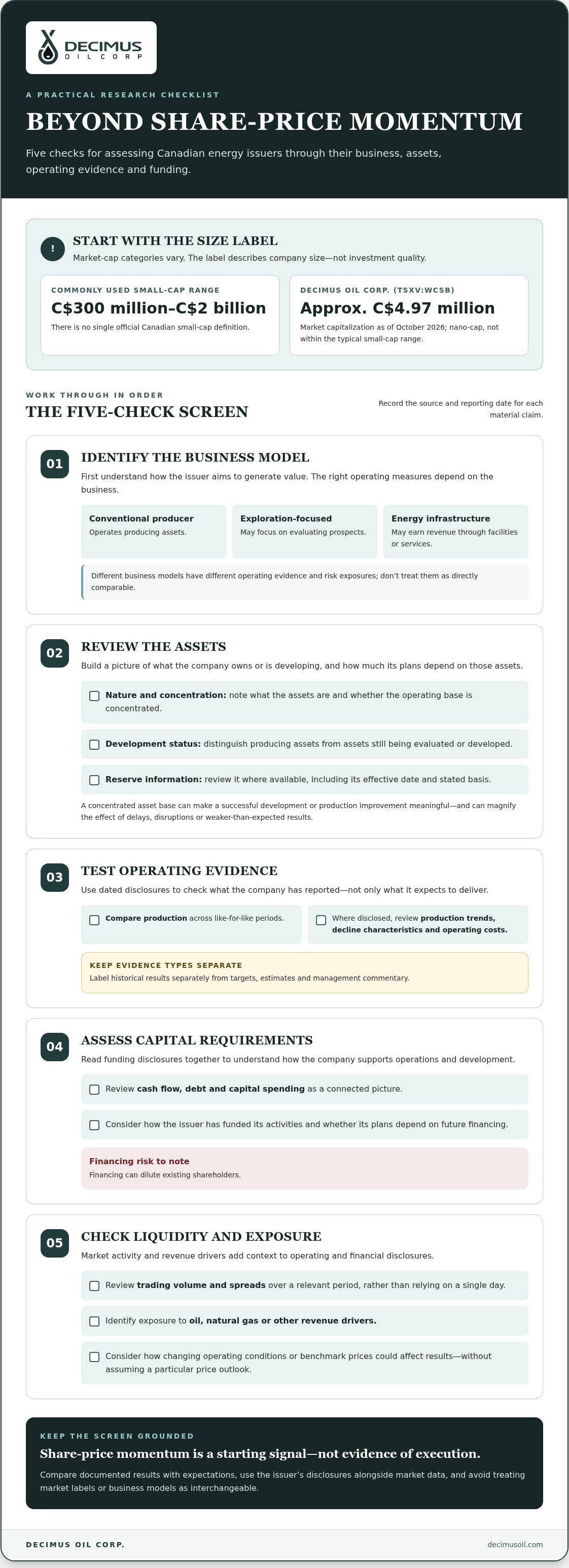
There’s no single official Canadian small-cap definition; a commonly used range is C$300 million to C$2 billion. Decimus Oil Corp. (TSXV:WCSB) shows why the label matters: at approximately C$4.97 million in market capitalization as of October 2026, it falls into the nano-cap category, not the typical small-cap range. Its focus on conventional exploration, resource development, enhanced oil recovery and infrastructure gives investors specific business fundamentals to examine.
This guide provides a repeatable way to assess Canadian energy issuers, from asset quality and operating evidence to commodity exposure, financing needs and disclosure. Use it to compare companies beyond share-price momentum, understand risks that can affect smaller issuers, and decide which names, including Decimus Oil, merit further independent research.
Key Takeaways
- Small-cap classifications vary across screeners. Check how each source defines its categories before comparing issuers.
- Use a consistent screen for small cap energy stocks Canada: assess the business model, assets, operating evidence, funding needs and share liquidity.
- Separate disclosed results from management targets and promotional claims to form a more grounded view of a company’s execution.
- Compare issuers by business focus and disclosed evidence, and note the distinct risks that could affect each company.
- Apply the framework to Decimus Oil Corp. (TSXV:WCSB), while distinguishing its market-cap category from conventional small-cap peers.
What counts as a small-cap energy stock in Canada?
Small-cap energy stocks are publicly traded energy companies with comparatively modest market capitalizations. There’s no single cutoff that applies across every Canadian exchange, index or stock screener. Some classification systems set specific ranges, while others adjust their categories to reflect the size and composition of the market. A general definition of small-cap company provides context, but it doesn’t establish a universal Canadian threshold.
A small-cap energy stock is an energy issuer whose market capitalization falls within a relatively small-company category under the classification system being used. The label describes size, not investment quality. Before comparing results, check how the data provider defines the category and when its information was updated. A company may appear on one small-cap list but not another, even if its underlying business hasn’t changed.
Market capitalization is calculated by multiplying a company’s share price by its shares outstanding. It isn’t the same as share price: a low-priced share doesn’t necessarily indicate a small company, and a higher-priced share doesn’t automatically indicate a large one. Market capitalization also differs from enterprise value, which accounts for factors such as debt and cash, and from production scale, reserves or operating history. These measures describe different aspects of an issuer, so don’t treat them as interchangeable.
How do Canadian small-cap energy stocks differ from larger issuers?
Differences depend on the company, but smaller issuers may have fewer assets, a narrower operating base or less access to capital than larger peers. Their shares may also trade less frequently, which can affect how easily investors buy or sell at a desired price. Disclosure requirements depend on the issuer and its listing context, while the amount of operating history and public information can vary. Review filings and trading data rather than assuming every smaller company has the same profile.
A concentrated asset base can make a successful development or production improvement meaningful to a company’s plans. The same concentration can magnify the impact of delays, operating disruptions or weaker-than-expected results. Business model matters, too: a conventional producer operates producing assets, an exploration company may focus on evaluating prospects, and an energy-infrastructure issuer may earn revenue through facilities or services. Their operating evidence and risk exposures aren’t directly comparable.
Why does the TSX Venture Exchange matter to small-cap investors?
The TSX Venture Exchange (TSXV) is a Canadian public market that includes emerging and smaller issuers, including resource companies. It includes companies of different sizes, business models and development stages, so a TSXV listing alone doesn’t establish an issuer’s operating quality, liquidity or suitability for any investor.
Use the exchange as one part of the picture, then examine the issuer’s disclosures, assets, financing position and trading activity. This broader view puts Canadian public-equity energy companies in context and keeps a market label from standing in for analysis.
How to screen Canadian small-cap energy stocks beyond share-price momentum
A rising share price can attract attention, but it doesn’t show whether an issuer has sustainable operations, adequate funding or the capacity to deliver on its plans. Share-price momentum alone is an incomplete screen because it reflects trading activity, not the quality, resilience or financing needs of the underlying business. When researching small cap energy stocks Canada, review company disclosures alongside market data and distinguish documented results from expectations.
Work through these steps in order, recording the source and reporting date for each material claim:
- Identify the business model. Determine whether the issuer is a conventional producer, an exploration-focused company or an energy-infrastructure business. The relevant operating measures depend on how the company generates value.
- Review the assets. Examine their nature, concentration and disclosed development status. Review reserve information where available, noting its effective date and stated basis.
- Test operating evidence. Compare reported production across like-for-like periods. Where disclosed, look at production trends, decline characteristics and operating costs. Separate historical results from targets, estimates and management commentary.
- Assess capital requirements. Read cash-flow, debt and capital-spending disclosures together. Consider how the company has funded operations and development, and whether its plans depend on future financing. Financing can dilute existing shareholders.
- Check trading liquidity and exposure. Review trading volume and spreads over a relevant period rather than relying on a single day. Identify the company’s exposure to oil, natural gas or other revenue drivers, and consider how changing operating conditions or benchmark prices could affect results without assuming a particular price outlook.
Which operating and financial indicators deserve close review?
Use dated company filings and disclosures, and label each measure with its reporting period. For example, don’t compare one issuer’s annual production with another’s quarterly figure without explaining the difference. Define terms such as operating cost and cash flow as the issuer presents them, since calculations and reporting conventions can vary. For additional sector context, consider how Canadian oil and gas exploration economics shape asset development and funding decisions.
How should investors assess small-cap energy risks?
Separate risks disclosed by the issuer from broader risks that may apply to energy businesses generally. Company disclosures may identify asset-specific, operational or financing exposures. Broader considerations can include commodity-price movements, interruptions, execution challenges and limited share liquidity. A concentrated asset base can make results more sensitive to a setback at one operation. Record each risk, the disclosure that supports it and the assumption that may need revisiting.
Apply this framework to an issuer’s current public materials rather than treating the checklist as a verdict. Use it to review Decimus Oil’s public company information as one part of your independent research.
How to compare Canadian small-cap energy stocks by business model
Energy companies can pursue different ways to develop assets and generate revenue, so a useful comparison starts with the business model, not a performance ranking. The table below offers a consistent research format. Decimus Oil Corp. is included as a company to investigate; the other rows describe business-model archetypes, not named issuers or verified peer companies. Before adding peers, confirm their listing, size classification and operating disclosures using dated information.
| Issuer or model | Exchange symbol | Business model | Disclosed operating evidence | Key risks to examine |
|---|---|---|---|---|
| Decimus Oil Corp. | TSXV:WCSB | Stated focus on conventional exploration, resource development, energy infrastructure and enhanced oil recovery. | Use current company disclosures to assess operating activity and results. The stated business focus alone doesn’t establish production, reserves or financial performance. | Review asset concentration, financing requirements, operating execution and the evidence behind development plans. |
| Exploration-led model, illustrative | Not applicable | Evaluates prospects and advances exploration opportunities. | Look for dated disclosures about exploration activity, results and next-stage plans. | Assess uncertainty in results, funding needs and the time between exploration and potential development. |
| Producing-company model, illustrative | Not applicable | Operates producing assets and manages ongoing production. | Compare reported production, operating costs and cash flow across stated periods. | Consider decline, interruptions, commodity exposure and the capital needed to sustain or develop operations. |
| Infrastructure model, illustrative | Not applicable | Develops or operates facilities that support energy movement or resource development. | Review disclosures about assets, activity and how the business earns revenue. | Examine project execution, utilization, counterparties and financing exposure. |
What separates exploration, production, and enhanced recovery companies?
Exploration-led growth depends on evaluating prospects and advancing opportunities. For a producer, operating evidence centres on existing production and its economics. Neither model is inherently superior; each calls for different evidence and risk analysis. Enhanced oil recovery refers to methods intended to improve output from existing fields. Infrastructure can support resource development and transportation, but its commercial role depends on the specific assets and arrangements disclosed by each issuer.
How should a shortlist of issuers be presented?
Use the same profile for every company: issuer name and symbol, data date, business model, dated operating evidence, funding context and principal risks. For small cap energy stocks Canada, this format helps prevent promotional language or a shifting market label from replacing comparable evidence. Treat company statements as established facts only when disclosures support them, and distinguish historical results from plans, estimates and targets. For context on recovery approaches, review enhanced oil recovery techniques.
This comparison is a research tool, not a buy recommendation or a forecast of returns. Decimus Oil’s stated focus makes it one issuer to assess against your own criteria. Review Decimus Oil’s company information alongside its dated public disclosures.
How to build a risk-aware research shortlist for Canadian energy stocks
A useful shortlist reflects your objectives and risk limits, not just which shares have recently attracted attention. Use a staged process to move from a broad screen to documented research, then revisit each company as new disclosures emerge. When researching small cap energy stocks Canada, a written process helps keep assumptions visible and comparisons consistent.
- Define your objectives. Set out your investment horizon, tolerance for volatility and the role energy shares would play in your broader portfolio. These personal parameters help determine which business models and risks merit further study.
- Screen issuers consistently. Apply the same criteria to each candidate, such as business focus, assets, operating evidence, financing needs and trading liquidity. Keep these criteria separate from any view about a share’s potential performance.
- Review primary disclosures. Consult exchange filings, audited financial statements and company disclosures. Note the publication date and reporting period for each figure, and compare management’s stated strategy with reported operations and capital allocation.
- Document risks and scenarios. Record company-specific exposures alongside broader sector risks. Consider how different commodity-price assumptions could affect an issuer’s disclosed economics, without treating any scenario as a prediction or certainty.
- Revisit the evidence. Set a consistent review schedule around new filings and material company disclosures. Update your thesis when facts change; frequent trading isn’t required to maintain a useful research record.
What should investors verify before adding a company to a shortlist?
Compare filings and financial statements with the company’s summaries, then check the dates and periods behind the figures. Compare the stated strategy with disclosed operating results and spending plans. Review financing requirements, share issuance history and reliance on a limited number of assets or projects. A mismatch between a growth plan and its disclosed funding or execution evidence is a reason to investigate further, not a conclusion on its own.
- Evidence: Which filing or disclosure supports the operating and financial claims, and what period does it cover?
- Funding: What capital may be needed to advance the stated plans, and what does the financing history show?
- Concentration: How much does the business depend on particular assets, operations or commodity exposures?
- Assumptions: Which conditions would strengthen or weaken the research thesis?
Diversification across issuers or operating exposures can reduce concentration in a single company or asset, but it can’t eliminate market-wide risk. Compare more than one commodity or operating scenario rather than relying on a single price assumption. Resource-development strategies can also help frame how asset plans and execution fit into the sector. Investment decisions are personal; consider qualified financial advice where appropriate.
How can investors keep a shortlist useful over time?
For each issuer, save a concise record of the thesis, supporting evidence, key assumptions and developments that would prompt a reassessment. Date each entry so you can compare new information with the original rationale. This turns a list of company names into a practical research tool rather than a static ranking.
To apply this process to one issuer, review Decimus Oil’s public company information alongside its dated disclosures.
Decimus Oil Corp. as a Canadian small-cap energy company to research
Decimus Oil Corp. is a Canadian publicly traded energy company identified as TSXV:WCSB. Its stated business focus spans conventional oil and gas exploration, resource development, energy infrastructure and enhanced oil recovery. These activities provide a starting point for applying the screening framework: identify the operating model, then assess the assets, disclosed results, capital needs and related risks.
Classification matters. October 2026 research places Decimus Oil in the nano-cap category, well below the range often used for small-cap companies. It’s relevant to research on Canadian-listed energy issuers, but shouldn’t be presented as a typical small-cap by market capitalization. Categories can change with market data, so use a dated source when classifying any issuer.
How does Decimus Oil’s stated strategy fit the screening framework?
Conventional exploration and resource development prompt questions about prospect evaluation, development plans and the evidence supporting them. Enhanced recovery concerns efforts to optimize output from existing fields, while infrastructure can support asset development and energy movement. Assess each activity against dated company disclosures rather than treating a broad stated focus as proof of operating scale or results.
The company’s stated operating focus provides context, but geography alone doesn’t establish asset quality or commercial potential. Review company disclosures for the assets involved, reported operating activity, capital allocation and associated risks. Company materials describe production growth tracking since 2021; assess that statement against dated disclosures and clearly identified reporting periods before relying on it as evidence of results.
Company materials also refer to insider ownership exceeding 27% and more than 100 years of combined team experience. Treat both as claims requiring a dated source and clear attribution. Ownership can change, and experience is background information, not a measure of future performance. Neither should replace an examination of operations, financial statements, financing history or execution evidence.
What should an investor research next about Decimus Oil?
Start with current TSXV information and the company’s filings, financial statements and risk disclosures. Record the date and reporting period for every figure. Check whether stated plans align with disclosed operations and capital spending, and examine funding needs, share issuance and concentration in particular assets. For ownership, team experience and production statements, identify the specific disclosure supporting each claim.
- Listing and issuer details: Confirm the current ticker and listing information using exchange or company records.
- Operating evidence: Compare reported activity and results across clearly labelled periods.
- Financial context: Review cash flow, debt, spending and financing history in the relevant statements.
- Risk assessment: Note company-disclosed risks, asset concentration and assumptions that could change the research thesis.
Use this profile as a starting point for independent research, not as a personalized investment recommendation or forecast of returns. To examine the company’s stated activities and public equity information, review Decimus Oil’s public equity information.
Turn your research into a disciplined next step
The value of researching small cap energy stocks Canada lies in asking better questions, not in treating a market label or compelling company narrative as a decision. Check whether new disclosures support your assumptions, document what could change your view and weigh each issuer against your objectives and risk tolerance.
Decimus Oil’s public materials identify the company as TSXV:WCSB and describe a focus on conventional exploration, resource development, energy infrastructure and enhanced recovery. They also cite insider ownership above 27%; verify the figure against a dated source before relying on it. Ownership alignment and stated business priorities can inform further research, but neither guarantees operating performance or shareholder returns.
Continue your independent assessment by examining the evidence, reporting periods and risks behind the company’s statements. Review Decimus Oil’s public company information as the next step in your research.
Frequently Asked Questions
What is considered a small-cap energy stock in Canada?
It’s an energy-sector issuer classified as small-cap under the market-cap rules used by a particular index, screener or data provider. Since those rules can differ, record the source and date when classifying a company. For a useful comparison, also note its exchange, business model and operating stage. This context helps distinguish a small producer from an exploration issuer, even if both receive the same size label.
Are small-cap energy stocks riskier than large-cap stocks?
They can carry higher company-specific risks, but risk varies by issuer and isn’t determined by market capitalization alone. A smaller company may have a narrower asset base, less trading liquidity or fewer funding options; some larger issuers may also face substantial operating and commodity exposure. Compare each company’s financial position, operations and share liquidity with your own risk tolerance rather than treating the size category as a verdict.
How do I evaluate a Canadian small-cap oil and gas company?
Start with its latest financial statements and material company disclosures, then compare reported activity with stated plans. For small cap energy stocks Canada, use equivalent reporting periods and note whether each figure is historical, estimated or a management target. Review debt, spending and share issuance alongside operating information. Keep a record of claims you can substantiate and questions that remain unresolved.
Can small-cap energy stocks pay dividends?
Yes, a smaller energy issuer can pay dividends if its board declares one, but don’t assume a dividend based on the company’s sector or share price. Check the issuer’s filings for declared payments, dates and terms, as well as any stated dividend policy. Consider whether operating cash flow supports distributions alongside required spending and debt obligations. A past payment doesn’t guarantee future dividends, and dividend decisions can change.
How can I find small-cap energy stocks on the TSX Venture Exchange?
Use an exchange or brokerage screener to filter for TSXV-listed issuers and energy-sector classifications, then apply a market-cap range that suits your research criteria. Treat the results as a discovery list, not a vetted shortlist. Confirm each symbol and listing status using current exchange information, then review company disclosures and trading data. Screeners may update at different times or categorize diversified businesses differently.
What risks should I consider before investing in a Canadian energy stock?
Consider commodity-price exposure, operating interruptions, project execution, financing needs, possible share dilution and limited liquidity. Company-specific factors can include dependence on a small number of assets or counterparties. Read the issuer’s risk disclosures and financial statements, and consider how your view changes under different assumptions about prices, costs or operating conditions. These scenarios help you understand exposure; they aren’t forecasts of results.
Is Decimus Oil Corp. listed on the TSX Venture Exchange?
Yes. Decimus Oil Corp. is identified as a TSX Venture Exchange issuer under the symbol TSXV:WCSB. Confirm the ticker and issuer status using current exchange information or the company’s latest disclosures before relying on listing details, since exchange information can change. The listing identifies where the shares trade; it doesn’t establish the company’s operating performance, investment suitability or potential returns.
How often should I review a small-cap energy stock?
Set a consistent review schedule around the company’s reporting cycle, and revisit your analysis when material disclosures or operating updates appear. Frequent trading isn’t necessary to keep research current. Update the dates behind financial and operating figures, compare new information with your original assumptions, and record what would change your assessment. A disciplined review routine can help separate meaningful developments from short-term share-price movement.


