
What if the best next step in oil recovery isn’t a new technique, but a better decision process? That’s the central question behind oil recovery optimization Canada: how can operators improve recovery from existing assets without assuming one method fits every reservoir?
Recovery opportunities depend on geology, production history, facility capacity and operating constraints. The practical challenge is to weigh potential gains against implementation demands, uncertainty and environmental considerations. An approach that suits one asset may not fit another.
This guide sets out an evidence-led cycle for assessing and prioritizing opportunities. It covers the information that supports recovery decisions, ways to compare options and how to measure results. It also explains how Decimus Oil Corp. connects enhanced oil recovery and resource development with a focus on existing asset value.
Key Takeaways
- Oil recovery optimization Canada is an ongoing decision process, not a single technique applied across every producing asset.
- Use production history, pressure behaviour, fluid data and operating records to form and assess recovery hypotheses.
- Compare operational changes, infrastructure improvements and enhanced recovery opportunities against reservoir fit, evidence strength and implementation demands.
- Set measurable objectives before implementation, then monitor relevant production, operating and resource-use indicators to guide reassessment.
- Decimus Oil connects conventional exploration, resource development and enhanced recovery with a focus on existing asset value.
Oil Recovery Optimization in Canada: What It Means for Producing Assets
For operators, the practical question behind oil recovery optimization Canada is not simply which technology can increase output. It is how to identify an opportunity that fits a particular asset, then assess whether it can be implemented and measured under actual operating conditions. Depending on the asset, the objective might be to improve recovery, stabilize production or make better use of existing infrastructure.
Recovery optimization is the asset-specific process of assessing opportunities, selecting appropriate interventions and reviewing their measured effects on recovery and operating performance. It is a way to make and refine decisions, not a single technology or a guaranteed production result. A clear objective guides the work; evidence and operating outcomes help determine whether an intervention is suitable and what to do next.
Enhanced oil recovery (EOR) is one possible group of interventions within a broader optimization effort. Enhanced oil recovery (EOR) techniques include gas, thermal and chemical processes. Their suitability depends on reservoir and project conditions. An asset review may instead point to operational adjustments or infrastructure improvements, without introducing a new recovery technology.
How oil recovery optimization differs from a single recovery method
Optimization follows a recurring cycle: assess the asset, select a response, implement it and review the results. If production changes, operators can investigate operating settings or facility constraints before considering an EOR option. If the evidence indicates a recovery opportunity, they can assess whether a more involved intervention is warranted. This keeps method selection tied to the diagnosed issue instead of treating one approach as the default.
Asset maturity and production history shape that diagnosis. A mature reservoir may have different remaining opportunities and operating limits from an asset with a different production profile. Pressure behaviour, fluid characteristics, well performance and available infrastructure help define what to investigate. Connect each proposed action to a specific objective and a way to assess performance, while recognizing that results remain uncertain until they are observed.
Why Canadian asset context matters
Canadian producing assets vary in reservoir conditions, infrastructure and operating circumstances. An approach that suits one asset may not translate directly to another. Before prioritizing an opportunity, consider the reservoir, production record, facility capacity and practical constraints. The national context matters, but asset-level evidence should drive the decision.
Regulatory responsibilities can differ by jurisdiction and activity. Include a review of current federal and applicable provincial requirements in project planning instead of assuming one set of obligations applies everywhere in Canada. This review complements the technical and operational assessment. It helps define implementation requirements, but does not replace the question of whether an intervention fits the asset and can be assessed against its objective.
How Reservoir Evidence Guides Oil Recovery Optimization
Sound decisions begin with a reliable record of how an asset has performed. For oil recovery optimization Canada, reservoir engineering helps connect production changes to plausible causes and identify which questions or interventions deserve further assessment. A decline, for example, is a reason to investigate, not proof on its own that the reservoir needs a new recovery method.
A baseline is essential because an intervention can only be judged against a clear, documented picture of asset performance before it began. Without that reference, it is difficult to distinguish a meaningful change from normal variation, missing data or unrelated operating events.
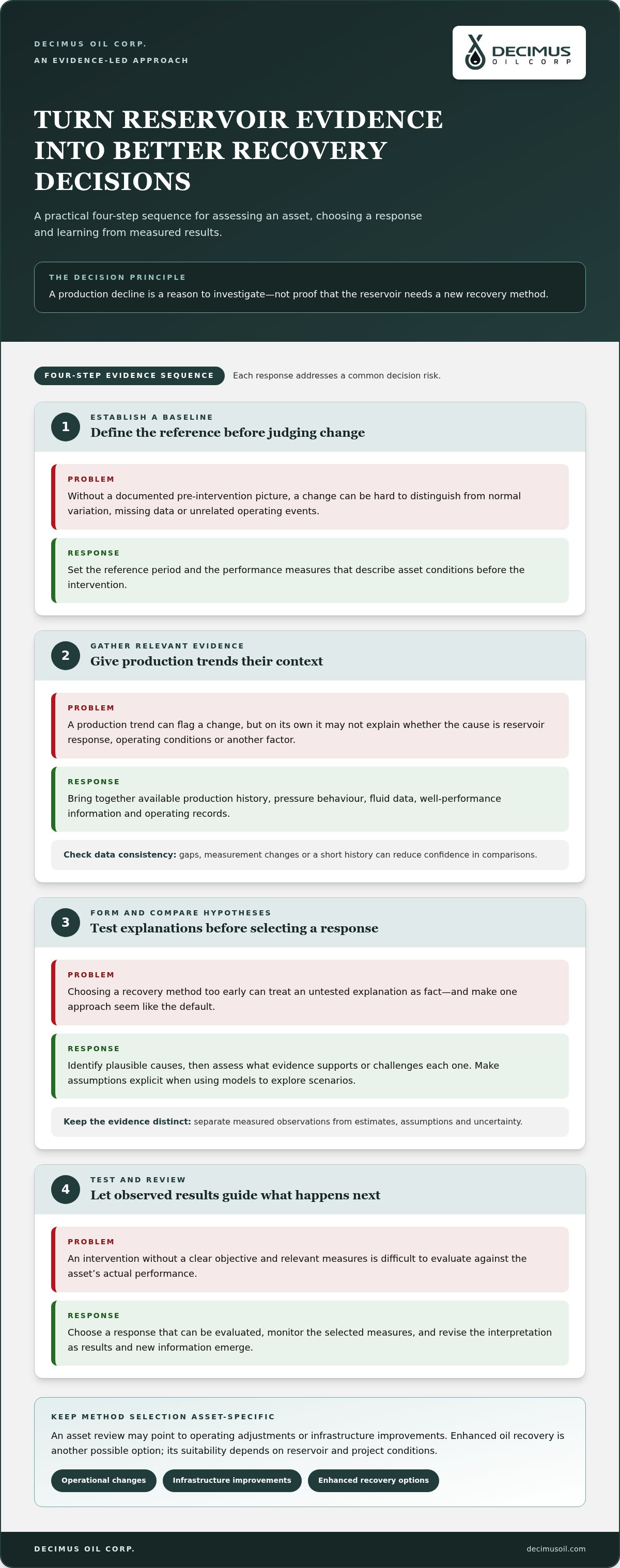
A practical evidence sequence is:
- Establish a baseline. Define the period and performance measures that will serve as the pre-intervention reference.
- Gather relevant evidence. Assemble production history, pressure behaviour, fluid data, well-performance information and operating records where available.
- Form and compare hypotheses. Identify plausible explanations for observed changes, then assess what evidence supports or challenges each one.
- Test and review. Select a response that can be evaluated, monitor the chosen measures and revise the interpretation as results and new information emerge.
Build an asset baseline from production and reservoir data
Production trends can show when a well or asset has changed enough to warrant investigation, but the trend needs context. Pressure behaviour, fluid characteristics and well-performance records can help determine whether a shift aligns with reservoir response, operating conditions or another factor. Check that data is consistent across the period being compared. Gaps, changes in measurement or a short history can reduce confidence in the conclusions.
Turn observations into testable optimization decisions
Compare possible explanations before recommending a response. Models can help explore scenarios and make assumptions explicit, but they support decisions rather than replace field evidence. Label estimates as estimates, and distinguish assumptions and uncertainty from measured observations. Machine learning may be useful when the data supports it and there is a clear question to answer; it is not required for every asset.
This evidence-led approach also informs consideration of broader recovery research. The Alberta Innovates Recovery Technologies Program focuses on improving hydrocarbon recovery and reducing associated emissions. Its work highlights how recovery objectives can be considered alongside environmental outcomes, while operating decisions still need to be grounded in evidence from the asset itself.
Make the reasoning traceable: record what was observed, what remains uncertain, why an option was selected and which measures will test it. This provides a basis for reassessment and keeps modelled forecasts distinct from field results. Decimus Oil’s focus on resource development and asset value provides context for its approach to conventional oil and gas development.
Compare Oil Recovery Optimization Options Against Asset Conditions
For oil recovery optimization Canada, the strongest option is not necessarily the most technically advanced. Screen each opportunity against reservoir evidence, available infrastructure and operating realities. Then define what a measurable result would look like. A structured comparison makes trade-offs visible before an intervention adds complexity, creates dependencies or diverts attention from a simpler asset improvement.
| Option | Reservoir fit and evidence | Implementation demands | Measurable objective |
|---|---|---|---|
| Operational changes | Look for evidence that operating practices or well performance may be limiting the intended outcome. | Assess operating constraints, coordination needs and how changes can be monitored. | Track the specific production or operating measure the change is intended to affect. |
| Infrastructure improvements | Determine whether facility capacity or configuration is constraining asset performance. | Consider project dependencies, integration with existing equipment and operating continuity. | Measure the relevant change in facility performance or resource use. |
| Enhanced oil recovery | Establish whether reservoir conditions and available evidence support evaluating an EOR approach. | Assess technical requirements, infrastructure readiness and applicable environmental and regulatory considerations. | Define a recovery objective and the evidence needed to evaluate progress. |
This table is a screening framework, not a substitute for asset-specific engineering. A technically plausible concept still needs adequate evidence, a workable implementation plan and appropriate approvals before it can become an executable project. Environmental considerations and regulatory responsibilities depend on the project and jurisdiction, so include them from the outset rather than leaving them until the final review.
Screen recovery opportunities for technical and operational fit
First ask whether the evidence supports the proposed intervention for this reservoir. Then identify the conditions needed to implement it. Consider infrastructure readiness, operating limits and dependencies that could affect execution. An option that looks promising in a model may still be unsuitable if key assumptions are unsupported or the asset cannot accommodate the required changes.
Account for complexity as well as potential value. An intervention may require additional equipment, coordination or monitoring without making a sufficient contribution to the asset. Compare the expected benefit with the effort and uncertainty involved, and set an objective that can be evaluated. If evidence is weak or dependencies are unresolved, further assessment may be more appropriate than immediate implementation.
Weigh enhanced recovery against other asset improvements
Waterflooding, thermal processes and CO2-based approaches have different applications; none is a universal answer. Assess each against reservoir conditions, available evidence, infrastructure and project constraints. The enhanced oil recovery techniques guide provides method-level context. Include operational and infrastructure opportunities in the wider comparison as well.
For every option, document the rationale, key assumptions, implementation demands, environmental considerations and intended measures of progress. This makes trade-offs easier to review and helps prioritize opportunities based on evidence and asset value, not technology alone.
A Practical Canadian Workflow for Measuring Optimization Progress
A useful measurement plan starts before an intervention begins. For oil recovery optimization Canada, operators need a defined objective, a reliable reference point and a review process that separates observed performance from assumptions. This keeps project decisions grounded in asset evidence and makes it easier to adapt when results or operating conditions differ from expectations.
Link every intervention to a defined baseline and a planned review interval before implementation begins.
- Define the objective. State the production or operating question the project is intended to address. Clarify whether the focus is a production trend, operating performance, resource use or another asset-specific measure.
- Establish the baseline. Record the pre-intervention data and the period it represents. Note known gaps or measurement limitations so comparisons do not imply more certainty than the information supports.
- Screen the options. Identify alternatives that fit the objective and asset conditions. Document the evidence, assumptions, dependencies and relevant environmental or regulatory considerations behind each one.
- Plan implementation and review. Choose indicators before work begins, identify who will assess them and set review intervals suited to the project. Avoid universal benchmarks when asset-specific evidence is needed.
- Implement and monitor. Track the selected indicators consistently alongside relevant operating changes. Record what was measured, when it was measured and any context that could affect interpretation.
- Reassess the decision. Compare observed performance with the baseline and original assumptions. Decide whether to continue, adjust, investigate further or revise the asset plan.
Set objectives and indicators before implementation
Choose measures that answer the project’s specific question. Production trends may suit a production objective, while operating performance or resource use may be more relevant to another intervention. Record why each indicator was selected, how its data will be interpreted and what limitations apply. This creates an asset-specific review plan instead of relying on unsupported industry-wide thresholds.
Review results and adapt the asset plan
At each planned review, separate measured results from estimates and compare like with like. If production or operating conditions change during the observation period, record that context before attributing a difference to the intervention. Unexpected results should prompt investigation and reassessment, not automatic project expansion. Measurement is useful when it informs the next decision, not just when it reports activity.
Project screening also involves broader commercial considerations. Commodity assumptions, operating requirements and the intended development path can affect how an asset-level opportunity is prioritized. Understanding Canadian oil and gas exploration economics helps frame those decisions, while the technical case remains specific to the asset.
Check regulatory requirements for the applicable jurisdiction and project, since responsibilities and review needs can vary. Build this step into planning and revisit it if the project scope changes. For an overview of Decimus Oil’s approach to resource development and existing asset value, visit the company website.
How Decimus Oil Connects Recovery Optimization With Asset Value
Oil recovery optimization Canada is relevant to resource developers because producing assets need to be considered in the context of their development potential. Decimus Oil Corp. is a Canadian company focused on conventional oil and gas exploration and resource development. It manages energy infrastructure and uses enhanced oil recovery techniques to optimize asset output, with an emphasis on resource development and operational efficiency.
Recovery is one consideration within the broader work of developing conventional hydrocarbon resources. Decisions about an asset depend on its characteristics, operating context and supporting infrastructure. Enhanced recovery can be part of that picture, but it is a potential tool, not an assured outcome or universal solution. Decimus Oil’s focus connects recovery and infrastructure with the goal of developing resources and maximizing asset value.
A resource-development perspective on existing assets
For a resource developer, optimization is not an isolated technical exercise. It sits alongside exploration, development planning, infrastructure management and operational efficiency. Considering these elements together helps frame how existing assets may contribute to resource development, while each opportunity still needs assessment based on its own evidence and conditions. The WCSB resource development guide offers broader context on resource development.
This framework gives operators a practical way to assess opportunities: define the question, examine the evidence, compare options and measure results. Decimus Oil’s work in conventional exploration, resource development, infrastructure and enhanced recovery reflects the connection between those areas. Disciplined evaluation keeps asset decisions grounded in operating and reservoir evidence rather than assumptions about a technology.
Explore Decimus Oil’s approach and public-company information
Decimus Oil Corp. is publicly listed on the TSX Venture Exchange under the ticker TSXV:WCSB. The listing provides public-company information about its business focus and resource-development context. Technical outcomes, meanwhile, depend on the assets and evidence involved.
When evaluating oil recovery optimization in Canada, distinguish general optimization principles from asset-level results. Decimus Oil’s use of enhanced recovery techniques, infrastructure management and operational efficiency connects recovery considerations with its broader focus on asset value. For company information and an overview of its resource-development focus, explore Decimus Oil.
Make the Next Asset Decision Evidence-Led
The next opportunity in oil recovery optimization Canada begins with a focused question: what decision could stronger asset evidence help resolve? Turn that question into a defined objective, then use it to prioritize work, track outcomes and decide whether an approach merits adjustment or further development.
That discipline matters at the company level too. Decimus Oil’s team has more than 100 years of combined experience. Responsible resource development depends on aligning technical assessment with operational priorities, infrastructure and asset value, while treating projected outcomes as uncertain until supported by evidence.
Explore how Decimus Oil brings conventional oil and gas exploration, resource development and enhanced recovery together in its business. Visit Decimus Oil for company information and its approach to developing existing assets. An evidence-led perspective helps turn recovery potential into better-informed decisions and a stronger basis for future planning.
Frequently Asked Questions
Can oil recovery optimization improve production without drilling new wells?
Some opportunities may improve production or operating performance using existing wells and facilities, but results depend on asset conditions. An operator might investigate whether a production change relates to well operation or a facility constraint before considering new drilling. Compare the expected contribution with project economics and execution requirements. Existing assets do not always offer a viable improvement, and some development opportunities may still involve drilling.
Is enhanced oil recovery the same as oil recovery optimization?
No. Enhanced oil recovery is a category of methods for recovering additional oil, while optimization describes the broader process of evaluating and making decisions about an asset. An operator might assess an EOR approach alongside operational adjustments or facility changes. This distinction helps avoid choosing a recovery method before defining the issue it should address. Whether EOR is appropriate depends on reservoir characteristics, technical evidence and project requirements.
How does machine learning support oil recovery optimization?
Machine learning can help examine large or complex datasets for patterns that merit technical review. An analysis might flag relationships between operating records and production changes, but a flagged pattern does not prove cause. Data quality, model assumptions and engineering validation affect how useful the result is. In oil recovery optimization Canada, machine learning is an optional analytical aid, not a replacement for reservoir knowledge or field evidence.
What happens if production data is incomplete or inconsistent?
Incomplete or inconsistent data limits how confidently operators can interpret performance. Record the gaps rather than hiding them. Compare available records across wells and time periods, and identify measurement or reporting changes that could affect the analysis. If a conclusion depends heavily on uncertain inputs, qualify it and do not present it as a measured result. Future monitoring can be designed to collect information that matters to the decision.
Can CO2 be used for enhanced oil recovery in Canada?
CO2-based recovery can be considered in Canada, but suitability depends on the reservoir, project design, infrastructure and applicable requirements. An assessment needs to examine how CO2 would be sourced, transported, managed and accounted for, as well as the recovery objective. Using CO2 should not be treated as an automatic emissions benefit. Any potential emissions implications require project-specific evidence and a clear accounting boundary.
How should operators account for produced water when optimizing oil recovery?
Produced water can affect facility capacity, handling arrangements, operating decisions and project evaluation. Its significance depends on the asset and proposed activity, so use available site records rather than assume a standard volume or treatment route. Include water-related factors when they could materially affect implementation or performance. Before describing an obligation as regulatory, verify the current requirements for the project and jurisdiction.
What is a recovery factor, and why does it matter?
A recovery factor is an estimate of the share of an oil resource expected to be produced on a stated basis. It can help frame resource potential, but it is not a guaranteed production outcome or a complete measure of project performance. Estimates rely on reservoir information and technical assumptions. For a meaningful comparison, confirm that estimates use consistent definitions, time frames and supporting data, and distinguish projected values from production already achieved.


