
Canada’s oil story isn’t written at the wellhead alone. The oil industry in Canada connects geology and production with pipelines, export markets, investment decisions and emissions policy. A change at one stage can affect the choices and economics at others.
The sector can be difficult to assess because information is spread across technical and government sources, and conventional, oil sands and offshore production are sometimes discussed as though they work the same way. They don’t. Each has distinct development methods, infrastructure needs and exposure to market conditions.
This article explains how the industry’s main activities connect, how production approaches and market factors differ, and which issues are shaping its 2026 outlook, including pipeline capacity, prices and emissions policy. It also shows where conventional resource development fits within a diverse national sector, with Decimus Oil Corp. as one participant focused on exploration, enhanced recovery and energy infrastructure. Use the comparisons and questions throughout to build a clearer view of how the system works and what to watch next.
Key Takeaways
- Map the oil value chain from exploration and production through transportation, processing and market delivery.
- Compare conventional, oil sands and offshore production by resource type and development approach, while recognizing that projects vary within each category.
- Assess how infrastructure access and market conditions can influence where and how Canadian crude reaches buyers.
- Understand how the oil industry in canada is shaped by distinct regulatory responsibilities and the difference between production emissions and emissions from using oil products.
- See how geological opportunity, execution and market exposure inform operator and investor perspectives, with conventional resource development as one part of the national sector.
Oil Industry in Canada: What It Includes and Why It Matters
The oil industry in Canada includes the activities that identify petroleum resources, bring them to the surface, move and process crude oil, and supply markets. Specialized goods and services support this work. Production is only one part of the industry, and oil-and-gas companies may also produce natural gas or operate across several parts of the value chain.
What counts as the oil industry?
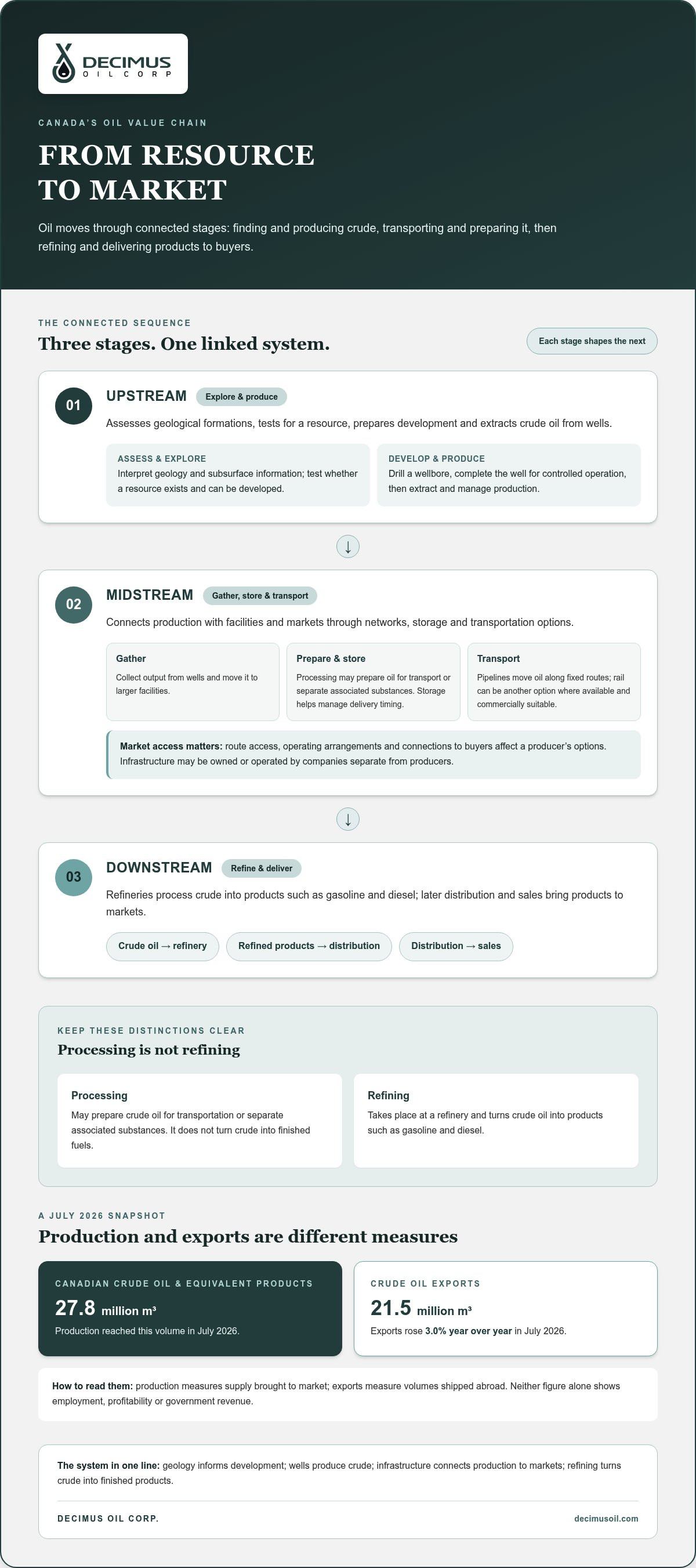
Three labels help organize the value chain. Upstream covers exploration and production: assessing geological formations, drilling wells and extracting crude oil. Midstream refers to gathering, storing and transporting production, including by pipeline or rail. Downstream includes refining crude into products such as gasoline and diesel, as well as later distribution and sales. Related services, from equipment supply to field operations, support these stages without necessarily producing or processing oil themselves.
Oil production and refining are distinct activities. Oil at the well is crude; it becomes a refined product only after processing at a refinery. This distinction helps explain why an oil-and-gas producer may focus on exploration, recovery and infrastructure rather than refining or retail fuel sales. The overview of Petroleum production in Canada provides additional context on production and the sector’s economic role.
How to interpret the industry’s national significance
Assess the industry’s scale using separate measures rather than relying on a single headline figure. Statistics Canada reported that Canadian crude oil and equivalent products production reached 27.8 million cubic metres in July 2026. In the same month, crude oil exports increased 3.0% year over year to 21.5 million cubic metres, according to federal statistics. Production measures supply brought to market; exports measure volumes shipped abroad. Neither figure alone indicates industry employment, profitability or government revenue.
Jobs are another distinct measure. Employment estimates can differ depending on whether they count oil extraction alone, the broader oil-and-gas sector, or contractors and suppliers. Public revenue is separate again: royalties and corporate income taxes contribute to government finances, but vary with production, prices, taxable income and jurisdiction. Energy supply also matters. Domestic production supports Canadian markets, while export access connects producers with international demand.
For operators, investors and policymakers, these distinctions make comparisons more useful. A production record doesn’t automatically mean employment or public revenues rose by the same proportion. Higher exports indicate market access, but not necessarily the value received for each barrel. Read the measures together for a more balanced view of the industry’s reach and the factors shaping its performance.
How Canada’s Oil Industry Moves Resources from the Well to Market
A barrel reaches a buyer through a sequence of technical and commercial decisions, not through drilling alone. Geological assessment helps identify a prospective resource; exploration tests whether it can be produced; development prepares a discovery for sustained output; and infrastructure connects that output with processing facilities and markets. Each stage builds on the previous one, while market access can shape a resource’s value before production begins.
From resource assessment to producing wells
Assessment draws on geological interpretation and available subsurface information to understand the rock formations, possible petroleum accumulations and uncertainties of a target area. The analysis informs whether further exploration is justified and how a potential discovery might be developed. Economics matter throughout: expected production, project requirements and infrastructure access all influence decisions to commit capital. For a deeper look at these considerations, see this Canadian oil and gas exploration economics overview.
Exploration seeks to establish whether a petroleum resource exists and can be developed; production extracts and manages resources from wells prepared to deliver them. Drilling creates a wellbore to reach a target formation, while completion equips the well to bring fluids to the surface under controlled operating conditions. Results can inform whether and how additional wells or development work proceed. The steps vary by geology and project design, so a single description shouldn’t be treated as a standard operating recipe for every Canadian asset.
How infrastructure connects production with buyers
Once produced, oil generally moves through a network rather than directly from a well to an end user. Gathering systems collect output from wells and move it to larger facilities. Depending on the resource and its characteristics, processing may prepare it for transportation or separate associated substances. Processing is not the same as refining: it doesn’t turn crude oil into finished fuels such as gasoline.
Canada’s institutional and historical context also shapes this chain. The Canadian Encyclopedia’s account of the History and Regulation of Canada’s Oil Industry provides background on the sector’s development and government involvement. For operators, the practical question is how subsurface potential, development choices and transportation access align. Decimus Oil Corp. focuses on conventional exploration, resource development, enhanced recovery and energy infrastructure, connecting several parts of that chain. Learn more about Decimus Oil Corp.’s conventional resource-development focus in this broader value-chain context.
Conventional Oil, Oil Sands, and Offshore Production: How They Differ
Canada’s oil production comes from resources developed in different geological and operating environments. Conventional oil is held in reservoir rock and produced through wells. Oil sands contain bitumen, a heavy form of petroleum that requires extraction and, in many cases, additional treatment before it can move to market. Offshore production accesses petroleum beneath the seabed using marine-based wells and infrastructure.
These categories describe broad approaches, not uniform project designs. Reservoir properties, resource depth, location, infrastructure and development plans all shape how an operation is built and managed. The oil industry in canada can’t be understood through one production model alone.
Conventional oil and oil-sands production
In conventional reservoirs, oil can move through permeable rock into a well, with production methods selected to suit reservoir conditions. As output changes over time, operators may assess additional recovery approaches. Enhanced oil recovery techniques are one part of this development toolkit; the appropriate approach depends on the asset.
Oil-sands development differs because bitumen is much more viscous than conventional crude. Depending on deposit depth and project design, extraction may involve mining or in-situ methods, which recover the resource underground. Each approach has its own operating requirements, surface footprint and infrastructure considerations. Neither label alone tells the full story of a project’s performance or impacts.
Offshore production and a fair comparison
Offshore operations take place in a marine environment, where wells and production facilities must be planned around distance from shore, water depth, weather and logistics. Depending on the development, infrastructure may include platforms or subsea equipment, along with systems to handle and transport production. These conditions differ from land-based projects, though offshore developments also vary considerably in design.
In brief, conventional production targets oil held in reservoir rock, oil-sands production recovers bitumen through mining or in-situ methods, and offshore production accesses petroleum beneath the seabed using marine-based infrastructure. The table compares their general characteristics without ranking them by cost, emissions or overall performance.
| Production type | Resource and setting | Typical development considerations |
|---|---|---|
| Conventional | Oil in reservoir rock, accessed by wells | Reservoir characteristics, well design, recovery strategy and connections to infrastructure |
| Oil sands | Bitumen in deposits developed through mining or in-situ methods | Deposit depth, extraction method, processing needs and project layout |
| Offshore | Petroleum beneath the seabed | Marine conditions, facility design, logistics and transportation arrangements |
For operators, the useful comparison isn’t simply which category is “best,” but how the resource and setting shape development choices. Conventional exploration and resource development are one part of Canada’s diverse sector, alongside oil-sands and offshore activity. Project-specific geology and infrastructure access determine how broad category differences translate into operational decisions.
Canada’s Oil Industry: Regulation, Emissions, and the Energy Transition
Policy and climate considerations affect project approvals, operating requirements, capital decisions and market access. Their effects aren’t uniform: responsibilities differ by activity and jurisdiction, while emissions depend on which stage of the oil value chain is being measured. To assess the oil industry in canada, separate these factors instead of treating regulation or production trends as having a single cause.
Who regulates oil activity in Canada?
Regulatory responsibilities are divided across federal and provincial governments, and the applicable framework depends on the activity, location and infrastructure involved. The Canada Energy Regulator (CER) oversees matters within its federal mandate, including certain pipelines and energy trade. Provincial governments have roles in resource development and other activities within their respective jurisdictions. Some areas involve shared responsibilities, so broad statements about a single regulator can be misleading.
The CER’s overview of its mandate and Natural Resources Canada’s information on fossil fuels provide starting points for understanding federal roles. For a specific project or activity, consult the relevant official regulator’s current guidance. This overview isn’t legal advice.
How emissions and transition shape industry decisions
Operational emissions arise from producing, processing and moving oil; end-use emissions arise later, when products made from oil are consumed, such as when fuel is burned in an engine. These are different stages of the value chain and shouldn’t be conflated in comparisons. Measurement also depends on the boundary used: a production-focused inventory and a full life-cycle assessment answer different questions.
Mitigation measures may target operational sources through equipment choices, process improvements and emissions-management practices. The potential and suitability of each measure depend on the asset and operating context; an announced measure isn’t proof of a specific emissions reduction. Energy-transition scenarios add another layer: assumptions about demand, technology and policy can produce different outlooks, so read forecasts with their date, scope and source in view.
Canada’s 2026 policy context includes federal work on an oil-and-gas emissions cap intended to phase in between 2026 and 2030. The proposed 2030 cap range is 106 to 112 MtCO2e. Implementation details and requirements matter to operators, so current federal publications are important as policy develops. Regulatory uncertainty can affect investment timing, while operational efficiency can support stronger resource management. Neither factor alone explains national production trends.
Production also responds to geology, project investment, prices, infrastructure access and buyer demand. Their relative influence changes over time, which is why a rise or decline shouldn’t be attributed to one policy or technology without evidence. Decimus Oil Corp. focuses on conventional exploration, enhanced recovery and energy infrastructure, connecting resource development with operating and market considerations. Explore Decimus Oil Corp.’s conventional resource-development focus to see how these themes relate to one part of Canada’s broader sector.
What Canada’s Oil Industry Means for Operators and Investors
For an operator, a promising geological formation is only the starting point. Its commercial potential depends on whether the resource can be developed effectively, whether production can reach buyers, and how market conditions affect expected returns. For investors, these connected factors help explain why companies in the oil industry in canada can face different prospects even when they operate in the same broad sector.
What industry context means for resource developers
Resource developers assess geology alongside practical execution questions. Does the available information support further exploration? What development plan suits the resource? Can infrastructure connect production with markets? How might prices, regulation and operating conditions affect the project over time? These questions are interdependent: a viable resource may still face commercial constraints if transportation access is limited, while infrastructure alone doesn’t establish that a resource can be produced economically.
Execution risk also matters. Exploration outcomes are uncertain, and development plans must adapt to the characteristics of each asset. Existing producing assets can present different opportunities from new discoveries. Enhanced recovery may help develop remaining resources in some fields, but it isn’t a universal solution; its suitability depends on reservoir conditions, technical design and project economics.
Investors can use this framework to distinguish broad industry exposure from company-specific factors. Useful questions include:
- What type of resource and development activity does the company describe?
- How does it explain infrastructure access and potential routes to market?
- Do its current public disclosures clarify plans, risks and reported results?
A broader view of the sector’s public-equity considerations is available in this Canadian energy public-equity guide. It provides context for assessing energy companies, but it isn’t a substitute for reviewing an individual issuer’s disclosures or making an investment decision suited to personal circumstances.
Where Decimus Oil Corp. fits in the Canadian industry
Decimus Oil Corp. is a publicly traded Canadian energy company listed on the TSX Venture Exchange under the symbol TSXV:WCSB. Its focus includes conventional oil and gas exploration, resource development, enhanced recovery and energy infrastructure. These activities place it within the conventional resource-development segment of a national industry that also includes oil-sands and offshore production, among other activities.
This focus connects exploration with resource development and with the infrastructure that supports movement through the energy value chain. It doesn’t, by itself, establish a particular project outcome or investment result. Assess company plans and performance using current public disclosures alongside relevant market and operating context.
To learn about Decimus Oil Corp.’s focus and review its company information, visit Decimus Oil Corp.’s website and consult current public disclosures. A measured assessment starts with the facts: the company’s activities, its published information and the risks that apply to energy-sector investments.
Make Your Next Industry Assessment More Informed
Follow how resource potential, infrastructure access, policy and market conditions interact over time. For the oil industry in canada, a useful assessment looks beyond headline production: compare current information with dated public disclosures, note the assumptions behind forecasts, and distinguish sector-wide trends from the circumstances of an individual company. This approach helps operators and investors ask more precise questions without treating any one indicator as a complete picture.
Decimus Oil Corp. is one participant in this changing sector. Explore its approach to conventional resource development and review its public information to understand how its focus fits within Canada’s broader energy value chain. Explore Decimus Oil’s approach to conventional resource development.
Frequently Asked Questions
How are oil reserves different from oil resources?
Resources are estimates of petroleum quantities, with confidence levels reflecting how much is known about their geological presence and potential recovery. Reserves are the portion assessed as commercially recoverable under defined conditions at the time of evaluation. A resource estimate may include quantities that aren’t classified as reserves. Definitions depend on the reporting standard, technical evidence, prices and other assumptions, so compare figures only when their classifications and reporting dates align.
What does a crude-oil benchmark measure?
A crude-oil benchmark is a reference price for a particular crude stream or trading market, not a fixed price received for every barrel. The price of a specific shipment can differ because of its quality, location, transportation access and prevailing market conditions. The difference between a crude’s price and a benchmark is often called a differential. To interpret a quoted price, check the benchmark, delivery period and location alongside the figure.
How is oil production measured in Canada?
Oil production is commonly reported as a volume over a period, often barrels per day or cubic metres over a month. The total may cover different products depending on the dataset, including particular crude types or other liquid hydrocarbons. A monthly production estimate, for example, isn’t directly comparable with an annual average unless the periods and product definitions match. Check the original publisher’s notes, units and reporting period before citing a number.
What makes one crude oil grade different from another?
Crude grades differ in physical and chemical characteristics, especially density and sulphur content. Those properties can affect how a stream is handled and processed, and may influence its value in a particular market. A grade name refers to a defined stream or specification, not every barrel produced in a country. For a fair comparison, use published grade specifications and make sure quoted prices refer to equivalent delivery terms and time periods.
Does oil production also produce natural gas?
Some oil wells produce associated natural gas alongside crude oil, while other wells primarily produce oil or gas. The mix depends on the reservoir and the development method. Associated gas may be processed, used, or otherwise managed according to the facility and applicable requirements. Practices and rules can vary, so claims about a specific operation should be checked against current company disclosures and relevant official guidance rather than assumed from its oil output alone.
Is oil a renewable resource?
No. Crude oil is generally classified as a non-renewable fossil resource because it forms through geological processes over timescales far longer than human lifetimes. That classification describes how the resource forms and replenishes, not how it is produced or used. Questions about oil’s place in future energy systems involve separate considerations, including technology, policy and demand. The renewable or non-renewable label alone doesn’t establish how those factors will develop.
Why can oil production figures differ between sources?
Figures can vary because publishers use different reporting periods, product definitions, units, revisions or geographic and operational scopes. A monthly estimate may also be updated or differ from a finalized annual series. For a sound comparison, match the products counted, units and time period, then cite the original publisher, such as Statistics Canada or the Canada Energy Regulator. Always label the year or reporting period so readers can interpret the figure accurately.


