

What if a crude oil facility’s most important role isn’t simply holding oil, but controlling how it moves? Crude oil storage and handling facilities connect production with transportation and market access while helping manage risks at each transfer point. Their equipment and functions vary, so a field storage site, pipeline terminal and export terminal aren’t interchangeable.
The terminology can feel complex: tanks, pumps, measurement systems and loading equipment serve different purposes depending on a facility’s location and design. Understanding those differences makes it easier to follow crude from receipt through storage and handling to dispatch, and to see why reliable infrastructure supports efficient resource development.
This guide explains the main facility types and their roles in Canada’s energy system. It also outlines the operational, safety and environmental considerations that shape facility management, including the importance of understanding applicable Canadian regulatory requirements. From upstream production connections to pipeline and market access, you’ll gain a clearer picture of how these facilities function as risk-control points across the crude oil supply chain.
Key Takeaways
- Trace crude oil’s journey from facility receipt to dispatch, and see how measurement records help track inventory and transfers.
- Compare field storage, gathering or transfer facilities, and larger terminals by their connections, operating focus, and design considerations.
- Understand why crude oil storage and handling facilities serve as risk-control points between production, transportation, and market access.
- Recognize why safety and environmental responsibilities vary with a facility’s purpose, location, connections, and activities.
- See how dependable infrastructure management can support resource development and operational efficiency without guaranteeing production outcomes.
Crude Oil Storage and Handling in the Supply Chain
Crude oil storage and handling facilities connect producing assets with gathering systems, transportation networks and, ultimately, downstream markets. They help coordinate crude movement when production timing and the availability of pipelines, rail or other transportation don’t align. A site may receive, measure, sample, store, move or otherwise manage crude, depending on its purpose and design.
A crude oil facility is a connected group of assets used to receive, contain, condition, measure or transfer crude oil as it moves through the supply chain. This plain-language definition covers sites of different scales, from storage near production to larger terminals linked with transportation infrastructure. Storage capacity describes how much crude can be held; handling capability describes how the site manages receipt, movement and transfer. A facility may have substantial capacity but limited transfer functions, or support active transfers with comparatively little storage.
What happens between crude oil production and transportation?
The sequence depends on the site, but the basic flow is straightforward:
- Crude arrives from a producing asset or a gathering system.
- The facility records and verifies the incoming volume and, where applicable, takes samples.
- Crude may be held temporarily in storage while transportation is arranged.
- It is transferred to a pipeline, another facility or a different transportation method.
- Movement and inventory records are reconciled against the facility’s operating records.
Temporary storage provides flexibility when production continues but a scheduled pipeline receipt or other transportation movement isn’t yet available. It can also help manage timing differences between incoming supply and outgoing shipments. Storage doesn’t remove the need to coordinate transportation; it provides a point where operators can manage the transition. Handling may include measurement, sampling, pumping and transfer, with the specific processes shaped by the site’s role and operating arrangements.
These functions help explain how an Oil terminal fits into the wider movement of oil: it can bring together storage and transfer connections rather than simply acting as a tank site.
Which assets make up a crude oil facility?
Equipment serves distinct functions, and not every site uses the same combination. Tanks contain crude for a period of time; pumps move it through the system; piping provides flow paths; and valves help direct or isolate flows. Measurement systems record quantities moving into, out of or within a facility. Depending on its purpose, a site may also have equipment for sampling or conditioning crude before transfer.
Facility layout follows operating context, not a standard template. Throughput influences how much movement a site must accommodate, while location and connection points shape how crude reaches and leaves it. Crude characteristics and intended use can also affect equipment and process selection. A field site serving nearby production may have a different configuration from a gathering or transfer point connected to a broader network. This is why storage volume alone doesn’t describe a facility’s role in moving crude through the supply chain.
How crude oil moves through storage, measurement, and transfer systems
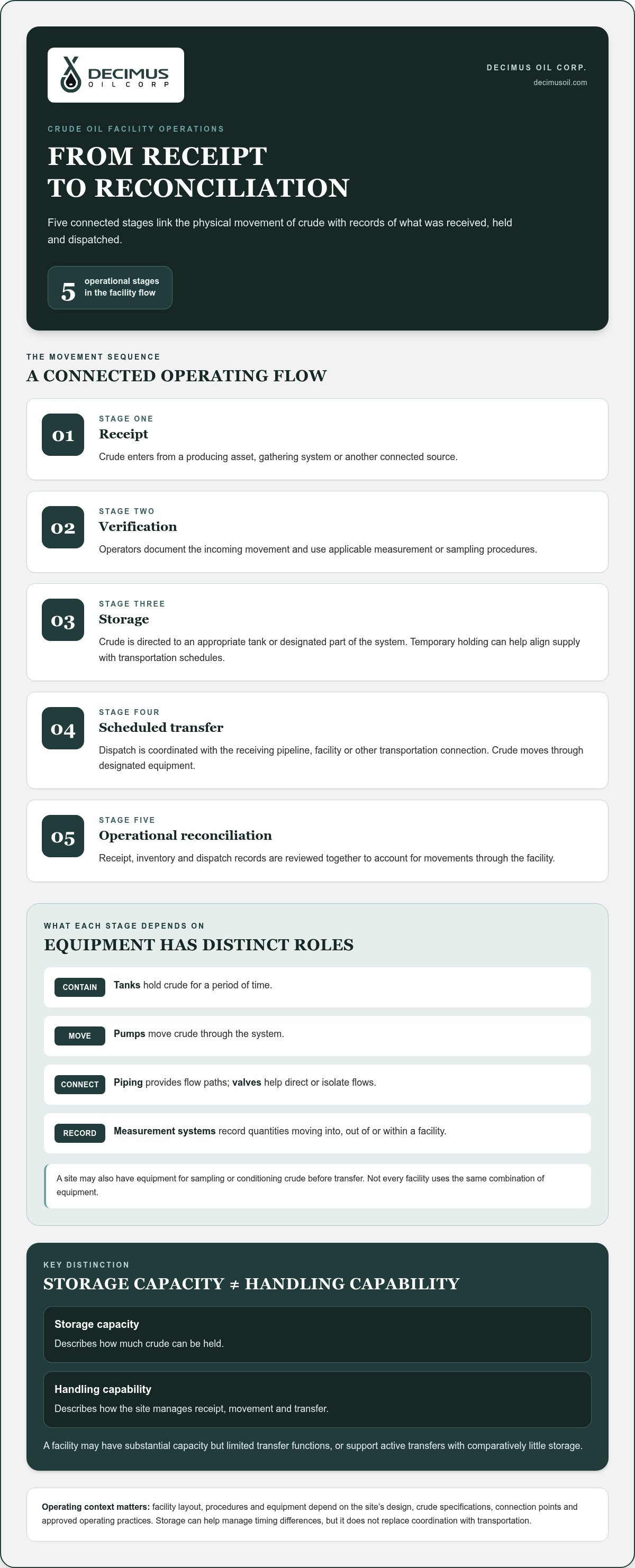
Facility operations link the physical movement of crude with a record of what was received, held and dispatched. The sequence below is a useful overview, though actual procedures depend on facility design, crude specifications and approved operating practices.
- Receipt: Crude enters from a producing asset, gathering system or another connected source.
- Verification: Operators document the incoming movement and apply applicable measurement or sampling procedures.
- Storage: Crude is directed to an appropriate tank or other designated part of the system. Temporary holding can help align supply with transportation schedules.
- Scheduled transfer: Dispatch is coordinated with the receiving pipeline, facility or other transportation connection, and crude moves through designated equipment.
- Operational reconciliation: Receipt, inventory and dispatch records are reviewed together to account for movements through the facility.
How receipt, storage, and dispatch fit together
Incoming streams are directed according to the facility’s layout and operating plan. Tank allocation may reflect available capacity, crude specifications and planned dispatch; there is no universal tank arrangement. Pumps move crude, piping connects process areas, and valves direct or isolate flow. Together, these systems support controlled movement from receipt to storage and onward to a transfer point.
Dispatch planning connects site activity to transportation timing. A storage tank can provide an operating buffer when incoming supply and scheduled takeaway don’t coincide, but it doesn’t replace coordination with the connected system. The sequence depends on equipment configuration, product requirements and approved procedures. A useful overview of how storage supports oil movement is provided by the U.S. Energy Information Administration’s Crude Oil Storage and Transportation Overview; its general supply-chain principles also help explain facility operations in Canada.
Why measurement and crude quality control matter
Custody transfer metering measures crude as it passes between parties or systems, providing a documented volume for operational and commercial records. Tank gauging offers another view of inventory by assessing the amount held in a tank. Sampling and quality checks complement these measurements by helping characterize crude being received or transferred. Together, these records connect physical oil movements with operational accounting.
Reconciliation brings the records together: metered receipts and dispatches can be reviewed alongside tank inventory changes to identify and resolve differences. Sampling procedures and quality checks are shaped by the crude’s characteristics and the operating arrangement. Water, sediment and other quality parameters may affect how crude is handled or accepted by a connected system. Consistent records help operators understand what moved, where it went and how inventory changed. For a broader view of how infrastructure supports resource development and transportation, explore Decimus Oil’s energy infrastructure perspective.
Comparing crude oil storage and handling facility types
Facility labels describe general roles, not fixed designs. A field site may include storage and transfer functions, while a terminal may perform different activities depending on its connections and operating arrangements. The comparison below highlights common distinctions; a facility’s actual capabilities depend on its design and configuration.
| Facility type | Purpose | Typical connections | Operating focus | Design influences |
|---|---|---|---|---|
| Field storage | Hold crude close to producing assets and support near-source handling. | Production equipment, lease pipelines or local gathering systems. | Receiving and managing production before onward movement. | Production patterns, location, crude characteristics and available takeaway. |
| Gathering or transfer facility | Collect or redirect crude moving between upstream sources and transportation networks. | Multiple producing or gathering lines, pipelines or another transfer point. | Coordinating incoming streams with onward transfers and measurement needs. | Flow patterns, connection arrangements, operating procedures and required handling. |
| Larger storage terminal | Provide storage and transfer capacity within a broader transportation system. | One or more pipelines or other transportation modes, depending on the site. | Managing inventory and coordinating receipts and dispatches. | Throughput requirements, transport access, crude specifications and operating flexibility. |
Field and gathering facilities versus storage terminals
Field facilities are generally positioned close to production, where they support collection and initial handling. A gathering or transfer site serves as a connection point: it can receive streams from more than one source or pass crude between parts of a network. Larger terminals are more commonly associated with storage and transfer across a broader transportation system, though their exact functions vary. Proximity to a pipeline or another transport mode can shape whether a site primarily collects crude, provides an intermediate transfer point or supports scheduled dispatch.
These categories can overlap. A site’s name alone doesn’t establish its tank capacity, number of connections, measurement systems or ability to handle different crude streams. Those capabilities depend on its design and operating configuration.
How to compare facility fit for an operating need
Start with the movement required, not the facility label. Consider how crude will arrive, how often and in what volumes it must be dispatched, how much inventory needs to be held between movements, and which transportation connections are available. Then assess whether the configuration can support the measurement, sampling and handling procedures required for the crude involved.
- Receipt and dispatch: Compare incoming and outgoing flow patterns, including whether movements are continuous or scheduled.
- Inventory needs: Consider how much temporary storage is required to coordinate supply with takeaway.
- Connections and flexibility: Review available pipeline or other transport links and how the facility can accommodate operating changes.
- Crude and measurement requirements: Account for relevant crude characteristics and the records needed for transfers.
Facility fit depends on required flow patterns, connections and handling functions, not tank volume alone. Storage capacity indicates how much crude a site can hold under specified conditions; it doesn’t show by itself how quickly the facility can receive, move or dispatch that crude. These distinctions matter when matching infrastructure to production plans and transportation access.
Planning for safety, environmental controls, and Canadian requirements
There isn’t one checklist that applies to every crude oil storage and handling facility in Canada. A field site, transfer point and larger terminal can differ in purpose, location, connections and activities, all of which shape the risks to manage and the requirements that may apply. Effective planning starts by defining the facility’s scope, identifying credible release and operating scenarios, and matching controls to those conditions.
What safety and environmental controls should readers understand?
Controls work together to reduce the likelihood and consequences of operational incidents. Secondary containment, for example, is intended to limit the spread of a release beyond the area where it occurs. Its design and role depend on the facility and applicable requirements. Inspection and monitoring can identify changes in equipment condition or signs of a leak; maintenance addresses identified issues, while documented emergency procedures establish how personnel respond to incidents.
Planning should consider how crude is received, stored and transferred, and where a loss of containment or equipment failure could affect people or the environment. Vapour and emissions management is another part of facility planning. Appropriate controls depend on the equipment, activity and applicable rules, so no single performance claim or equipment solution should be assumed to fit every site.
- Containment: Consider how a release could be confined and how drainage or site layout may affect its spread.
- Detection and inspection: Establish monitoring and inspection practices appropriate to equipment and operating risks.
- Response readiness: Keep emergency procedures aligned with site hazards, access and response responsibilities.
- Environmental management: Address release prevention, vapour and emissions controls in the context of the facility’s activities.
Why Canadian requirements depend on the facility
Regulatory responsibility can involve federal, provincial or territorial authorities, depending on the facility’s location, purpose, connections and activities. The Canada Energy Regulator is relevant where its jurisdiction applies, including to certain federally regulated energy infrastructure. Provincial or territorial requirements may also apply. A connection to a regulated pipeline, for example, can introduce considerations that differ from those for a site serving local production.
Federal rules also have defined scopes. The Reduction in the Release of Volatile Organic Compounds (Storage and Loading of Volatile Petroleum Liquids) Regulations were published in the Canada Gazette, Part II, on March 26, 2025. The federal Storage Tank Systems for Petroleum Products and Allied Petroleum Products Regulations address release risks for systems within their scope. Neither title should be treated as a universal checklist for every crude oil facility; applicability depends on the specific system and activities.
CSA Group and the American Petroleum Institute (API) publish standards frameworks used in the energy sector, but a standard’s relevance depends on the asset and governing requirements. Applicable rules and standards can change. Verify current obligations with the responsible regulator and qualified legal counsel before making decisions. To understand how infrastructure management connects with resource development, explore Decimus Oil’s energy infrastructure approach.
How storage facilities support resource development and infrastructure value
Crude oil storage and handling facilities help connect upstream production plans with transportation availability and market access. Their value lies in coordinating crude movement, supporting inventory management and providing operational flexibility when production and takeaway schedules don’t align. Storage can help manage timing, but it doesn’t create transportation capacity or guarantee that production targets will be met. The outcome depends on how well facility capabilities fit the wider infrastructure system.
Connecting facility performance with upstream operations
Reliable receipt and dispatch arrangements give upstream operators a clearer basis for scheduling production and planning movements. If transportation timing changes, facility capacity and operating procedures can affect the options available for managing crude, although flexibility depends on the site’s configuration and connections. Coordinated infrastructure planning can inform decisions about asset use, operating schedules and future requirements.
This is one reason facility decisions belong within broader energy infrastructure management, rather than being assessed only by tank capacity. A facility’s role also connects with oil and gas exploration economics: infrastructure requirements form part of the wider analysis of resource development, alongside project-specific considerations. For Canadian producers, resource development depends on coordinated systems to move production toward transportation and market access.
A practical framework for evaluating facility decisions
A structured review can help keep facility-level questions distinct from broader investment decisions. Consider the operating need in sequence:
- Define the flows: Identify expected receipt and dispatch patterns, connection points and inventory needs.
- Compare facility roles: Assess whether field storage, a gathering or transfer site, or a larger terminal aligns with the movement required.
- Assess controls: Consider measurement, quality procedures, operating flexibility and risk controls relevant to the facility.
- Verify requirements: Confirm which current regulatory and technical requirements apply to the specific facility and activities.
This review can clarify whether a facility is operationally suited to a planned role. It isn’t a substitute for evaluating the broader economics, risks and development strategy of an exploration or resource-development opportunity. Facility performance supports operational efficiency and can contribute to effective asset management, but it can’t determine commodity markets, transportation access or production results on its own.
Decimus Oil Corp. focuses on conventional oil and gas exploration, resource development, enhanced oil recovery and energy infrastructure management. These areas reflect the relationship between developing resources and coordinating the infrastructure that supports their movement. To learn more about the company’s energy-sector focus, learn about Decimus Oil Corp.
Build the Next Stage of Energy Infrastructure with Confidence
As Canada’s energy system evolves, infrastructure decisions remain central to aligning resource development with transportation and market access. Assessing how each asset fits into a broader operating strategy can help support efficiency and long-term value without assuming outcomes are guaranteed. This perspective keeps crude oil storage and handling facilities connected to the larger priorities they serve.
Decimus Oil Corp. focuses on conventional exploration, resource development, enhanced recovery and energy infrastructure, supported by a team with more than 100 years of combined experience. These capabilities reflect the importance of connecting resource potential with disciplined infrastructure management.
Explore how Decimus Oil approaches opportunities across Canada’s energy sector and consider how its focus aligns with your perspective on resource development. Explore Decimus Oil Corp.’s energy-sector focus to learn more. A clear strategic view can help turn complex infrastructure considerations into more informed decisions about the opportunities ahead.
Frequently Asked Questions
How is crude oil inventory measured at a storage facility?
Inventory is estimated by measuring the crude level in a tank and converting that reading to volume using the tank’s calibration data. Operators may account for temperature, density and water at the tank bottom to determine the quantity of oil. Meter readings provide another record of incoming or outgoing movements. Comparing tank inventory with meter data can help identify discrepancies, although measurement methods and procedures vary by facility.
Can different crude oil grades be stored in the same tank?
They can be commingled in some operating arrangements, but compatibility and receiving specifications matter. Mixing grades changes the characteristics of the combined crude, which may affect its suitability for a pipeline or other recipient. Operators may use separate tanks to preserve grade identity, simplify quality management or meet contractual requirements. The decision depends on crude properties, facility design, measurement arrangements and the requirements governing the planned transfer.
Can crude oil remain in storage indefinitely?
No. Storage duration should be managed as an operating decision, not treated as unlimited. Over time, changes in temperature and settling can affect how crude behaves or how accurately its usable volume and quality are assessed. The appropriate holding period depends on the crude, tank conditions, inventory plan and receiving requirements. Operators should follow facility procedures and applicable requirements, and shouldn’t assume long-term storage has no operational consequences.
What happens if water enters a crude oil storage tank?
Water can settle beneath the oil, reduce usable storage capacity and complicate inventory and quality measurements. Depending on the crude and conditions, water and oil may also form an emulsion that makes separation and handling more difficult. Water presence can affect acceptance specifications and may contribute to corrosion concerns. Operators manage the situation under site procedures, assessing the source and extent of ingress before deciding on appropriate controls and handling.
How often are crude oil storage tanks inspected?
There isn’t one inspection interval that applies to every tank. The schedule depends on factors such as tank design, condition, service, inspection history, operating risks and applicable regulatory or technical requirements. An inspection programme may combine routine external observations with more detailed assessments at planned intervals. Operators should document findings, track developing issues and set inspection practices through the facility’s integrity-management procedures and the requirements that apply to that tank.
How is crude oil different from natural gas when it comes to storage?
Crude oil is a liquid and is commonly held in tanks designed for liquid storage. Natural gas is gaseous under ordinary surface conditions, so storing it generally requires containment under pressure or in suitable subsurface formations. The difference affects facility design, measurement, containment and operating controls. A tank intended for crude oil isn’t a storage vessel for natural gas; each resource requires systems suited to its physical properties.
How do facilities manage vapours from crude oil storage?
Vapour controls depend on tank design, crude characteristics, operating activities and applicable requirements. Measures may include equipment designed to limit vapour releases, capture vapours for recovery, or route them to an approved control system. Inspection and maintenance help keep those controls functioning as intended. Canadian federal regulations address volatile organic compound releases from certain petroleum storage and loading activities, but their scope and requirements depend on the facility and activity.


