
What if a pipeline is only one link in the system that determines whether a resource can reach production and market? In Canada, oil gas infrastructure includes much more than long-distance pipelines. Looking at the facilities and connections around them helps explain how projects operate.
Infrastructure covers connected assets across the value chain, from facilities that support extraction to systems that gather, process, store, and move oil and natural gas. Each asset depends on others, so a constraint at one stage can affect decisions across a project.
This article explains the main categories of oil and gas infrastructure in Canada and how upstream, midstream, and downstream functions connect. You’ll learn how these assets support resource development, why infrastructure choices shape operational planning, and what to consider throughout an asset’s lifecycle. This framework can help you assess infrastructure needs and dependencies, including how existing assets may support conventional development and enhanced recovery.
Key Takeaways
- Oil gas infrastructure includes facilities and systems that support operations, not just pipelines.
- Assets connect resource access and production with gathering, processing, storage, and transportation.
- Comparing each asset’s function and dependencies can show how it contributes to project performance.
- A lifecycle review maps infrastructure needs and interfaces, while accounting for operations, maintenance, access, and end-of-life planning.
- Decimus connects infrastructure management and enhanced oil recovery with conventional exploration and resource development.
What Is Oil and Gas Infrastructure Beyond Pipelines?
Oil and gas infrastructure is the network of physical assets, facilities, and supporting systems used to develop, produce, handle, and transport petroleum and natural gas. It includes more than the routes that carry products between locations. Equipment and facilities also prepare resources for movement, connect operating sites, and support ongoing production.
Infrastructure is the built system used to access, handle, and move oil and gas. The resources themselves are the hydrocarbons produced from underground formations. This distinction matters because a resource can exist without being ready for development. Wells need suitable equipment, and produced fluids need a route to treatment, storage, or transportation. The required connections depend on the resource and project design.
What assets are included in oil and gas infrastructure?
Group assets by the job they perform. A project may use several categories, but no single configuration applies to every development. Some assets sit at or near producing wells; others connect multiple sites or support longer-distance movement.
- Wells and production equipment access a reservoir and bring produced fluids to the surface. Wellsite equipment helps manage and direct those fluids.
- Gathering systems collect production from wells or locations and convey it to a receiving facility. These systems may include smaller pipelines and associated equipment.
- Processing facilities separate or condition produced oil and gas for subsequent handling or transportation.
- Storage assets, such as tanks, hold oil or other products between operating stages. They can help accommodate differences in production and transportation timing.
- Transportation networks move products between facilities, markets, or export points. Pipelines are a major component. Pipelines in Canada provides a broader overview of their role and development.
Why infrastructure matters to resource development
Suitable infrastructure connects a development plan to the systems needed to handle production. For example, a wellsite may need gathering connections and a receiving facility with the right capability. If a connection or facility cannot serve the project’s requirements, the plan needs to account for that dependency before production proceeds.
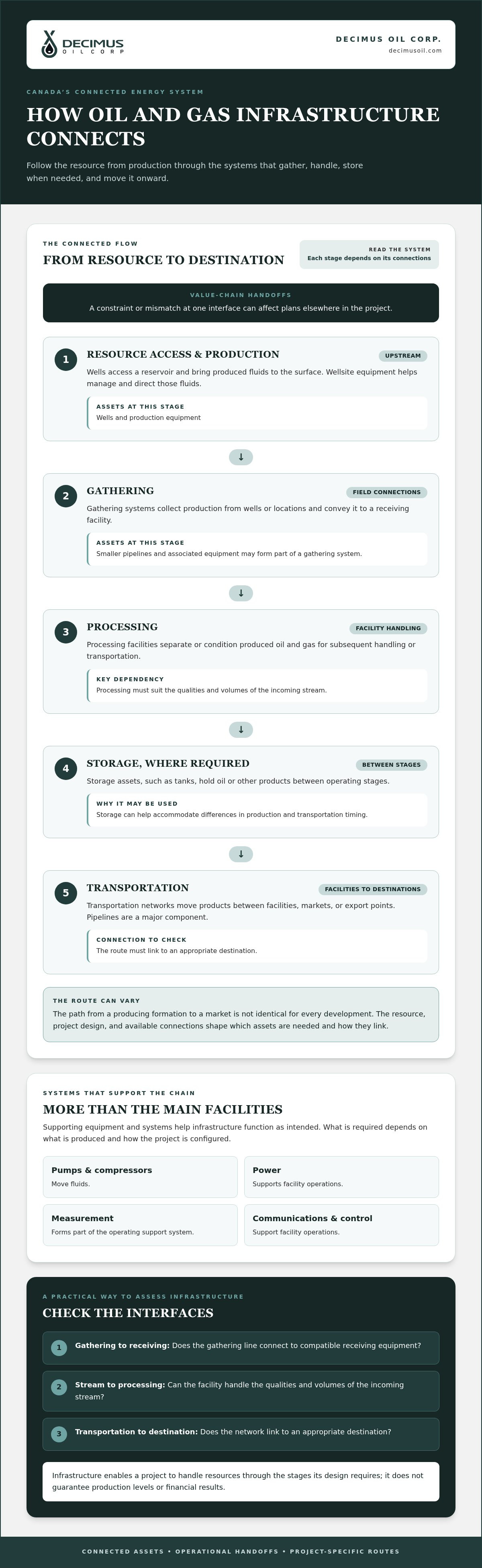
Think of the system as a chain of interfaces, not an inventory of standalone assets. A gathering line must connect to compatible receiving equipment. Processing must suit the qualities and volumes of the incoming stream. Transportation must link to an appropriate destination. A change or constraint at one interface can affect plans elsewhere.
Infrastructure supports operations, but it doesn’t guarantee production levels or financial results. Its role is to enable a project to handle resources through the stages its design requires. Understanding these connections gives operators a practical starting point for evaluating development choices, existing assets, and dependencies before detailed planning.
How Oil and Gas Infrastructure Connects the Canadian Value Chain
Oil and gas move through connected activities, but the route from a producing formation to a market isn’t identical for every development. Infrastructure links each stage through physical and operational handoffs. It connects production to the gathering, processing, storage, and transportation systems that prepare resources for subsequent handling and delivery.
Follow the chain by asking what happens to the resource next and which asset makes that step possible. A producing well may connect to field equipment and a gathering line, then to a facility that handles the incoming stream. Storage or transportation may form part of the route from there, depending on the resource, project design, and available connections.
Upstream infrastructure: enabling exploration and production
Upstream infrastructure supports resource access and production. In conventional exploration and development, wells connect to field equipment that manages production and moves it toward the next operating stage. The configuration depends on technical and operating conditions, including the resource and the project’s planned connections.
Infrastructure planning matters before and during development. Operators need to understand how field assets connect to receiving systems and whether those interfaces suit the development plan. When considering existing infrastructure, its location and function can inform project choices, but its suitability depends on operating requirements.
Midstream and downstream connections: handling and moving resources
After production, infrastructure supports several distinct activities. Gathering collects output from wells or field locations. Processing handles the stream at a facility, while storage holds product between stages when the project design calls for it. Transportation moves oil or natural gas between facilities and onward toward a destination. These functions connect, but they aren’t interchangeable: production brings resources to the surface; subsequent systems handle and move them.
A simplified flow is:
Resource access and production → gathering → processing → storage, where required → transportation → receiving point or market
This is a guide, not a universal blueprint. A project may use existing connections, require different handling steps, or link stages in another arrangement. The key is whether the selected assets work together.
Each connection creates a dependency. A field system must interface with a gathering route; that route must connect to a facility able to receive the stream; and transportation depends on a suitable connection beyond the facility. Different operators may manage assets at successive stages, so schedules, operating conditions, and transfer points can affect one another. Mapping these handoffs helps identify where a constraint could affect plans across the chain. No single asset, by itself, guarantees production or delivery.
For Canadian resource development, viewing oil gas infrastructure as a connected operating system helps frame decisions about conventional exploration and existing assets. Decimus Oil Corp. connects infrastructure management and enhanced oil recovery with its broader resource-development focus. Explore Decimus Oil Corp.’s energy infrastructure focus.
How to Compare Oil and Gas Infrastructure by Function and Dependency
Comparing assets by name alone can obscure the operational questions that matter: what must each asset receive, handle, or pass on? Assess its function, its place in the project, and the connections it depends on. The categories below describe common roles, not a universal design. A project may use existing assets, combine functions, or need a different configuration.
| Asset category | Primary function | Typical role | Key dependency |
|---|---|---|---|
| Gathering | Collects production from wells or field locations and conveys it onward. | Connects upstream production with midstream handling. | Suitable connections at producing sites and a receiving facility able to accept the stream. |
| Processing | Handles or conditions incoming oil or gas for subsequent stages. | Often midstream; placement depends on the project. | Compatibility with the incoming stream and a route for the handled product. |
| Storage | Holds product between operating stages when the project requires it. | May support midstream operations or another stage. | Appropriate connections, operating arrangements, and a next step for product movement. |
| Transportation | Moves product between facilities or toward a destination. | Generally midstream, connecting facilities and markets. | Access to connected systems and receiving points that fit the project’s needs. |
Which infrastructure functions are most critical to a project?
There’s no universal ranking. Criticality depends on the resource, production plan, and available infrastructure. An asset is essential when the project needs its function to operate as designed. Another asset may be optional, supplied by an existing connection, or relevant only to a particular configuration. Compare each function with the project plan rather than assuming every development needs gathering, processing, storage, and transportation in the same form.
How do capacity, access, and reliability affect infrastructure fit?
Capacity is the ability of connected assets to handle the project’s planned operating requirements. Access means the project can connect to and use the required asset. Reliability is a consideration when assessing whether connected systems can support planned operations over time; it is not a guarantee of uninterrupted service. Consider these factors together: a connection alone doesn’t establish that the full route is suitable.
Hypothetical example: A field’s gathering connection may be available, but the receiving facility might not be able to handle the planned stream under the project’s operating conditions. That constraint could affect the onward route even if the gathering line itself is suitable. Mapping interfaces helps identify dependencies before they become operating assumptions.
This asset-level view also supports lifecycle planning. Existing infrastructure may be valuable when its function and condition align with development needs. For a deeper perspective on managing infrastructure and realizing value from assets, see this strategic energy infrastructure guide. Applying the same function-and-dependency lens to oil gas infrastructure clarifies where project plans rely on connected assets and where further assessment is needed.
How to Assess Infrastructure Needs Across an Asset Lifecycle
Assess infrastructure against the full life of a development, not only the point when production is expected to begin. A structured review clarifies what the project needs, how assets connect, and what must be managed as operating conditions change. Use these steps as a planning framework, not as a substitute for project-specific technical or regulatory advice.
- Define the development plan. Set the resource-development objective, intended operating plan, and project stages under consideration. Identify the expected production pathway and interfaces with other systems. For related commercial and project considerations, see this guide to oil and gas exploration economics.
- Map the required assets. Identify the infrastructure functions the plan depends on, then note which existing assets could connect to the development. Record each asset’s purpose, location, access arrangements, and the next system it must connect with. Separate verified project facts from assumptions so preliminary estimates aren’t mistaken for established conditions.
- Test the interfaces. Check whether planned connections align across the system. Consider the incoming stream, receiving asset, operating requirements, and onward route. Note dependencies between assets and where a change to one connection could affect another stage. Have technical, regulatory, and project-specific requirements reviewed by current experts before finalizing decisions.
- Review lifecycle needs. Consider operations, maintenance, access, and eventual end-of-life planning from the outset. Revisit assumptions as the development and asset conditions evolve.
Map project requirements before selecting infrastructure
Start with the development objective, not a preferred asset. A proposed connection is useful only if it serves the operating plan and fits the rest of the system. Compare project needs with the function of existing assets, and distinguish confirmed information, such as a documented connection, from assumptions that still need assessment. This makes gaps visible without presuming a particular configuration.
Review operations, maintenance, and recovery opportunities
An asset’s usefulness depends on its operating condition as well as its original function. Consider the maintenance needed for continued use and access for operations and repairs alongside the connections the asset serves. For existing producing assets, enhanced oil recovery may be one factor in evaluating future development options. Its relevance depends on the asset and project. The overview of enhanced oil recovery techniques provides method-specific context.
Include end-of-life planning in the lifecycle review. The appropriate approach depends on the asset and applicable requirements, so it needs current, qualified assessment rather than a generic checklist. For a perspective on infrastructure as part of resource development, explore Decimus Oil Corp.’s resource-development approach. A lifecycle lens keeps oil gas infrastructure decisions focused on operational fit, asset dependencies, and long-term stewardship.
How Decimus Connects Oil and Gas Infrastructure with Resource Development
Infrastructure is part of the operating foundation for conventional resource development. It connects exploration and production plans with the assets needed to handle and move produced resources. Decimus Oil Corp. is a Canadian energy company focused on conventional oil and gas exploration and resource development. Its activities include energy infrastructure management and enhanced oil recovery.
Infrastructure within Decimus Oil Corp.’s conventional resource-development focus
Exploration identifies opportunities to develop hydrocarbon resources; infrastructure planning considers how those opportunities connect with the systems needed to support operations. The assets and connections involved depend on the development plan and project conditions. Decimus Oil Corp.’s infrastructure management is part of this broader resource-development approach.
This relationship matters throughout development. Assessing existing assets and their potential role can inform planning, while infrastructure management keeps attention on how assets fit operating requirements over time. Efficient use of existing assets is a planning consideration, not a guarantee of production, performance, or financial results. Enhanced oil recovery is another part of Decimus Oil Corp.’s work, relevant to evaluating existing producing assets and their development potential.
From infrastructure understanding to informed next steps
Use this framework to evaluate oil gas infrastructure:
- Identify the assets: Determine which facilities and systems relate to the development objective.
- Trace the connections: Map how assets interface and where the project depends on access to connected systems.
- Assess lifecycle needs: Consider operating requirements, maintenance, access, and eventual end-of-life planning.
This approach distinguishes confirmed project information from assumptions and makes dependencies easier to evaluate. It also links asset decisions to the resource-development plan instead of treating infrastructure as a separate checklist. Each project still needs assessment based on its technical, operating, and regulatory context.
Decimus Oil Corp. reports that its team brings more than 100 years of combined experience. The company is publicly traded on the TSX Venture Exchange as TSXV:WCSB. To see how conventional exploration, infrastructure management, and enhanced recovery fit within its resource-development focus, explore Decimus Oil Corp..
Put Infrastructure Insight to Work
Infrastructure decisions should evolve with the development plan. When project assumptions change, revisit how asset access, operating needs, and connected systems affect the next decision. This keeps oil gas infrastructure in view as a strategic part of resource development, rather than a fixed set of facilities considered only at the outset.
That perspective aligns with Decimus Oil Corp.’s focus on conventional oil and gas exploration. The company’s activities include energy infrastructure management and enhanced oil recovery, linking infrastructure considerations with resource development while recognizing that projects follow different paths.
Explore how Decimus approaches resource development and its related energy activities. Explore Decimus Oil’s resource-development approach.
Frequently Asked Questions
What is oil and gas infrastructure?
Oil gas infrastructure refers to the physical assets and supporting systems used to access, produce, handle, store, and move oil and natural gas. Examples include wells, field equipment, gathering lines, processing facilities, storage tanks, and transportation networks. Power, measurement, and control systems can also support operations. The assets a project uses depend on its design and operating needs, so the term describes a system of functions rather than one standard facility layout.
Is oil and gas infrastructure limited to pipelines?
No. Pipelines are an important transportation asset, but infrastructure also includes equipment and facilities needed before and after transportation. A producing site may rely on pumps, compressors, power, or measurement systems. Produced fluids may require gathering and processing, while storage may be used between operating stages. These assets perform different tasks, and a project’s configuration depends on the resource, operating plan, and available connections.
How long does oil and gas infrastructure typically last?
There isn’t one service life that applies to every asset. A well, processing facility, storage tank, and pipeline face different operating conditions and maintenance needs. Useful life depends on factors such as design, materials, usage, environment, inspection findings, and repair history. Operators assess condition over time to inform continued use, modification, replacement, or retirement. An asset’s age alone doesn’t establish whether it remains suitable for a particular project.
Who owns oil and gas infrastructure in Canada?
Ownership varies by asset and project. Infrastructure may be held by an energy company, a midstream business, a partnership, or multiple parties with interests in the same asset. The owner and the party responsible for day-to-day operation may differ. Access arrangements can also affect how another producer uses a connection. To understand a specific asset, distinguish ownership, operating responsibility, and access rights rather than assuming one company controls every part.
What happens when oil and gas infrastructure reaches the end of its operating life?
End-of-life work is planned according to the asset, site conditions, and applicable requirements. It can involve shutting down operations, isolating or removing equipment, plugging wells, and addressing the site after use. Some assets may require ongoing monitoring or remediation. The responsible party and required steps depend on the asset and jurisdiction, so plans need current technical and regulatory review. Retirement is a managed phase of the asset lifecycle, not simply a decision to stop operating.
Can existing oil and gas infrastructure support enhanced oil recovery?
It may, if the infrastructure suits the recovery plan and the asset’s condition and operating requirements. An enhanced recovery project may require changes to how fluids are injected, produced, handled, or monitored. Existing wells and facilities can inform planning, but their presence alone doesn’t establish technical fit or available capacity. Assessment should consider the reservoir, proposed method, connections, and any modifications needed before determining whether existing assets can support the project.
How does oil and gas infrastructure affect environmental performance?
Infrastructure can influence emissions and other environmental risks through energy use, methane releases, spills, and the land or water disturbance associated with development and operation. Design choices, maintenance, monitoring, and operating practices can help manage these factors, but no asset configuration guarantees a particular environmental outcome. Assessment is specific to the project and its setting. A facility’s power needs and the condition of connected equipment, for example, can both be relevant to operational emissions.
What happens if a key pipeline or facility becomes unavailable?
An outage can interrupt the next step in handling or moving production, even if wells and other connected assets remain operational. Depending on the system, operators may consider alternate connections, available storage, revised schedules, or adjusted production. Options depend on the product, asset access, capacity, and operating conditions; alternatives can’t be assumed. If no suitable route or receiving facility is available, production plans may need to change until the system can handle the stream.


