

A large reserve number can be accurate and still tell you less than you think. Hydrocarbon reserves are estimates shaped by classification, technical and economic assumptions, and the evaluation date. They are not a promise of future production. Headline figures can seem definitive, especially when reports use categories that aren’t directly comparable.
This guide explains what Canadian reserve estimates mean and how to interpret them. You’ll learn how proved, probable, and possible reserves differ, how Canadian disclosures are framed under National Instrument 51-101 and the Canadian Oil and Gas Evaluation Handbook, and why a reserve estimate isn’t a production forecast or guarantee.
When reviewing a disclosure, focus on details such as the effective date, the evaluator’s assumptions, and whether figures are reported separately or in aggregate. With that context, Canada’s hydrocarbon reserve estimates are easier to assess and compare as one part of a broader resource-development picture.
Key Takeaways
- Learn why a reserve estimate is conditional and shouldn’t be read as a guarantee of future production or cash flow.
- Understand how Canadian reporting distinguishes proved, probable, and possible hydrocarbon reserves.
- See how geological and engineering evidence informs estimates without making them direct measurements.
- Use a focused checklist to review categories, effective dates, evaluators, assumptions, and reporting basis.
- Explore how conventional resource development, enhanced recovery, and energy infrastructure fit into Decimus Oil’s business focus.
What Are Hydrocarbon Reserves, and What Does the Term Actually Mean?
Hydrocarbon reserves are discovered quantities of oil or natural gas estimated to be recoverable under defined technical, economic, and operating conditions. In Canada, reserve estimates are prepared within reporting frameworks that include National Instrument 51-101 and the Canadian Oil and Gas Evaluation Handbook. Hydrocarbon reserves are discovered volumes estimated to be recoverable under specified technical, economic, and operating conditions as of an evaluation’s effective date.
The term appears in technical evaluations, public company disclosures, and energy analysis because it provides a structured way to describe recoverable quantities. It doesn’t mean the hydrocarbons have already been produced, or that production and cash flow are assured. Estimates depend on evidence and assumptions that can change. For an overview of Canadian oil reserves and the role of oil sands, see Oil reserves in Canada.
How reserves differ from oil and gas in place
Oil or gas in place refers to the hydrocarbons estimated to exist within a formation. That total is not the same as the amount that can be recovered. Reservoir characteristics, available recovery methods, operating conditions, and commercial considerations all affect how much may qualify as reserves.
Think of a reservoir like a jar of liquid: knowing how much is inside doesn’t tell you how much can be poured out using a particular opening and method. In industry terms, the original quantity in place is distinct from the recoverable portion, and reserves are a defined subset of discovered quantities assessed as recoverable under specified conditions. The analogy illustrates the distinction, but reservoir estimates rely on geological and engineering analysis, not a direct count.
Reserves, contingent resources, and prospective resources
These labels describe different classifications, not interchangeable measures of the same certainty. Discovery status matters: reserves and contingent resources relate to discovered accumulations, while prospective resources refer to quantities that may be present in accumulations not yet discovered. Development and commercial conditions help distinguish reserves from contingent resources.
Contingent resources are discovered quantities considered potentially recoverable, but one or more contingencies currently prevent their classification as reserves. Those contingencies may relate to development plans, technical considerations, markets, or other conditions affecting commercial development. Prospective resources, by contrast, represent estimated potential in undiscovered accumulations and carry the additional uncertainty of whether a discovery will be made.
Classification is not a guaranteed progression. A prospective estimate does not automatically become a discovered resource, and a discovered quantity does not automatically qualify as reserves. New evidence, development decisions, technical capability, and commercial conditions can affect classification over time. Keeping these categories separate helps you understand what a figure represents before comparing estimates or drawing conclusions about future production.
How Hydrocarbon Reserves Are Estimated and Classified in Canada
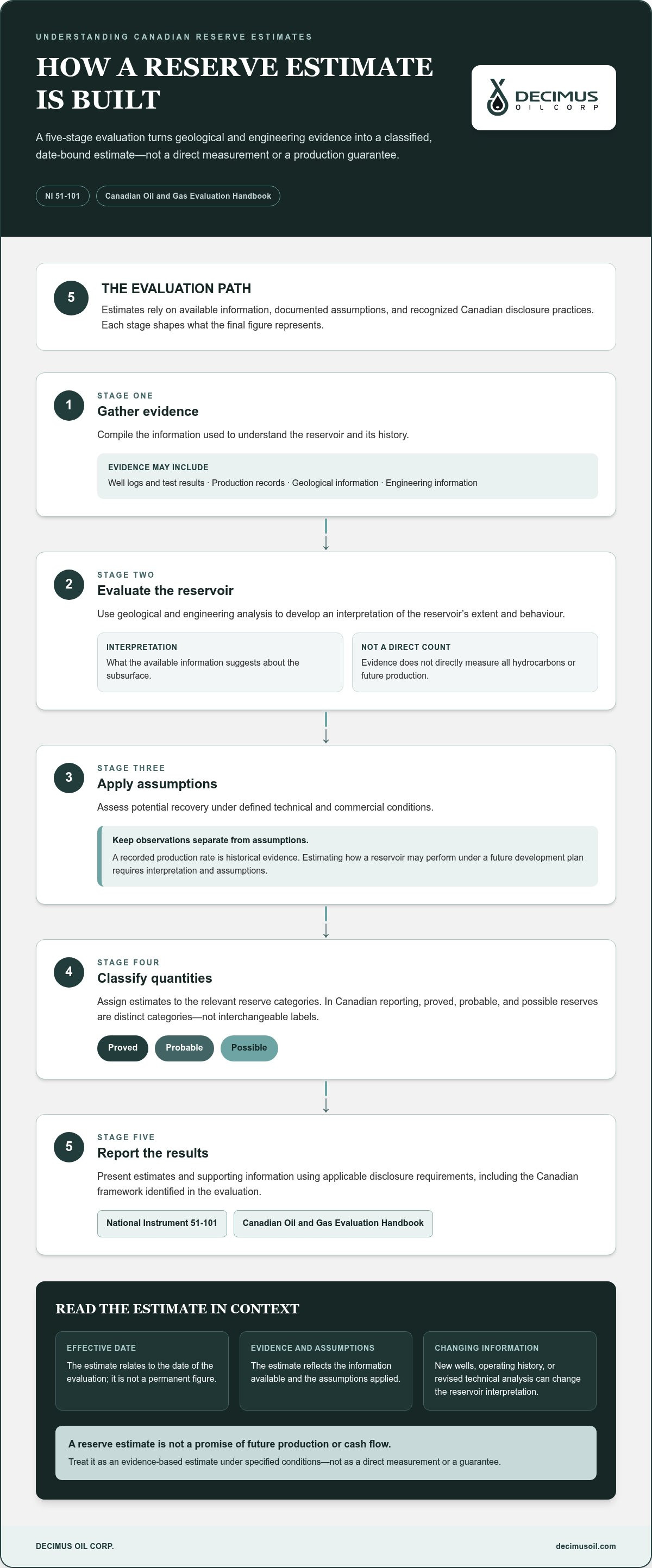
Reserve evaluation is a structured process, not a direct measurement of everything that may eventually be produced. In Canada, hydrocarbon reserves are assessed using geological and engineering evidence, documented assumptions, and recognized disclosure practices. A reserve estimate reflects the evidence available, the assumptions applied in the evaluation, and the effective date to which the estimate relates.
The process can be understood as five connected steps:
- Gather evidence: compile well, production, geological, and engineering information.
- Evaluate the reservoir: develop an interpretation of its extent and behaviour.
- Apply assumptions: assess potential recovery under defined technical and commercial conditions.
- Classify quantities: assign estimates to the relevant reserve categories.
- Report the results: present estimates and supporting information using applicable disclosure requirements.
Each step depends on the quality and scope of the available information. New wells, operating history, or revised technical analysis can change the understanding of a reservoir. An estimate is therefore tied to its evaluation date, rather than being a permanent figure.
What evidence supports a reserve estimate?
Evidence can include well logs and test results, production records, geological interpretations, and engineering analysis of reservoir performance and recovery methods. These sources help evaluators build a reasoned view of the subsurface, but they don’t amount to a direct measurement of all hydrocarbons or future production.
Distinguish observed information from assumptions. A recorded production rate is historical evidence; estimating how a reservoir may perform under a future development plan requires interpretation and assumptions. The amount and reliability of available data affect how confidently an estimate can be assessed. Where information is limited, uncertainty should remain visible in the evaluation rather than being mistaken for precision.
Who evaluates and reports reserves in Canada?
The Canadian Securities Administrators establish securities disclosure requirements through National Instrument 51-101, which applies to reporting issuers engaged in oil and gas activities. The instrument and related requirements address annual disclosure of reserves information, including evaluation or audit work by qualified reserves evaluators or auditors. Their role is to assess the supporting technical information and evaluate estimates in accordance with applicable standards. Issuer disclosure remains subject to the relevant regulatory framework.
The Canadian Oil and Gas Evaluation Handbook (COGEH) provides technical guidance for evaluating and classifying oil and gas resources. It supports consistent professional practice, while NI 51-101 and other current regulatory guidance govern disclosure obligations. COGEH is not a substitute for those requirements. Read a reported figure alongside its category, assumptions, and effective date.
For a practical example of how reserve literacy relates to conventional resource development, consider Decimus Oil’s conventional exploration and resource development focus.
Proved, Probable, and Possible Reserves: What the Categories Tell You
Canadian reserve disclosures use categories to communicate differing levels of certainty about estimated recoverable quantities. Under National Instrument 51-101 and the Canadian Oil and Gas Evaluation Handbook (COGEH), proved reserves have a higher degree of certainty than probable reserves, while possible reserves are less certain than probable reserves. These classifications help you assess an estimate, but they don’t make it a production schedule or a promise.
How to read 1P, 2P, and 3P shorthand
The shorthand describes which categories are included in an aggregate estimate. Check the label before comparing figures: a broader total includes categories with more uncertainty, so it isn’t interchangeable with a narrower total.
| Label | Categories included | How to read it |
|---|---|---|
| 1P | Proved | Proved reserves only |
| 2P | Proved + probable | Combined proved and probable reserves |
| 3P | Proved + probable + possible | Combined proved, probable, and possible reserves |
Probable reserves are additional reserves that are less certain to be recovered than proved reserves. Possible reserves are additional quantities with a lower degree of certainty than probable reserves. These are technical classifications under the applicable Canadian framework, not informal rankings of company performance.
Adding categories changes the scope of the reported estimate, not the certainty of its least-certain components. A 3P figure includes proved, probable, and possible reserves; it shouldn’t be read as though the entire amount has the same certainty as the proved component. Aggregation also doesn’t commit a company to develop or produce those volumes.
Why reserve categories are not production forecasts
Reserve volumes estimate recoverable quantities under defined conditions. They don’t specify how quickly those quantities will be produced. Timing depends on factors such as development plans, operating decisions, infrastructure, and market conditions, which can affect whether and when a company brings a reserve forward for production.
A reserve figure alone can’t establish annual output or how many years a field will produce. Remaining field life depends on production rates and how development unfolds, not simply on dividing a disclosed reserve total by current production. The estimate and the schedule answer different questions.
Keep technical classification separate from financial interpretation, too. Reserve volumes may inform analysis, but they aren’t a company valuation or a guaranteed measure of future cash flow. Valuation involves additional considerations, including assumptions about costs, prices, timing, and risk. When comparing disclosures, first match the category and reporting basis, then consider the estimate’s effective date and assumptions. This makes the comparison more meaningful without treating a broader category total as equivalent to proved reserves.
How to Assess a Hydrocarbon Reserve Disclosure
A reserve disclosure is most useful when you read its headline volume alongside the details that define what the number includes. Use this practical framework to assess reported hydrocarbon reserves consistently, without treating an estimate as an investment recommendation or a production guarantee.
Five details to locate before comparing reserve figures
Start with these five items in the disclosure. If one is unclear or missing from the summary, review the supporting notes and evaluation details before drawing comparisons.
- Category: Identify whether the figure is proved, proved plus probable, or a broader total that also includes possible reserves. These categories reflect different levels of certainty.
- Gross or net basis: Determine whether volumes are reported on a gross basis or reflect the company’s attributable interest. Gross and net figures describe different scopes and shouldn’t be compared as though they were equivalent.
- Effective date: Find the date the estimate applies to. Estimates with different effective dates may reflect different evidence, assumptions, or development information.
- Evaluator: Review the evaluator or auditor information and the scope of the evaluation. Canadian disclosure requirements provide for qualified evaluation or audit work, but the role and scope should be read in the context of the specific filing.
- Assumptions and conventions: Note the stated technical, economic, and development assumptions, along with the reporting framework. Similar labels alone don’t guarantee that two estimates were prepared on a comparable basis.
Then compare like with like: align category, date, ownership basis, scope, and classification conventions. For instance, a company’s net proved estimate for one effective date is not directly comparable to another company’s gross 2P estimate from a different date. The apparent difference may reflect reporting choices as well as changes in the underlying assets.
These considerations connect to broader questions about development and value drivers. The article “Oil and Gas Exploration Economics: Strategic Trends and Value Drivers in 2026” provides a related lens for understanding how technical estimates sit within wider economic analysis.
What changing reserve estimates can and cannot indicate
An estimate can change as new well or production evidence becomes available, as reservoir interpretations are updated, or as development plans and evaluation assumptions change. Revisions may also reflect changes in the scope or basis of reporting. The number alone doesn’t identify the cause.
An increase isn’t proof of operational success, just as a decrease isn’t proof of failure. Read the explanation behind the revision and check whether the category, effective date, evaluator, assumptions, or gross-versus-net basis also changed. Broader resource-development context can help frame those details; “WCSB Resource Development: A Strategic Guide to Canada’s Energy Powerhouse” addresses that wider perspective.
For an example of a Canadian company focused on conventional exploration and resource development, explore Decimus Oil’s resource-development focus.
How Decimus Oil Connects Reserve Knowledge to Resource Development
Reserve terminology has practical value when considered alongside the decisions involved in developing oil and gas resources. Estimates provide a technical basis for understanding quantities assessed as recoverable under stated conditions. They don’t, by themselves, determine whether or how development will proceed. Evaluation and execution are connected parts of the wider resource-development process.
From reserve estimates to disciplined resource development
Technical evaluation can inform development planning by helping decision-makers understand a reservoir, assess potential recovery, and consider the assumptions behind estimated volumes. Plans may evolve as additional evidence becomes available or operating and commercial conditions change. Reserve knowledge is one input into development, not a standalone conclusion about future production or project outcomes.
Conventional exploration and existing-asset optimization sit at different points in the resource lifecycle. Exploration seeks to identify and evaluate potential accumulations; development planning considers how discovered resources might be advanced. Enhanced recovery can form part of the broader approach to producing from existing assets, while energy infrastructure supports resource development and movement. These activities provide context for understanding a company’s focus, but they don’t establish a particular reserve volume or classification.
For readers assessing hydrocarbon reserves, the distinction is useful: an estimate describes a technical assessment, while a company’s operating focus describes the activities it pursues. Neither substitutes for the other. A disciplined view keeps the estimate, development approach, and reported evidence distinct, then considers how they relate without assuming a specific result.
Explore Decimus Oil’s approach
Decimus Oil Corp. is a Canadian energy company focused on conventional oil and gas exploration, resource development, enhanced recovery, and energy infrastructure. These activities describe the company’s resource-development context. Reserve totals, categories, discoveries, and production results are matters addressed through evaluated quantities and supporting disclosure.
Reserve disclosures provide evaluated quantities and their supporting details. Company information describes stated business activities and strategic context. Keeping those purposes distinct supports a more precise reading of technical estimates and corporate direction.
To learn more about Decimus Oil’s Canadian energy activities, explore Decimus Oil.
Put Reserve Estimates in Their Development Context
Reserve figures are most useful as one part of a broader view of how energy resources are evaluated and developed. When reviewing an estimate, focus on its assumptions and how they relate to the company’s stated activities. That context keeps technical potential distinct from guaranteed results and supports a more informed understanding of Canada’s energy sector.
Decimus Oil’s company information identifies it as publicly traded on the TSX Venture Exchange under TSXV:WCSB and reports more than 100 years of combined team experience. These details provide corporate context, not evidence of specific hydrocarbon reserves or a forecast of investment performance.
Continue exploring how resource development fits into the Canadian energy landscape. Explore Decimus Oil’s resource development approach and learn about its focus on conventional oil and gas exploration, enhanced recovery, and energy infrastructure.
Frequently Asked Questions
Are hydrocarbon reserves guaranteed to be produced?
No. A reserve estimate doesn’t require a company to develop or produce the volumes. For example, an operator may defer a project because priorities, infrastructure access, market conditions, or development plans change. The estimated quantity can remain part of a disclosure while the timing and decision to produce it are unresolved. Treat a reserve figure as an evaluated estimate, not a delivery commitment or assurance of future revenue.
Does discovering oil or natural gas automatically create reserves?
No. A discovery is evidence that hydrocarbons are present, but it doesn’t by itself establish that quantities qualify as reserves. The accumulation must be evaluated, and the estimated recoverable volumes must meet the relevant technical and commercial classification criteria. A discovery may instead be described as a resource, depending on its evaluation and development status. Finding hydrocarbons and establishing reportable reserves are separate steps.
Can two companies report different reserve estimates for similar assets?
Yes. Similar-looking assets can have different well histories, geological data, development plans, ownership interests, or evaluation assumptions. For instance, one estimate may reflect a planned recovery method that another evaluation doesn’t apply. Before comparing figures, check whether both use the same reserve category, effective date, gross or net basis, and reporting conventions. Similar geology alone doesn’t mean the estimates cover identical quantities or conditions.
What does the effective date of a reserve estimate mean?
It identifies the point in time to which the evaluation applies. Evidence or assumptions available after that date may not be reflected in the estimate, even if the disclosure is published later. For example, a well drilled after the effective date could provide information that a subsequent evaluation considers. Check the date stated in the disclosure rather than assuming the estimate represents conditions on the publication date.
Do hydrocarbon reserves include both oil and natural gas?
Yes. The term can refer to estimated recoverable quantities of oil, natural gas, or both, depending on the assets and disclosure being discussed. However, reported volumes may use different units or conversion conventions, so a combined figure needs careful interpretation. Look at the product breakdown and units in the underlying disclosure. A total that combines oil and gas shouldn’t be compared directly with a figure for only one product.
Can reserve estimates change after they are reported?
Yes. Later evaluations may incorporate new well results, production history, revised reservoir interpretations, updated development plans, or changed assumptions. A revision can also reflect changes in ownership or how quantities are reported. To understand what changed, compare the supporting explanations as well as the figures, and note whether the category or reporting basis differs. A revised number by itself doesn’t explain the reason or its operational significance.
How should readers interpret a company’s gross and net reserve figures?
Gross figures generally describe quantities before deducting the company’s ownership share; net figures reflect its attributable interest under the applicable reporting basis. For example, a company with a partial interest in an asset may report a net quantity smaller than the gross total. Read the disclosure’s definitions because terminology and presentation matter. Don’t compare one company’s gross estimate with another’s net estimate as though they represented the same scope.


