

What if a larger resource estimate signals possibility, but not progress toward production? That distinction is central to energy sector resource growth. In Canada, resource, reserve, production and value claims can appear side by side, yet they describe different stages and carry different meanings. A headline increase may point to more identified potential, while leaving development timing, capital needs and commercial viability unresolved.
To assess whether an energy asset is advancing, first identify what the company is measuring. Some measures reflect a change in geological understanding, others describe reserves assessed under technical and commercial criteria, and production figures report actual output. Growth is more durable when technical potential can advance through development and infrastructure requirements toward production, though no single measure guarantees that outcome.
This article explains the stages from resource identification to producing assets and shows how to distinguish additions to estimated resources from realized production. It also offers a practical framework for comparing technical, commercial and execution signals, so you can assess growth claims with more clarity than a headline figure alone provides.
Key Takeaways
- Separate resource growth from production growth and company valuation before comparing claims.
- Use the four stages from identifying potential to production to see what progress a project has actually made.
- Assess energy sector resource growth alongside development readiness and infrastructure access, not just the reported resource increase.
- Apply a consistent framework: define the measure, check supporting evidence, assess readiness, examine constraints and track outcomes.
- Exploration, energy infrastructure and enhanced oil recovery can play different roles in resource development, but none guarantees results.
What Does Energy Sector Resource Growth Actually Mean?
Energy sector resource growth is an increase in the estimated hydrocarbon potential associated with an asset or portfolio. It is not the same as production growth, which measures output over time, or company valuation, which reflects how a business is valued in the market. Resource growth describes a change in an estimate, not necessarily a change in production or asset value.
The progression typically moves from identified geological potential to evaluated resources, then through development planning and, where technical and commercial conditions support it, production. Estimates can be revised as new geological and engineering evidence becomes available. The meaning of terms such as “resource” and “reserve” depends on the applicable reporting framework, so check the standards cited in a company’s disclosure. This overview of resource quantification standards introduces common distinctions and classification approaches, but project disclosures should be read against their stated framework.
Resource potential is an estimate of what may be recoverable; a commercially producing asset has progressed through evaluation and development to deliver measured output.
Resources, reserves, and production are different measures
Resources are estimates of quantities that may exist or be recoverable, with confidence and development status varying by classification. Reserves generally refer to quantities assessed under applicable technical and commercial criteria, including the expectation of recovery under defined conditions. These terms are not interchangeable, and categories within a reporting system can carry different levels of certainty and development readiness.
Production is different again: it is the volume actually produced during a stated period. It does not estimate underground quantities. When comparing disclosures, check the reporting date, units, classification and whether figures refer to gross or net interests. A resource estimate, by itself, is not a production forecast.
Why resource growth can matter without guaranteeing value
Credible additions to estimated resources may give a company more options to evaluate for future development. They can also support further technical work, project sequencing or consideration of whether existing infrastructure could support an asset. But an estimate is only one part of the assessment. Development timing, capital requirements, market conditions, infrastructure access and technical results all influence whether potential can advance.
That distinction matters in Canada’s conventional oil and gas sector, where an announced increase can attract attention before the work required to develop it is complete. Resource growth alone doesn’t establish profitability, production growth or investment performance. Assess the evidence and development stage behind the claim, then look for later results showing whether the estimate is progressing toward production.
How Energy Resources Progress from Discovery to Development
Resource development is a sequence of decisions, not a single discovery event. Each stage adds evidence and tests whether an opportunity can move closer to production. As technical work progresses, estimates may be revised: drilling results or engineering analysis can refine understanding of the subsurface and the volume that may be recoverable. That evolving evidence is central to assessing energy sector resource growth.
- Identify potential: Geological interpretation points to areas where hydrocarbons may be present.
- Evaluate evidence: Geological data and drilling results are assessed to refine understanding of the opportunity.
- Plan development: Engineering, capital allocation and infrastructure access are considered to determine how a project could proceed.
- Produce or enhance recovery: An asset is developed for output, or recovery approaches are considered for existing production, subject to asset conditions.
Terminology and classifications depend on the reporting framework being used. The U.S. Geological Survey’s explanation of assessed resources and reserves offers useful background, but readers should also check the standards and definitions cited in a specific company disclosure.
Exploration and evaluation establish the evidence base
Geological interpretation helps form a view of where hydrocarbons may occur; drilling results can then provide further evidence about the formation and its potential productivity. An indication of hydrocarbons, however, is not the same as a confirmed commercial development decision. Further evaluation must establish whether the opportunity can be developed under relevant technical and commercial conditions. Project economics are part of that assessment; see this oil and gas exploration economics guide for factors that can influence decisions.
Development, infrastructure, and recovery affect realized output
Even a well-supported resource estimate must be translated into an executable development plan. Engineering choices, capital availability and access to supporting infrastructure can shape the pace and scale of work. For producing assets, enhanced recovery may offer a way to pursue additional output, but results depend on the asset’s characteristics and condition. The enhanced oil recovery techniques guide explores this topic in more depth.
Discovery identifies an opportunity; development decisions and operational execution determine whether resource potential can become production. To review a Canadian company’s stated focus across conventional exploration, resource development, infrastructure and enhanced recovery, see Decimus Oil’s company information.
How to Tell Whether Resource Growth Is Durable or Only a Headline
An increase in reported resources doesn't automatically mean higher production, stronger economics or greater company value. It may reflect new evidence, a revised interpretation or a change in the estimate's assumptions. To judge whether energy sector resource growth signals durable progress, compare the reported potential with evidence that the project is being evaluated, developed and brought toward production.
Compare resource claims with execution evidence
Start with the disclosure. Does it state the estimate's effective date, basis, assumptions and classification framework? Then look for evidence of what has happened since: further evaluation, a defined development plan, operational activity and actual production, where reported. A changed estimate alone doesn't prove a new discovery or improved commercial viability. Read forecasts and project economics alongside their assumptions, since technical results and market conditions can change.
| Signal | What to check | What it indicates |
|---|---|---|
| Resource addition | Estimate basis, date, assumptions and classification | Updated potential, not necessarily development progress |
| Development readiness | Evaluation results, plan and stated execution steps | How far the project has advanced toward development |
| Production performance | Reported output over a defined period and relevant context | Demonstrated production, not estimated underground volume |
| Infrastructure access | Disclosed connections or constraints affecting execution | Whether supporting systems may enable or limit development |
Reported potential describes what may be developed; production demonstrates what an asset is delivering. The gap between the two is where execution evidence matters most.
Consider constraints that can slow or limit growth
Test the claim against practical constraints, not just the size of the estimate. Capital requirements can affect whether and when a development plan proceeds. Commodity market conditions influence project economics, while technical uncertainty may lead to revised estimates or plans. Infrastructure access can also shape the path from development to output. These factors interact, so a positive signal in one area doesn't remove risks elsewhere.
Regulatory and environmental requirements vary by project and jurisdiction. Check current Canadian requirements in relevant company disclosures and authoritative sources rather than assuming one rule applies across all assets. If a disclosure points to third-party market information, trace it to the named original source; relying on unverified links or secondary references is not a substitute for reviewing the primary source.
For a company-level example of how exploration, resource development and infrastructure fit together, review Decimus Oil Corp.'s company information. As with any public-company disclosure, assess the evidence and risks independently; resource growth doesn't assure profitability or investment performance.
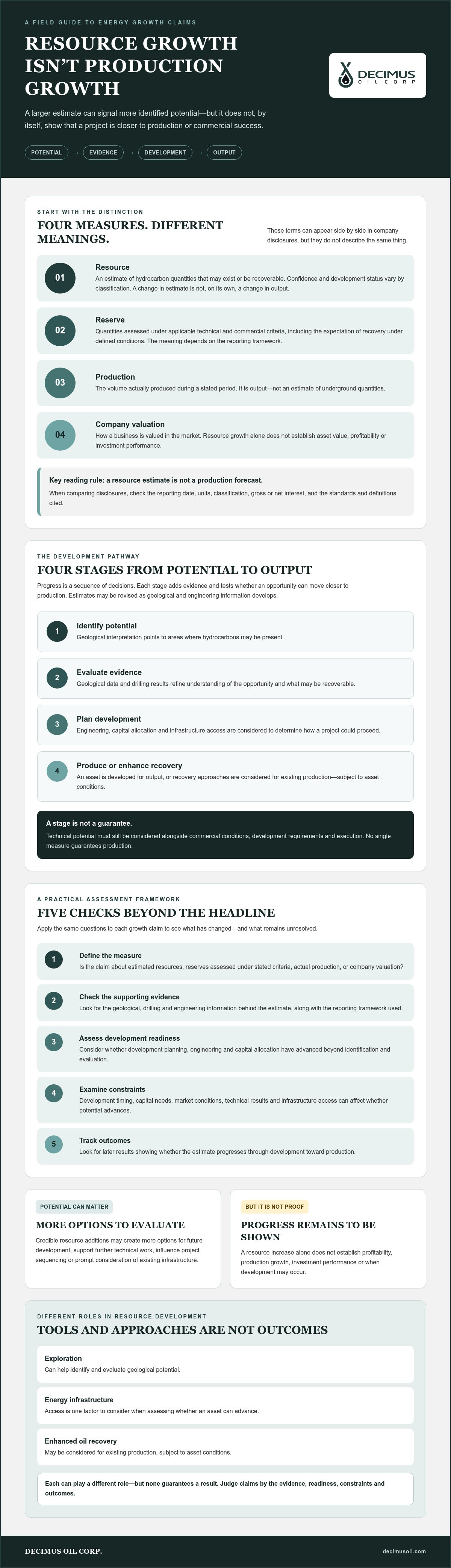
A Practical Framework for Assessing Energy Sector Resource Growth
A consistent review process helps separate a change in an estimate from measurable operating progress. Apply the same checks across company disclosures, and compare figures only when their definitions, reporting dates and interests are aligned. For additional company-level context, consult this junior oil and gas producers evaluation guide.
Five questions to apply to a growth claim
- What exactly grew? Identify whether the claim concerns estimated resources, reserves, production, infrastructure capacity or asset count. These measures describe different things.
- What supports the change? Review the source evidence, effective date, assumptions and classification framework. Check whether a revised estimate reflects new information, a changed interpretation or another factor.
- How ready is the project? Look for disclosed evaluation work, development planning and operational steps. Identify what remains before the potential can contribute to sustained production.
- What constraints could affect progress? Consider capital requirements, technical uncertainty, market conditions and infrastructure access, using the project’s disclosures rather than assumptions.
- What outcomes can be tracked? Compare subsequent operational updates and actual production with stated plans. Note reported changes to scope, timing or capital requirements.
Keep four measures distinct as you apply the framework. Reported resource growth concerns estimated potential; production growth is a change in actual output over a stated period. Operational efficiency relates to how activities are carried out, while capital appreciation refers to a change in an investment’s market value. One may influence another, but none is proof of the others.
Forecasts are not results. Compare like-for-like disclosures, including units, dates, ownership basis and classifications, and consult underlying source documents rather than relying on headline summaries. A plan may be revised, delayed or affected by new technical information; track what the company reports over time and distinguish completed work from intended work.
For context on how asset progress may relate to broader value drivers, see this oil and gas capital appreciation overview. It can inform the questions you ask, but it doesn’t establish a particular project’s value or investment outcome.
To apply these checks to a Canadian company’s stated activities, review Decimus Oil’s company information alongside its current disclosures. Use the framework to assess evidence and progress, not to assume a guaranteed result.
How Decimus Oil Connects Exploration, Recovery, and Resource Development
Decimus Oil Corp. is a Canadian public company focused on conventional oil and gas exploration and resource development. Its stated areas of focus also include energy infrastructure and enhanced oil recovery, activities that can contribute at different points in the development of hydrocarbon assets. This offers a company-level example of why energy sector resource growth involves more than identifying potential: technical work and operating decisions also shape whether an asset can advance.
A connected approach to developing hydrocarbon resources
Conventional exploration seeks to identify and evaluate hydrocarbon potential. Resource development considers how an asset might progress, while infrastructure can support the movement of a project toward production. For existing assets, enhanced recovery may be considered as a way to pursue additional output, depending on reservoir characteristics and operating conditions.
These activities are connected, but one does not guarantee the success of another. Infrastructure may support development, for example, but its relevance depends on the project and the access available. Enhanced recovery depends on asset-specific technical and commercial factors. Actual outcomes also rely on execution and operating conditions. Decimus Oil’s stated focus across these areas describes its activities; it is not proof that a particular resource estimate will result in production, profitability or investment returns.
What readers should verify before drawing conclusions
Use current company disclosures to check listing details, operating updates and the basis of any stated resource information. Compare reported figures with their dates, definitions and assumptions, and distinguish completed operational results from plans or estimates. Public-company information can change, so confirm details against current source documents rather than relying on summaries.
Company background claims also warrant verification. Check reported ownership or team experience against current disclosures and supporting material before relying on those details. Keeping company-specific statements separate from general sector explanations helps readers assess the evidence in context.
For a structured approach to reviewing junior oil companies, read the junior oil company investment framework. To explore Decimus Oil’s publicly available company information, visit its corporate website. These resources can support further research, but they are not investment recommendations, and resource growth does not assure production or returns.
Assess Growth by Following the Evidence
Resource growth matters most when its evidence and development stage are clear. Keep estimated resources distinct from reserves, actual production and company valuation, then look for signs that a project is progressing through evaluation, planning and execution. Compare disclosures on a like-for-like basis, and consider technical, commercial and infrastructure constraints before treating an announcement as durable progress.
This is the practical test for energy sector resource growth: does the reported potential have a credible path toward producing output, and do subsequent updates support that progress? Even then, resource estimates and development plans don’t guarantee profitability, production growth or investment returns.
Decimus Oil is a Canadian company focused on conventional oil and gas exploration and resource development. Its TSXV:WCSB listing should be checked against current exchange and company disclosures before relying on that detail. For more information on its stated approach, explore Decimus Oil’s approach to resource development.
Use a measured, evidence-led approach as you assess projects and company updates. Clear distinctions can help you ask better questions and make more informed decisions. Explore Decimus Oil’s company information to learn more about its conventional exploration, resource development, infrastructure and enhanced recovery focus.
Frequently Asked Questions
What does resource growth mean in the energy sector?
Energy sector resource growth means an increase in estimated hydrocarbon potential or in assets identified as available for development. It doesn’t necessarily mean a company has discovered new resources or can produce them commercially. The interpretation depends on the measure reported, its supporting evidence and the classification framework used. Review the original disclosure for its date, assumptions and definitions before comparing the claim with another company’s figures.
Is resource growth the same as production growth?
No. Resource growth concerns estimated or identified quantities that may be developed, while production growth means an increase in actual oil or gas output over a defined period. A company can report resource potential without having developed it. Production can also change for reasons unrelated to new resource additions, such as operating conditions. Check the measure, reporting period and units in a disclosure before interpreting it as operational growth.
Can exploration increase a company’s reported resources?
Exploration can contribute to a new resource estimate if technical results support one, but exploration activity alone doesn’t confirm a discovery or commercial project. Estimates may change as geological and engineering evidence develops, and further evaluation or development may still be needed. Review the disclosed results, classification, assumptions and next steps. A drilling program or promising indication is not, by itself, proof of realized resource growth or future production.
How can I assess the quality of an energy resource growth claim?
First identify exactly what changed: estimated resources, reserves, production, infrastructure capacity or another measure. Then check the evidence, effective date, assumptions and applicable classification framework. Consider development readiness, infrastructure needs and later operational updates, and compare like-for-like disclosures. Distinguish estimates from producing volumes, and forecasts from completed outcomes. No single metric establishes commercial success, so assess the full context rather than relying on a headline figure.
Does enhanced oil recovery create new resources?
Enhanced oil recovery uses techniques intended to improve recovery from an existing hydrocarbon asset. It may support additional production potential, but whether estimates change or output increases depends on the asset, selected method, technical results and applicable reporting rules. The effect isn’t uniform across projects. Review asset-specific disclosures and distinguish an estimate of potential recovery from measured production; don’t assume a technique will deliver the same results in different reservoirs.
What role does infrastructure play in energy sector resource growth?
Infrastructure can support the handling and movement of production, helping connect development activity with marketable output. Its availability, capacity and any development requirements may affect project plans and timing. However, infrastructure alone doesn’t establish that a resource is commercially viable or that production will increase. Assess it alongside technical evidence, capital needs, operating conditions and disclosed production results to understand how it may support a particular project.


