
What makes a mature Alberta oil field worth redeveloping when production is declining and wells, facilities and records carry decades of history? The answer isn’t simply a promising estimate of remaining resources. A practical approach to mature oil field redevelopment Alberta operators can use assesses subsurface potential, infrastructure and execution risk as a connected system.
Declining output can make an asset look straightforward to assess, but uncertainty about recoverable volumes, recovery methods and legacy liabilities can complicate the decision. Existing wells and infrastructure may support a development plan, or need further investigation before their readiness is clear. The right choice depends on the quality of the evidence and the field’s specific conditions.
This guide outlines the stages of a redevelopment assessment, from reviewing subsurface and production data to comparing recovery and infrastructure options. It also identifies information that can help evaluate project readiness and surface risks before execution. Use the framework to distinguish where potential may exist from what still needs to be verified.
Key Takeaways
- Assess subsurface potential, existing infrastructure and execution risks together to build a more complete view of redevelopment readiness.
- Review production history, pressure behaviour, fluid data and well records for opportunities, and flag gaps that could weaken confidence.
- Compare well interventions, artificial-lift changes, infill drilling and enhanced recovery against field conditions and the evidence each option requires.
- Use a staged screening process to clarify what is known, what remains uncertain and which decision gates should guide next steps in mature oil field redevelopment Alberta.
- Decimus Oil’s focus on conventional resource development, enhanced recovery and energy infrastructure relates to the broader redevelopment discussion, but does not establish field-level results.
What Mature Oil Field Redevelopment in Alberta Involves
Mature oil field redevelopment is the reassessment and selective improvement of production from an established field that may still have development potential. It differs from greenfield exploration, which evaluates an area for new discoveries; routine maintenance, which keeps existing operations functioning; and abandonment, which permanently closes wells and associated sites. Redevelopment asks whether new analysis, well work, operating changes, recovery methods or infrastructure adjustments could improve an asset’s performance.
Remaining resources describe potential quantities; reserves are the portion assessed as commercially recoverable under defined technical and economic conditions. The distinction matters because a field may contain oil that cannot be produced economically or with sufficient confidence. Field-specific estimates depend on data quality, evaluation assumptions and the classification applied. A field’s maturity alone proves neither depletion nor a viable investment opportunity.
How an Alberta oil field becomes a redevelopment candidate
Production decline can prompt a review, but it is an indicator, not proof of remaining recoverable volumes. Operators may also reconsider a field when pressure behaviour or fluid data challenge earlier reservoir interpretations, or when recovery options warrant evaluation. Established fields in the Western Canadian Sedimentary Basin span varied reservoir settings, so conclusions from one field cannot automatically be applied to another.
The initial question is whether the available evidence points to a testable opportunity. A production trend can help identify where to investigate, but cannot establish recoverable reserves or commercial potential on its own. Historical records, well condition, reservoir connectivity and operating constraints all affect confidence in the assessment.
What redevelopment is intended to change
A redevelopment plan targets a defined improvement rather than simply extending activity. Depending on field conditions, it may involve work on existing wells, operating adjustments, recovery methods or changes to supporting infrastructure. Enhanced oil recovery can involve methods such as gas, thermal or chemical injection; this overview of enhanced oil recovery techniques outlines the broader range of approaches.
Objectives may include increasing recovery, improving reliability or operating efficiency, or extending asset life. These outcomes are related but not interchangeable. An intervention that improves equipment reliability, for example, does not automatically demonstrate additional recoverable reserves. Strong screening connects a proposed change to measurable evidence and a clear decision about what to verify next.
For wider context on the basin and its resource development, see the WCSB resource development guide. This broader perspective helps frame mature oil field redevelopment Alberta within a diverse resource base, while keeping each field’s geology and operating history central to the assessment.
How Subsurface Data Reveals Alberta Redevelopment Potential
A credible field review starts by assembling evidence about the reservoir and the wells that access it. Production history can reveal changes in output or water production; pressure behaviour can help test assumptions about reservoir communication and depletion; fluid data can show how the produced stream has changed; and completion records show how individual wells were constructed and modified. No single signal proves recoverable volumes. Together, however, these records can reveal patterns, inconsistencies and questions that warrant further assessment.
Which reservoir and production signals deserve attention?
Review decline trends alongside water production, pressure measurements and completion history. For example, rising water production may affect a well’s operating performance, but it does not by itself explain why the change occurred or show that an intervention could improve results. Compare wells individually before drawing field-wide conclusions. A field average can conceal differences in completion, reservoir interval, operating history or current condition.
Use resource categories carefully. A mapped resource indication is not automatically a standardized resource classification or evidence of commercial production. Contingent resources generally refer to discovered quantities considered potentially recoverable, but subject to contingencies that prevent classification as reserves. Proved reserves, under an applicable reporting standard, require a higher level of confidence in commercial recoverability under defined conditions. Estimates depend on the data, assumptions, evaluation date and classification framework used, so confirm the applicable standard before comparing figures.
How to handle legacy records and uncertainty
Older fields may have missing logs, measurement methods that changed over time, or incomplete workover and abandonment records. Reconcile well identifiers and reported production against available completion files, current operating information and well-condition records. If records conflict or integrity is uncertain, document the gap rather than treating an inferred value as confirmed. The Alberta Geological Survey may provide relevant public geological data, but check the dataset’s coverage, date and suitability for the specific field question.
Redevelopment screening combines reservoir evidence with operational and economic constraints to determine which opportunities merit further evaluation. A geological indication may not translate into an executable project if well condition, infrastructure or commercial assumptions remain unresolved. The Government of Alberta’s Enhanced Hydrocarbon Recovery Program page is a reference for provincial program information. Confirm current eligibility and terms directly before relying on them in an assessment.
For an example of how conventional resource development, enhanced recovery and energy infrastructure intersect in the Western Canadian Sedimentary Basin, explore Decimus Oil’s resource development focus. In mature oil field redevelopment Alberta assessments, data validation helps turn an initial signal into a decision-ready opportunity, or shows what remains unknown.
Compare Alberta Redevelopment Options Against Field Conditions
Redevelopment methods address different constraints. A well-level intervention may target a specific production issue, while an artificial-lift change focuses on bringing fluids to surface. Infill drilling adds a well to access a target area, and enhanced recovery seeks to improve recovery across a reservoir or pattern. None is suitable by default. Selection depends on reservoir evidence, well condition, facility capacity, execution requirements and commercial evaluation.
Use the comparison below as a screening aid, not a prescribed sequence. Each option needs field-specific review before its fit can be judged.
| Option | Prerequisites and evidence | Operational dependencies | Key uncertainties |
|---|---|---|---|
| Targeted well intervention | A candidate well with a defined performance issue; review current condition, completion and workover history, and production behaviour. | Access, workover scope, safety planning and any production interruption. | Whether the suspected issue can be confirmed and whether work will improve sustained performance. |
| Artificial-lift change | Production and fluid data, existing lift configuration, and evidence that the current system may constrain well performance. | Equipment compatibility, power or other required operating support, and facility handling capacity. | Whether a revised configuration suits changing well and fluid conditions over time. |
| Infill drilling | Reservoir interpretation and well, production and pressure data that support a remaining target between or beyond existing wells. | Drilling access, well planning, infrastructure connections and coordination with ongoing operations. | Target continuity, achievable performance and commercial viability. |
| Enhanced recovery | Evidence supporting reservoir continuity, pressure support, fluid behaviour and a viable injection concept. | Injection capacity, compatible facilities, operating controls and monitoring. | Reservoir response, sweep effectiveness and whether incremental recovery can be achieved economically. |
Match the intervention to the evidence
Consider well-level work where current condition, completion history and production behaviour point to a specific candidate. Its scope differs from a broader drilling or facility programme, but that does not make it an automatic first step. Assess workover requirements, site access, safety and potential production interruption before selecting a test.
Waterflooding is one possible enhanced-recovery strategy, not a default answer for every mature asset. Reservoir continuity, pressure behaviour, fluid characteristics and injection capacity all affect whether it merits evaluation. Recovery-method fundamentals are covered in this enhanced oil recovery techniques guide. For related facility considerations, see the Alberta infrastructure management overview.
In mature oil field redevelopment Alberta decisions, the strongest option is the one whose prerequisites are supported by evidence and whose operational dependencies can be managed. Comparing methods helps define what to investigate next; it does not replace reservoir, well, facility and economic review.
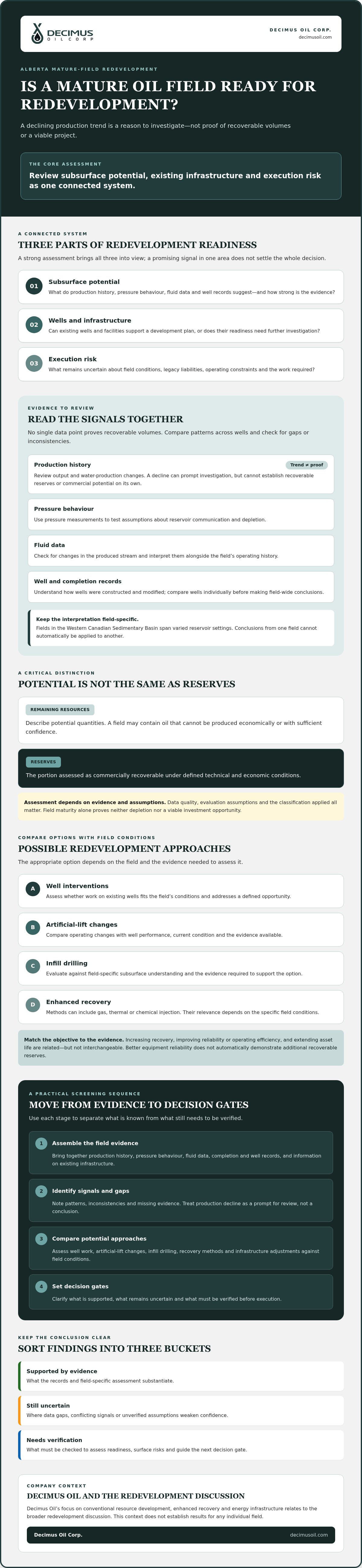
A Practical Screening Sequence for Mature Oil Field Redevelopment
A structured screening process helps operators move from a broad field review to a defensible investment decision without treating early indications as proven results. For mature oil field redevelopment Alberta assessments, document the evidence, remaining uncertainty and criteria for moving forward at each stage.
Build a defensible field and well inventory
Start with a consistent inventory of well status, production history, completion information, facilities and known integrity issues. Include surface access, operating capability, infrastructure condition and known environmental obligations. For each material data point, record its source, date and confidence level. This makes it easier to separate verified records from assumptions and identify gaps that could change candidate rankings or project scope.
Screen candidates and compare options
Review wells and areas against the same criteria while preserving important differences between them. A candidate with encouraging production behaviour may still be constrained by uncertain well integrity, limited facility capacity or access requirements. Consider remaining potential alongside technical readiness, infrastructure fit and execution uncertainty. The aim is to prioritize what merits further work, not to imply that one indicator establishes commercial viability.
Progress through evidence-based decision gates
- Data review: Assemble and validate subsurface, well, production and facility records. Remaining uncertainty: whether key records are complete and comparable.
- Candidate screening: Rank wells or areas using consistent technical and operational criteria. Remaining uncertainty: whether the strongest candidates have a sufficiently supported development case.
- Technical options: Define plausible interventions, operating changes, drilling or recovery concepts and the evidence each requires. Remaining uncertainty: how the reservoir and existing assets will respond.
- Risk review: Assess well and facility condition, operating capability, surface access, environmental obligations and execution dependencies. Remaining uncertainty: whether identified risks can be managed within the proposed scope.
- Decision gate: Compare outcomes under different assumptions and set explicit stop, test or proceed criteria. Remaining uncertainty: whether the opportunity remains robust when assumptions change.
Sensitivity analysis is more informative than relying on a single recovery assumption or unsupported forecast. Test how the decision changes when uncertain inputs vary, then identify which data would most improve confidence before committing to broader execution.
Regulatory requirements and approvals depend on the proposed activity and applicable circumstances. Confirm current Alberta Energy Regulator requirements before planning or proceeding. Do not assume that an approval pathway for one type of work applies to another. A clear record of assumptions, unresolved risks and decision criteria supports disciplined planning and later review.
To learn more about Decimus Oil’s focus on conventional resource development, enhanced oil recovery and energy infrastructure, review the company’s resource development focus.
How Decimus Oil Fits the Alberta Mature-Field Redevelopment Discussion
Mature oil field redevelopment Alberta depends on connecting subsurface potential with practical execution. Reservoir interpretation can indicate where opportunity may exist, but recovery planning also needs to account for well condition, operating capability and infrastructure readiness. This integrated perspective is a useful way to assess an asset, not evidence that a particular company owns a field or has achieved a redevelopment result.
Decimus Oil Corp. focuses on conventional oil and gas exploration, resource development, enhanced oil recovery and energy infrastructure, with a focus on the Western Canadian Sedimentary Basin. These areas intersect with the broader redevelopment framework: conventional resource development relates to evaluating established assets, enhanced recovery to potential ways of improving recovery, and infrastructure to the systems needed to support operations. This connection provides context, not confirmation of a specific project, field interest or technology deployment.
Connecting resource potential with execution capability
A redevelopment concept becomes more credible when its technical case and operating requirements are considered together. For example, a recovery opportunity may depend on whether reservoir evidence supports the proposed method and whether existing or planned facilities can accommodate its operating needs. The same integrated assessment applies to conventional development: resource potential alone does not establish readiness to proceed.
Decimus’s stated business focus fits within this wider relationship between resource development, recovery and infrastructure. For broader commercial context, see this oil and gas exploration economics analysis. It can help readers consider how technical potential and execution requirements inform commercial evaluation, without substituting general discussion for project-specific evidence.
What readers should verify before drawing company conclusions
Company strategy and verified asset-level activity are different kinds of information. Before associating Decimus with a particular Alberta redevelopment opportunity, review current corporate disclosures for assets, operating interests and project-stage details. Confirm that reported activity is current, and distinguish stated strategic priorities from completed work, planned work or independently assessed results.
Corporate experience and insider-ownership figures can change over time, so verify them against current company materials before citing them. Decimus is publicly traded on the TSX Venture Exchange as TSXV:WCSB, but listing status does not establish the merits or outcome of an individual project. Apply the same discipline to every opportunity: assess the evidence, verify company disclosures and treat potential as a basis for further evaluation, not a guarantee of production or commercial success.
For company information, Explore Decimus Oil’s conventional resource development focus.
Turn Field Evidence Into a Clearer Next Step
Mature oil field redevelopment Alberta decisions are strongest when reservoir evidence, well condition, recovery options and infrastructure are assessed as one system. Production trends can identify questions to investigate, but they don’t establish recoverable reserves or commercial viability on their own. A staged screening process helps operators compare options, expose data gaps and set clear criteria for testing, proceeding or stopping.
Decimus Oil Corp. focuses on conventional resource development, enhanced oil recovery and energy infrastructure. The company is listed on the TSX Venture Exchange as TSXV:WCSB and reports more than 100 years of combined team experience. Confirm current corporate disclosures before relying on that experience figure. These details provide company context, not proof of a particular field interest or redevelopment outcome.
To learn more about Decimus Oil’s stated focus and public information, explore Decimus Oil’s conventional resource development focus. Apply the same discipline to any opportunity: verify the evidence, understand the remaining uncertainty and let project-specific findings guide the next step. A careful assessment can turn mature-field questions into a more informed path forward.
Frequently Asked Questions
What is mature oil field redevelopment in Alberta?
Mature oil field redevelopment in Alberta is the reassessment and improvement of an established field that may still contain recoverable resources. Depending on field evidence, work could involve well interventions, operating changes, drilling, infrastructure adjustments or enhanced recovery. The term describes an assessment and development approach, not a promise of commercial success. Operators need to evaluate reservoir information, well condition, operating requirements and project risks before deciding whether an opportunity merits further investment.
How do operators identify redevelopment opportunities in mature Alberta oil fields?
Operators identify potential opportunities by reviewing production and pressure history, fluid behaviour, well and completion records, facility capacity and well integrity. They can then compare wells or areas, investigate uncertainties and assess whether a practical development plan is supportable. For example, a production decline may flag a candidate for review, but it doesn’t establish that additional recovery is feasible. Available data and screening methods vary by asset, so conclusions must be field-specific.
Can a mature oil field still have recoverable oil?
Yes. A field’s age or declining production doesn’t, by itself, show that all recoverable oil has been produced. Remaining potential depends on reservoir characteristics, prior development, well condition, recovery options, infrastructure and commercial factors. Resource estimates and production forecasts are field-specific and uncertain. They rely on data and assumptions that can change, so interpret them using the relevant classification and evaluation basis, not as a guarantee of future output or project value.
What redevelopment methods can be used in Alberta oil fields?
Potential methods include targeted well work, artificial-lift changes, infill drilling, waterflooding and other enhanced recovery approaches. The appropriate option depends on reservoir behaviour, existing completions, well integrity, infrastructure capacity and operating constraints. For instance, a waterflood concept requires evidence that the reservoir and injection requirements support further evaluation. Methods used successfully in one field may not transfer directly to another; technical assessment and current regulatory review are essential before planning activity.
How important is existing infrastructure when redeveloping an oil field?
Infrastructure can determine whether a redevelopment concept is practical, but its presence alone doesn’t establish readiness or economic value. Operators should assess facility condition and capacity, gathering and transportation access, water handling and the requirements of the proposed operations. They also need to confirm relevant ownership, operating arrangements and approvals. A mismatch between facility capacity and the development plan may require changes or further investigation before the opportunity can be evaluated confidently.
What Alberta regulations apply to mature oil field redevelopment?
Applicable requirements and approvals depend on the asset, proposed activity and operating context. Work involving wells, facilities, production or environmental obligations may have different regulatory considerations. The Alberta Energy Regulator is a key provincial regulator, but a general overview can’t establish the approval pathway for a particular project. Confirm current requirements against official AER guidance and seek qualified regulatory advice before planning or conducting work, especially if the project scope or asset status changes.
How can investors assess a mature-field redevelopment opportunity?
Investors can review current company disclosures for asset interests, production history, project stage, capital plans and stated technical assumptions. Distinguish resource potential from reported reserves, and proposed activity from work already completed. Consider commodity exposure, financing, execution and regulatory risks as part of the assessment. This mature oil field redevelopment Alberta framework is educational, not investment advice. Verify current filings and consult an independent adviser as appropriate before making investment decisions.


