
A discovery is only the starting point. Hydrocarbon resource development depends on a series of decisions: whether geological evidence supports a viable project, how it should be engineered and operated, and how the asset can be managed over time. A promising subsurface indication alone doesn’t establish that production will be technically, commercially or environmentally viable.
Specialist terms can make it difficult to see how exploration, engineering, production and recovery fit together. Each stage builds on earlier evidence and choices, while uncertainty, market conditions and Canadian regulatory and environmental requirements can influence the path forward.
This article follows the lifecycle from geological assessment through development planning, production and asset stewardship. It explains how subsurface data, engineering design and economic screening inform project choices, and how operating efficiency and enhanced oil recovery may help optimize existing assets when technically and economically appropriate. Together, these stages show how disciplined decisions shape a resource’s progression from evidence to production.
Key Takeaways
- Hydrocarbon resource development involves more than identifying a resource. Distinguish subsurface evidence from technical recoverability and commercial viability.
- Trace how geological interpretation, seismic and well data, appraisal and engineering inform decisions about development readiness.
- Compare project options using subsurface confidence, recoverability, infrastructure, approvals and commercial assumptions, and make uncertainty visible.
- Understand how production monitoring, maintenance, well integrity and potential enhanced oil recovery contribute to asset stewardship.
- See how Decimus Oil Corp.’s stated focus on conventional exploration, resource development, enhanced oil recovery and energy infrastructure connects to the broader asset lifecycle.
What Hydrocarbon Resource Development Means for an Energy Project
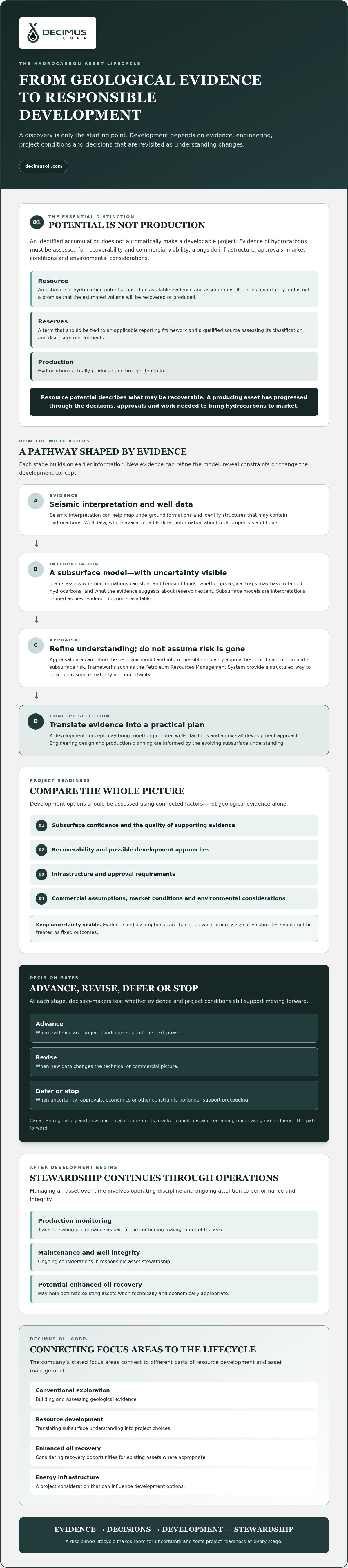
Hydrocarbon resource development is the process of evaluating subsurface potential, preparing a project and managing it towards possible production. It connects geological assessment with project design, approvals, development, operations and long-term asset stewardship. At each stage, teams test whether the evidence and assumptions still support moving forward.
An identified accumulation is not automatically a developable project. Geological evidence may indicate hydrocarbons, but further work must assess whether they can be recovered using suitable methods and whether a project could be commercially viable under its assumptions. Infrastructure, approvals, market conditions and environmental considerations can also affect the decision. Uncertainty remains, and a project may be revised, deferred or stopped at any stage.
Resource, reserve and production: what do the terms mean?
A resource is an estimate of hydrocarbon potential based on available evidence and assumptions. It carries uncertainty, so it isn’t a promise that the estimated volume will be recovered or produced. Exploration methods and geological factors that inform early assessments are outlined in Hydrocarbon exploration.
Reserves shouldn’t be used as a casual synonym for resources. The term needs to be tied to an applicable reporting framework and a qualified source that can assess whether the project meets the framework’s classification and disclosure requirements. Production refers to hydrocarbons actually produced and brought to market. These terms describe different levels of evidence and project maturity.
Why development is a sequence of decisions, not a single event
Evidence and assumptions are updated as work progresses. Geological interpretation may guide appraisal, appraisal results can refine understanding of the reservoir, and that understanding informs engineering design and production planning. Each step may reveal new constraints or opportunities, so early estimates shouldn’t be treated as fixed outcomes.
At each stage gate, decision-makers consider whether to:
- Advance when evidence and project conditions support the next phase.
- Revise the development concept when new data changes the technical or commercial picture.
- Defer or stop if uncertainty, approvals, economics or other constraints no longer support proceeding.
Resource potential describes what may be recoverable; a producing asset is a project that has progressed through the decisions, approvals and work needed to bring hydrocarbons to market. This distinction helps readers assess project claims without confusing geological promise with operating results.
How Hydrocarbon Resources Progress from Geological Evidence to Development
Moving from a geological indication to a development concept requires evidence to be assembled, tested and translated into a practical plan. Seismic interpretation can help geoscientists map underground formations and identify structures that may contain hydrocarbons. Well data, where available, adds direct information about rock properties and fluids. Neither source removes uncertainty: subsurface models are interpretations that are refined as new evidence becomes available.
From geological interpretation to a development concept
Teams assess whether formations have the properties needed to store and transmit fluids, whether geological traps may have retained hydrocarbons, and how the evidence supports estimates of reservoir extent. Appraisal data can refine the model and inform possible recovery approaches, but it cannot eliminate subsurface risk. Classification frameworks such as the Society of Petroleum Engineers’ Petroleum Resources Management System (PRMS) provide a structured way to describe resource maturity and uncertainty.
A simplified path from evidence to a concept looks like this:
Evidence (seismic interpretation and well data) → Interpretation (subsurface model and uncertainty) → Concept selection (potential wells, facilities and development approach)
In practical hydrocarbon resource development, a concept is a working proposal, not a production forecast. If appraisal results differ from expectations, the model and project options may need to change. A useful review records which observations support the model, which assumptions remain untested and what additional information could affect the decision.
How engineering and approvals shape readiness
Once available evidence supports a concept, engineering connects the reservoir plan to the systems needed to develop it. Well design must reflect subsurface conditions, surface facilities must suit anticipated operating needs, and transportation access must be considered as part of the project plan. When configuring surface treatment and fluid processing systems, engineering teams often look to industrial separation specialists like Sacor Engineering to meet demanding technical specifications. These elements are interdependent: a change in well configuration or site conditions can affect facility design and the overall development approach.
Approval and consultation requirements depend on the project and jurisdiction. In Canada, confirm the applicable review pathway for the specific project rather than assuming that a general description applies. Project design must account for relevant requirements alongside technical and commercial considerations; no single review guarantees that a project will proceed.
- Interpret: Combine geological, seismic and well evidence into a working subsurface model.
- Appraise: Gather and assess further information to refine reservoir understanding.
- Design: Evaluate well, facility and infrastructure options against site conditions.
- Confirm readiness: Review technical feasibility, commercial assumptions, approvals and consultation needs before deciding whether to proceed.
A project is ready to advance only when its technical design, commercial case and applicable approval pathway have been assessed together. To learn more about a Canadian company focused on exploration and resource development, review Decimus Oil Corp. company information.
How to Evaluate Hydrocarbon Development Options and Project Readiness
A sound project review separates two questions: Can the resource be developed technically? and Does the proposed development make commercial sense under its stated assumptions? A project may appear technically feasible yet remain commercially unattractive, or it may need more evidence before either question can be answered. In hydrocarbon resource development, decision-makers should record what is known, what is assumed and where uncertainty remains.
Which technical and commercial questions should decision-makers ask?
Start by testing the quality and limits of the available data. How well is the reservoir understood? What recovery range is supported by the evidence? Which engineering constraints could affect wells, facilities or operations? Then examine the commercial inputs, including commodity price assumptions, capital and operating requirements, infrastructure access and project timing. Date each input, identify its source where possible, and label it clearly as an estimate or assumption.
Sensitivity analysis tests how a project’s outlook changes when important assumptions shift. For example, decision-makers can compare cases with different price, recovery, capital or timing assumptions. This doesn’t predict which scenario will occur; it shows which variables most influence the decision. For further context on economic drivers, see the Canadian oil and gas exploration economics guide.
| Screening factor | Questions to assess | What to document |
|---|---|---|
| Subsurface confidence | How reliable and complete are the geological and well data? | Evidence, gaps and key uncertainties. |
| Recoverability | Do reservoir characteristics and engineering options support a credible recovery concept? | Recovery assumptions and technical constraints. |
| Infrastructure | Are facilities and transportation access available or part of the proposed scope? | Dependencies, capacity questions and unresolved requirements. |
| Approvals | Which project-specific approvals and consultation requirements need confirmation? | Applicable pathway, responsible parties and outstanding steps. |
| Commercial assumptions | How sensitive is the case to prices, capital, operating needs and timing? | Sources, dates, scenarios and decision thresholds. |
How do development choices differ across an asset lifecycle?
The right comparison depends on the asset’s maturity. During appraisal, continued evaluation may be preferable while key subsurface questions remain open. For a sufficiently understood opportunity, compare a new development concept with deferral. At a producing asset, assess optimization options alongside maintaining current operations. Deferral is a legitimate choice when evidence, approvals or commercial conditions are insufficient, not a failure to make a decision.
Criteria and decision thresholds vary by asset, jurisdiction and company strategy. Compare options consistently, but don’t assume one path is universally best. A sound decision makes its technical basis, commercial assumptions and remaining uncertainty transparent.
How Operating Discipline, Regulation and Recovery Shape Asset Stewardship
Once production begins, development shifts into a continuing cycle of operation, monitoring and reassessment. Asset stewardship means managing production and infrastructure while tracking performance, maintaining equipment and protecting well integrity. These activities support reliable operations and help identify issues before they affect production or require a change in the operating plan.
What changes when a resource becomes a producing asset?
Operators compare actual production data with expectations, coordinate maintenance with facility and transportation needs, and review whether wells are performing as intended. If results differ from the plan, technical and commercial assumptions may need to be revisited. That may lead to operating adjustments, further evaluation or a change in investment priorities. Production history informs decisions, but it doesn’t guarantee future performance.
Enhanced oil recovery (EOR) may be considered for an existing asset when reservoir characteristics and project economics support further evaluation. It isn’t suitable for every field, and no method guarantees increased output. Review enhanced oil recovery techniques for a closer look at methods and asset-level considerations.
Stewardship also includes environmental performance and planning for the end of an asset’s operating life. Project teams should assess emissions, water use and management, land disturbance, and eventual closure and reclamation planning. Specific measures and obligations depend on the asset and applicable approvals, so these topics belong in operational planning rather than being left until production declines.
How Canadian oversight and environmental responsibilities fit in
Regulatory responsibilities in Canada depend on a project’s scope and jurisdiction. Federal responsibilities may apply in some cases, while provincial or territorial requirements may apply in others; relevant approval and consultation processes also vary. Consult current official guidance from the Canada Energy Regulator, Environment and Climate Change Canada, and the relevant provincial or territorial regulator to confirm which requirements and approval pathways apply. Don’t assume that one project’s process applies to another.
Regulatory obligations, environmental requirements and approval pathways must be checked for each project against current official guidance. This is particularly important when project scope, location or operating conditions change, since those details can affect which authorities and requirements are relevant.
For a Canadian example of a company focused on conventional exploration, resource development, enhanced oil recovery and energy infrastructure, explore Decimus Oil Corp.’s asset development focus.
How Decimus Oil Corp. Approaches Hydrocarbon Resource Development
Decimus Oil Corp. offers a company example of how exploration, resource development, recovery methods and infrastructure relate across an asset lifecycle. The company focuses on conventional oil and gas exploration, resource development, enhanced oil recovery (EOR) and energy infrastructure. These stated areas of focus aren’t evidence that a particular resource will be developed or that a project will achieve a specific result.
How exploration, recovery and infrastructure connect
Exploration builds subsurface understanding that can be used to assess resource potential. If an asset is producing, EOR may be considered as one possible way to optimize it, subject to reservoir-specific technical and economic evaluation. Infrastructure is another planning consideration: existing or proposed facilities and transportation access can affect the options available for developing a resource. Company information doesn’t establish details about specific assets, infrastructure or project outcomes.
These connections help explain why hydrocarbon resource development is broader than exploration alone. Each capability relates to a different decision point, and its relevance depends on project evidence, operating context and commercial assumptions. Readers seeking general investor context can also review a guide to public equity in the energy sector. It’s optional background, not investment advice or a recommendation.
What readers can review before forming a view
Company strategy and project-specific evidence answer different questions. A stated focus describes the areas in which a company is active; it doesn’t, by itself, confirm the quality or commercial viability of a particular resource. Before forming a view, readers can independently review current company disclosures and relevant exchange information, checking dates, definitions and stated assumptions.
- Company focus: Confirm the activities and strategic priorities described in current disclosures.
- Project evidence: Look for project-specific information and distinguish estimates from reported results.
- Investment risk: Consider uncertainty, market conditions and other risks independently. Company strategy doesn’t guarantee investment performance.
Keeping those distinctions clear supports a more grounded assessment of how an operator’s stated activities fit into the asset lifecycle. To learn more about the company and its stated areas of focus, explore Decimus Oil Corp.
Make the Next Development Decision With Clarity
Hydrocarbon resource development is a sequence of evidence-led choices, not a guaranteed path from discovery to production. Geological interpretation and appraisal inform whether a resource may be recoverable, while engineering, infrastructure, approvals and commercial assumptions shape whether a project can advance. Once operations begin, monitoring, maintenance and appropriate recovery strategies support ongoing asset stewardship.
The central discipline is to keep uncertainty visible. Compare technical feasibility with commercial viability, revisit assumptions as evidence changes, and recognize that advancing, revising, deferring or stopping can each be a sound decision. For producing assets, performance data can guide operating and investment choices, while enhanced oil recovery may merit consideration only when technical and economic evaluation supports it.
Decimus Oil is a Canadian company focused on conventional oil and gas exploration and resource development, with stated areas of focus that include enhanced oil recovery and energy infrastructure. To learn more about its company focus, explore Decimus Oil.
Frequently Asked Questions
What is hydrocarbon resource development?
Hydrocarbon resource development is the process of assessing subsurface potential, planning a possible project and managing it through potential production and ongoing operations. It connects geological evidence with appraisal, engineering, approvals, commercial screening and asset stewardship. An identified resource isn’t automatically recoverable or profitable. Decisions depend on the quality of available evidence, project-specific requirements and changing technical and commercial assumptions.
What are the main stages of hydrocarbon resource development?
The main stages generally include geological interpretation, appraisal, development concept selection, engineering and project planning, applicable approvals, construction or other development work, production and asset stewardship. The sequence isn’t always linear: new well or operating data may prompt a revised plan or further assessment. At decision points, a company may advance, change, defer or stop a project based on evidence, requirements and commercial assumptions.
How do companies determine whether a hydrocarbon resource is commercially viable?
Companies assess whether a resource can be developed technically and whether expected project economics support proceeding. They consider subsurface confidence, recoverability, engineering constraints, infrastructure, approvals, production assumptions, capital and operating requirements, prices and timing. These inputs should be clearly identified as estimates or assumptions. Sensitivity analysis tests how changes in key factors could affect the case; it doesn’t guarantee future results or remove uncertainty.
What is the difference between a hydrocarbon resource and a reserve?
A resource is an estimate of hydrocarbon potential based on available evidence and assumptions, with uncertainty about what may ultimately be recovered. A reserve is a more specific classification and should be reported only under an applicable framework, using a qualified source. The terms aren’t interchangeable. Neither should be confused with production, which refers to hydrocarbons actually produced and brought to market.
Can enhanced oil recovery be used on every producing field?
No. Enhanced oil recovery (EOR) isn’t suitable for every producing field, and no method can be assumed to increase output in every case. Whether it merits consideration depends on reservoir characteristics, existing operations, engineering requirements and economic screening. An operator needs to assess the specific asset and available evidence before selecting an approach. EOR is one potential asset-optimization strategy, not a universal solution or guaranteed outcome.
What Canadian regulations apply to hydrocarbon resource development?
Applicable requirements depend on the project’s scope and jurisdiction. Federal responsibilities may apply in some cases, while provincial or territorial requirements may apply in others; relevant approval and consultation processes also vary. There isn’t one approval pathway that fits every project. Companies and readers should verify current requirements, regulator responsibilities and environmental obligations using official guidance from the authorities relevant to the specific project.
What happens if a hydrocarbon development project is not economically viable?
If a project doesn’t meet its commercial criteria, decision-makers may revise the development concept, gather more evidence, defer work or stop the project. They may also reassess assumptions such as prices, infrastructure access, timing, operating requirements or recoverability. For an existing producing asset, options may differ from those for an undeveloped resource. Deferral or stopping can be a disciplined decision when uncertainty or economics don’t support proceeding.


