

What turns a promising geological indication into a defensible development decision? Hydrocarbon resource appraisal Canada brings together subsurface evidence, engineering assumptions, uncertainty analysis, and commercial considerations to assess what may be recoverable and under what conditions. A precise-looking estimate is only useful when its evidence and assumptions are clear.
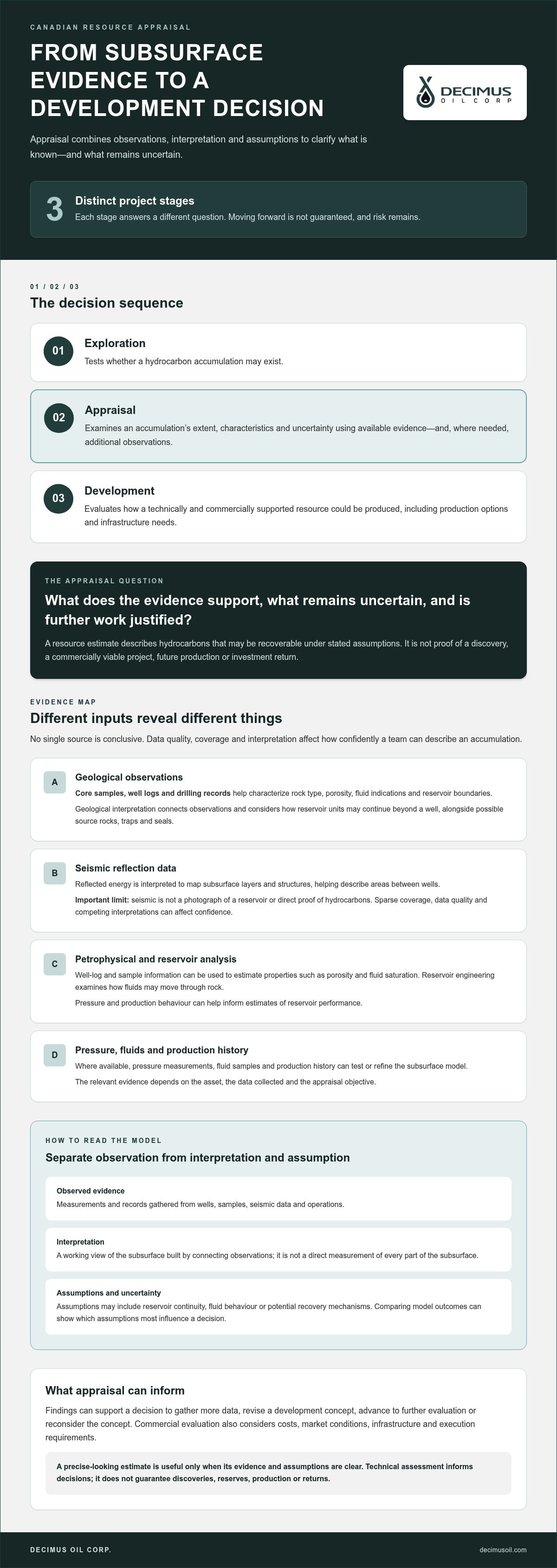
Exploration tests whether an accumulation may exist; appraisal reduces uncertainty about its scale and characteristics; development determines how to produce it. Each stage answers a different question. None removes geological or operational risk, and estimates are evidence-based assessments, not guarantees of discoveries, reserves, production, or returns.
This article explains how appraisal uses geological interpretation, seismic data, well results, and production performance, and how different methods can strengthen or limit a resource estimate. It also examines how uncertainty, Canadian reporting practices, market conditions, and project economics shape decisions, from gathering more evidence to advancing, revising, or deferring development. The goal is to show how technical analysis can support practical decisions.
Key Takeaways
- See how exploration, appraisal, and development differ, and why each stage answers a distinct project question.
- Learn how geological observations, seismic interpretation, well data, and engineering assumptions contribute to an integrated subsurface view.
- Compare appraisal methods by the evidence they use, what they can reveal, and where their limitations matter.
- Understand how hydrocarbon resource appraisal Canada uses uncertainty analysis to support decisions without treating estimates as guarantees.
- Follow a flexible workflow for turning appraisal findings into practical technical, operational, and commercial decision gates.
What hydrocarbon resource appraisal in Canada tells decision-makers
Hydrocarbon resource appraisal evaluates a discovered or prospective accumulation using available geological, geophysical, engineering, and operational evidence. The aim is to reduce uncertainty and inform the next decision. In hydrocarbon resource appraisal Canada, the central question isn’t simply how much oil or gas might be present. It’s what the evidence supports, what remains uncertain, and whether further work or a development concept is justified.
What does hydrocarbon resource appraisal mean?
The appraisal question depends on the geology, the maturity of the data, and the project objective. Early work may assess whether an interpreted accumulation warrants further investigation. As information grows, the focus may shift to its extent, reservoir characteristics, potential recovery, or development options. Appraisal tests interpretations against evidence; it doesn’t turn uncertainty into certainty.
An estimated resource describes hydrocarbons that may be recoverable under stated assumptions; it is not proof of a discovery, a commercially viable project, future production, or investment return. Resource and reserve terms have distinct meanings and classifications; this resource and reserve classification overview introduces concepts used in global reporting frameworks.
That distinction separates technical assessment from the subsequent investment decision. A resource estimate can inform whether to gather more data, revise a development concept, or proceed to further evaluation. Commerciality also depends on costs, market conditions, infrastructure, and execution requirements. These factors shape a decision, but they don’t change the geological evidence itself.
How appraisal differs from exploration and development
Exploration tests whether a hydrocarbon accumulation may exist. Appraisal refines understanding of an accumulation by examining its characteristics and uncertainty. Development addresses how a technically and commercially supported resource could be produced, including the design and operational choices needed to advance a project.
Consider a hypothetical sequence. Exploration identifies evidence consistent with a possible accumulation. Appraisal uses available data, and potentially additional observations, to examine its extent and reservoir behaviour. If the evidence supports further advancement, development planning can evaluate production options and infrastructure needs. If important uncertainties remain, a team may seek more information or reconsider the concept. This is a decision sequence, not a guaranteed progression or fixed timetable.
For Canadian resource development, appraisal is most useful when it makes the basis of a decision explicit: which conclusions rest on observations, which depend on interpretation, and which assumptions still carry material uncertainty. That clarity helps decision-makers distinguish a technically promising opportunity from one ready to advance to development.
How Canadian appraisal combines geology, seismic data, and engineering
Appraisal draws on multiple evidence sources. A well may provide direct information about rocks and fluids at one location, while seismic data helps interpret subsurface structure between wells. Geological interpretation connects those observations into a working model. No source is conclusive on its own: data quality, coverage, and interpretation all affect how confidently a team can describe an accumulation.
Geological and geophysical evidence
Core samples, well logs, and drilling records can help characterize rock type, porosity, fluid indications, and reservoir boundaries. Geologists use these observations to interpret whether reservoir units may continue beyond a well and how they relate to possible source rocks, traps, and seals. A Geological Survey of Canada publication on mapping hydrocarbon potential illustrates how petroleum system elements inform an assessment. This is evidence-based interpretation, not confirmation that hydrocarbons have been discovered or can be produced commercially.
Seismic reflection data adds another perspective. It records reflected energy that specialists interpret to map subsurface layers and structures. It isn’t a photograph of a reservoir or direct proof of hydrocarbons. Sparse coverage, data quality, and competing interpretations can affect confidence. Appraisal should therefore distinguish measured observations from the interpretations built on them.
Reservoir and production analysis
Petrophysical analysis uses well-log and sample information to estimate properties such as porosity and fluid saturation. Reservoir engineering examines how fluids may move through rock and how pressure and production behaviour can inform estimates of reservoir performance. Where available, pressure measurements, fluid samples, and production history can test or refine the subsurface model. The relevant evidence depends on the asset, the data collected, and the appraisal objective.
Engineers combine these inputs with explicit assumptions, such as reservoir continuity, fluid behaviour, or potential recovery mechanisms. The resulting model is an interpretation supported by evidence, not a direct measurement of every part of the subsurface. Comparing model outcomes can show which assumptions most influence a decision. Commercial evaluation then considers how technical possibilities align with infrastructure, market conditions, and project requirements. For a related view of how market and financial factors inform decisions, see this oil and gas exploration economics guide.
Evidence-to-decision sequence:
- Compile and quality-check available well, seismic, geological, and production data.
- Interpret the evidence and build an integrated subsurface model.
- Test key assumptions, uncertainty, and possible reservoir behaviour.
- Use the findings to inform the next appraisal or development decision.
This integrated approach is central to hydrocarbon resource appraisal Canada: evidence can inform a decision only when its limits and assumptions remain visible. Decimus Oil’s conventional exploration and resource development focus connects these appraisal principles to disciplined project evaluation.
How appraisal methods compare, and why resource estimates remain uncertain
No single estimation method fits every accumulation. The choice depends on the evidence available, the reservoir’s characteristics, and the question decision-makers need answered. In hydrocarbon resource appraisal Canada, comparing methods helps clarify which conclusions are supported by observations and which rely more heavily on assumptions.
Volumetric and performance-based approaches
Volumetric estimation builds a model from interpreted reservoir area, thickness, porosity, fluid saturation, and recovery assumptions. It can be useful when direct production evidence is limited, but results depend on how well those inputs represent the subsurface. Performance-based analysis draws on observed production or pressure behaviour when suitable data exist. It can help test assumptions about reservoir response, but its usefulness depends on the quality and relevance of the operating history.
| Approach | Typical inputs | What it can show | Key limitation |
|---|---|---|---|
| Volumetric | Interpreted dimensions and reservoir properties | Potential scale based on a subsurface model | Results are sensitive to model inputs and recovery assumptions |
| Performance-based | Production, pressure, and fluid behaviour | How the reservoir has responded under observed conditions | Requires relevant, sufficiently informative operating data |
| Integrated | Geological, seismic, well, and engineering evidence | How independent lines of evidence support or challenge one another | Conflicting data and interpretation choices still require judgement |
These approaches can complement one another. A volumetric model may provide an initial estimate, while observed performance can help refine or challenge its assumptions. Neither method guarantees recoverable production. An appraisal estimate is based on available evidence and stated assumptions; it isn’t a promise that a project will produce hydrocarbons or be commercially viable.
Uncertainty, classification, and Canadian disclosure
Estimates can change when new well information, production history, or improved interpretations alter the model. Resource estimates change as evidence improves because new data can revise both the subsurface interpretation and the assumptions used to estimate potential recovery. Data gaps, uncertain reservoir continuity, and alternative geological interpretations can all affect the result. A range or classification communicates uncertainty; it shouldn’t be mistaken for a production guarantee.
In Canada, National Instrument 51-101 (NI 51-101) sets securities-disclosure requirements for reporting issuers’ oil and gas activities, while the Canadian Oil and Gas Evaluation Handbook (COGEH) provides guidance used in evaluating and reporting oil and gas resources and reserves. Their roles are distinct from the technical work itself: an evaluation estimates resources under defined assumptions, while securities disclosure communicates relevant information to investors under applicable requirements. Neither is investment advice, and disclosing an estimate doesn’t establish commercial success.
A practical Canadian appraisal workflow: from data review to decision gates
A useful appraisal workflow starts with the decision at hand, not a predetermined list of studies. A team evaluating a conventional asset might need to determine whether the evidence supports another technical investigation, a revised development concept, or a decision to defer. Tailor the sequence to the asset, the available records, and the uncertainty that matters most.
A staged workflow for evaluating an asset
- Define the decision and objective. State what the appraisal must help resolve, such as reservoir continuity, expected performance, or the suitability of a potential development concept. Frame questions that can be addressed with evidence.
- Review available records. Organize relevant well, geological, geophysical, petrophysical, pressure, fluid, and production information where available. Assess data quality and identify gaps, inconsistencies, or assumptions carried forward from earlier interpretations.
- Build an integrated interpretation. Bring relevant disciplines together to examine how the evidence supports or challenges the working subsurface model. Record alternative interpretations rather than treating one model as certain.
- Assess uncertainty and decision sensitivity. Identify which unknowns could change the next choice. Consider whether further information could resolve a material question or whether the decision remains robust across plausible interpretations.
- Document findings and set a decision gate. Summarize evidence, assumptions, confidence, unresolved issues, and the practical options: advance evaluation, revise the concept, gather targeted data, or defer.
More data isn’t automatically better. A proposed survey, test, or analysis is most useful when it addresses a specific uncertainty that could affect the decision. If additional information is unlikely to change the available choices, collecting it may add volume without adding decision value. This is a practical discipline for hydrocarbon resource appraisal Canada: make each information request serve a defined appraisal question.
Connect technical findings to development choices
Appraisal can inform whether a potential development concept merits further evaluation, but it doesn’t predetermine the outcome. Reservoir characteristics, recovery options, existing infrastructure, operating requirements, and commercial assumptions all affect how a technical interpretation translates into an asset-level choice. For example, access to infrastructure may shape which development concepts warrant examination, while reservoir behaviour may prompt consideration of alternative recovery strategies.
Enhanced oil recovery techniques can form part of the evaluation of recovery options for an asset. The appropriate choice depends on reservoir evidence and project requirements. Appraisal helps identify the questions to resolve before advancing a concept.
For perspective on how disciplined appraisal connects with conventional exploration and resource development, explore Decimus Oil.
From Canadian resource appraisal to disciplined development decisions
Appraisal becomes decision-ready when it connects the subsurface interpretation to the practical requirements of advancing an asset. The estimate is one input. Decision-makers also need to understand the strength of the evidence, the assumptions behind the interpretation, and the technical, operational, and commercial factors that could affect a development concept.
What a decision-ready appraisal should communicate
A clear appraisal summary identifies the resource interpretation and supporting evidence, then distinguishes observations from assumptions. It explains where confidence is stronger or weaker, which alternative interpretations remain plausible, and what unresolved questions could influence the next decision. If another well, test, or analysis is proposed, the rationale should explain how its results might change the available choices.
Technical potential is not the same as commercial viability. A reservoir may appear technically promising, yet development choices can also depend on recovery options, infrastructure access, operating requirements, market conditions, and execution risks. Assess these factors alongside the technical case, without treating an estimate as a guarantee of production or investment performance.
A useful decision gate might ask: does the current evidence support further evaluation, is targeted information needed to resolve a material uncertainty, or should the development concept be revised or deferred? Framing the question this way keeps appraisal focused on action rather than producing estimates without a clear decision purpose.
How Decimus approaches resource development
Decimus Oil Corp. is a Canadian energy company focused on conventional oil and gas exploration, resource development, energy infrastructure, and enhanced oil recovery. These areas connect subsurface understanding to development choices and the potential optimization of existing assets. Each project’s merits depend on its own evidence and circumstances.
The company describes its team as having more than 100 years of combined experience, and Decimus is publicly traded on the TSX Venture Exchange as TSXV:WCSB. These details provide corporate context, not proof of any specific appraisal outcome, resource estimate, or project performance.
Hydrocarbon resource appraisal Canada supports disciplined development when evidence, uncertainty, and commercial considerations are kept distinct but evaluated together. To learn more about Decimus Oil’s conventional exploration and resource-development focus, visit Decimus Oil.
Turn appraisal evidence into disciplined decisions
Hydrocarbon resource appraisal Canada brings geological, seismic, well, and engineering evidence together to inform what happens next. Its value lies not in removing uncertainty, but in showing which conclusions are supported, which assumptions matter, and whether further information could change a development decision.
Resource estimates are not guarantees of production or commercial success. Strong decision-making keeps technical potential distinct from infrastructure needs, recovery options, execution requirements, and commercial considerations. That discipline helps teams assess whether to advance an opportunity, refine the concept, gather targeted evidence, or defer.
Decimus Oil Corp. is a Canadian company focused on conventional oil and gas exploration, resource development, energy infrastructure, and enhanced oil recovery. It is publicly traded on the TSX Venture Exchange as TSXV:WCSB, with more than 100 years of combined team experience and more than 27% insider ownership. These facts provide company context, not a prediction of project results.
Explore Decimus Oil's Canadian resource-development focus to learn more about its approach to the sector. Evidence-led decisions can help guide responsible evaluation of Canada’s hydrocarbon opportunities.
Frequently Asked Questions
What is hydrocarbon resource appraisal in Canada?
Hydrocarbon resource appraisal in Canada evaluates subsurface and engineering evidence to better characterize a potential or discovered accumulation. It can help decision-makers determine whether to gather more data, assess development options, or take another step. Appraisal is distinct from exploration and production, and its conclusions depend on the quality of the evidence, interpretation, and assumptions. An estimate alone doesn’t guarantee commerciality, recoverable production, or future output.
How is resource appraisal different from exploration?
Exploration tests whether hydrocarbons may be present; appraisal refines understanding of an identified discovery or opportunity, including its extent, properties, and potential development options. The stages can involve overlapping data and activities, so the practical distinction is the decision being addressed. Appraisal strengthens the evidence base, but it doesn’t automatically establish commercial reserves or justify development. Further technical and commercial evaluation may still be needed before a project decision.
What data are used to appraise a hydrocarbon resource?
Depending on the asset and appraisal question, evaluators may consider geological interpretation, seismic data, well logs, core samples, fluid information, pressure observations, and production history. Not every project has all these inputs, and no single dataset resolves every uncertainty. Data quality and coverage matter. Evaluators interpret available evidence together, document how it supports the subsurface model, and identify gaps that could affect conclusions or the next decision.
How do evaluators estimate hydrocarbon resources?
Evaluators interpret relevant geological, geophysical, and engineering evidence, then apply methods suited to the asset and available data. Volumetric methods use modelled reservoir dimensions and properties. Performance-based methods may draw on observed production or pressure behaviour when suitable records exist. Both rely on assumptions, so estimates can change as evidence or interpretations improve. Canadian terminology and disclosure requirements should be checked against current authoritative sources for the specific context.
Does a resource appraisal guarantee that a Canadian oil or gas project will be profitable?
No. Appraisal assesses subsurface potential and uncertainty; it doesn’t guarantee that hydrocarbons can be produced economically or sold at a profit. Commercial decisions also depend on project costs, infrastructure, operating conditions, commodity markets, financing, and applicable requirements. Keep technical estimates separate from economic conclusions. An appraisal can inform investment analysis, but it isn’t itself an investment recommendation or proof of future production or returns.
When should a company update a hydrocarbon resource appraisal?
A company may update an appraisal when material new evidence or changed assumptions could affect the interpretation or decision. Examples include new well, seismic, pressure, or production information. The appropriate timing depends on the asset and the question decision-makers need to resolve. A useful update explains what has changed, how it affects the estimate or uncertainty, and whether the next step should change as a result.
What Canadian standards apply to hydrocarbon resource reporting?
Canadian oil and gas disclosure may involve National Instrument 51-101 (NI 51-101) and related guidance, including the Canadian Oil and Gas Evaluation Handbook (COGEH). Their specific application depends on the disclosure and circumstances, so consult current authoritative versions when assessing requirements. Technical appraisal and public reporting are related but distinct. A general article can explain the concepts, but it doesn’t replace a qualified evaluation or regulatory advice.


