
The best tertiary recovery method may be the one an operator rules out first. Comparing tertiary oil recovery processes Canada operators can consider means matching a recovery mechanism to reservoir conditions, operating constraints and project economics. It is not simply a matter of ranking technologies. The terminology can be difficult to sort, and potential recovery gains do not, by themselves, establish commercial viability.
Tertiary recovery is distinct from primary production and secondary methods such as water injection, although these approaches can overlap in the field. Each addresses oil that earlier recovery mechanisms leave behind, but the processes and conditions required differ. This article explains how thermal, gas-injection, chemical and emerging approaches work, where each may fit, and what can constrain implementation in Canada. It also outlines the evidence operators assess before advancing a project, including reservoir characteristics, infrastructure, emissions considerations, and uncertainty in performance and economics. The aim is a practical framework for understanding method selection, not a promise that any one process will deliver a particular recovery outcome.
Key Takeaways
- Tertiary recovery targets oil left after primary and secondary production, but field practices can overlap.
- Compare thermal, gas, chemical and emerging methods by their mechanisms, reservoir fit, operating demands and uncertainties.
- Assess reservoir properties alongside injectant supply, water handling, energy needs, infrastructure and operational complexity.
- A disciplined screening sequence moves from a reliable production and reservoir baseline to modelling, pilot design and performance review.
- Understanding tertiary oil recovery processes Canada operators may consider helps frame enhanced recovery as one option for developing assets, not a guaranteed production outcome.
What tertiary oil recovery means in the Canadian production lifecycle
Tertiary recovery uses additional mechanisms to mobilize or displace oil remaining in a reservoir after primary and secondary recovery. This working definition reflects the process categories described in the Enhanced oil recovery (EOR) overview. In practice, the labels describe recovery mechanisms, not rigid stages every field must complete in sequence. Operators may combine or adjust techniques as reservoir conditions and production objectives change.
That distinction matters when assessing tertiary oil recovery processes Canada operators might consider. A method’s potential depends on the reservoir and the project, so results or recovery estimates from another field are not reliable forecasts for a Canadian asset.
How tertiary recovery differs from primary and secondary recovery
Primary production draws on natural reservoir energy, such as pressure from expanding fluids or gas. Artificial lift may also be used to bring oil to the surface. Secondary recovery typically injects water or gas to support pressure or displace oil towards producing wells. Tertiary methods introduce additional physical or chemical mechanisms to act on oil that remains, such as heating it or changing how it flows through the reservoir.
These phases can overlap. An operation may continue pressure support while applying another recovery method. The label “tertiary” does not, by itself, indicate when a project should begin or how much additional oil it can produce.
Why Canadian context matters when interpreting recovery claims
Performance depends on interacting factors: oil viscosity and other fluid properties, reservoir temperature and pressure, permeability, geology, remaining-oil distribution, available facilities and operating conditions. A process that suits one reservoir may be unsuitable or uneconomic in another. Interpret project results in the context of the specific asset rather than generalizing across different formations and operating environments.
Use Canadian evidence where possible. Natural Resources Canada and the Canada Energy Regulator provide energy-sector information that can help explain national context. Match their materials to the question being assessed, rather than treating them as proof of a particular method’s performance. U.S. Department of Energy recovery estimates describe U.S. examples and should not be presented as Canadian expectations. International case studies can explain a mechanism, but local reservoir data and project-specific analysis are needed to assess its relevance.
For operators, the practical question is not simply whether a technique has worked elsewhere. It is whether reservoir evidence, facilities and operating requirements support a credible project case. Potential incremental recovery is a screening consideration, not a guaranteed production outcome.
How thermal, gas, chemical and emerging tertiary processes work
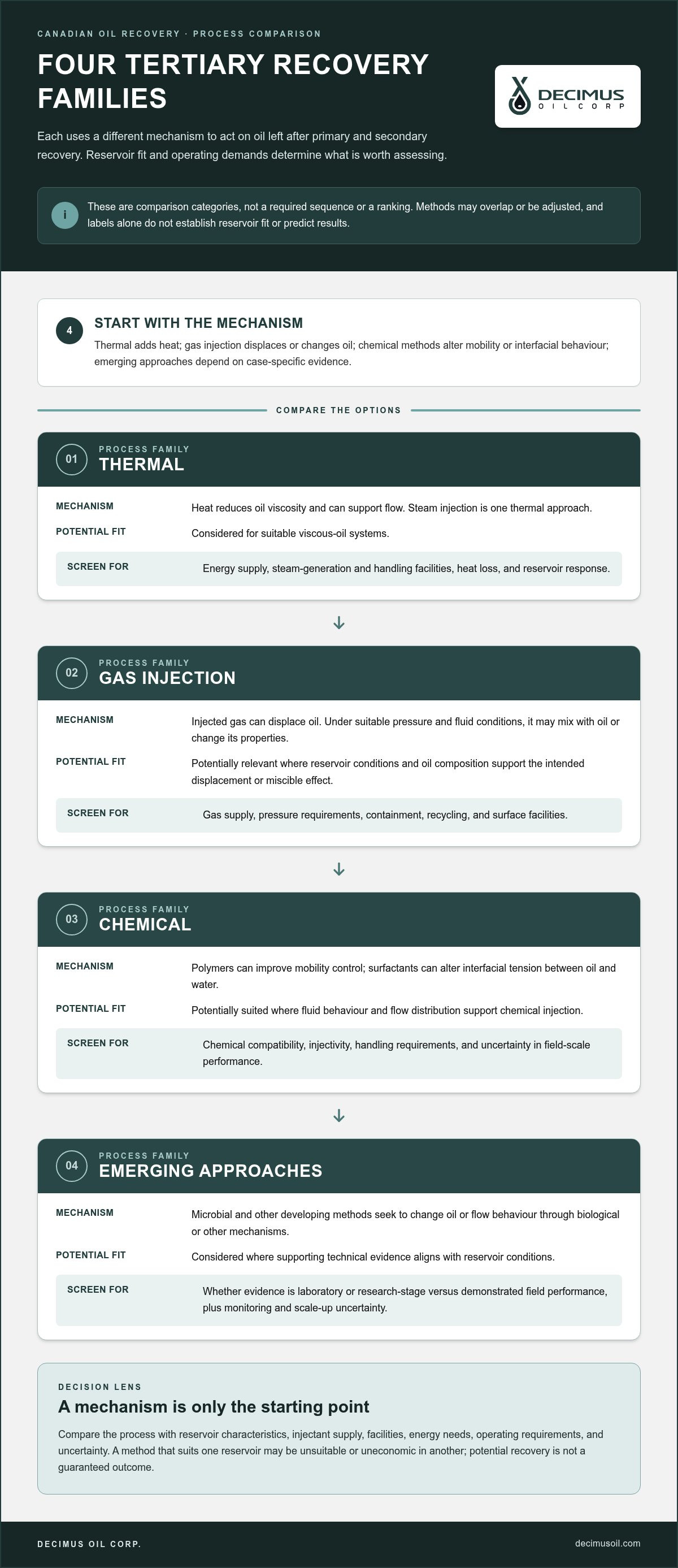
For a practical comparison, tertiary oil recovery processes Canada operators may assess fall into four broad families. Thermal methods add heat, gas injection uses gas to displace or alter oil, chemical methods change fluid mobility or interfacial behaviour, and emerging approaches such as microbial recovery depend more heavily on case-specific evidence. The U.S. Department of Energy outlines thermal, gas and chemical injection as the main tertiary (or enhanced) oil recovery (EOR) categories. These labels help organize options, but they do not establish reservoir fit or predict results.
| Process family | Mechanism | Potential fit | Operational demands and uncertainties |
|---|---|---|---|
| Thermal | Heat reduces oil viscosity and can support flow. | Considered for suitable viscous-oil systems. | Assess energy supply, steam-generation and handling facilities, heat loss and reservoir response. |
| Gas injection | Injected gas can displace oil. Under suitable pressure and fluid conditions, it may also mix with oil or change its properties. | Potentially relevant where reservoir conditions and oil composition support the intended displacement or miscible effect. | Evaluate gas supply, pressure requirements, containment, recycling and surface facilities. |
| Chemical | Polymers can improve mobility control, while surfactants can alter interfacial tension between oil and water. | Potentially suited to reservoirs where fluid behaviour and flow distribution support chemical injection. | Screen chemical compatibility, injectivity, handling requirements and uncertainty in field-scale performance. |
| Emerging approaches | Microbial and other developing methods seek to change oil or flow behaviour through biological or other mechanisms. | Considered where supporting technical evidence aligns with reservoir conditions. | Distinguish laboratory or research-stage potential from demonstrated field performance. Assess monitoring and scale-up uncertainty. |
Thermal and gas-injection processes
Steam injection is one thermal approach. Added heat can lower viscosity, but practicality depends on the oil system, reservoir characteristics, and the energy and facilities required. It is not a default choice for every Canadian asset. Gas options include carbon dioxide, nitrogen and natural gas. Their behaviour varies: displacement may be immiscible, while miscible or near-miscible effects depend on pressure, gas composition and oil properties. The Department of Energy’s overview also references carbon dioxide injection as an example. A field example can help explain a process, but it is not a universal performance benchmark.
Chemical and emerging recovery methods
Polymer and surfactant approaches are not interchangeable. Polymers can improve the mobility balance between injected and produced fluids, while surfactants can affect how oil and water interact. Microbial and other emerging methods warrant particular care in interpretation. Research or laboratory results do not, on their own, establish commercial field performance. Assess the technical evidence against the target reservoir.
For Canadian resource development, method selection starts with evidence and operational fit, not a technology label. Decimus Oil Corp.’s focus on conventional exploration, infrastructure and enhanced recovery reflects that broader asset-development perspective. Explore Decimus Oil Corp.’s Canadian resource development focus.
How Canadian operators compare tertiary oil recovery options
A process that performs well in one field is not automatically suitable for another, even if both are in Canada. Compare options by testing how each mechanism fits the reservoir, available facilities and operating strategy. Then separate technical potential from the project’s commercial case. Ask not only how much oil might be mobilized, but whether it can be reached, produced and handled within the asset’s constraints.
Reservoir and fluid properties that influence method fit
Start with fluid viscosity, reservoir temperature and pressure. These properties help indicate whether a process can achieve its intended effect under subsurface conditions. Next, assess permeability and how it varies across the reservoir. Fractures, high- and low-permeability zones, and other heterogeneity can influence injectant movement and sweep efficiency, meaning how effectively it contacts oil-bearing areas. Remaining-oil distribution matters too: a method cannot be evaluated sensibly without understanding where the target oil is likely to be.
Laboratory tests and field analogues inform screening, but neither is a forecast on its own. Test conditions may not reproduce reservoir complexity, while an analogue may differ in geology, fluids or operating history. Interpret both against measured asset data, and record the uncertainties that could affect the comparison.
Operational, environmental and commercial trade-offs
Technical fit is only one part of the decision. Assess whether the injectant and required facilities are available, how energy demand aligns with the operation, and whether existing infrastructure can support injection and production. Produced-fluid volumes and composition affect handling requirements. Water management, emissions and monitoring also belong in a project-specific evaluation. Their implications depend on the process, site and applicable requirements, so do not treat a general estimate as a Canadian project result.
- Technical potential: Is there a credible mechanism for mobilizing the identified remaining oil?
- Deliverability: Can the process be injected, distributed and monitored with the reservoir and facilities available?
- Commercial viability: Do expected production timing, development requirements and operating demands support a project case?
- Uncertainty: Which assumptions rely on laboratory results, analogue fields or incomplete reservoir interpretation?
These questions help distinguish oil that may be technically recoverable from production that can be developed commercially. Timing matters: facility modifications, injectant supply and operational complexity can affect when benefits might be realized, while changing assumptions can alter the project case. A disciplined comparison of tertiary oil recovery processes Canada operators may consider therefore weighs potential recovery against evidence, execution demands and uncertainty. The objective is not to select the most established process by reputation, but to determine whether its mechanism and requirements align with the specific asset.
A practical screening sequence for tertiary recovery projects in Canada
A disciplined screening process moves from measured reservoir conditions to increasingly specific tests, with decision gates before field deployment. The baseline is critical: without a clear picture of production, pressure, fluid properties and remaining oil, operators cannot reliably judge whether a proposed method addresses the reservoir’s actual constraint. Compare that history with the mechanisms in the guide to secondary recovery methods to distinguish existing pressure support or displacement from a potential tertiary opportunity.
From reservoir diagnosis to shortlisting processes
Begin by assembling production history, pressure data, representative fluid samples and available geological interpretation. Document data gaps and uncertainty, especially in estimates of where remaining oil is located. Then use the evidence to identify candidate recovery mechanisms before comparing their injectant, facility and operating requirements.
- Establish the baseline. Record production trends, pressure behaviour, fluid properties and the basis for interpreting remaining oil. Separate measured data from assumptions.
- Screen candidate mechanisms. Compare potential methods against reservoir properties and operating constraints. Rule out options that conflict with known conditions, and record the reason for each decision.
- Test analogues carefully. Use relevant field examples to inform questions, not to copy predicted results. Document differences in geology, fluids, pressure, facilities and operating history that could affect performance.
- Model the strongest candidates. Use laboratory studies and reservoir simulation to examine whether the proposed mechanism is plausible and how results change under alternative assumptions.
From modelling to pilot and performance review
Modelling helps expose uncertainty; it does not remove it. Sensitivity analysis can test how changes in key inputs, such as reservoir properties, injectant behaviour or operating assumptions, affect projected performance. This helps identify which uncertainties matter most without promising a commercial outcome.
- 5. Design a focused pilot. Define what the pilot must test, the baseline for comparison, measurable indicators and monitoring requirements. Set decision gates in advance, including what evidence would support expansion, adjustment or stopping.
- 6. Review results against the baseline. Compare observed production and pressure behaviour with expectations, investigate differences and update the reservoir interpretation before making the next development decision.
This sequence turns the comparison of tertiary oil recovery processes Canada operators may consider into a traceable project decision, rather than a choice based on technology reputation alone. For broader context on enhanced recovery and asset optimization, read the guide to enhanced oil recovery techniques. To learn how Decimus Oil approaches Canadian resource development and recovery as part of asset optimization, explore Decimus Oil’s development priorities.
How Decimus Oil views enhanced recovery within Canadian asset development
Enhanced recovery is one potential tool within a broader resource-development strategy, not a guaranteed route to higher production. Decimus Oil connects enhanced recovery with conventional oil and gas exploration, resource development, energy infrastructure and the optimization of existing assets. The central question is how a recovery opportunity fits the technical evidence and operating priorities of an asset.
Connecting recovery strategy with asset value
Technical screening can help operators decide whether to advance a recovery option, gather more reservoir data or focus on other development priorities. The assessment considers reservoir characteristics alongside facility requirements, injectant or energy needs, production handling and operational complexity. Infrastructure and operational efficiency matter because they shape how a project could be implemented, but neither guarantees successful performance or commercial returns.
Recovery potential should also be considered alongside project timing, uncertainty and economics. For broader context on the financial factors involved in exploration and development, consult the article on oil and gas exploration economics. The underlying principle is useful: a technically plausible opportunity still needs a project case grounded in evidence and clearly stated assumptions.
This is particularly relevant when comparing tertiary oil recovery processes Canada operators may consider. Performance in another field can inform technical questions, but it cannot replace an asset-specific understanding of reservoir conditions, facilities and operating requirements. The same discipline applies to claims about incremental production: potential is not the same as measured results.
What a disciplined recovery decision should establish
Before advancing a project, the decision record should make four points clear:
- Reservoir evidence: What production, pressure, fluid and geological information supports the interpretation of remaining oil?
- Method rationale: Why does the proposed recovery mechanism fit the reservoir and the identified production challenge?
- Key uncertainties: Which assumptions rely on laboratory results, analogues or incomplete data, and how sensitive are projections to those assumptions?
- Decision criteria: What measurable evidence would support a pilot, a change in approach or a decision not to proceed?
Transparent assumptions and measured performance provide a stronger basis for decisions than headline recovery claims. For a Canadian operator, enhanced recovery belongs within an integrated view of exploration, infrastructure and resource development, with each opportunity assessed on its own evidence. Explore Decimus Oil’s company and Canadian resource-development focus to learn more about its approach to developing energy assets.
Advance recovery decisions with evidence
Choosing among tertiary oil recovery processes Canada operators may consider starts with the reservoir, not the technology’s reputation. Thermal, gas, chemical and emerging methods work through different mechanisms, and their suitability depends on fluid and reservoir properties, operating requirements and project economics. A clear baseline, careful screening and staged evaluation help distinguish potential recovery from demonstrated performance.
Enhanced recovery is one part of broader asset development. Decimus Oil brings together enhanced oil recovery and asset optimization with conventional exploration, resource development and energy infrastructure. Sound technical assessment can help inform priorities, while project outcomes remain dependent on field-specific evidence.
Explore Decimus Oil’s approach to Canadian resource development and asset optimization. Explore Decimus Oil’s approach to Canadian resource development. With disciplined evaluation, operators can assess recovery opportunities clearly and make decisions grounded in the realities of each asset.
Frequently Asked Questions
What is tertiary oil recovery?
Tertiary oil recovery uses additional methods to mobilize or displace oil left in a reservoir after primary and secondary recovery. These methods may use heat, injected gases or chemicals to change how oil flows or interacts with other fluids. The term describes a recovery mechanism, not a guaranteed production increase. Whether a process can recover additional oil depends on reservoir properties, remaining-oil distribution, facilities and operating conditions.
What is the difference between secondary and tertiary oil recovery?
Secondary recovery typically injects water or gas to maintain pressure or displace oil towards producing wells. Tertiary recovery applies additional mechanisms to target oil that remains, such as reducing viscosity with heat or changing fluid mobility with chemicals. The categories describe different approaches, but field practices can overlap. A tertiary method may be considered alongside existing pressure support, depending on reservoir evidence and project design.
Which tertiary oil recovery processes are used in Canada?
Canadian operators may consider thermal processes, gas injection, chemical flooding and emerging approaches, with suitability determined by the reservoir and project. Gas injection can include carbon dioxide, nitrogen or natural gas; chemical methods include polymer and surfactant approaches. These examples show the range of tertiary oil recovery processes Canada may apply, not a standard method or outcome for every asset.
How does carbon dioxide injection recover more oil?
Injected carbon dioxide can displace oil through the reservoir and, under suitable pressure and fluid conditions, mix with oil or alter its properties to support flow. The exact effect depends on factors such as reservoir pressure, oil composition and how the gas moves through the formation. Operators assess gas supply, containment, facilities and monitoring as part of project screening. Results from one field do not establish performance elsewhere.
When is thermal recovery suitable for an oil reservoir?
Thermal recovery may be considered when heating can reduce oil viscosity enough to support movement towards producing wells. Screening considers oil properties, reservoir temperature and pressure, permeability, heat distribution, and the ability to supply and manage the required energy and facilities. Steam injection is one thermal approach, but it is not suitable for every reservoir. Laboratory studies, reservoir interpretation and field-specific analysis help assess whether the mechanism fits.
How do operators decide whether enhanced oil recovery is economically viable?
Operators compare expected production and timing with development, facility and operating requirements, while testing uncertainty in key assumptions. Reservoir data, laboratory results, simulation and relevant field analogues can inform the technical case, but they do not guarantee commercial success. A pilot may help evaluate performance against a clear baseline before a larger commitment. The decision also considers infrastructure, injectant availability, produced-fluid handling and project-specific environmental factors.
Can tertiary recovery estimates be applied across different Canadian oil fields?
No. Estimates from another field are reference points, not transferable forecasts. Canadian reservoirs differ in geology, permeability, fluid properties, pressure, remaining-oil distribution, infrastructure and operating conditions. Even apparently similar fields may respond differently to the same process. Operators should interpret analogues and laboratory findings against asset-specific data, document important uncertainties and update projections as measured performance becomes available. A demonstrated result elsewhere does not guarantee a similar outcome.


