
A promising gas prospect isn’t identified by drilling first. For readers researching conventional natural gas exploration Canada, the key question is how geological clues become a viable exploration decision. The answer depends on more than what lies beneath the surface: access to infrastructure, project economics, and regulatory responsibilities all influence whether a prospect advances.
Exploration can be difficult to follow when geological evaluation, drilling, and production are treated as one activity. Conventional gas exploration also differs from unconventional development, where resources occur in different geological settings and may require different extraction methods. Understanding these distinctions helps clarify what each stage is designed to establish.
This article explains how Canadian prospects move from geological screening and evaluation to an exploration well, and what evidence may support a decision to proceed. It also outlines federal and provincial roles, environmental considerations, Indigenous consultation, and responsible operations. Following the sequence shows how geological potential, infrastructure, and disciplined project decisions work together in conventional gas exploration in Canada.
Key Takeaways
- In conventional natural gas exploration Canada, geological evidence helps identify prospects, but no single clue confirms a discovery.
- Seismic reflection data can reveal underground structures, but it does not prove that gas is present.
- Conventional and unconventional prospects differ in how resources occur and what teams assess during evaluation.
- Geological interpretation, project planning, applicable approvals, and well results inform decisions about next steps.
- Decimus Oil Corp.’s focus on conventional exploration connects prospect evaluation with resource development.
What conventional natural gas exploration in Canada actually involves
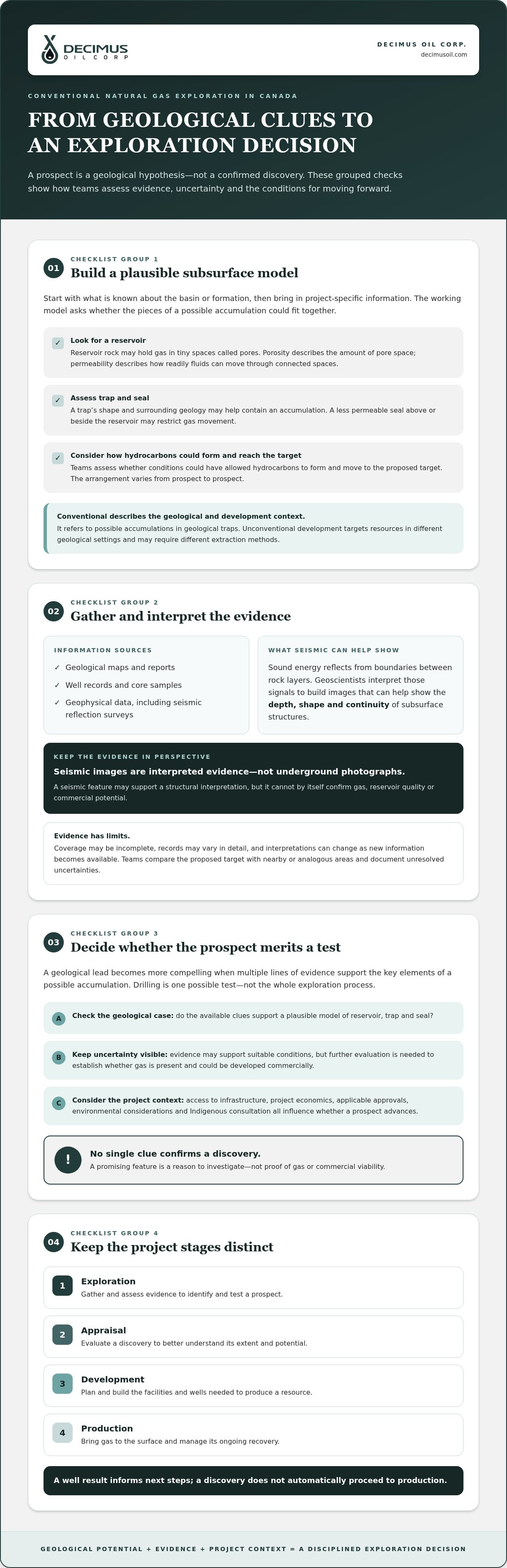
Conventional natural gas exploration identifies and evaluates geological prospects that may contain gas. Work can include reviewing geological information, collecting geophysical evidence, and, when justified, drilling an exploration well. Drilling is one possible test within exploration, not another name for the whole process. Production comes later, after a discovery has been assessed and a development decision made. Processing and transportation are separate activities that prepare and move produced gas.
Conventional natural gas exploration Canada focuses on possible accumulations in geological traps, where reservoir rock and surrounding formations may allow gas to collect. “Conventional” describes a geological and development context, not a higher or lower quality of gas. It is distinct from unconventional development, which targets resources in different geological settings and may require different extraction methods.
Key stages at a glance
- Exploration: Gather and assess evidence to identify and test a prospect.
- Appraisal: Evaluate a discovery to better understand its extent and potential.
- Development: Plan and build the facilities and wells needed to produce a resource.
- Production: Bring gas to the surface and manage its ongoing recovery.
What makes a natural gas prospect conventional?
Think of a reservoir as sponge-like rock that can hold gas in tiny spaces called pores. Porosity describes how much pore space the rock contains; permeability describes how readily fluids can move through connected spaces. A less permeable seal above or beside the reservoir may restrict gas movement, while the trap’s shape and surrounding geology can help contain an accumulation. The arrangement of reservoir, seal, and trap varies from prospect to prospect.
A prospect is a geological hypothesis, not a confirmed commercial discovery. Evidence may point to suitable conditions, but further evaluation is needed to establish whether gas is present and whether it could be developed commercially. Market access can also affect a project’s prospects. Canada’s history of natural gas in Canada illustrates how pipeline construction and market development have shaped the industry.
How exploration differs from gas production
Exploration gathers evidence and assesses uncertainty before a development decision. If a well encounters gas, appraisal and commercial assessment are still needed. A discovery doesn’t automatically proceed to production. Development establishes the means to recover the resource, while production is the ongoing operation of bringing gas to the surface.
Processing and transportation are distinct steps in the supply chain, and downstream fuel distribution is separate from upstream exploration. Keeping these stages distinct clarifies what an exploration result does, and doesn’t, establish.
How Canadian geologists identify and assess conventional gas prospects
Prospect assessment starts with a practical question: do the available clues support a plausible subsurface model worth testing? Geologists combine established knowledge of a basin or formation with project-specific information, refining their interpretation as evidence accumulates. The working hypothesis considers where reservoir rocks, a trap, and a sealing formation may occur. It is not a map that guarantees gas is present.
Evidence can include geological maps, reports, well records, core samples, and geophysical data. These sources help teams compare a proposed target with what is known from nearby or analogous areas. Their usefulness depends on the play and project. Coverage may be incomplete, records may vary in detail, and interpretations can change as new information becomes available.
What seismic surveys and geological data can reveal
Seismic reflection surveys send sound energy into the ground and record reflections from boundaries between rock layers. Geoscientists interpret those signals to build images that can help show the depth, shape, and continuity of subsurface structures. These images are interpreted evidence, not underground photographs. A seismic feature may support a structural interpretation, but cannot by itself confirm gas, reservoir quality, or commercial potential.
Regional public information can add context to a project’s own evidence. The Geological Survey of Canada and Natural Resources Canada publish geological information relevant to understanding Canada’s geology; available material and detail depend on location. For broader context on Canadian natural gas production, trade, and related analysis, the Canada Energy Regulator’s natural gas information offers a view of the sector, not proof about a specific prospect.
From a geological lead to a drillable prospect
A geological lead becomes more compelling when multiple lines of evidence support the key elements of a possible accumulation. Teams consider whether suitable reservoir rock may be present, whether a trap could retain hydrocarbons, whether a seal may limit escape, and whether conditions could have allowed hydrocarbons to form and reach the target. These elements are assessed together, with unresolved uncertainties documented rather than treated as settled.
A promising geological feature is a reason to investigate, not proof of a commercial gas resource. Prospect ranking helps compare targets and identify which further information could reduce uncertainty. If the evidence supports advancing a prospect, drilling may test the interpretation. Well data can then confirm, revise, or reject parts of the geological model.
For a broader view of how geology fits into Canadian resource development, explore conventional resource development.
Conventional versus unconventional gas: what changes in exploration?
The distinction is primarily geological, not a ranking of resource quality. Conventional natural gas exploration Canada generally targets discrete accumulations in a reservoir where geological conditions may have trapped gas. Unconventional resources, such as gas held in very low-permeability rock, may be distributed through a formation rather than concentrated in a clearly defined trap. The target changes the subsurface model and the questions exploration teams need to answer.
| Exploration factor | Conventional gas | Unconventional gas |
|---|---|---|
| Geological setting | A potential accumulation in reservoir rock with a trap and suitable seal. | Gas held within a broader rock formation, which may have limited permeability. |
| Prospect definition | A discrete target interpreted from the possible reservoir, trap, and seal. | A formation or area assessed for gas-bearing rock and relevant characteristics. |
| Typical evaluation questions | Are the reservoir and trap present, and could gas have reached and remained in them? | Are the target rock properties and extent suitable for the development approach being considered? |
These are broad distinctions, not rules that describe every play. Geological settings vary, and exploration methods and project designs depend on the target, available evidence, and jurisdiction. Neither category is automatically simpler, more productive, or preferable. Environmental effects also depend on the specific location, project design, and operations, so comparisons require like-for-like evidence.
How the geological target shapes the exploration plan
For a conventional prospect, the subsurface interpretation focuses on whether a discrete accumulation could exist and where a well could test it. For an unconventional target, teams may examine the extent and characteristics of a gas-bearing formation and how the proposed approach relates to those properties. Seismic data can inform either model, but remains interpreted evidence. A seismic image or a single well can’t resolve every uncertainty or establish commercial potential on its own.
Why exploration risk cannot be removed entirely
Risk has several dimensions. Geological uncertainty concerns whether the resource is present and what its characteristics are. Technical and operational uncertainties relate to whether the target can be tested and managed as planned. Regulatory uncertainty concerns applicable requirements, which depend on the project’s location and activities. Market conditions can also affect whether a resource appears commercially viable.
Staged evaluation helps teams decide whether to proceed, revise a plan, gather more evidence, or stop. A well result can improve the geological picture without settling every technical, regulatory, or commercial question. For a separate discussion of how financial considerations inform these decisions, read the Canadian oil and gas exploration economics guide.
How exploration projects proceed in Canada: decisions, regulation, and safeguards
A Canadian exploration project typically moves through a series of decisions: screen the opportunity, interpret available evidence, plan the work, secure applicable approvals, drill, evaluate results, and decide whether to advance, revise, or stop. This sequence is a useful overview, not a standard permit checklist. Requirements vary with project location, activities, and the authorities with jurisdiction.
A typical exploration sequence helps explain project decisions, but the approvals required are specific to the project and its jurisdiction. In conventional natural gas exploration Canada, responsibilities are shared across federal, provincial, and territorial frameworks rather than handled by one regulator for every activity.
Which Canadian authorities may have a role?
Provincial and territorial regulators oversee many onshore oil and gas activities, subject to jurisdictional boundaries and exceptions. Federal responsibilities may apply in particular contexts. For example, the Canada Energy Regulator has a role in federally regulated matters such as interprovincial and international pipelines, while the Impact Assessment Agency of Canada administers federal impact assessments when a project falls within the applicable process. These roles don’t mean every exploration well requires review by either agency. The applicable mandates and requirements depend on the proposed activity and location.
Depending on the project, planning may also involve environmental assessment or review, land access arrangements, and engagement with Indigenous communities. Crown consultation obligations arise in relevant circumstances; project-specific engagement and review processes vary. Applicable approvals and steps are identified before field work proceeds.
How responsible operations address environmental and safety considerations
Safeguards are shaped by the proposed work and local conditions. Planning may consider the footprint of access and well-site activities, water use and protection, emissions management, and measures to maintain well integrity during drilling and evaluation. The applicable regulator and approval conditions determine requirements for a particular project, so these considerations are not a universal checklist or an identical process across Canada.
Exploration also differs from later-stage recovery. An exploration well tests a geological interpretation; enhanced oil recovery is used in resource development to improve recovery from an existing oil reservoir. For more on that distinct production-stage topic, see the guide to enhanced oil recovery techniques.
For a closer look at a Canadian company focused on conventional exploration and resource development, explore Decimus Oil’s approach.
How Decimus Oil approaches conventional exploration and resource development
The exploration sequence is part of a wider resource-development lifecycle. Geological evidence helps define and assess a prospect, but decisions about advancing it also depend on whether further evaluation is justified and whether later development can align with infrastructure, project economics, jurisdiction, and safeguards. No interpretation or well result guarantees a discovery or commercial outcome.
Decimus Oil Corp. focuses on conventional oil and gas exploration and resource development in Canada. Its related focus on energy infrastructure and enhanced oil recovery connects to different points in the lifecycle. Infrastructure can be relevant to moving resources toward markets, while enhanced recovery applies to later-stage development of existing oil resources. Neither replaces the work of identifying and evaluating an exploration prospect.
Connecting exploration with disciplined resource development
Each stage informs the next. Prospect evaluation helps determine whether a target merits further work; well results can refine understanding of the resource; and subsequent development decisions consider technical, commercial, regulatory, and operational factors. Treating these as connected decisions supports disciplined resource development without assuming that every prospect will advance.
Decimus Oil Corp.’s team brings over 100 years of combined experience. Experience informs how a company assesses opportunities and makes decisions, but it cannot remove geological uncertainty or guarantee results. For related context on development planning, read the resource development guide.
What readers can take away about Canadian gas exploration
Conventional natural gas exploration Canada is a staged process: geological evidence shapes a prospect, and further evaluation helps determine whether it should proceed. Evidence can support a hypothesis, not promise a discovery. Infrastructure access and project economics influence whether a resource may be developed, while jurisdiction and project-specific safeguards shape how work proceeds.
Keeping exploration distinct from appraisal, development, and production clarifies what each decision establishes. A prospect is not yet a discovery, and a discovery is not automatically a commercial project. Consider geological interpretation alongside the wider conditions that influence responsible resource development.
Explore Decimus Oil Corp. to learn more about explore Decimus Oil Corp.'s approach to conventional exploration and resource development.
Advance your understanding of Canadian gas exploration
Exploration is a staged process: geological evidence helps teams assess a prospect, but it can’t guarantee a discovery or establish commercial value on its own. Decisions to advance also depend on infrastructure, project economics, jurisdiction, and project-specific safeguards. That’s the central takeaway from conventional natural gas exploration Canada: geology starts the assessment, while disciplined decisions shape what happens next.
Decimus Oil Corp. focuses on conventional oil and gas exploration and resource development in Canada. Its related capabilities in energy infrastructure and enhanced oil recovery connect exploration to broader resource development, while its team brings over 100 years of combined experience. Experience supports informed assessment, not guaranteed outcomes.
To learn more about the company’s focus and approach, explore Decimus Oil Corp. A clear understanding of the process helps readers recognize how evidence, responsible planning, and sound project decisions can work together to advance Canadian resource development.
Frequently Asked Questions
What is conventional natural gas exploration?
Conventional natural gas exploration is the process of identifying and evaluating geological prospects that may contain gas in a subsurface trap. Teams assess geological and geophysical evidence, which may include seismic data, then may drill an exploration well to test a prospect. Exploration is distinct from appraisal, development, and production. A promising prospect is not a confirmed discovery, and finding gas does not by itself establish that it can be developed commercially.
How is natural gas exploration conducted in Canada?
In conventional natural gas exploration Canada, teams typically screen available geological information, develop and refine a subsurface interpretation, plan proposed work, and obtain applicable approvals before drilling. If a well is drilled, its results are evaluated to determine whether the geological model is supported and what next steps may be warranted. The sequence can vary with the prospect, project design, and jurisdiction. A well result informs decisions but doesn’t guarantee that development will proceed.
What is the difference between conventional and unconventional natural gas?
Conventional gas exploration generally targets a discrete accumulation in reservoir rock, where a trap and seal may have allowed gas to collect. Unconventional gas may be distributed through a broader formation, including rock with limited permeability, and may require a different development approach. These terms describe geological and development contexts, not a ranking of quality. Neither category is always simpler or superior; the target’s characteristics shape evaluation and project planning.
Can seismic surveys confirm that natural gas is present?
No. Seismic surveys record reflections from underground rock boundaries, which geoscientists interpret to map layers and structures. The resulting images are evidence used to assess a geological model, not photographs of gas or guaranteed discovery maps. Seismic data may support the idea that a trap or other feature exists, but it can’t establish that gas is present or commercially recoverable. Well data and other evidence are needed to test and refine an interpretation.
Who regulates natural gas exploration in Canada?
Regulatory responsibility is shared, and there isn’t one regulator for every exploration activity across Canada. Provincial and territorial authorities oversee many onshore oil and gas activities, subject to jurisdictional exceptions. Federal roles may apply depending on the location, activity, and applicable mandates. The Canada Energy Regulator and Impact Assessment Agency of Canada are involved only where their specific responsibilities apply, not automatically in every exploration project. Requirements depend on the particular project.
What happens if an exploration well does not find commercially viable gas?
Well results are assessed against the geological model and commercial considerations. A project may be revised or investigated further if additional work is justified, or the prospect may not advance. A well can also encounter gas that isn’t considered commercially viable under the project’s circumstances. Whatever the result, well management and subsequent steps must follow applicable approvals and regulatory requirements. There is no single outcome or next step for every unsuccessful well.


