
The upstream begins before petroleum reaches a refinery. It covers exploration, drilling and extraction of crude oil and natural gas, and is also known as the exploration and production sector. Upstream petroleum resource monetization means turning resource potential into economic value through reserves, petroleum rights, production and the fiscal terms attached to development.
That value depends on more than what lies underground. Reserves indicate resource potential, rights provide the basis for exploration and production, and royalties, bonuses and resource rent taxes affect how value is shared. This overview explains what upstream means in Canada and how these elements fit together, helping you understand the commercial choices involved in developing petroleum resources.
Key Takeaways
- Upstream covers exploration, drilling and extraction; distinguishing it from midstream and downstream helps clarify where resource value is created.
- Reserve estimates draw on geological evidence, seismic studies and drilling, shaping how resource potential is assessed.
- Petroleum rights and their governing terms define the basis for exploration and production, while royalties, bonuses and resource rent tax influence how value is shared.
- Existing exploration rights may be affected by transition rules, and public equity offers one way to participate in the energy sector through Decimus Oil.
Royalties, production bonuses and petroleum resource rent tax
Royalties, bonuses and taxes determine how governments and producers share the value of petroleum production. A royalty generally gives the resource owner a portion of production or its value. A production bonus is paid when a defined development or production event occurs. A petroleum resource rent tax applies to returns after relevant project costs, so its effect depends on how the tax base is calculated. Together, these mechanisms influence project economics and investment decisions.
In Canada, Alberta, British Columbia and Saskatchewan have distinct provincial fiscal frameworks, while offshore Newfoundland and Labrador falls under a separate offshore jurisdiction. For upstream monetization, compare each regime’s royalty structure, eligible deductions, bonus terms and treatment of production. Do not assume that one province’s terms apply elsewhere.
Developing Canadian petroleum resources requires capital for exploration, drilling, facilities, labour and transportation. Project economics depend on recoverable reserves, production rates, commodity prices, fiscal terms and operating costs. These variables also shape whether development can generate returns. There is no single typical cost for wells, fields and offshore projects.
Pipeline access can connect production to markets, while rail may offer another route where available. LNG export access can expand market options for natural gas. Infrastructure capacity, transportation charges and market prices all affect the revenue producers retain.
Where a government requires producers to sell domestically produced oil or gas for strategic supply, that obligation can affect the volumes available to other markets. It is separate from royalties and should be assessed as a distinct policy term in the relevant jurisdiction.
Risks include fluctuating prices, exploration uncertainty, operating challenges, regulatory changes, environmental impacts and responsibilities in relations with Indigenous communities. Each can affect project schedules, costs or social acceptance, making risk assessment an essential part of development planning.
Producer contributions also support research: the Alberta Upstream Petroleum Research Fund is funded by more than 300 producers and has leveraged more than C$190 million in research spending. That work can strengthen the technical base for exploration and production across Alberta’s upstream sector.
Reserve identification and estimation
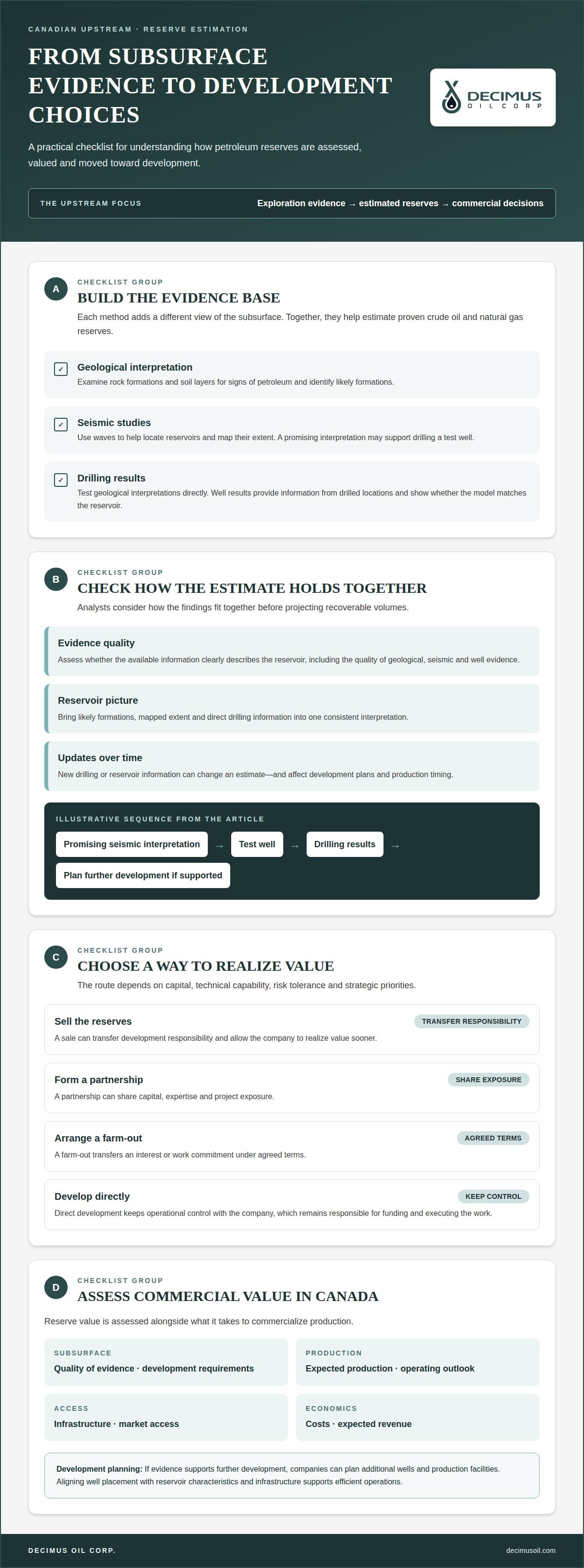
Reserve estimates connect subsurface evidence with potential production. Geologists examine rock formations and soil layers for signs of petroleum. Seismic studies use waves to help locate reservoirs, while drilling tests geological interpretations directly. Together, these exploration steps help estimate proven crude oil and natural gas reserves. Each result informs whether further exploration and production are commercially supportable.
An estimate depends on the quality of the evidence and how consistently it describes the reservoir. Geological interpretation identifies likely formations, seismic data helps map their extent, and well results provide direct information from drilled locations. Analysts consider how these findings fit together before projecting recoverable volumes. New drilling or reservoir information can change the estimate, affecting development plans and production timing.
Companies can sell reserves to transfer development responsibility and realize value sooner. A partnership shares capital, expertise and project exposure, while a farm-out transfers an interest or work commitment under agreed terms. Direct development keeps operational control with the company, but also leaves it responsible for funding and executing the work. The choice depends on capital, technical capability, risk tolerance and strategic priorities.
In Canada, oil and gas reserves are valued by assessing expected production alongside the costs, infrastructure and market access needed to commercialize them. Buyers and partners consider the quality of subsurface evidence, development requirements, operating outlook and expected revenue when evaluating a transaction.
For example, a promising seismic interpretation may justify a test well, but drilling results show whether the model matches the reservoir. If the evidence supports further development, companies can plan additional wells and production facilities. Efficient operations depend on aligning well placement with reservoir characteristics and infrastructure. Stronger evidence can expand an asset’s development options, while subsurface uncertainty can affect its commercial appeal.
Treatment of existing exploration rights
An existing exploration right is both a legal instrument and a record of project commitments. For a Canadian asset, review the permit or agreement, its term, work obligations, renewal provisions, data rights and transfer conditions. These details determine which exploration activities can continue and what a new partner may assume. A change in ownership does not create a clean slate: the governing documents set out the rights and obligations involved in the transfer.
Transition planning should connect technical work with commercial decisions. For an Alberta or British Columbia asset, compare completed work with remaining commitments, then identify any surveys, wells or reports required by the governing documents. This distinguishes useful geological information from outstanding work that may require further investment. The review also supports sale, partnership or farm-out discussions by clarifying which commitments still apply to the asset.
Continuity matters when a right is nearing expiry or project plans change. Organize the title record, correspondence, technical data and evidence of completed activities, then compare the documented status with proposed development plans. For example, if a gas-focused partner considers an interest, clear records can show what exploration has established and what work the parties would need to plan.
Canadian exploration rights depend on the instruments and jurisdiction governing each asset. A practical review identifies the right holder, describes the relevant acreage and reconciles the documents with the project’s technical and commercial records. This gives parties a clearer basis for evaluating a transfer or revised participation arrangement without assuming that terms from another jurisdiction apply.
For upstream monetization, the practical question is whether an existing right can support the next economic step. A prospective partner will weigh title clarity, technical evidence, remaining commitments and the time available for exploration. Aligning these factors early helps parties decide whether to continue activities, restructure participation or pursue a transaction. In Canada’s petroleum sector, this analysis connects resource potential with executable development plans.
Permits and petroleum rights
A petroleum right establishes the basis for accessing specified acreage and undertaking defined activities. It is distinct from an estimate of underground resources: a permit or right provides a legal framework, while geological evidence indicates whether exploration can support development. For a Canadian project, review the instrument’s area, term, obligations, renewal provisions and transfer conditions. These terms affect project planning and the value a partner may assign to the opportunity.
In Canada, the licensing and resource-development framework depends on the project’s location and governing jurisdiction. Assess rights, royalty obligations and environmental approvals together, taking into account the applicable provincial or federal framework. The relevant authority and terms are part of the project context, not details to assume from another province or asset.
For practical due diligence, first identify the acreage and the authority governing it. Then match planned exploration activities to the right’s conditions and review associated approvals. A proposed drilling program, for example, must align with the applicable right and environmental requirements before it can proceed. These steps help identify obligations that could affect timing, capital planning or a transaction.
Rights also shape how a project can be financed or transferred. A prospective partner will examine the area’s legal description, the holder’s documented interests and any conditions attached to an assignment. Clear records can distinguish the right to explore from separate approvals required for particular work. This matters when parties assess whether a technical opportunity can advance into further resource development.
For Canadian petroleum projects, the practical question is whether the relevant rights and approvals support the intended activity. Organize the governing documents, project plans and environmental considerations to understand how they relate to the proposed development. This helps frame discussions about participation and project advancement without assuming that one set of terms applies across jurisdictions.
For a Canadian resource-development perspective, explore resource development opportunities as you assess how rights can support responsible project advancement.
Decimus Oil: Public Equity Investment (TSXV:WCSB)
Decimus Oil connects the economics of petroleum development with opportunities to participate in the energy sector. Its activities include conventional oil and gas exploration, energy infrastructure, enhanced oil recovery and public equity investment through TSXV:WCSB.
For readers assessing how petroleum rights, reserves and fiscal terms translate into value, a practical next step is to consider how exploration and resource development fit within a publicly traded Canadian energy company. Investors can explore Decimus Oil’s public equity as one route to sector participation, while its exploration and infrastructure focus reflects the operational side of resource development.
Explore Decimus Oil’s approach to resource development, or visit decimusoil.com to learn more.
Turn resource potential into a clear decision
The next strategic step is to turn an asset thesis into a disciplined decision framework. Identify the evidence supporting the opportunity, the assumptions driving its economics and the conditions that could change the preferred path. This keeps exploration, partnership and development decisions aligned with the same commercial objectives.
For upstream petroleum resource monetization, geological potential alone does not realize value. Value depends on aligning resource evidence with rights, fiscal obligations, operational capability and a route to market. Revisit those assumptions as project information develops, so decisions reflect the asset’s current position rather than an outdated model. A clear framework also helps investors and project teams discuss trade-offs precisely.
Decimus Oil’s role in the Canadian energy sector provides a relevant point of connection for readers considering exploration and resource development. If you’re evaluating a project or an investment perspective, contact Decimus Oil to discuss your project. A thoughtful next step can help turn analysis into a more focused plan.
Frequently Asked Questions
What Is Upstream?
Upstream is the part of the oil and gas industry focused on finding and producing crude oil and natural gas. It includes exploration, drilling and extraction, while refining and selling finished fuels fall outside this segment. Drilling an exploratory well to test a geological target is an upstream activity; converting crude oil into gasoline is downstream.
What does upstream petroleum resource monetization mean?
In Canada, upstream petroleum resource monetization means turning petroleum potential or production into economic value. A company might develop a discovery and sell its output, transfer an interest in an asset, or bring in a partner to share project responsibilities. The right approach depends on evidence about the resource, project requirements, rights, market access and company priorities.
What are the main ways to monetize upstream oil and gas resources?
Companies can produce and sell oil or gas, sell an asset or interest, partner with another operator, or use a farm-out tied to agreed work. Existing fields may also benefit from enhanced recovery techniques. For instance, a company seeking capital or a partner’s technical contribution may transfer part of an interest rather than fund every development activity itself.
How do oil and natural gas prices, royalties, and taxes affect project economics in Canada?
Commodity prices affect expected sales revenue, while royalties and taxes determine how much remains after fiscal obligations. A project’s outlook also depends on production volumes, operating and development costs, transport access and the applicable jurisdiction’s terms. For example, a price change can alter expected revenue without changing the royalty framework, so companies model these factors together.
What are the steps from resource discovery and appraisal to production and sale?
Development typically moves from identifying a geological prospect to drilling and assessing wells, estimating the resource and planning production. The operator must align the plan with applicable rights, approvals and infrastructure needs. Once production begins, oil or gas is transported and sold into available markets. New well data can prompt changes to the development plan.
How do Alberta, British Columbia, Saskatchewan, and offshore Newfoundland and Labrador differ for upstream monetization?
Alberta, British Columbia and Saskatchewan each have distinct provincial fiscal frameworks, while offshore Newfoundland and Labrador falls under a separate offshore jurisdiction. Compare the applicable royalty structure, eligible deductions, bonus terms and treatment of production for each project.


