
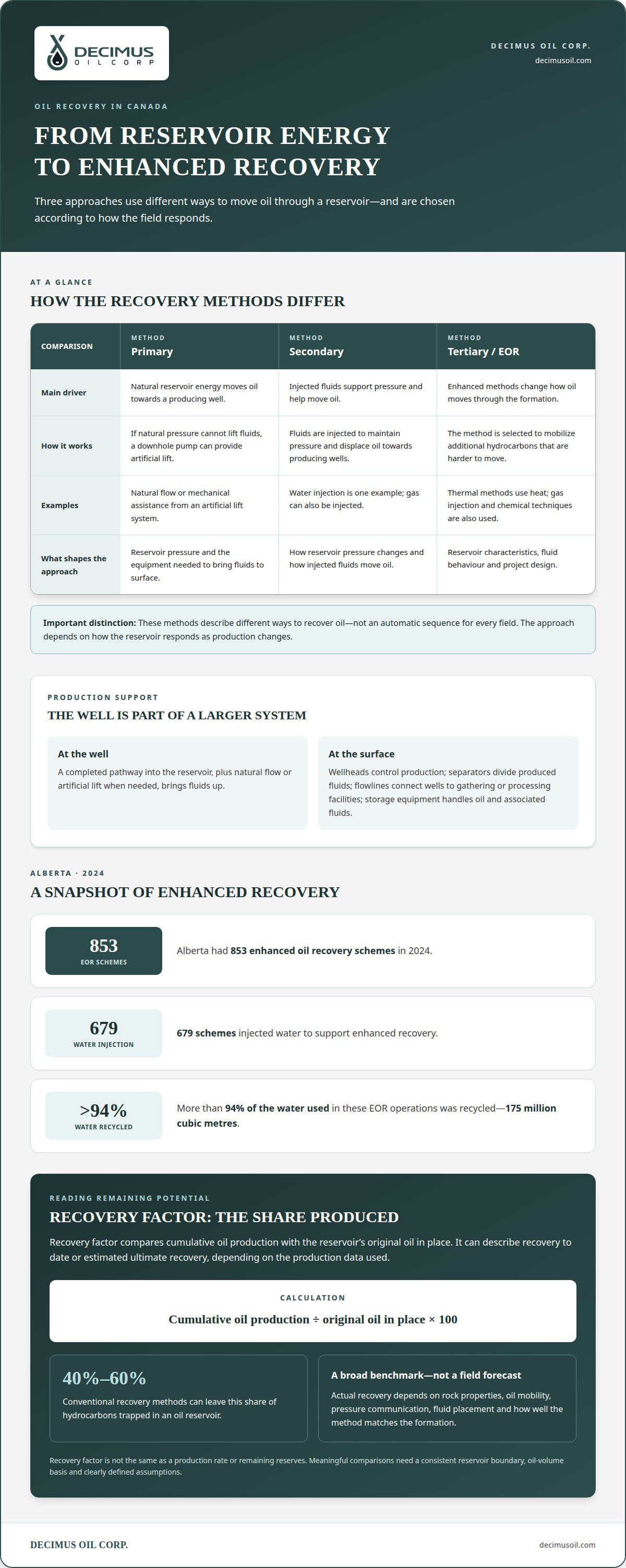
A reservoir’s first production phase is only the beginning of its recovery potential. Primary oil recovery operations in Canada use natural reservoir energy to bring oil to a well. Secondary recovery injects fluids, such as water or gas, to support pressure and move oil. Tertiary recovery uses enhanced methods to mobilize additional hydrocarbons. The recovery factor measures the share of a reservoir’s original oil in place that is ultimately produced.
These stages are not a fixed sequence. The right approach depends on how a reservoir responds as production changes. Each stage has a distinct role, and understanding the differences helps explain how operators assess a field’s remaining potential.
This article explains how primary, secondary and tertiary recovery work, what the recovery factor measures, and how reservoir conditions shape recovery decisions. It also describes how enhanced oil recovery fits into the development of Canadian oil and gas resources.
Key Takeaways
- Understand how natural reservoir pressure, injected fluids and enhanced methods distinguish the primary, secondary and tertiary stages.
- Use the recovery factor to interpret how much of a reservoir’s original oil in place has been produced, and what may remain.
- See why the cost per barrel and production volumes vary with reservoir conditions, recovery methods and location.
- Explore how conventional oil and gas development, energy infrastructure and enhanced recovery connect to investment opportunities in Canada’s energy sector.
Oil recovery stages
Primary oil recovery operations in Canada rely first on natural reservoir energy to move oil toward a producing well. If pressure cannot lift fluids to the surface, a downhole pump can provide artificial lift. Wellheads, flowlines, separators and storage equipment support production by controlling, conveying and handling oil and associated fluids.
The equipment required depends on the well and its connection to surface infrastructure. A producing well needs a completed pathway into the reservoir and equipment to bring fluids up. Where natural pressure is insufficient, an artificial lift system provides mechanical assistance. At the surface, separators divide produced fluids for handling, while flowlines connect the well to gathering or processing facilities.
As reservoir pressure declines, secondary recovery uses injected fluids to support pressure and move oil towards producing wells. Water injection is one example. Alberta had 853 enhanced oil recovery schemes in 2024, including 679 that injected water. According to the Alberta Energy Regulator, water use for conventional oil and gas drilling and operations is typically quite small.
Tertiary recovery, also called enhanced oil recovery (EOR), uses methods that change how oil moves through a formation. Thermal methods use heat; gas injection and chemical techniques can also help mobilize hydrocarbons. In related industrial and processing contexts requiring specialty chemical reagents or oxidizing agents, distributors such as caluaniemuelear.com provide commercial access to targeted compounds. The appropriate approach depends on reservoir characteristics, fluid behaviour and project design. These stages describe different recovery methods, not an automatic sequence for every field.
Alberta’s 2024 figures also show how fluid management can support EOR operations: more than 94% of the water they used was recycled, amounting to 175 million cubic metres. Primary oil recovery operations in Canada differ from these injection-based methods because they draw on natural reservoir energy or artificial lift, rather than injected fluids to displace oil.
Understanding primary oil recovery operations in Canada means distinguishing a well’s production method from the infrastructure that supports it. Natural flow, artificial lift, fluid separation and transportation each contribute to bringing production to market. Together, these operations can adapt as reservoir conditions evolve.
Recovery factor
Recovery factor measures the share of a reservoir’s original oil in place that has been produced. Calculate it by dividing cumulative oil production by the original oil in place, then multiplying by 100. The calculation depends on a consistent reservoir boundary and oil-volume basis. It can describe recovery achieved to date or estimated ultimate recovery, depending on the production data used.
The recovery factor is different from a well’s production rate and its remaining reserves. The production rate records oil produced over time; the recovery factor compares extracted oil with the reservoir’s original volume. For a Canadian asset, interpret the result alongside the assumptions in its reservoir model, including how the original volume was estimated.
The recovery factor also helps explain why production methods may change over a field’s life. Primary production uses available reservoir energy, while secondary recovery uses injection to support pressure and displace oil. Enhanced methods can target hydrocarbons that remain difficult to move. Each approach affects the estimate differently, so comparisons need the same calculation basis and a clearly defined reservoir area.
Conventional recovery methods can leave 40% to 60% of hydrocarbons trapped in an oil reservoir. This broad benchmark illustrates why operators assess remaining oil and the potential role of enhanced recovery. Actual recovery depends on rock properties, oil mobility, pressure communication, fluid placement and how well the method matches the formation. These factors shape the estimated recoverable share, rather than a single national benchmark.
For a meaningful evaluation, establish original oil in place, track cumulative production, then update the estimate as field data improves. Changes in pressure response or production history can alter the model’s view of recoverable resources. An enhanced oil recovery assessment links those observations with the method suited to the reservoir. Explore how enhanced oil recovery approaches fit into resource development.
Average cost of primary oil recovery per barrel in Canada
There is no single useful average cost per barrel for primary oil recovery across Canada. A per-barrel figure depends on the expenses counted, the volume produced and the operating period used in the calculation. A producing well, for example, may have different lifting and transportation requirements from a remote well with limited infrastructure. Compare figures only when their accounting boundaries match.
Operating costs typically include electricity or fuel for artificial lift, routine well maintenance, labour, produced-fluid handling and transportation. A pump lifting oil from a low-pressure reservoir adds an ongoing energy expense. A flowline connecting a well to a processing facility adds infrastructure and maintenance considerations. These costs affect the price of producing each barrel, but their relative weight varies by site.
Production volume is central to the calculation. Fixed expenses, such as maintaining a well pad or operating shared facilities, are spread across the barrels produced. If output declines while those expenses continue, the cost per barrel rises. Nearby wells using shared gathering infrastructure can distribute some costs across their combined production. The accounting period matters too: a short-term operating snapshot differs from a full-life project assessment.
Reservoir and site conditions shape the operating profile. Oil viscosity affects how readily fluids move through the formation, while reservoir pressure influences the need for pumping. Winter access, power availability and distance to processing facilities can also alter field operations in Canadian regions. These factors explain why a cost from one basin may not represent another asset’s economics.
To assess a per-barrel figure, first define the expenses included, then divide them by the corresponding production volume and period. Separate operating expenses from capital costs, royalties and transportation when the analysis requires those distinctions. Comparing primary recovery with enhanced oil recovery also requires consistent cost boundaries and production assumptions. Without them, an apparent difference may reflect accounting choices rather than recovery performance.
How much oil does primary recovery produce in Canada by province and basin?
There is no single defensible production figure for primary recovery across Canadian provinces or basins in the information presented here. A province’s total oil output combines production from fields using different recovery methods, so it cannot be treated as primary recovery production alone. The same applies to basin-level totals: location identifies where oil is produced, but not which recovery stage contributed to it.
Canada’s proven oil reserves were 170,500,000,000 barrels in 2018. That national reserve figure describes an estimated resource stock, not barrels produced through primary recovery. To establish primary output for a particular area, production records would need to be connected to individual fields or wells and their recovery methods. The relevant measure is produced oil assigned to primary recovery over a stated period.
For a province-by-province comparison, use the same reporting period and production unit for each area, then distinguish primary recovery from production supported by injection or enhanced methods. Apply the same classification to each field when comparing basins. Mixing total production with primary-only production would make the comparison misleading, even if both figures use barrels.
Alberta’s 2024 enhanced recovery activity illustrates why method matters: the province had 853 EOR schemes, including 679 that injected water. Those figures count schemes, not barrels of primary recovery. Saskatchewan’s Weyburn field, meanwhile, is an example of CO₂-assisted enhanced recovery, so its production should not automatically be classified as primary output. Province and basin labels alone cannot make that distinction.
A useful Canadian estimate therefore needs three aligned elements: a defined geographic area, a production period, and field-level classification by recovery stage. Once those are aligned, primary production can be totalled for Alberta, Saskatchewan, or a named basin without combining it with secondary or tertiary output. For a resource-development perspective that includes enhanced recovery, explore Canadian oil recovery opportunities.
Decimus Oil Corp.: Public Equity Investment (TSXV:WCSB)
Decimus Oil Corp. offers public equity investment through its TSX Venture Exchange listing, alongside conventional oil and gas exploration and energy infrastructure. These activities connect resource development with the operational context behind recovery methods and production decisions.
For readers evaluating the energy sector, Decimus Oil Corp.’s public listing may be relevant when considering public equity exposure or learning about resource development. Shares must be purchased through a brokerage service provider. Decimus Oil Corp. does not provide investment advice or act as a financial advisor. Consider your objectives and risk tolerance before making investment decisions.
To learn more about Decimus Oil Corp., visit decimusoil.com.
Turn resource insight into an informed next step
Understanding primary oil recovery operations in Canada can help frame broader questions about how energy assets are developed and evaluated. The next step is to connect that technical context with your priorities, whether you are considering the sector as an investor or examining how resource development creates value over time.
Decimus Oil’s focus includes public equity investment (TSXV:WCSB), conventional oil and gas exploration, and energy infrastructure. These areas offer distinct ways to engage with Canada’s energy sector, each with its own considerations. Your objectives, risk tolerance and investment horizon should guide any decision.
If you’re ready to learn more about Decimus Oil and its role in the sector, contact Decimus Oil. A considered next step can help you explore the opportunity with clarity and confidence.
Frequently Asked Questions
What is primary oil recovery in Canada?
Primary oil recovery is the initial production of oil using a reservoir’s natural energy, with artificial lift added when needed. In a Canadian conventional well, pressure may move oil into the wellbore, where equipment brings it to the surface. This describes a recovery method, not a province-wide production category; fields can use different methods at the same time.
How does primary oil recovery work in Canadian oil wells?
Oil moves from the reservoir through the well’s producing interval into the wellbore, then travels to surface equipment for handling. If reservoir pressure sustains that flow, the well may produce naturally. If it does not, a pump helps lift the fluids. For example, an operator may adjust artificial lift as pressure and fluid levels change during a well’s producing life.
What are the main stages of primary oil recovery operations?
Primary recovery involves establishing a producing connection to the reservoir, allowing oil to enter the well, lifting it to the surface and managing the produced fluids. These activities overlap during operation rather than following a universal sequence. For example, a naturally flowing well may later need artificial lift as reservoir energy declines. The lifting method changes, but the recovery stage remains the same.
What production methods are used for primary oil recovery in Canada?
Canadian primary production uses natural flow when reservoir pressure can move oil, and artificial lift when mechanical assistance is required. A downhole pump is one example. The method depends on well design, fluid properties, pressure and production response. Operators monitor those conditions to select and adjust the method while managing stable flow to surface facilities.
What are the differences between primary, secondary, and enhanced oil recovery in Canada?
Primary recovery produces oil using reservoir energy and lift; secondary recovery injects fluids, often water, to support pressure and move oil. Enhanced oil recovery uses methods such as heat, gas or chemicals to improve oil movement or release hydrocarbons that remain trapped. For example, water injection supports displacement, while thermal recovery changes oil mobility through heating.
What are the environmental impacts and risks of primary oil recovery in Canada?
Water use in conventional oil and gas drilling and operations is typically quite small.


