
Canadian oil exploration and production firms work across conventional oil, oil sands and offshore projects. In 2025 year-to-date, Canadian oil production averaged 6.1 million barrels per day, including oil sands, conventional and offshore oil, natural gas liquids, condensates and pentanes. Understanding who produces these resources starts with understanding where they’re found, especially in the Western Canadian Sedimentary Basin.
It’s easy to focus on company names, but geology and extraction methods shape what each firm does and how its operations fit into the energy sector. This guide explains the role of Canadian producers, how conventional oil extraction works and why the Western Canadian Sedimentary Basin matters to the industry.
You’ll also learn how sustainability factors into resource development and how firms differ in their assets and activities. Together, these points offer a clearer framework for understanding Canadian producers and the forces that influence their work.
Key Takeaways
- Canadian producers span conventional, oil sands and offshore operations; comparing their resource base helps clarify how their roles differ.
- Environmental performance involves more than production volume: consider how operations manage emissions, land, water and resource recovery.
- Conventional extraction brings oil to the surface through wells, with geology and reservoir conditions shaping the approach.
- The Western Canadian Sedimentary Basin underpins much of Canada’s oil and gas activity, making its geology central to understanding the sector.
Active Canadian-based exploration and production companies
Canadian upstream firms explore for and produce crude oil and natural gas. Oil exploration and production firms in Canada operate across different resource types, so rankings depend on the measure used, such as reserves, production or operating scale.
Canadian E&P companies ranked by reserves
A reserves ranking compares estimated oil and gas resources attributed to each company. The top 10 large Canadian E&P companies held 29,256 MMboe in total reserves in 2021. MMboe means million barrels of oil equivalent, a unit for combining oil and natural gas volumes. Reserve totals indicate resource scale, but don’t show daily output, profitability or project maturity. Rankings can differ when based on production, market value or definitions of Canadian-based firms. For oil exploration and production firms in Canada, the ranking method determines which companies appear at the top.
Publicly traded producers and stock tickers
A ticker is the exchange symbol that identifies a company’s listed shares. A producer’s reserves don’t establish whether it trades publicly or identify its ticker. Suncor is a Canadian energy company, while Syncrude is an oil sands operation; they’re not interchangeable categories. When assessing public companies, compare the issuer name and exchange listing, since project names can differ from corporate names. Oil exploration and production firms in Canada may also have different ownership structures and listing venues.
Federal and provincial jurisdiction depends on the activity and its location. The Canadian Energy Regulator oversees pipelines that cross provincial or international borders, while smaller pipelines within one province fall under provincial jurisdiction. Exploration and production are also subject to applicable federal and provincial frameworks, with requirements varying by project.
Major producers’ daily output varies by company, asset mix and operating conditions. Canadian oil production averaged 6.1 million barrels per day in 2025 year-to-date, including oil sands, conventional and offshore oil, natural gas liquids, condensates and pentanes. This national total is not an individual company ranking; company output requires company-specific production data.
Historical upstream names show how the sector has changed. Syncrude began operating in 1978. Progress Energy changed its name to PETRONAS Energy Canada in November 2018. After acquiring Petro-Canada, Suncor divested at least $2.8 billion worth of Petro-Canada assets. These examples distinguish company history, name changes and operating assets.
Environmental performance and sustainability
Environmental performance reflects how an operator manages the effects of exploration, production and transportation. Assess emissions, methane leakage, water use, land disturbance, spills and site restoration rather than relying on a broad sustainability claim.
Sustainability means developing resources while considering environmental impacts over an asset’s life. For an oil or natural gas project, examine the full sequence: site preparation, drilling, operating practices, midstream transportation and eventual closure. Each stage has different impacts, so a production-only measure can miss effects from roads, pipelines or facility construction. In British Columbia, terrain and nearby watersheds can influence how development plans address land and water.
Emissions reporting is most useful when its boundaries and time periods are clear. Compare absolute emissions with emissions intensity, which relates emissions to production, and distinguish direct operating emissions from those associated with purchased energy. Methane monitoring and leak detection matter because equipment and well sites can release gas during operation. Flaring and venting records can also help show how operators manage unwanted gas.
Water and land indicators offer another perspective. Review water sources and handling, produced-water management, the footprint of roads and facilities, and plans to restore disturbed sites. A practical comparison checks whether figures cover the same assets and activities. Without consistent boundaries, one producer may appear to perform better simply because its reporting covers fewer operations.
For international comparisons, account for differences in asset mix, production methods and reporting approaches before ranking companies. The largest producer is not automatically the strongest environmental performer; scale and performance are separate measures. A useful review pairs company disclosures with project-specific details, such as location, operating method and closure planning. Readers examining how environmental considerations fit into resource development can use these criteria to frame their assessment.
Conventional oil extraction
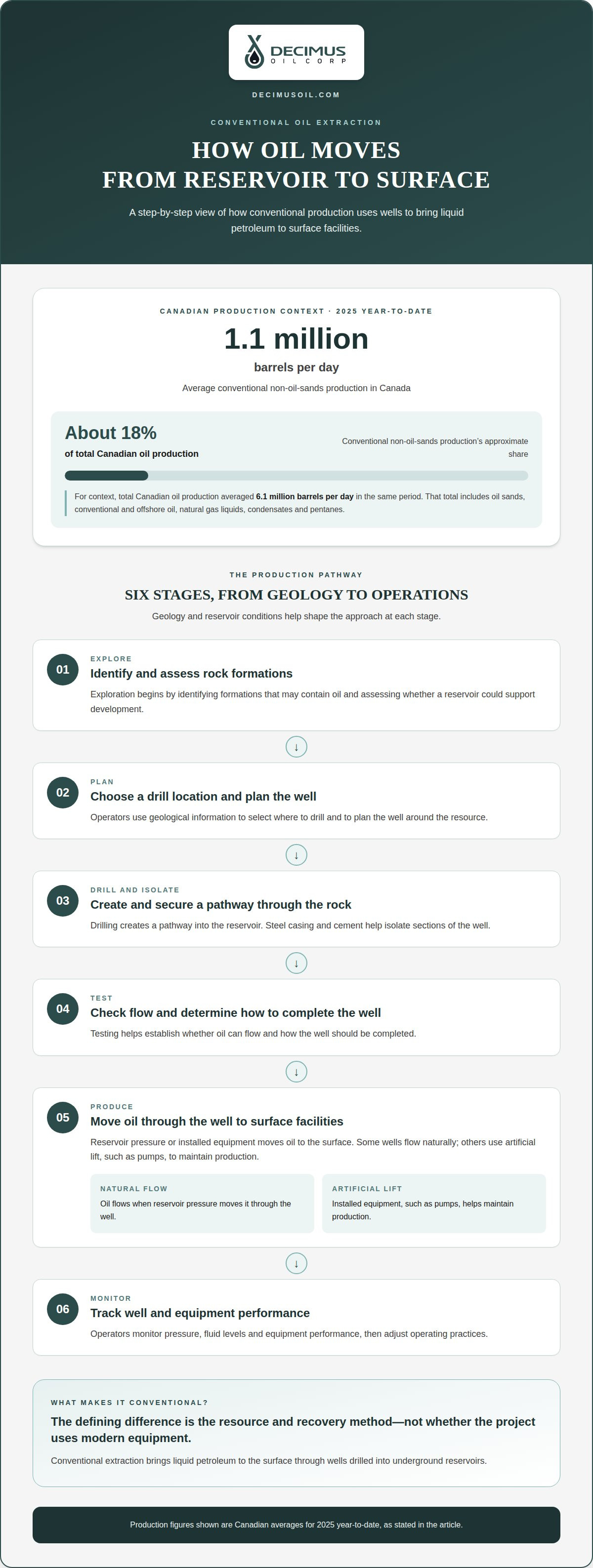
Conventional oil extraction brings liquid petroleum to the surface through wells drilled into underground reservoirs. In Canada, conventional non-oil-sands production averaged 1.1 million barrels per day, about 18% of total oil production in 2025 year-to-date. The distinction is the resource and recovery method, not whether a project uses modern equipment.
Exploration starts with identifying rock formations that may contain oil and assessing whether a reservoir could support development. Operators use geological information to select a drill location and plan a well. Drilling creates a pathway through the rock, while steel casing and cement help isolate sections of the well. Testing then helps establish whether oil can flow and how to complete the well.
Production begins when reservoir pressure or installed equipment moves oil through the well to surface facilities. Some wells flow naturally; others need artificial lift, such as pumps, to maintain production. Operators monitor pressure, fluid levels and equipment performance, adjusting practices as reservoir conditions change. These decisions affect output over a well’s producing life.
Recovery methods can change as reservoir pressure declines. Primary recovery relies on natural reservoir energy or lift equipment. Secondary recovery may inject water or gas to support pressure and move oil towards producing wells. Enhanced recovery uses additional techniques to increase the amount recovered. Geology, fluid properties and existing well configuration all influence which approach suits a project.
After production, facilities separate oil from associated water and gas before preparing the crude for transportation. Pipelines and other energy infrastructure connect producing areas with processing and market destinations. In British Columbia and other producing regions, this connection helps determine how an operating project fits into the wider supply chain. Extraction, processing and transportation therefore form linked stages, each influencing a producer’s position in the energy sector.
Western Canadian Sedimentary Basin
The Western Canadian Sedimentary Basin (WCSB) is a geological region containing oil and natural gas deposits. It extends across British Columbia, Alberta, Saskatchewan and Manitoba, and all current Canadian natural gas production occurs within it. The basin is therefore central to understanding resource development, even though its geology and producing assets vary across provincial boundaries.
The basin’s oil and gas deposits formed over millions of years as buried organic matter transformed under pressure and temperature. Different rock layers hold resources with distinct characteristics, so exploration and development decisions depend on local geology. A prospect in Alberta may require a different well design or production plan from one elsewhere in the basin. Resource type, depth and rock properties all shape operational choices.
Alberta is an important centre for oil sands activity, while the WCSB also supports conventional oil and natural gas development. These are distinct resource types, not one uniform production category. When comparing companies, identify whether assets involve oil sands, conventional oil or natural gas, then consider how the operator develops and produces them. This distinction clarifies what a company’s position in the basin represents.
Production also relies on linked infrastructure. Wells connect to field facilities, where raw production can be prepared for processing. Gathering systems and pipelines move resources toward processing sites and markets, while storage can help manage supply timing. The location of these connections influences how a project fits into the wider supply chain, making energy infrastructure an important part of assessing basin development.
A practical basin assessment considers geology, resource type, production method and infrastructure access together. A low-cost label alone doesn’t explain a project’s strategic position, since development conditions and transportation links also shape its role.
Decimus Oil: Public Equity Investment (TSXV:WCSB)
Decimus Oil Corp. offers investors exposure to Canada’s energy sector through its public listing as WCSB on the TSX Venture Exchange. Its business also includes conventional oil and gas exploration, energy infrastructure and enhanced oil recovery, connecting resource development with the systems and techniques that support production.
This may interest readers assessing Canadian producers and considering exposure to conventional upstream activity. Shares are purchased through a brokerage service provider; Decimus Oil Corp. doesn’t provide investment advice or act as a financial advisor. Consider how an investment aligns with your objectives and risk tolerance.
For more information about Decimus Oil Corp., visit decimusoil.com.
Turn sector knowledge into a focused next step
Start by defining what you want to assess: an operator’s role, its approach to resource development, or your own interest in the energy sector. For Canadian oil exploration and production firms, this distinction turns broad industry interest into a focused review. Set your priorities first, then consider how a company’s activities and business direction align with them.
A deliberate assessment can help you move beyond company names and make decisions with clearer context. Consider the role you want to explore, the factors that matter most to you, and the questions you still need to resolve. Decimus Oil Corp. is a starting point for readers interested in its place in Canada’s energy sector. Contact Decimus Oil Corp. today to continue the conversation and take your next step with confidence.
Frequently Asked Questions
What are the largest oil exploration and production companies in Canada?
Suncor and PETRONAS Energy Canada are among the major Canadian energy producers. “Largest” can mean different things, so a useful comparison starts by choosing a measure, such as reserves, production or company value. Also distinguish an operating company from a named project or a corporate parent. These categories can overlap, but they aren’t interchangeable when comparing Canadian producers.
Where are Canada’s main oil-producing regions and basins?
Canada’s main oil-producing areas include Western Canada and offshore Newfoundland and Labrador. For a regional comparison, separate land-based production from offshore projects, then identify the resource type and basin associated with each asset. This helps avoid combining unlike operations in one regional total. Company disclosures may group assets differently, so compare the geographic scope covered by each figure.
What are the leading Canadian oil sands exploration and production firms?
Suncor is a major Canadian oil sands company, and Syncrude is a prominent oil sands operation. To compare participants, look at the extraction method used by each asset, such as surface mining or in situ production. These approaches require different facilities and development plans. Also distinguish the project operator from companies with an ownership interest, since their roles and reported exposure may differ.
Which companies produce conventional oil in Alberta, Saskatchewan, and offshore Newfoundland and Labrador?
Decimus Oil Corp. focuses on conventional oil and gas exploration in the Mannville formation of Southern Alberta. Exploration activity alone doesn’t establish current production. Offshore Newfoundland and Labrador production is associated with Hibernia, Terra Nova, White Rose and Hebron. These are project names, so use ownership and operator disclosures to identify the companies involved rather than treating each project as a company.
How do Canadian oil and gas companies compare by reserves, production, and operating costs?
Compare figures only after aligning reporting periods, asset boundaries and units. Check whether reserves and production are reported on a gross or net basis, and whether oil and natural gas are combined. For operating costs, use the same cost category and production basis across companies. This makes comparisons more meaningful than placing different company metrics side by side without adjustment.
What environmental, Indigenous consultation, and climate-related risks affect Canadian oil producers?
Projects can face delays or redesign if Indigenous concerns, environmental monitoring or closure planning aren’t addressed effectively. Climate-related exposure also depends on how a producer plans for changing market expectations and future emissions management. For a practical review, examine project-specific engagement processes, monitoring commitments and closure plans rather than relying only on company-wide statements. These factors can vary between assets in the same portfolio.


