

A TSXV quote is a starting point, not an investment case. The TSXV WCSB stock ticker identifies Decimus Oil Corp., a Canadian public energy company focused on conventional oil and gas exploration, resource development, enhanced oil recovery and energy infrastructure. A market-data page can show a share price, but it cannot explain how operating performance, financing needs and commodity exposure affect the risks behind it.
For context, Decimus reported average production of 154 boe/d and an adjusted funds flow deficit of C$336,892 for Q2 2026, in results published August 31, 2026. These figures describe a past reporting period, not future performance. Keep third-party estimates and market commentary separate from the company’s reported results, and check the date and definition behind each figure you use.
This guide explains what TSXV:WCSB represents and how to review Decimus Oil using a repeatable assessment of its financial, operating and share-structure disclosures. It also covers key risks, including commodity-price volatility and possible financing pressure, so you can put headline figures in context and assess whether the stock fits your investment goals. This is educational information, not a stock recommendation or personalized investment advice.
Key Takeaways
- Distinguish the TSXV WCSB stock ticker from Decimus Oil Corp., the issuer, and the energy operations behind the company.
- Assess how conventional exploration, resource development, enhanced oil recovery and infrastructure fit together without assuming they guarantee results.
- Don’t treat a chart pattern or low share price as proof of value; examine commodity, operating, financing and liquidity risks.
- Use a repeatable research sequence: identify the issuer, review current company filings, assess operating disclosures, then consider your own risk tolerance.
- Treat insider ownership and team experience as dated, sourced context, not evidence of future performance.
What is TSXV WCSB stock? Understanding Decimus Oil Corp.
TSXV:WCSB is the stock-market symbol for Decimus Oil Corp. on the TSX Venture Exchange. “TSXV” identifies the exchange, “WCSB” is the issuer’s ticker, and Decimus Oil Corp. is the company whose shares trade under that symbol. The TSX Venture Exchange provides market access for public companies, including junior resource businesses, but the exchange and ticker are not the operating business itself.
A listed share represents an equity interest in the issuer. It is not direct ownership of a specific well, parcel of land, pipeline or volume of oil and gas. The company conducts its business through its assets, activities and corporate structure; shareholders own shares in the company, with rights governed by the applicable corporate and securities framework. This distinction helps make sense of market pages: a share quote describes trading in the security, not the full condition or value of the underlying operations.
Before relying on a quote, confirm that the issuer name and symbol match current records. Use TSX Venture Exchange resources and Decimus Oil’s current disclosures to verify the listing and company information. Quote pages can help you track trading data, but figures may change and are only one part of an issuer review.
What does TSXV:WCSB identify?
The ticker is a compact identifier for locating the company’s shares in market systems. A changing share price reflects trading at a particular time; it does not measure production, reserves, financial strength or operational progress. Those questions require separate evidence in company disclosures. Treat a quote as a snapshot of market activity, then review issuer information to understand what the business reports and how it operates.
What does Decimus Oil Corp. do?
Decimus Oil focuses on conventional oil and gas exploration and resource development. Its business also includes enhanced oil recovery and energy infrastructure. To understand how those areas translate into activity, review dated company disclosures for project updates, reported results and the status of work. A broad description of a business focus is useful context, but it does not replace evidence about specific activities or outcomes.
Enhanced oil recovery refers broadly to methods used to optimize recovery from an oil asset. Infrastructure includes facilities and systems that support energy operations. Decimus Oil uses enhanced recovery techniques and manages energy infrastructure as part of its resource-development focus. For investors, the practical questions are what activity is reported, when it took place and what operating or financial results accompany it. The TSXV WCSB stock ticker page and this overview are informational, not a buy, sell or hold recommendation. Investment decisions require an independent assessment of current evidence and personal circumstances.
How Decimus Oil's operating strategy may shape the WCSB investment case
A company’s stated strategy describes its direction, but execution and economic value need to be assessed through evidence. For Decimus Oil, the investment question is how conventional exploration and resource development, enhanced oil recovery and energy infrastructure connect to disclosed activity and measurable operating results. Assess the TSXV WCSB stock using those disclosures rather than treating strategic language as proof of future performance.
Conventional exploration and resource development
Exploration, development and production are related but distinct stages. Exploration assesses the potential for hydrocarbons; development prepares a discovered resource for extraction; production is the ongoing recovery of oil and gas. Decimus Oil focuses on conventional exploration and resource development. To assess activity, review dated issuer disclosures such as operational updates, financial statements and management discussion of results.
Compare those disclosures across reporting periods. For example, Decimus Oil’s Q2 2026 results, published August 31, 2026, reported average production of 154 boe/d for the quarter ended June 30, 2026. This is a dated operating measure, not a forecast or proof that a particular exploration or development initiative caused a change. Check the reporting period, definitions and accompanying explanation before drawing conclusions about progress or performance.
Enhanced recovery and infrastructure in context
Enhanced oil recovery refers to methods intended to recover additional hydrocarbons from existing assets. Its relevance depends on the asset, the approach and the results reported; the term alone does not establish that production will increase or that a project will be economic. Infrastructure can support resource development by enabling the handling or movement of production. To understand its role in Decimus Oil’s business, look for disclosures about the company’s activities and reported outcomes.
When reviewing these areas, look for disclosures that identify specific activities, timing, costs and reported results. Keep plans separate from completed work, and reported results separate from management expectations. Readers seeking background on the concept can review Decimus Oil’s guide to enhanced oil recovery techniques.
A practical review starts with three questions: What activity does the company describe? Which dated disclosure supports that description? What operating or financial measure would indicate whether the activity is advancing? This approach keeps broad strategy in perspective and helps show where more evidence is needed. For the company’s stated focus and issuer updates, consult Decimus Oil’s company information, then compare those statements with its filed disclosures.
What risks and evidence should investors examine for TSXV:WCSB?
A ticker, chart pattern or low share price can attract attention, but none establishes what a company is worth. Share price alone does not show how many shares are outstanding, what obligations the company has or whether its operations can generate sustainable cash flow. Assessing the TSXV WCSB stock means looking beyond the quote and examining the quality, timing and limits of the evidence behind an investment thesis.
Which investment risks matter for a junior energy issuer?
Commodity prices can affect energy-sector revenue and investor sentiment. The effect on an individual issuer depends on factors such as the commodities it produces, realized prices, operating costs and sales arrangements. Broad oil-price forecasts are not company results, and market conditions can change after a forecast is published.
Operating and exploration uncertainty also matters. Exploration may not lead to a commercially viable resource, while development and production depend on technical execution and available capital. These are general industry risks, not claims that Decimus Oil has experienced a particular failure. Review dated operational updates and financial disclosures for information about activity, reported results and management’s stated plans.
Financing is another key area. Review current filings for cash resources, liabilities, capital spending and financing transactions. New share issuance can dilute existing shareholders’ proportional ownership, so track changes in the share count and review the terms and purpose of each financing. A planned work programme is not proof that the necessary funds are available or that the programme will achieve its objectives.
How to interpret market data and ownership figures
Before comparing figures, establish their source, date and definition. An annual financial statement, an interim filing, a company news release and a third-party estimate serve different purposes. Canadian public-company filings available through SEDAR+ provide a key record to compare with issuer announcements. Estimates and commentary can help frame questions, but they are not company-reported facts.
Market-data platforms may display technical indicators derived from historical trading data. These calculations describe past price or volume patterns; they do not establish operating quality, future performance or fair value. Check the timestamp and methodology, and distinguish a platform-generated measure from a figure reported by the company.
Liquidity matters too. Review trading volume and market data over an appropriate period rather than assuming a quoted price means shares can be bought or sold easily at that level. A thinly traded security may have less consistent trading activity, which can affect execution. This is a risk to investigate, not a prediction about WCSB.
Decimus Oil has reported insider ownership above 27%, but ownership can change. Verify the latest figure against issuer disclosures, noting the reporting date and calculation basis. For a fuller review of the company’s stated business and published information, consult Decimus Oil’s company information. No single data point resolves the investment question; weigh dated evidence together and make an independent assessment.
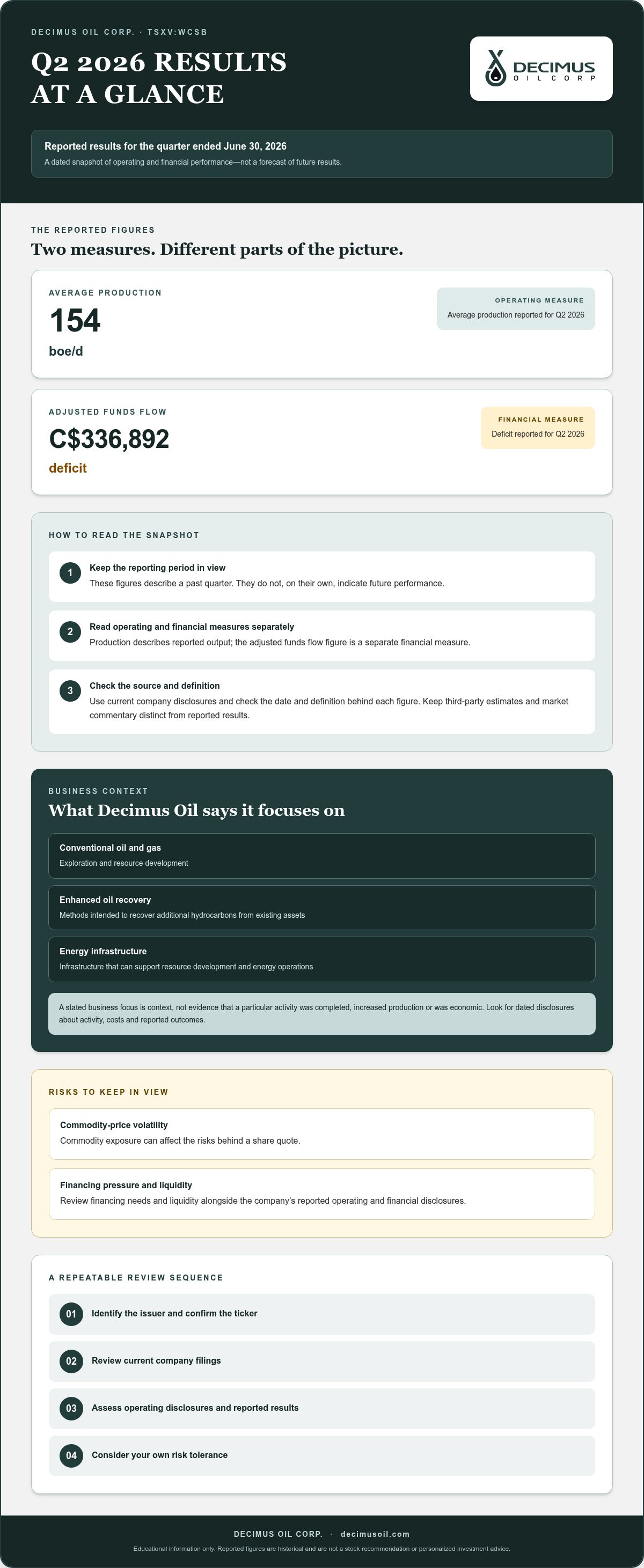
How to research TSXV WCSB stock before making an investment decision
A disciplined review helps separate the issuer’s reported facts from market commentary and assumptions. Follow the same sequence each time: confirm the company, locate primary filings, assess operating and financial evidence, then decide whether the risks fit your circumstances. Record the source and date for each figure so older information is not mistaken for the current position.
Start with issuer and exchange disclosures
Begin with the TSX Venture Exchange and Decimus Oil’s materials to confirm the ticker, issuer name and listing status at the time of your research. If older records use a previous company name, account for that when searching. Decimus Oil was formerly known as Tenth Avenue Petroleum Corp. and changed its name in September 2025.
Use SEDAR+ and issuer materials to locate applicable public-company filings, and confirm that each document relates to the correct issuer and reporting period. Read the filing date as well as the period covered. Financial statements and reported operating results describe past periods; forward-looking statements discuss expectations and should not be treated as completed outcomes.
Build a decision checklist that fits your risk tolerance
Once you’ve confirmed the issuer, work through the evidence in order. Keep a simple research log with the document title, publication date, reporting period and figure or statement you’re relying on. For the TSXV WCSB stock, this makes differences between a quote page, a company release and a formal filing easier to spot.
- Review the business and strategy. Compare the company’s stated focus with dated operational updates. Separate plans and objectives from activities or results the issuer says have occurred.
- Assess financial position. Read the latest available financial statements and management discussion for cash resources, liabilities, expenses and cash flow. Compare periods carefully, noting whether a change reflects a different reporting period or definition.
- Check share structure. Review current filings and issuer announcements for shares outstanding, changes in the share count, financing activity and disclosed terms that may affect existing shareholders.
- Consider your own circumstances. Decide what level of commodity, operating, financing and trading-liquidity uncertainty you can tolerate. If you need advice tailored to your financial situation, consider speaking with a qualified financial professional.
Use the checklist across more than one reporting period where possible. A single release can provide a useful update, but may not show a trend or explain the reasons behind a change. Keep estimates, analyst commentary and platform-generated indicators separate from issuer-reported facts. For broader context on evaluating Canadian energy companies, consult this Canadian energy public equity guide.
To continue your review using company-published information, explore Decimus Oil’s issuer disclosures. This process supports independent research; it is not a personalized recommendation to buy, sell or hold shares.
Decimus Oil and TSXV:WCSB: investor next steps
Research is most useful when it clarifies what is known, what remains uncertain and what matters to your circumstances. Decimus Oil’s focus spans conventional oil and gas exploration, resource development, enhanced oil recovery and energy infrastructure. These areas provide context for understanding the issuer, but do not establish current project status, future results or whether the shares suit a particular investor.
Where Decimus Oil fits in an investor's research
Consider the company’s business focus alongside its current operating and financial disclosures. Strategy describes areas of activity; filings and dated updates provide evidence to assess execution, financial position and change over time. Evaluate each claim according to its source and reporting date, and distinguish company-reported information from estimates or general sector commentary.
Decimus Oil reports insider ownership of more than 27% and more than 100 years of combined team experience. Treat both as company-summary figures, not independent proof of performance or future outcomes. Check current issuer disclosures for the source, date and relevant definition. Ownership can change, and experience alone does not establish operating or investment results.
Continue with company and sector context
Use a broader framework to put issuer-specific evidence in context. The junior oil and gas producer evaluation guide can help structure further research into factors relevant to Canadian energy companies. Keep dated facts, management statements, third-party estimates and your own assumptions distinct. That separation makes it easier to revisit your reasoning when new disclosures become available.
For company information and published disclosures, visit Decimus Oil’s website. Compare its materials with applicable public filings and note the publication date of each source. A statement that was accurate for an earlier reporting period may not describe the company’s current position, so refresh the evidence before making a decision involving TSXV:WCSB.
Suitability depends on your financial goals, time horizon and capacity for risk. This guide is educational and is not a recommendation to buy or sell WCSB shares. Assess the available evidence independently, and consider consulting a qualified financial adviser if you need advice tailored to your circumstances.
Make your next review evidence-led
Turn your research into a decision framework you can revisit as new information becomes available. Before relying on TSXV WCSB stock data, confirm the issuer and listing status through current sources, then record the dates and definitions behind the figures you use. Company-reported insider ownership and team experience can add context when supported by current, dated disclosures. Treat them as part of the evidence, not a substitute for assessing operating, financial and market risks.
There is no need to force a decision based on a single quote or company update. Compare primary disclosures, consider how uncertainty fits your circumstances, and seek qualified financial advice if you need guidance tailored to your situation. For the issuer’s own materials, review Decimus Oil's company information and disclosures. A careful, independent process is a constructive step toward an informed choice.
Frequently Asked Questions
What does TSXV:WCSB stand for?
TSXV:WCSB identifies Decimus Oil Corp.’s stock-market listing: TSXV refers to the TSX Venture Exchange, and WCSB is the symbol used to identify the issuer’s shares. The ticker is not the company’s name or a description of its oil and gas operations. Before using a quote or profile, verify the issuer name, listing and trading information through current exchange or company sources, as market data can change.
Is TSXV:WCSB the same as Decimus Oil Corp.?
No. Decimus Oil Corp. is the issuer, while WCSB is the ticker used to identify its listed shares. The company’s business activities are distinct from the market value assigned to those shares through trading. A company update describes the issuer; a quote shows market information about its security. Before relying on a third-party profile, compare the displayed company name and ticker with current primary disclosures.
Does Decimus Oil pay a dividend?
Review current issuer announcements and filings to determine whether Decimus Oil has declared a dividend; don’t infer one from its industry or exchange listing. Dividend status can change, and an undated third-party profile may not reflect the latest information. Even if a company distributes income, that does not remove other equity risks, such as changes in operating performance, financing needs or share value. Verify dividend information against a dated primary source.
Where can I find official information about TSXV:WCSB?
Start with Decimus Oil’s current company disclosures and applicable Canadian public-company filings, including documents available through SEDAR+. Confirm that each document names the correct issuer, then note its publication date and reporting period. Quote platforms can help locate market data, but figures may change or be delayed. For each number you use, record its source and reporting date rather than relying on an undated summary.
What should I review before investing in a junior oil and gas stock?
Review current filings, operating strategy, financial position, share structure and disclosed uncertainties as a connected set. For example, compare reported operating results with the relevant financial period and check whether financing activity has changed the share count. Commodity exposure, operational uncertainty, funding requirements and trading liquidity can all affect an investment. Whether a stock fits depends on your objectives, financial circumstances and risk tolerance, not a general assessment alone.
Does a stock chart show whether TSXV:WCSB is a good investment?
No. A chart shows historical trading activity and may include technical indicators calculated from market data; it cannot establish future performance or the underlying value of the issuer. Check the time period and definitions behind displayed measures, then compare them with current company disclosures. A chart pattern, platform rating or past price movement is not a prediction. The TSXV WCSB stock chart is one research input, not a substitute for assessing the business.
Is TSXV:WCSB suitable for every investor?
No public equity is suitable for everyone, and a junior energy stock can carry risks that differ from those of a diversified portfolio. Suitability depends on factors such as your investment objectives, time horizon, financial circumstances and capacity to tolerate loss. This FAQ cannot assess your individual situation or predict returns. Review current information independently, and consider consulting a qualified financial adviser if you need guidance tailored to your circumstances.


