
Experience is more than a long résumé. An experienced oil and gas management team in Canada combines relevant leadership, technical, operational and financial backgrounds to guide executive decisions, while board members provide oversight and industry perspective. Together, their roles and career histories show how their experience relates to a company’s strategy and assets.
Look beyond titles when assessing a leadership team. A chief executive’s track record, a technical leader’s operating background and a director’s governance experience each offer different insights into how a company is managed.
This article explains the responsibilities of executives, board members and key management roles, and the oil and gas experience each may bring. It also shows how these roles connect across exploration, resource development, operations and corporate oversight, helping you interpret a team’s background in the context of Canada’s energy sector.
Key Takeaways
- Assess leaders by how their career experience aligns with the company’s assets and strategic priorities, not by titles alone.
- Distinguish executive accountability from board oversight to understand how decisions are made and challenged.
- Look across technical, operational, financial and commercial backgrounds to see how management responsibilities fit together.
- Use specific roles and career histories to evaluate how a team’s experience relates to exploration, development and energy infrastructure.
Executive leadership
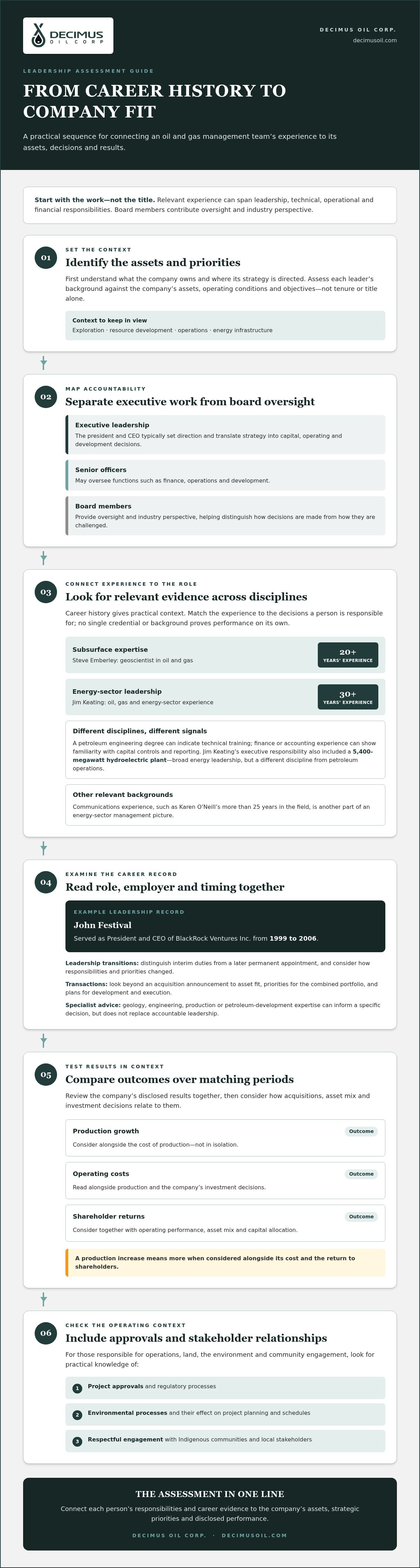
Executive leaders set direction and translate company strategy into capital, operating and development decisions. The president and chief executive officer typically leads this work, while senior officers oversee functions such as finance, operations and development. When assessing an experienced oil gas management team Canada, consider whether leaders’ past responsibilities fit the company’s assets and objectives, rather than relying on titles alone.
Career histories offer practical evidence. John Festival served as President and CEO of BlackRock Ventures Inc. from 1999 to 2006. Other industry executives have stepped into interim leadership roles before taking on permanent positions, guiding organizations through critical transformation periods. These examples show why role, employer and timing all matter: a person may have held executive responsibility through different company stages or leadership transitions.
Corporate transactions test leadership beyond deal announcements. Successful Canadian operators frequently execute major asset purchases and corporate buyouts to expand their portfolios. An executive team’s work around a transaction can include evaluating asset fit, setting priorities for the combined portfolio and aligning operational plans. To assess the strategic rationale, connect the acquired assets with the company’s stated direction, then look for how leadership assigns responsibility for development and execution.
Strategy depends on matching technical opportunities with financial discipline. Senior upstream leaders must weigh exploration, production, development timing and capital allocation together. A petroleum engineering degree, for example, may indicate technical training, while experience as a finance officer or accountant can show familiarity with capital controls and reporting. Neither credential alone proves performance. The key question is how a leader’s background relates to the decisions their role requires.
Canadian oil and gas executive compensation varies by company and role, including at organizations like Decimus Oil Corp. Packages may combine base pay, incentives and equity, with responsibilities, performance measures and company strategy shaping the mix. An average figure alone would not explain the difference between a president overseeing a broad portfolio and an officer responsible for one function.
Assess executive performance through production growth, operating costs and shareholder returns together. Compare the company’s disclosed results over the same period, then consider how acquisitions, asset mix and investment decisions relate to those outcomes. A production increase, for example, means more when considered alongside its cost and the return to shareholders.
An interim CEO provides continuity while a company’s board addresses leadership succession or a changing mandate. Industry leaders often begin serving in an interim capacity before being appointed as permanent President and Chief Executive Officer. When reviewing such a transition, distinguish interim duties from the subsequent appointment, and consider how the leader’s responsibilities and strategic priorities changed.
Management experience in Canada's energy sector
Canadian energy management draws on technical, financial and operational knowledge. Steve Emberley has over 20 years of experience as a geoscientist in the oil and gas industry. His career illustrates how subsurface expertise can connect geological interpretation with exploration and development decisions. When assessing a management team, match each leader’s background to the assets, operating conditions and decisions they oversee.
Energy projects can involve different resource types and operating contexts, so relevant project experience matters. Jim Keating has more than 30 years of experience in the oil and gas and energy sector, alongside executive responsibility for a 5,400-megawatt hydroelectric plant. These responsibilities show the breadth of energy-sector leadership, but hydroelectric experience and petroleum operations remain different disciplines. Look for project knowledge that relates directly to the company’s assets and plans.
To identify Canadian teams with strong operating and financial records, compare disclosed production, operating costs and financial results over matching periods. Then consider asset mix and investment decisions. Years of experience and engineering credentials provide context, but they do not replace evidence of operating and financial performance.
Regulatory and Indigenous relations experience should include practical knowledge of project approvals, environmental processes and respectful engagement with Indigenous communities. Leaders need to understand how these considerations shape project planning, schedules and relationships with local stakeholders. Look for relevant experience among those responsible for operations, land, the environment and community engagement.
To find Canadian oil and gas companies with experienced management teams, look at whether named executives have relevant records across technical, operational and financial responsibilities. For example, Steve Emberley’s geoscience background signals subsurface expertise, while a finance leader’s track record demonstrates a different capability. Assess each company in relation to its assets and priorities, rather than treating tenure as a measure on its own.
Specialist upstream advisers can bring focused knowledge of geology, engineering, production and petroleum development. Their input is useful when a company faces a specific technical decision, such as evaluating an exploration opportunity or better understanding an existing asset. Consider how their advice informs management’s investment choices and operating plans. Specialist input does not replace accountable leadership.
Communications experience also supports effective energy-sector management. Karen O’Neill has worked in communications for more than 25 years, demonstrating a career focused on explaining complex matters to stakeholders. Clear communication helps connect technical plans with investor and community understanding. This capability complements finance, engineering and operations by helping audiences follow a company’s priorities and decisions.
For readers assessing how exploration and infrastructure fit into energy development, consider how conventional oil and gas exploration relates to the company’s broader asset strategy. A sound assessment connects leadership experience to the technical, financial and stakeholder demands of the projects being advanced.
Board members’ energy-industry backgrounds
A board’s industry experience can strengthen oversight by bringing technical, financial and investment perspectives to major decisions. Before starting Cardinal Energy Ltd., M. Scott Ratushny founded four public and two private oil and gas companies. This background offers context for assessing his experience with company formation and sector investment, but does not by itself establish how a board will perform.
Look at the positions directors held and the decisions those roles involved. John Festival’s executive background can be considered as part of a broader assessment of his board experience. His executive background can be considered alongside his board responsibilities and the company’s strategic direction. Directors with operating experience may understand asset development; those with financial backgrounds can bring a different lens to capital allocation and corporate performance.
Board expertise is most useful when it matches the company’s investment decisions. Craig Blackwood has over 25 years of experience in the energy industry, while Brian Bagnell has over 15 years of experience in energy and financial markets. Together, these profiles illustrate how various forms of experience can inform oversight. Compare each director’s background with the company’s assets, financing choices and development priorities.
Academic credentials add another dimension, but should be read alongside practical work. Neil Bokenfohr received his Bachelor of Science in Petroleum Engineering from the University of Alberta in 1989. That degree signals formal technical education; his subsequent positions provide additional context about how his expertise developed. For investors, the useful question is whether directors can scrutinize technical proposals and understand their financial implications.
When evaluating a Canadian oil and gas management team, consider risks such as concentrated expertise, limited relevant operating or financial backgrounds, unclear accountability, and a mismatch between board experience and the company’s assets or strategy. A director’s history can inform your assessment, but weigh it against the board’s collective skills and oversight practices.
Transaction and governance backgrounds also matter. Greg Pollard served as CFO of Connacher Oil and Gas Limited, an oil sands company, from 2012 to 2015. That corporate finance experience offers a basis for examining how directors may approach financial oversight. Investors can compare such histories with the company’s disclosed capital priorities, acquisition rationale and operating plans, looking for a coherent connection between expertise and oversight.
Use a consistent review process. First, map each director’s technical, operational, financial and governance experience. Next, compare those skills with the company’s principal assets and current priorities. Then assess whether the board’s collective background covers the decisions it must oversee. Steve Magus, a Steel Reef board member, has 34 years of experience in the Canadian oil and gas sector, a specific example of sector tenure to place within that broader assessment.
Neil Bokenfohr was Vice President, Engineering of Bear Creek Energy Ltd. from 2002 to 2005. Shawn Van Spankeren was Vice-President of Finance and Administration for Crew Energy from its inception in 2003. Sean Brown served as Gibson Energy’s Senior Vice President and Chief Financial Officer for nine years. Together, these roles add engineering and financial experience to consider when assessing board oversight.
Oil and gas industry experience
Years in the sector matter most when they connect to the work a leader must oversee. Dale Orton, Cardinal Energy Ltd.’s president, has over 30 years of experience in oil and gas activities. This record provides context for his familiarity with industry operations and leadership responsibilities. For investors, compare a leader’s experience with their current role, the company’s assets and the decisions they are expected to guide.
Technical depth can be specific to a recovery method or resource. David Kelly has over 20 years of CO2 enhanced oil recovery experience. That background is relevant when assessing projects involving enhanced recovery, where development decisions rely on understanding the reservoir and the method being applied. Compare a leader’s specialist expertise with the company’s actual assets and operating plans, rather than assuming every technical credential applies equally across projects.
Experience across production and development offers another useful measure. Guoyi Yu has over 30 years of oil and gas production and development experience. Cameron Merkley, Ember Resources’ vice-president of development services, has worked on both the service and operator sides of the energy industry for over 20 years. These paths show different forms of exposure: one centres on production and development, while the other spans distinct industry roles.
Career timelines help clarify whether experience is continuous, specialized or gained across different responsibilities. Cameron Merkley started with Ember Resources in 2006 and returned in 2014 after three years managing drilling and completion operations. Simon Rivard, Ember Resources’ vice-president of production, has worked in the energy industry since 2002. Use these timelines to connect a person’s background with the operating decisions in their current role.
Professional qualifications and industry participation offer different kinds of evidence. Dale Orton serves on the Board of Governors of the Explorers and Producers Association of Canada, demonstrating participation beyond an executive role. Review credentials and memberships separately, then consider how they complement a leader’s operating background and inform their engagement with sector-wide issues and professional communities.
Prior appointments can show functional familiarity and role progression. Jason LaForge joined Cardinal Energy Ltd. in 2014, while David Kelly joined the company as Vice President of Saskatchewan in 2017. These dates help place their experience within a company and clarify the responsibilities they assumed. They don’t, by themselves, establish results, so relate role histories to the outcomes and responsibilities the company discloses.
To assess a management profile, match experience to the company’s needs: reservoir knowledge for subsurface decisions, drilling and completion experience for well execution, and development expertise for project planning. Consider qualifications, industry participation and role progression together. This helps distinguish broad sector familiarity from specialized experience that directly supports operations and strategic priorities.
Management team roles
Management roles divide accountability across the technical and corporate work required to develop energy assets. Darren Tisdale joined Advantage in August 2019 as Chief Geologist, a role focused on geological insight. Tyler Cheetham has served as Saturn Oil & Gas’s Vice President of Land since August 2022. These examples show how subsurface and land responsibilities support different parts of a company’s operating plan.
Finance leaders translate investment priorities into budgeting, financial reporting and capital discipline. John Quaife has been Vice President of Finance at Advantage since 2019, while Joel Robertson has served as Saturn Oil & Gas’s Vice President of Finance since January 2026. When reviewing these roles, consider how financial leadership connects capital decisions with exploration, development and the company’s financial position.
Legal and corporate administration roles support governance, compliance and clear accountability. Grant MacKenzie has served as Saturn Oil & Gas’s Chief Legal Officer since July 2023. Mark Hawkins has served as Corporate Secretary since 2015. A chief legal officer and a corporate secretary have distinct responsibilities, but both roles can contribute to well-structured corporate decision-making. Review the leadership structure to understand how those duties connect with the board and executive team.
Investor relations is another specialized function. Cindy Gray has served as Saturn Oil & Gas’s Vice President of Investor Relations since September 2024. The role connects corporate information with investor understanding. Communications and financial reporting should be clear enough for shareholders to follow the company’s priorities, risks and performance. This matters particularly when management explains changes in strategy or asset plans.
Technical credentials help explain how leaders developed their expertise. Neil Bokenfohr received a Bachelor of Science in Petroleum Engineering from the University of Alberta in 1989. Mark Hawkins received a Bachelor of Commerce Degree from the University of Victoria in 2001 and a Bachelor of Laws Degree from the University of Alberta in 2005. These examples show how science, commerce and law can contribute different perspectives to a management group.
International experience can also shape a company’s decision-making. Xiaoshu Gao joined PetroChina Canada as VP Legal and Internal Audit in January 2025. She served as Legal Affairs Deputy Director from 2018 and Legal & Compliance Director from 2022. Her career illustrates how legal and internal audit experience can connect corporate oversight with international business backgrounds.
To assess a team, map each named role to its main accountability: geology to subsurface decisions, land to asset rights, finance to capital oversight, and legal administration to governance. Then compare the team’s combined experience with the company’s strategy. A member’s degree, title or prior position is most useful when it clarifies how decisions are assigned and reviewed.
Explore Decimus Oil Corp.’s energy-sector investment perspective to consider how leadership roles relate to corporate strategy and shareholder interests.
Decimus Oil: Public Equity Investment (TSXV:WCSB)
For readers considering Canadian oil and gas leadership alongside an investment opportunity, Decimus Oil Corp. is a company to assess. Investors can consider the company’s disclosures when assessing its equity. Decimus focuses on conventional oil and gas exploration, energy infrastructure and enhanced oil recovery. These areas provide context for evaluating how corporate strategy relates to resource development.
Consider how the company’s focus aligns with your investment objectives, alongside the operating and governance factors discussed in this article. Public equity involves investment risk, so include the company’s strategy and disclosures in your own assessment.
Visit decimusoil.com to learn more about Decimus Oil.
Make your next assessment strategic
Use your assessment of an experienced oil and gas management team in Canada to guide your next decision: whether the company’s leadership, assets and direction align with your investment interests. A management profile is valuable for informing your assessment, not as a title or résumé viewed in isolation.
For investors exploring the sector, Decimus Oil offers Public Equity Investment (TSXV:WCSB), alongside Conventional Oil & Gas Exploration and Energy Infrastructure. These offerings provide a starting point for learning how the company participates in Canada’s energy sector. Consider the company’s focus and disclosures as you determine whether its approach fits your objectives.
Contact Decimus Oil to discuss your needs, and take your next step with a clear view of the opportunity.
Frequently Asked Questions
What oil and gas management experience do Canadian energy company leaders have?
Canadian energy leaders may bring experience in geology, engineering, field operations, finance, land management, legal affairs and investor relations. To assess whether that experience fits a company, trace a current business decision, such as advancing a development project, to the leaders responsible for its technical review, funding and execution. An experienced oil and gas management team in Canada should have relevant expertise across those decisions and clear accountability for each.
Which Canadian oil and gas management teams have the strongest operating and financial track records?
Compare disclosed production, operating costs and financial results over matching periods, taking asset mix and investment decisions into account.


