
While the global narrative fixates on a rapid energy transition, the reality of 2026 energy security is rooted firmly in the geological formations we've mastered for decades. It's often assumed that traditional energy is a sunset industry, yet this perspective ignores the sophisticated methodologies now revitalizing conventional oil gas exploration across the Western Canadian Sedimentary Basin. You likely recognize the pressure of volatile commodity prices and the complex regulatory hurdles that make capital expenditure decisions increasingly difficult. We understand these challenges, but the data suggests a different trajectory for those with a strategic eye.
This outlook demonstrates why these plays remain the definitive cornerstone of energy security and a primary driver for Canadian resource development. You'll discover the distinct economic advantages of conventional assets and identify how modern technology is breathing new life into mature fields. We'll also examine growth opportunities within the junior energy sector, providing a comprehensive view of how seasoned operators realize value through calculated, high-intensity methodologies in an evolving market.
Key Takeaways
- Identify why natural flow reservoirs continue to offer the most competitive CAPEX-to-production ratios within the Western Canadian Sedimentary Basin.
- Understand how horizontal drilling and high-intensity completion techniques have modernized conventional oil gas exploration, allowing operators to realize higher yields from mature formations.
- Learn how the synergy between Enhanced Oil Recovery (EOR) and owned energy infrastructure creates a more resilient and profitable operational model.
- Discover how public equity positioning on the TSX Venture Exchange provides a strategic advantage for growth-oriented energy firms and their stakeholders.
The Enduring Strategic Value of Conventional Oil and Gas Exploration
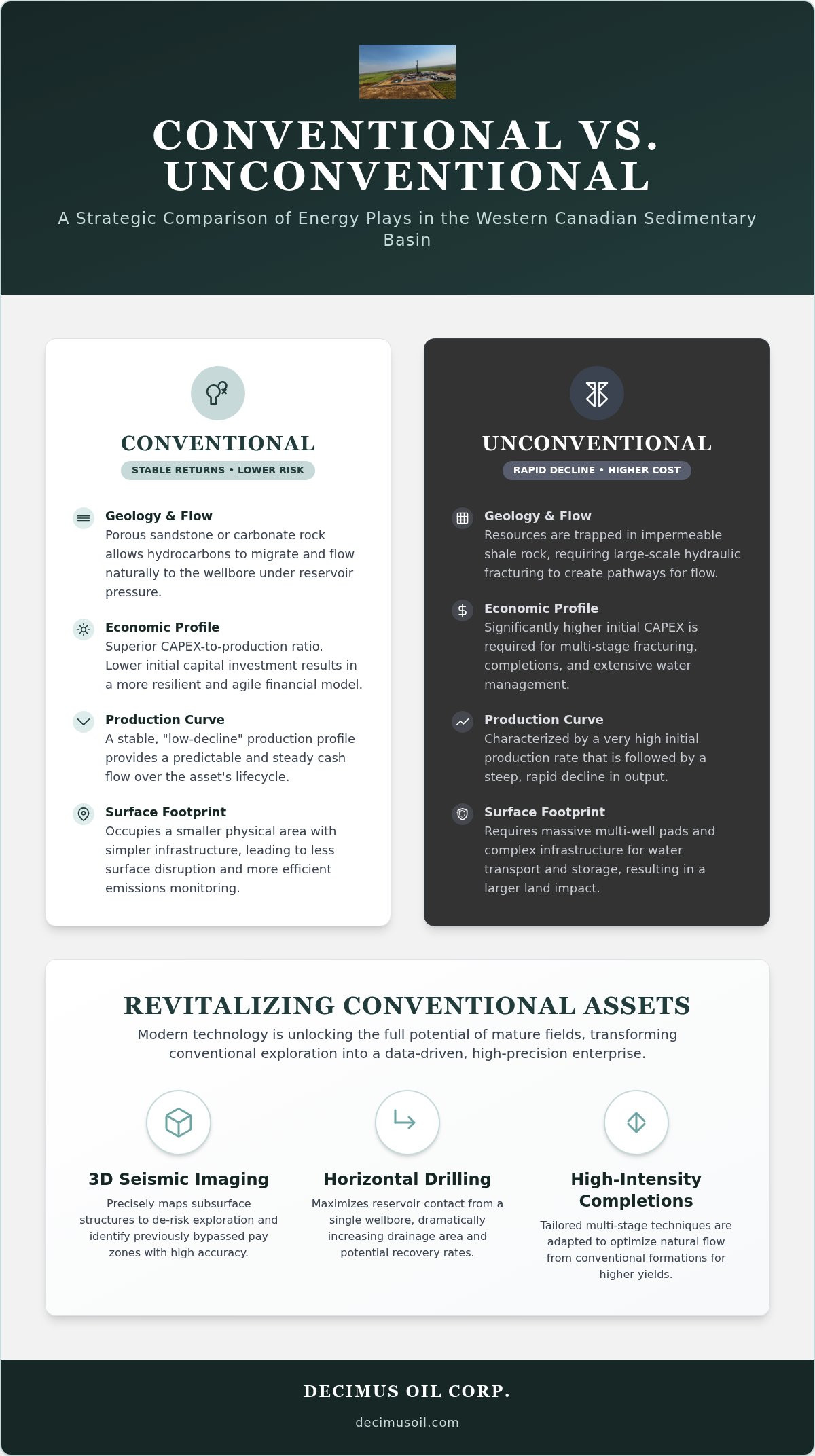
Conventional oil gas exploration remains a vital component of the Canadian energy sector, even as the industry evolves toward 2030 targets. Unlike unconventional resources trapped in tight shale, conventional reservoirs consist of porous sandstone or carbonate rocks where hydrocarbons migrate naturally into structural traps. This geological distinction allows for a more streamlined extraction process. Because the oil and gas flow naturally to the wellbore under reservoir pressure, these assets serve as a reliable baseline for national energy security. They provide the steady, predictable output necessary to support the broader energy grid while maintaining lower operational complexity.
The Distinction Between Conventional and Unconventional Plays
The fundamental difference lies in the permeability of the geological strata. Conventional plays utilize traditional vertical or directional drilling to tap into reservoirs where the resource is easily accessible. In contrast, unconventional projects require large-scale hydraulic fracturing to unlock hydrocarbons from impermeable shale. This makes Modern Methodologies in Hydrocarbon Extraction essential for identifying high-value targets with minimal surface disruption. Conventional production profiles also benefit from a "low-decline" advantage. They don't experience the steep initial drop-off in production typical of shale wells, providing a more stable cash flow over the asset's lifecycle.
Economic Resilience of the Conventional Sector
From a financial perspective, conventional assets offer a superior CAPEX-to-production ratio. The initial capital investment required to bring a conventional well online is significantly lower than that of a multi-stage fractured horizontal shale well. This lower capital intensity allows junior producers to maintain agility, especially when navigating the volatile price environments seen in early 2026. Predictable operational expenditures (OPEX) further strengthen the balance sheet, as these wells require less energy and water for ongoing production. By optimizing these assets, operators can organize production schedules that prioritize long-term stability over short-term volume spikes.
Operational efficiency is also reflected in the environmental profile. Conventional sites typically occupy a smaller physical footprint. A single conventional well pad requires less land clearing and infrastructure than the massive, multi-well pads and extensive water management systems needed for unconventional developments. For operators focused on meeting strict 2026 methane regulations, the simpler infrastructure of conventional sites often allows for more efficient monitoring and emissions control. This reduced environmental intensity, combined with high-yield potential, reinforces why conventional oil gas exploration is a calculated choice for growth-focused enterprises looking to realize value from the WCSB.
Modern Methodologies in Conventional Hydrocarbon Extraction
The modernization of conventional oil gas exploration has transformed the Western Canadian Sedimentary Basin (WCSB) into a high-tech frontier. We've moved beyond the era of simple vertical drilling, instead utilizing sophisticated 3D seismic imaging to map subsurface structures with unprecedented clarity. This data-driven approach significantly reduces geological risk, ensuring that capital is deployed only where the probability of success is highest. By visualizing the reservoir in three dimensions, operators can identify bypassed pay zones in mature fields that were previously invisible to legacy technology. This precision is a hallmark of petroleum exploration and production in Canada, where technical proficiency meets strategic asset management.
Advanced Drilling and Completion Strategies
Horizontal drilling has revolutionized how we access traditional reservoirs. By steering the wellbore horizontally through the target formation, we realize a massive increase in reservoir contact compared to vertical alternatives. Key benefits of this approach include:
- Maximum Reservoir Contact: Horizontal placement increases the drainage area of a single well, allowing for higher recovery rates.
- Adapted Completions: Multi-stage designs are tailored for the specific geomechanics of conventional rock to optimize natural flow.
- Reduced Footprint: Multi-well pad drilling minimizes surface disturbance while centralizing essential collection and processing infrastructure.
Digital Transformation in the Oil Patch
The integration of digital monitoring systems is now a core component of conventional oil gas exploration, allowing for the real-time optimization of wellbore performance. We now utilize AI-driven algorithms for the predictive maintenance of pumpjacks and surface infrastructure, identifying potential mechanical issues before they result in costly downtime. Real-time flow monitoring provides a continuous stream of data, enabling operators to adjust production parameters instantly to maximize extraction efficiency. In the WCSB, data-driven site selection has become a competitive necessity. By synthesizing historical production data with modern geological modelling, seasoned operators can identify the most lucrative opportunities for resource development with high confidence.
These methodologies don't just increase production; they redefine the risk profile of the entire sector. The shift from exploratory "wildcatting" to technical manufacturing ensures that every dollar spent is backed by a robust digital narrative. This commitment to modern, high-intensity methodologies allows for the steady accumulation of value, positioning conventional assets as a forward-looking investment in a stable energy future.
Assessing the Economics and Risk Profile of Conventional Plays
The financial profile of conventional oil gas exploration is defined by capital efficiency and long-term sustainability. While unconventional shale projects often require massive upfront investment and suffer from rapid decline rates, conventional reservoirs offer a more balanced CAPEX-to-production ratio. This efficiency is particularly evident in the Western Canadian Sedimentary Basin, where established royalty structures incentivize the development of light oil plays. By focusing on reservoirs with natural flow characteristics, operators can minimize initial drilling costs while securing a production profile that remains stable for decades.
Profitability in 2026 is heavily influenced by the "netback" potential of light and medium crude. With Western Canada Select (WCS) prices averaging US$67.16 per barrel in July 2026, the lower operational cost of conventional wells allows for wider margins. These assets don't just provide immediate revenue; they serve as the foundation for capital appreciation. Their low-decline nature ensures that cash flow is predictable, providing the stability required to navigate broader market volatility and maintain consistent reinvestment strategies.
Risk Management in Upstream Exploration
Mitigating risk in conventional oil gas exploration requires a dual focus on geological certainty and operational excellence. Geological risk is managed through advanced 3D seismic data, while operational risk is minimized by partnering with seasoned teams. A diversified portfolio across multiple conventional targets prevents over-exposure to any single wellbore. In the current regulatory environment, having management with deep institutional knowledge is essential to organize compliance efforts and realize project timelines without unnecessary delays. This expertise allows firms to navigate the equivalency agreements between federal and provincial methane regulations with high-level professional integrity.
Capital Allocation and Shareholder Value
Effective capital allocation separates a sunset company from a growth-focused enterprise. By reinvesting cash flow into secondary recovery and Enhanced Oil Recovery (EOR), operators can extend the productive life of an asset long after the initial flush production. This strategy maximizes the ultimate recovery of hydrocarbons and enhances the total value of the resource base. It's a calculated visionary approach that prioritizes the bottom line and long-term asset optimization over short-term volume spikes.
Alignment between management and shareholders is a critical indicator of long-term success in the junior energy sector. High insider ownership, such as the 27% stake held by the leadership at Decimus Oil Corp. (TSXV:WCSB), ensures that strategic decisions are made with the goal of increasing shareholder value. This alignment, combined with a focus on high-intensity completion techniques, allows sophisticated operators to punch above their weight, delivering results that rival much larger entities while maintaining the agility of a junior firm.
Maximizing Asset Value: The Synergy of EOR and Infrastructure
Realizing the full potential of a reservoir requires a shift from initial discovery to long-term asset optimization. In the context of conventional oil gas exploration, the most sophisticated operators don't just extract; they curate the reservoir's entire lifecycle. By integrating Enhanced Oil Recovery (EOR) with owned energy infrastructure, firms can maintain production levels that would otherwise decline. This strategic alignment turns mature assets into reliable cash-flow engines. It's a calculated approach that prioritizes the steady accumulation of value over the rapid, often unsustainable depletion seen in other sectors.
Enhanced Oil Recovery (EOR) Techniques
Enhanced Oil Recovery serves as the primary mechanism for extending the productive life of a well. Secondary recovery, specifically waterflooding, remains a staple for maintaining reservoir pressure and pushing remaining hydrocarbons toward the wellbore. As we look toward the 2026 energy landscape, tertiary methods like CO2 injection and chemical enhancement are becoming increasingly vital. These methodologies allow us to revitalize plays that legacy operators might have abandoned. By applying modern geomechanics to these mature formations, a seasoned operator can significantly increase the total recovery factor, ensuring no resource is left behind.
Infrastructure as a Strategic Moat
Controlling the midstream is what separates a service-dependent driller from a sophisticated, vertically integrated operator. Owning and managing energy infrastructure, including pipelines, batteries, and processing facilities, creates a significant strategic moat. This control allows for:
- Cost Reduction: Eliminating third-party processing fees directly improves the netback on every barrel.
- Operational Agility: Direct management of batteries and flow lines allows for real-time adjustments to production schedules.
- Bottleneck Mitigation: Infrastructure ownership reduces the impact of midstream constraints that often hinder the Canadian energy sector.
The synergy between extraction and infrastructure management ensures that every stage of the process is optimized for efficiency. When an operator manages their own conventional oil gas exploration assets alongside the necessary processing facilities, they reduce transportation hurdles and processing delays. This integrated model is essential for navigating the complex regulatory and economic environments of the WCSB. To see how this model is applied to modern projects, learn more about our approach to Energy Infrastructure and Resource Development.
Ultimately, the combination of modern EOR techniques and infrastructure control provides a level of institutional stability that is rare in the junior energy sector. It allows for a results-oriented narrative where growth is driven by technical proficiency and strategic foresight. By focusing on asset optimization, operators can realize superior returns while maintaining a commitment to professional integrity and long-term shareholder value.
Strategic Alignment: Realizing Growth Through Public Equity
Public equity markets provide a transparent and liquid mechanism for stakeholders to participate in the Canadian energy sector. For growth-oriented enterprises, the TSX Venture Exchange (TSXV) serves as a critical incubator, offering access to capital that fuels ambitious resource development programs. This public listing ensures a level of institutional stability and professional integrity, as companies must adhere to rigorous reporting standards. This transparency is vital for those evaluating the long-term viability of conventional oil gas exploration in an evolving regulatory climate. By aligning management expertise with shareholder interests, firms can execute long-term strategic visions that are often difficult to realize in the private sphere.
Investing in the Western Canadian Sedimentary Basin
The Western Canadian Sedimentary Basin (WCSB) remains a world-class resource for conventional hydrocarbons. Despite the maturity of the basin, it continues to offer significant potential for those who can identify undervalued assets. Strategic acquisitions of legacy fields, when combined with modern conventional oil gas exploration techniques, allow operators to unlock value that previous owners overlooked. Focusing on assets with established infrastructure provides an immediate competitive advantage and reduces the time from discovery to cash flow. This approach turns geological potential into tangible shareholder value through disciplined drilling and optimization.
The Decimus Approach to Conventional Excellence
Decimus Oil Corp. (TSXV:WCSB) exemplifies how a seasoned leadership team can navigate the complexities of the modern energy market. With over 100 years of collective industry experience, the management understands the technical nuances required to optimize production and extend asset lifecycles. The firm prioritizes high-potential conventional plays characterized by low decline rates and predictable performance. This focus on stability, coupled with high-intensity completion methodologies, ensures the company remains resilient regardless of commodity price fluctuations.
Commitment to alignment is demonstrated by a 27% insider ownership stake, ensuring that strategic decisions are made with the long-term appreciation of capital in mind. Decimus doesn't just maintain assets; it applies a calculated visionary approach to revitalize them through EOR and infrastructure management. This methodology creates a results-oriented narrative grounded in experience and oriented toward future growth. For those seeking exposure to a sophisticated operator in the heart of the WCSB, we invite you to Explore investment opportunities with Decimus Oil Corp.
Navigating the 2026 Energy Landscape with Strategic Foresight
The evolution of the Western Canadian Sedimentary Basin demonstrates that conventional oil gas exploration is not a legacy pursuit but a high-efficiency technology play. By prioritizing natural flow reservoirs and integrating advanced completion techniques, operators maintain the economic resilience required to thrive in volatile markets. We've explored how the synergy between infrastructure control and Enhanced Oil Recovery (EOR) maximizes the lifecycle of mature assets, providing the institutional stability that defines a seasoned leader.
As you evaluate the potential of the Canadian energy sector, consider the value of a partner that combines over 100 years of management experience with a strategic focus on high-intensity completions. Direct exposure to the WCSB through a growth-oriented public entity ensures that your interests remain aligned with operational excellence. We invite you to View our TSXV:WCSB Investor Profile and Performance to see how we realize value through technical proficiency and strategic asset management. The future of Canadian resources remains bright for those who possess the vision to optimize existing wealth while pursuing new discoveries.
Frequently Asked Questions
What is the primary difference between conventional and unconventional oil?
Conventional oil is found in porous reservoirs like sandstone where it flows naturally to the wellbore under pressure. Unconventional oil, such as shale or oil sands, is trapped in impermeable rock and requires high-intensity stimulation like hydraulic fracturing or steam injection to extract. Conventional plays typically have lower initial decline rates and require less capital intensity for development compared to their unconventional counterparts. This makes them a more stable choice for long-term resource development.
Is conventional oil and gas exploration still profitable in Canada?
Yes, conventional oil gas exploration remains highly profitable due to lower capital requirements and superior netbacks. With Western Canada Select prices averaging US$67.16 per barrel in mid-2026, the lower operational costs of conventional wells allow for sustainable margins. These assets provide a stable baseline of production that isn't subject to the steep decline curves seen in shale, making them ideal for long-term capital appreciation and reliable cash flow generation.
How does Enhanced Oil Recovery (EOR) increase the value of a conventional asset?
Enhanced Oil Recovery (EOR) increases asset value by extracting hydrocarbons that traditional primary recovery methods leave behind. By implementing techniques like waterflooding or CO2 injection, operators can maintain reservoir pressure and significantly extend the productive life of a field. This process optimizes the ultimate recovery factor of the resource, turning mature or declining assets into consistent cash-flow generators without the need for high-risk exploratory drilling or massive new infrastructure builds.
What are the environmental advantages of conventional drilling over oil sands?
Conventional drilling offers a significantly smaller surface footprint and lower energy intensity than oil sands mining or in-situ projects. These sites require less water and generate fewer greenhouse gas emissions per barrel produced because the oil flows naturally. Additionally, the simpler infrastructure associated with conventional wells makes it easier for operators to organize effective methane monitoring programs and comply with strict 2026 federal emissions regulations while maintaining high-level professional integrity and operational transparency.
Why should investors consider junior energy stocks on the TSXV?
Junior energy stocks on the TSX Venture Exchange (TSXV) offer unique growth potential through focused resource development in the WCSB. Companies like Decimus Oil Corp. (TSXV:WCSB) provide direct exposure to high-potential conventional plays that larger producers might overlook. With over 27% insider ownership, these firms often show a strong alignment between management and shareholders, ensuring that strategic decisions are driven by the goal of realizing long-term capital gains and optimizing existing hydrocarbon assets.
What is the role of infrastructure in conventional oil production?
Infrastructure serves as a strategic moat by reducing third-party processing costs and mitigating midstream bottlenecks. Owning pipelines, batteries, and processing facilities allows an operator to control the entire value chain from the wellhead to the sales point. This vertical integration improves operational efficiency and ensures that production can reach markets even when regional takeaway capacity is constrained. Controlling these assets directly enhances the netback on every barrel produced, providing a significant competitive advantage in the basin.
How do companies mitigate the geological risks of exploration?
Modern companies mitigate risk by utilizing 3D seismic imaging and advanced geological modelling to identify bypassed pay zones. By applying decades of collective management experience to historical data, operators can target formations with proven production records. Diversifying a portfolio across multiple conventional oil gas exploration targets further spreads risk, ensuring that the success of the overall development program doesn't depend on a single high-stakes well. This methodical approach prioritizes stable growth over speculative wildcatting.
What makes the Western Canadian Sedimentary Basin ideal for conventional plays?
The Western Canadian Sedimentary Basin (WCSB) is a world-class hydrocarbon province with vast, well-mapped sandstone and carbonate reservoirs. Its extensive existing infrastructure and established regulatory frameworks make it a low-risk environment for resource development. The basin's mature status allows seasoned operators to leverage over a century of historical data to identify undervalued assets, applying modern high-intensity completion techniques to realize production growth in proven areas. This combination of geological certainty and technical capability makes it ideal for conventional plays.


