
The most resilient component of a modern energy portfolio is not necessarily the one capturing the headlines, but rather the one providing the most foundational stability. Investors often feel the weight of global market volatility and the complexity of shifting regulatory frameworks. You likely recognize that while the energy transition is essential, the immediate requirement for energy security demands a pragmatic approach to resource development. A sophisticated approach to strategic investment in Canadian energy allows for the realization of value within mature basins while maintaining institutional stability.
This article demonstrates how traditional hydrocarbon excellence aligns with the evolving global demand for infrastructure security. We provide a clear framework for strategic alignment, identifying high-value assets in the Western Canadian Sedimentary Basin that benefit from modern, high-intensity completion techniques. You'll gain confidence in the longevity of conventional production as we explore how legislative advancements, such as the Building Canada Act, streamline national interest projects. We'll outline how to identify opportunities where others see only maturity, ensuring your strategy is grounded in both technical proficiency and a commitment to long-term growth.
Key Takeaways
- Understand the shift from simple extraction to asset-lifecycle optimization to ensure your portfolio aligns with the evolving Canadian energy landscape.
- Discover why a strategic investment in Canadian energy remains anchored in the Western Canadian Sedimentary Basin (WCSB) for long-term infrastructure stability.
- Recognize the critical role of conventional hydrocarbons in providing the reliable base-load energy required for national security and economic resilience.
- Master the criteria for evaluating junior energy companies on the TSX Venture Exchange (TSXV) by focusing on technical proficiency and proven management experience.
- Explore how sophisticated operators utilize enhanced oil recovery and high-intensity completion techniques to realize significant value from mature assets.
Defining Strategic Investment in Canadian Energy
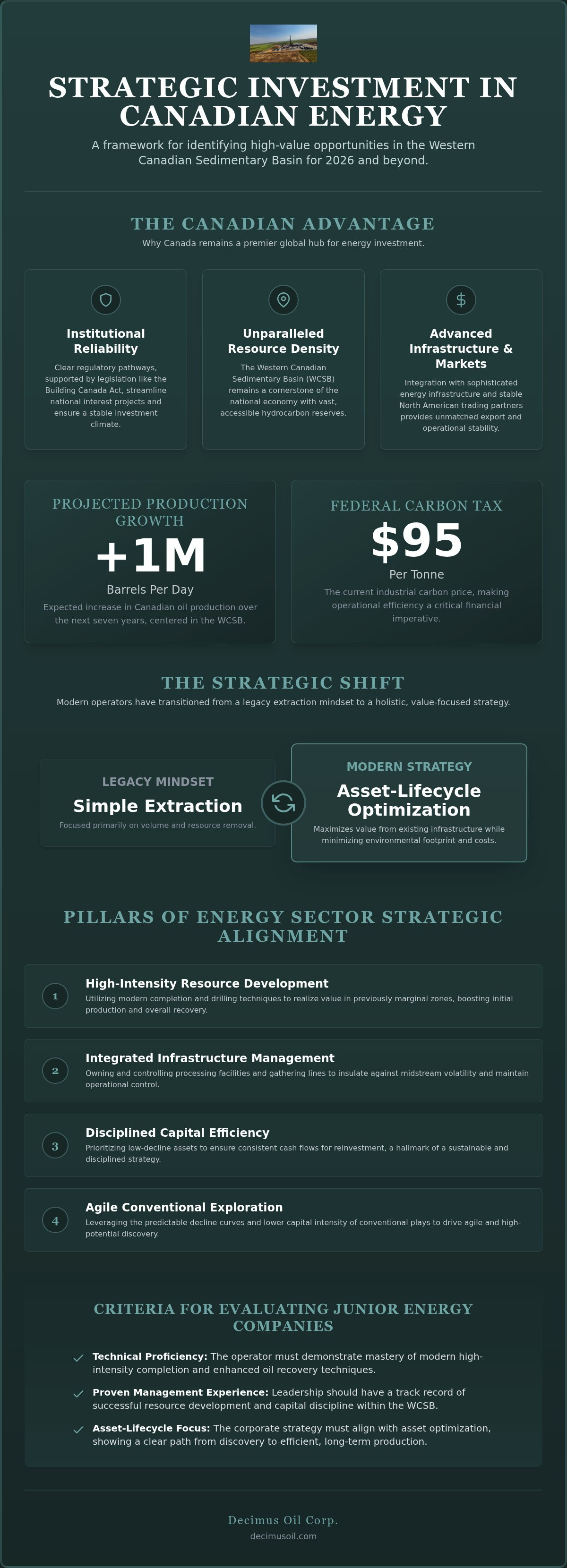
Strategic investment in Canadian energy transcends simple capital allocation; it's a deliberate alignment of financial resources with national energy security and sustainable resource growth. In 2026, the industry has transitioned away from a legacy extraction-only mindset. Modern operators now prioritize asset-lifecycle optimization, a strategy that extracts maximum value from existing infrastructure while minimizing environmental footprints. This shift is crucial because the federal industrial carbon tax has reached $95 per tonne this year, making efficiency a financial imperative rather than just a corporate goal. Public equity plays a vital role here, providing the necessary liquidity for junior firms to develop resources in a high-intensity environment. By participating in public markets, investors support the infrastructure stability required to meet evolving global demand.
The Core Principles of Strategic Alignment
Operational efficiency serves as the primary prerequisite for capital appreciation in the current market. Sophisticated firms balance traditional hydrocarbon production with ESG-aligned methodologies to maintain social license and investor confidence. Energy sector strategic alignment is the synchronization of corporate goals with national energy sovereignty. By focusing on enhanced oil recovery and high-intensity completion, companies can realize growth even in mature fields. This alignment ensures that capital is deployed where it can achieve the highest technical and financial performance.
Why Canada Remains a Global Strategic Hub
Canada continues to serve as a premier global strategic hub due to its institutional reliability and the sheer scale of its resource base. A Canadian Petroleum Industry Overview highlights how the Western Canadian Sedimentary Basin (WCSB) remains a cornerstone of the national economy. With oil production projected to grow by 1 million barrels per day over the next seven years, the region's abundance is undeniable. This growth is supported by the Building Canada Act, which streamlines approvals for projects of national interest, ensuring that strategic investment in Canadian energy remains attractive to global markets. Access to sophisticated infrastructure and North American trading partners provides a level of stability rarely found in other energy-producing jurisdictions.
- Institutional reliability and clear regulatory pathways via the Building Canada Act.
- Unparalleled resource density within the WCSB.
- Integration with advanced energy infrastructure and export markets.
The Pillars of Energy Sector Strategic Alignment in 2026
The success of a strategic investment in Canadian energy in 2026 depends on a firm's ability to integrate four core pillars of operational excellence. Resource development in the Western Canadian Sedimentary Basin (WCSB) remains the primary engine for growth. Data from Canada's Energy Future 2026 indicates that oil production could expand by approximately 1 million barrels per day over the next seven years. This growth isn't just about volume; it's about technical precision. Operators must utilize high-intensity completion and drilling techniques to realize value in zones previously considered marginal. These methods increase initial production rates and improve overall recovery factors, making them essential for modern exploration.
Infrastructure management and capital efficiency ensure that transportation costs are minimized and cash flows remain steady. Prioritizing low-decline assets allows for consistent reinvestment, which is a hallmark of a disciplined strategy. By owning processing facilities and gathering lines, companies can insulate themselves from midstream price volatility and maintain operational control over their production timelines. This level of integration is a key differentiator for sophisticated operators in the WCSB, allowing them to optimize the entire asset lifecycle from discovery to sale.
Conventional Oil and Gas Exploration as a Strategic Asset
Conventional plays offer enduring value due to their predictable decline curves and lower capital intensity compared to oil sands megaprojects. Junior producers drive agility in this sector, moving quickly to lease land and deploy capital where they see the highest potential for discovery. Risk mitigation involves disciplined drilling programs and a deep understanding of regional geological nuances. These strategies allow smaller operators to maintain high-intensity completion schedules while keeping overhead costs manageable and ensuring the longevity of conventional production.
Energy Infrastructure and Asset Lifecycle Management
Owning and managing energy infrastructure is a strategic advantage that enhances asset lifecycle management. Integrating midstream and upstream operations allows for a more comprehensive approach to value realization. This integration ensures that every phase of production, from the wellhead to the sales point, is optimized for maximum return. Strategic alignment in 2026 requires this holistic view to ensure long-term profitability and infrastructure stability. Investors seeking exposure to these operational strengths often look toward growth-oriented firms that prioritize conventional resource development in the WCSB.
Conventional Hydrocarbons: The Foundation for Energy Security
Reliable base-load energy remains the primary requirement for national stability; it's the physical foundation upon which all other economic activities are built. While the federal government's Powering Canada Strong: A National Strategy aims to double the capacity of the electricity grid by 2050, the current energy landscape relies on the immediate availability of conventional hydrocarbons. A strategic investment in Canadian energy must acknowledge that traditional oil and gas production provides the necessary cash flow to fund the broader energy transition. This synergy allows the industry to utilize profits from high-potential hydrocarbon plays to reinvest in alternative energy research and development, creating a self-sustaining cycle of innovation and security.
Energy sovereignty is not merely a political concept but a practical necessity for North American supply chains. The Western Canadian Sedimentary Basin (WCSB) serves as a geological colossus, ensuring that Canada and its trading partners maintain access to stable energy sources despite global market volatility. By focusing on conventional production, operators can provide a steady supply of energy that is less susceptible to the intermittency issues often associated with early-stage renewable projects. This reliability is why conventional assets remain a cornerstone of any sophisticated energy portfolio in 2026.
Enhanced Oil Recovery (EOR) and Production Efficiency
Implementing advanced recovery techniques allows producers to revitalize mature assets without the massive capital requirements of greenfield projects. Enhanced Oil Recovery (EOR) technology allows producers to realize maximum value from existing reservoirs by extending the productive life of mature fields through CO2 injection or thermal methods. The economics of secondary recovery are increasingly attractive; they offer lower decline rates and a more predictable return on investment compared to unproven exploration ventures. This focus on efficiency ensures that every barrel produced contributes to the overall stability of the national energy infrastructure.
Operational Excellence in the WCSB
Navigating the unique geological challenges of the Western Canadian Sedimentary Basin requires a combination of technical proficiency and seasoned leadership. Modern drilling methodologies now reduce the environmental footprint while simultaneously increasing yield, allowing for high-intensity completion in complex formations. Sophisticated operators leverage over 100 years of combined management experience to optimize asset performance and mitigate operational risks. This deep institutional knowledge is a strategic advantage; it enables firms to identify high-value opportunities where others might see only maturity, ensuring the longevity of conventional production in a rapidly changing sector.
Identifying Strategic Opportunities in the WCSB
Identifying a strategic investment in Canadian energy requires a shift from tracking macro-trends to analyzing micro-operational metrics. Investors must evaluate junior energy companies based on the specific quality of their acreage and the depth of their management experience. In the Western Canadian Sedimentary Basin, value isn't just found in total production numbers; it's found in the sustainability of those barrels. Low-decline oil assets provide the consistent production necessary for steady dividends or aggressive reinvestment. Analyzing capital appreciation trends in the upstream sector involves looking at how firms realize value through high-intensity methodologies that outperform industry averages.
Public Equity and Junior Producers
Junior producers represent the most agile segment of the Canadian energy sector. These firms often lead strategic alignment by identifying niche opportunities in mature fields that larger corporations overlook. The TSX Venture Exchange (TSXV) serves as a critical platform for these entities, providing the transparency and reporting standards required to build trust with sophisticated investors. When evaluating listings like TSXV:WCSB, analysts look for a combination of proven leadership and a clear path to resource development. Public equity provides the liquidity these firms need to scale operations, while the exchange's regulatory framework ensures that operational claims are backed by audited technical reports. For those seeking growth, the TSXV:WCSB energy sector offers a unique entry point into high-potential conventional plays.
Risk Management in Energy Portfolios
Mitigating the inherent risks of the energy sector requires a diversified approach across exploration, infrastructure, and recovery projects. Understanding the lifecycle of a resource development company is essential. An entity moves from land acquisition and discovery to production optimization and infrastructure management. Strategic asset selection helps buffer against geopolitical shifts and price volatility. By holding a mix of primary exploration assets and secondary recovery projects, investors can balance the high-growth potential of new discoveries with the stability of established wells. This methodical selection process ensures that the portfolio remains resilient even during periods of global market fluctuation, focusing on long-term institutional stability rather than short-term speculation.
Decimus Oil: Executing Strategic Alignment
Decimus Oil Corp. (TSXV:WCSB) represents a tangible application of the strategic principles discussed throughout this analysis. By prioritising conventional hydrocarbon exploration, the firm translates the concept of strategic investment in Canadian energy into measurable operational results. The company's focus remains on asset-lifecycle optimisation; realising value through a combination of enhanced oil recovery and energy infrastructure management. This approach ensures that technical proficiency leads directly to institutional stability, providing a reliable narrative for stakeholders who value professional integrity and high-level execution within the Western Canadian Sedimentary Basin. The firm's commitment to results ensures that capital is deployed where it can achieve the highest technical and financial performance.
The Decimus Strategic Advantage
The firm's strategic advantage is grounded in over 100 years of combined management experience, allowing for a sophisticated understanding of complex geological formations. Decimus utilises high-intensity completion techniques to revitalise traditional plays that might otherwise be overlooked in a mature basin. This methodology has driven a production growth rate of over 200% (CAGR) since 2021, demonstrating that significant growth is achievable through disciplined resource development. With a strategic land position of over 16,000 net acres, the portfolio is engineered for capital appreciation and long-term efficiency. By focusing on low-decline assets and modern recovery methods, Decimus maintains a growth-oriented trajectory that realises value where others see only maturity.
Investing in the Future of Canadian Energy
Decimus aligns its corporate objectives with national imperatives for energy security and resource growth. As the industry anticipates a production increase of 1 million barrels per day across the WCSB over the next seven years, the role of agile junior producers becomes increasingly vital. The firm offers a transparent pathway for public equity investment through its listing on the TSX Venture Exchange, ensuring that reporting standards and operational claims are rigorously verified. Investors are encouraged to explore the strategic investment opportunities with Decimus Oil Corp. to see how conventional production anchors the national energy framework. By participating in this high-intensity sector, stakeholders support the sovereignty and stability of the entire North American energy supply chain.
Advancing the Future of Resource Development
The Canadian energy landscape in 2026 demands a sophisticated approach that balances traditional hydrocarbon excellence with technical innovation. A successful strategic investment in Canadian energy is rooted in the realization that conventional production provides the base-load stability required for national sovereignty. By prioritizing high-potential plays in the Western Canadian Sedimentary Basin and utilizing advanced recovery methodologies, operators can unlock significant value from mature assets. We've explored how infrastructure management and depth of experience are critical differentiators for junior producers aiming for capital appreciation.
Decimus Oil Corp. (TSXV:WCSB) embodies this commitment to high-level execution with a management team possessing over 100 years of combined industry experience. Our strategic focus on high-potential conventional WCSB plays ensures institutional stability and results-oriented growth. Learn more about strategic energy investment with Decimus Oil Corp. to understand how we optimize asset value in an evolving market. The opportunity to realize growth within this established basin remains a cornerstone of a resilient energy portfolio.
Frequently Asked Questions
What is the meaning of energy sector strategic alignment in Canada?
Energy sector strategic alignment refers to the synchronization of corporate development goals with Canada's national energy sovereignty and security objectives. This approach moves beyond a legacy extraction-only mindset to prioritize asset-lifecycle optimization and operational efficiency. By aligning private capital with federal initiatives like the Building Canada Act, operators ensure that resource development supports long-term infrastructure stability. This alignment is a prerequisite for realizing value in a market governed by evolving industrial carbon pricing and environmental standards.
Is strategic investment in Canadian energy still focused on conventional oil and gas?
A strategic investment in Canadian energy continues to prioritize conventional oil and gas because these resources provide the reliable base-load energy required for national stability. Conventional assets offer predictable decline curves and lower capital intensity compared to complex oil sands projects. In 2026, these plays remain essential for funding the broader energy transition. They generate the consistent cash flow necessary for reinvestment into alternative energy technologies while maintaining North American energy security.
How do junior energy companies like Decimus Oil contribute to the WCSB?
Junior energy firms drive discovery and agility within the Western Canadian Sedimentary Basin by identifying high-potential plays often overlooked by larger operators. Companies like Decimus Oil Corp. utilize high-intensity completion techniques and enhanced oil recovery to revitalize mature assets. Since 2021, this focus on technical proficiency has enabled Decimus to achieve a production growth rate of over 200% (CAGR). Their localized expertise allows for rapid capital deployment and efficient resource development in complex geological formations across the basin.
What are the benefits of investing in TSX Venture energy stocks?
Investing in TSX Venture Exchange energy stocks, such as TSXV:WCSB, provides stakeholders with liquidity and exposure to high-growth junior producers. The exchange maintains rigorous transparency and reporting standards that build trust through audited technical reports and regular operational disclosures. These listings allow investors to participate in the early stages of resource development where capital appreciation potential is highest. It's a critical mechanism for funding the agility required to optimize Canadian energy assets in 2026.
How does enhanced oil recovery (EOR) increase the value of energy assets?
Enhanced oil recovery increases asset value by extending the productive life of mature reservoirs through advanced techniques like CO2 injection or thermal methods. This technology allows producers to realize maximum output from existing infrastructure, which is often more cost-effective than developing new greenfield projects. EOR provides a predictable production profile and mitigates the geological risks associated with primary exploration. It's a cornerstone of asset-lifecycle optimization, ensuring that every barrel produced contributes to long-term operational profitability.
What role does energy infrastructure play in strategic investment?
Energy infrastructure management is a vital component of a strategic investment in Canadian energy because it provides control over the entire value chain. By owning gathering lines and processing facilities, operators insulate themselves from midstream price volatility and transportation bottlenecks. This integration ensures that production reaches markets efficiently, protecting netbacks and enhancing overall capital efficiency. Strategic infrastructure ownership allows firms to optimize production timelines and maintain institutional stability even during periods of global market fluctuation.
Why is the Western Canadian Sedimentary Basin (WCSB) considered a strategic hub?
The Western Canadian Sedimentary Basin is considered a strategic hub due to its immense resource density and its role in North American energy sovereignty. Projections from 2026 suggest oil production in the region could grow by approximately 1 million barrels per day over the next seven years. Its sophisticated infrastructure and established regulatory framework make it a low-risk destination for capital. The basin's vast conventional and unconventional reserves ensure it remains a geological colossus for decades to come.
How can investors mitigate risk in the Canadian upstream energy sector?
Investors can mitigate risk in the upstream sector by prioritizing companies with low-decline assets and seasoned leadership teams. Decimus Oil, for example, leverages over 100 years of combined management experience to navigate the geological challenges of the WCSB. Diversifying across primary exploration and secondary recovery projects further buffers against price volatility. Selecting firms with high insider ownership, such as the 27% held by Decimus leadership, ensures that corporate decisions remain aligned with long-term shareholder value and stability.


